
Study Notes
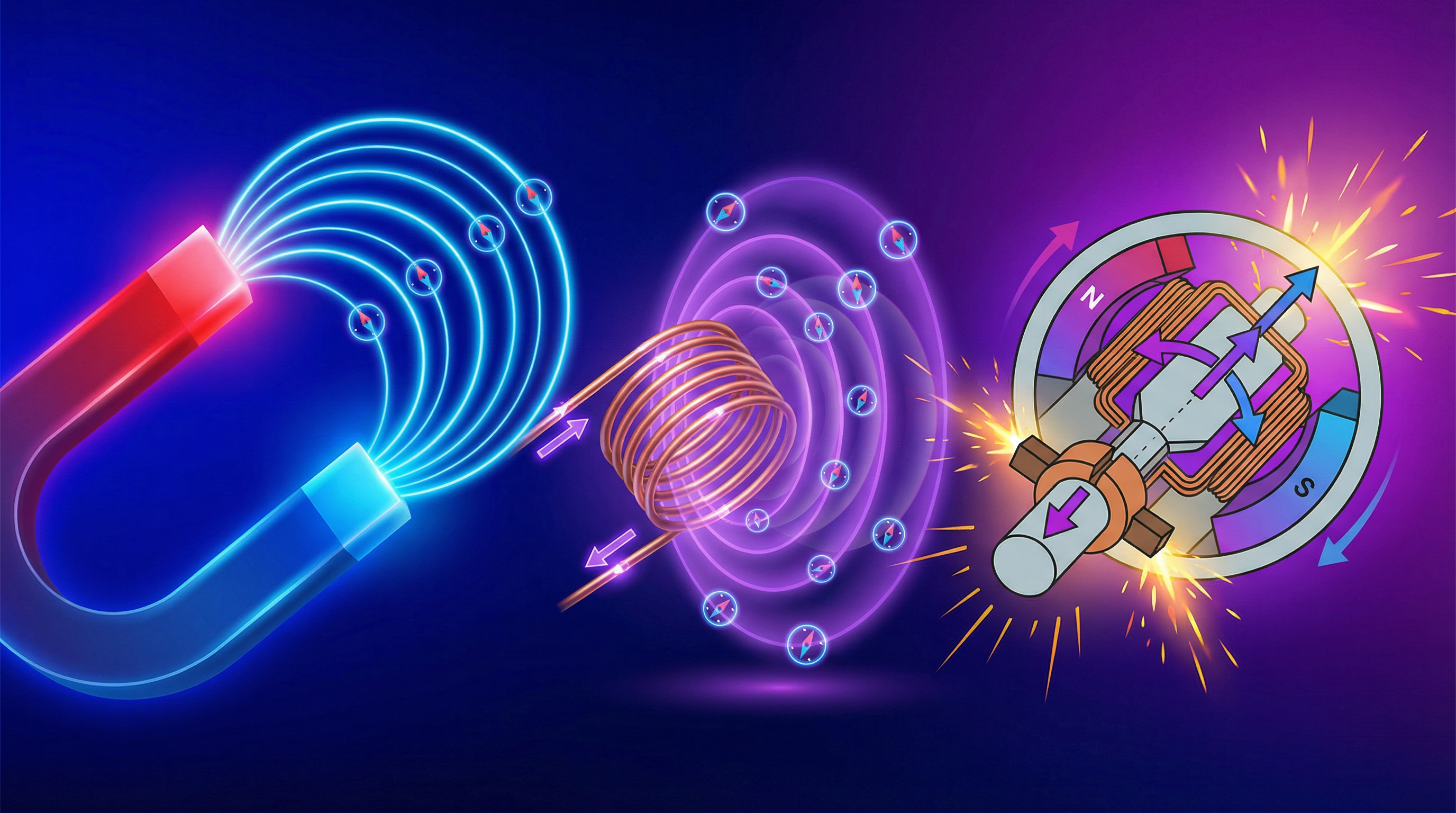
Overview
Welcome to Magnetism and Electromagnetism, a core topic in your Edexcel GCSE Combined Science course (Topic 3.4). This area of physics is fundamental to understanding much of the technology we use every day, from electric motors and generators to speakers and data storage. In the exam, this topic is a favourite for testing your ability to visualise concepts (AO1), apply rules to new situations (AO2), and interpret experimental data (AO3). You will encounter questions ranging from drawing magnetic field patterns to calculating the force on a wire in a magnetic field. This guide will break down the key concepts, provide you with the tools to tackle exam questions confidently, and show you how this topic links to other areas of your specification, such as energy and forces.
Key Concepts
Concept 1: Permanent and Induced Magnetism
A permanent magnet is an object that produces its own persistent magnetic field. Think of a typical bar magnet or a fridge magnet. These materials, like steel, have their internal magnetic domains aligned in the same direction. The key property is that they have a fixed North and South pole.
Induced magnetism occurs when a magnetic material (like iron, steel, cobalt, or nickel) is placed within a magnetic field. The material becomes a magnet itself, but only temporarily. The crucial rule that examiners want you to know is that induced magnetism always causes a force of attraction. This is because the pole induced in the material is always opposite to the pole of the permanent magnet nearest to it. For example, if you bring the North pole of a bar magnet near an iron nail, the end of the nail closer to the magnet becomes a South pole, and they attract.
Concept 2: Magnetic Fields
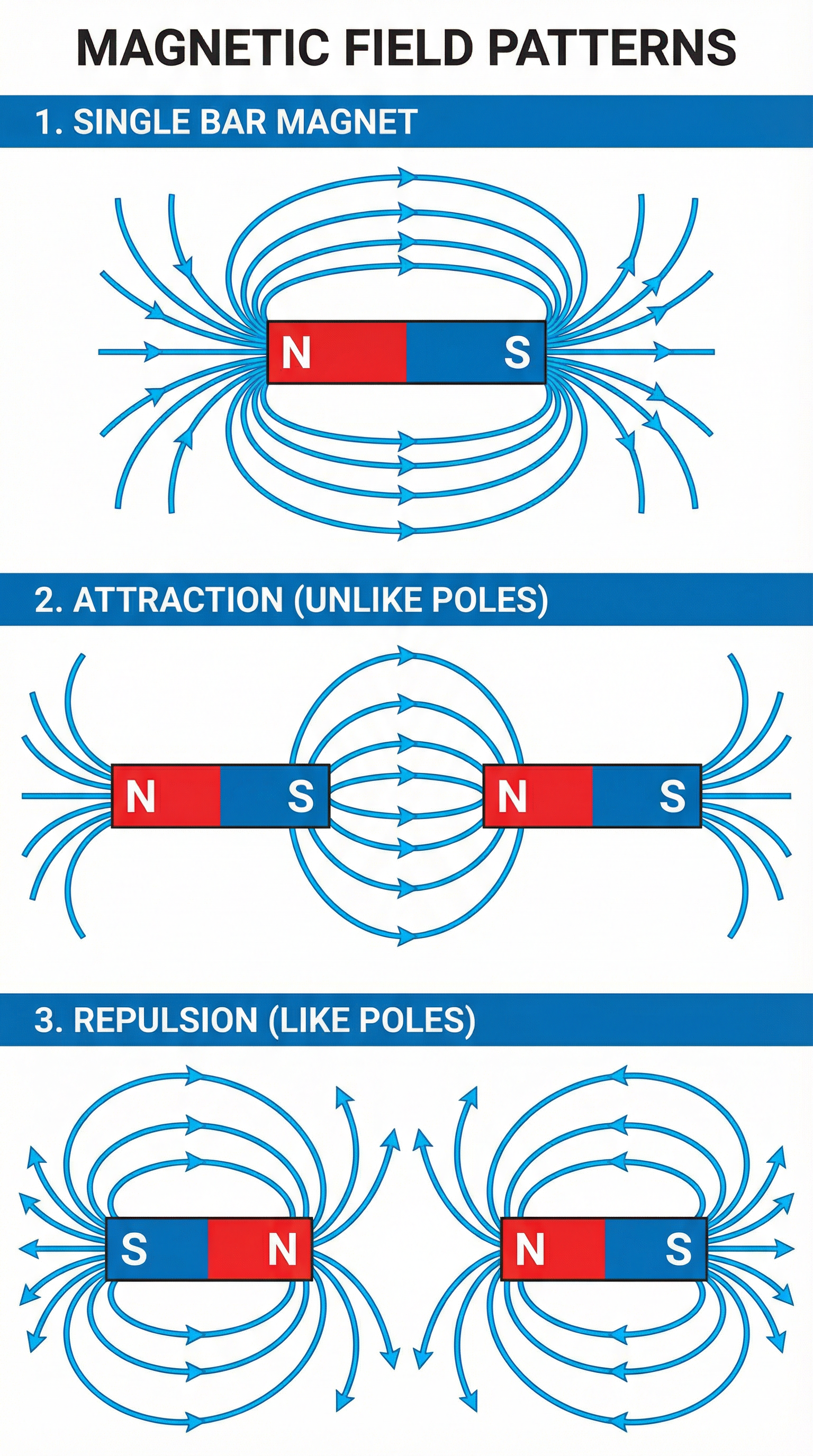
A magnetic field is a region where a magnetic force can be detected. We represent these fields using magnetic field lines. For your exam, you must follow these rules when drawing them:
- Direction: Field lines always travel from the North pole to the South pole. Arrows must be drawn on the lines to show this direction.
- No Crossing: Field lines never cross or touch each other.
- Density: The closer the field lines are together, the stronger the magnetic field. This is known as a higher magnetic flux density.
Examiners will expect you to be able to draw the field patterns for a single bar magnet, for two attracting magnets (N-S), and for two repelling magnets (N-N or S-S).
Concept 3: Electromagnetism
This is the principle that an electric current produces a magnetic field. When current flows through a wire, a circular magnetic field is created around it. The strength of this field depends on two factors:
- The size of the current (a larger current produces a stronger field).
- The distance from the wire (the field is weaker further away).
To create a more useful and powerful magnet, we can coil the wire into a solenoid. This concentrates the magnetic field lines inside the coil, creating a strong and uniform field. You can increase the strength of a solenoid by:
- Increasing the current.
- Increasing the number of coils (turns) of wire.
- Adding an iron core inside the solenoid.
Concept 4: The Motor Effect (Higher Tier Only)
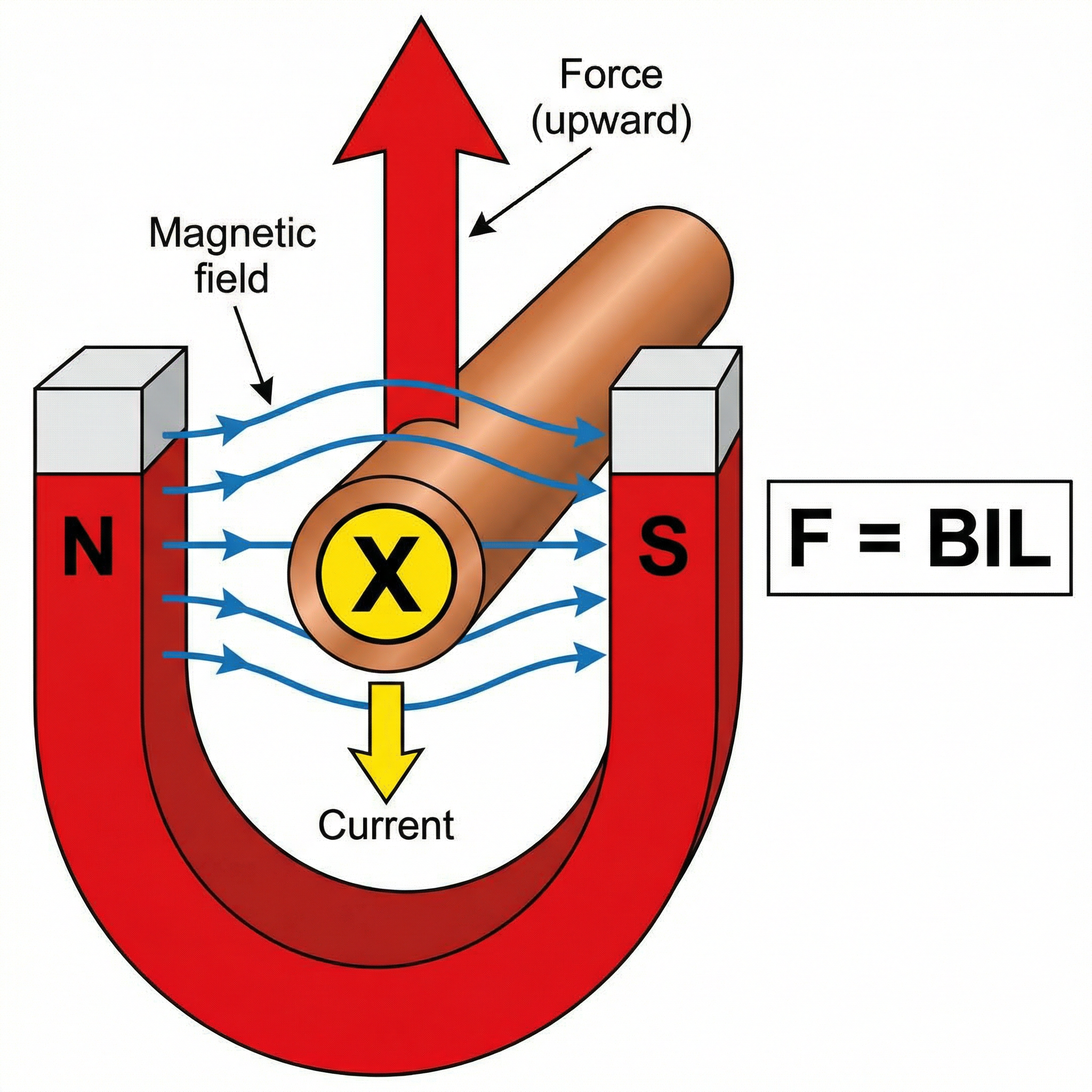
When a wire carrying a current is placed in a magnetic field, the magnetic field from the current interacts with the field from the permanent magnet. This interaction produces a force on the wire. This is the motor effect, and it's the principle behind all electric motors.
To find the direction of the force, we use Fleming's Left-Hand Rule.
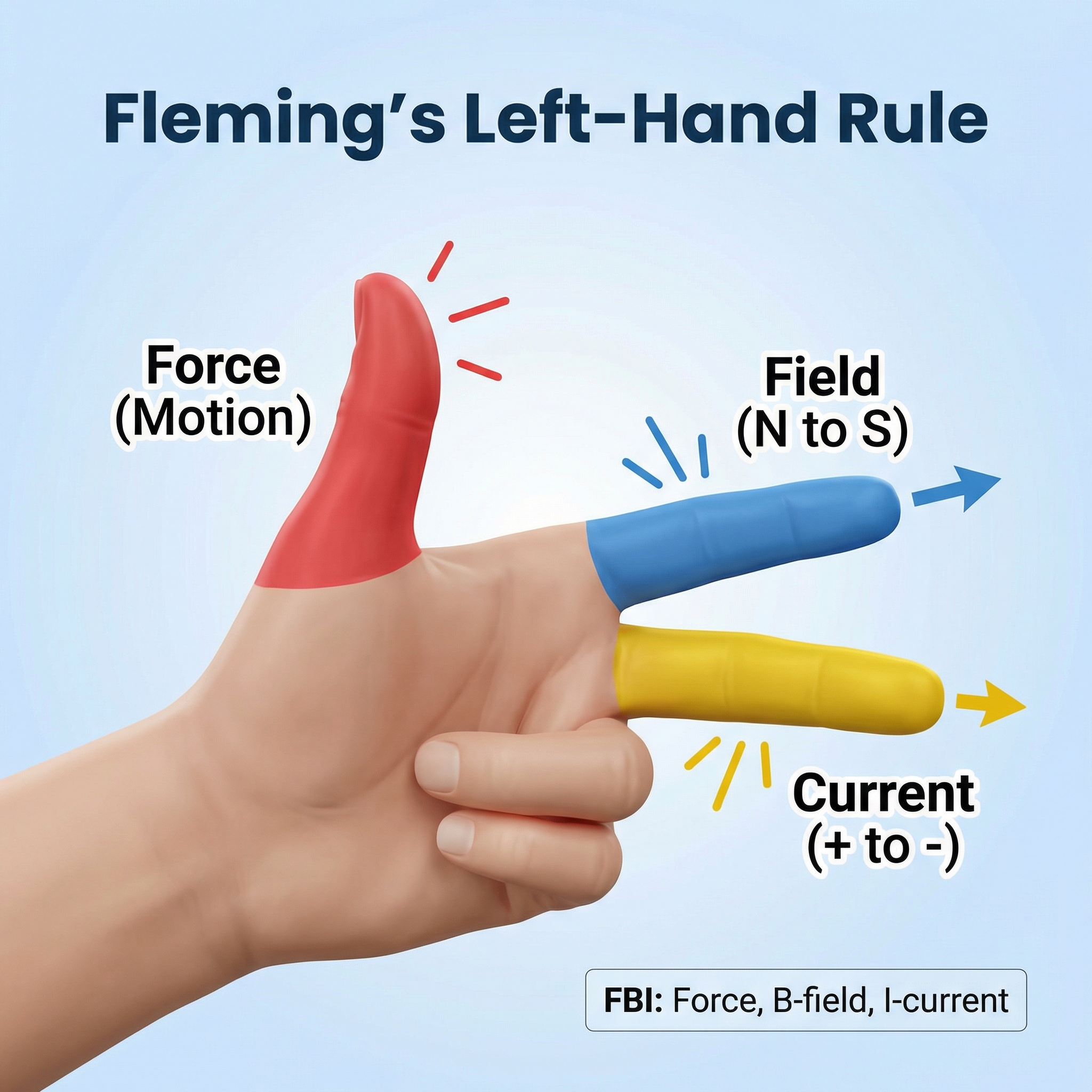
- ThuMb = Motion (Force)
- First finger = Field (North to South)
- SeCond finger = Current (Positive to Negative)
Remember to use your left hand and orient your fingers at 90 degrees to each other. This is a guaranteed source of marks if you can apply it correctly.
Mathematical/Scientific Relationships
The Motor Effect Equation (Higher Tier Only)
The size of the force created by the motor effect can be calculated using the following equation:
F = B x I x L
- F is the Force, measured in Newtons (N).
- B is the Magnetic Flux Density, measured in Tesla (T). This represents the strength of the magnetic field.
- I is the Current, measured in Amperes (A).
- L is the Length of the wire in the magnetic field, measured in metres (m).
This formula is given on the formula sheet, but you must know what each symbol represents and be able to rearrange it. A common exam mistake is forgetting to convert the length from centimetres to metres. To convert cm to m, you must divide by 100.
Practical Applications
The principles of magnetism and electromagnetism are vital in many technologies:
- Electric Motors: Found in everything from washing machines and fans to electric cars. They use the motor effect to turn electrical energy into kinetic energy.
- Loudspeakers: A loudspeaker uses a solenoid attached to a cone. A varying current passes through the solenoid, which is in a magnetic field. This creates a varying force, causing the cone to vibrate and produce sound waves.
- Scrapyard Cranes: These use powerful electromagnets to pick up and move large iron and steel objects. The magnetism can be switched off to release the objects.
- MRI Scanners: Medical imaging scanners use very strong electromagnets to create detailed images of the inside of the body.