Study Notes
Overview
Thomas Hardy’s poetry occupies a pivotal, often uncomfortable, space between the waning certainty of the Victorian era and the fragmented consciousness of Modernism. For OCR A-Level candidates, success hinges on navigating this tension. Examiners are not looking for simple biographical readings; they expect a sophisticated analysis of how Hardy’s personal griefs—most famously the death of his first wife, Emma—are transmuted into universal explorations of time, memory, and the indifference of the cosmos. The collection is a study in contrasts: rigid, traditional forms like the ballad are often filled with dissonant, colloquial language, creating a friction that mirrors the speaker's psychological state. Credit is given for candidates who can dissect this 'awkwardness' not as a flaw, but as a deliberate artistic choice. The 'Wessex' landscape is not a mere backdrop but a character in itself—a repository of memory and a symbol of a pre-industrial world succumbing to the forces of modernity. A top-band response will trace the development of Hardy's haunted persona across the collection, integrating the context of the Victorian 'Crisis of Faith' with a precise analysis of his metrical and linguistic innovations.
Plot/Content Overview
As this is a collection of poems, there is no single plot. However, the most significant narrative arc is found within the Poems of 1912-13, a sequence written in the months following the death of Hardy's estranged wife, Emma Gifford. These poems trace a journey of grief, guilt, and memory.
- The Going: The sequence opens with a poem of shocked disbelief and regret, lamenting the lost opportunities for reconciliation. The speaker asks, "Why did you give no hint that night / That quickly you would close your term?"
- Your Last Drive: A reflection on their final carriage ride together, now imbued with a tragic irony. The speaker is haunted by what was left unsaid.
- The Voice: One of the most famous poems, where the speaker hears Emma's ghost calling to him. The poem's rhythm shifts dramatically, moving from a lilting, dance-like measure to a faltering, broken metre, mirroring the speaker's psychological collapse.
- After a Journey: The speaker revisits the Cornish coast where he and Emma first fell in love. The landscape becomes a portal to the past, and he addresses her ghost directly, creating a powerful sense of temporal displacement.
- Beeny Cliff: A specific location from their courtship is recalled, contrasting the vibrant past ("The purl of a runlet that never ceases") with the desolate present.
- At Castle Boterel: A moment of intense memory is triggered by a familiar landmark. The poem ends with the poignant realisation that time has eroded everything but the memory itself.
Other key poems in the selection explore broader philosophical themes:
- Neutral Tones (1867): An early poem depicting the death of a relationship, set against a bleak, wintery landscape. The sun is "white, as though chidden of God," a classic example of Hardy's indifferent universe.
- The Darkling Thrush (1900): Written on the cusp of the 20th century, this poem presents a desolate, deathly landscape representing the end of an era. The sudden, inexplicable song of a thrush offers a flicker of hope that the speaker cannot share.
- The Convergence of the Twain (1912): An elegy for the Titanic, which Hardy presents not as a human tragedy but as a cosmic inevitability, orchestrated by the "Immanent Will."
Themes
Theme 1: Memory and Haunting
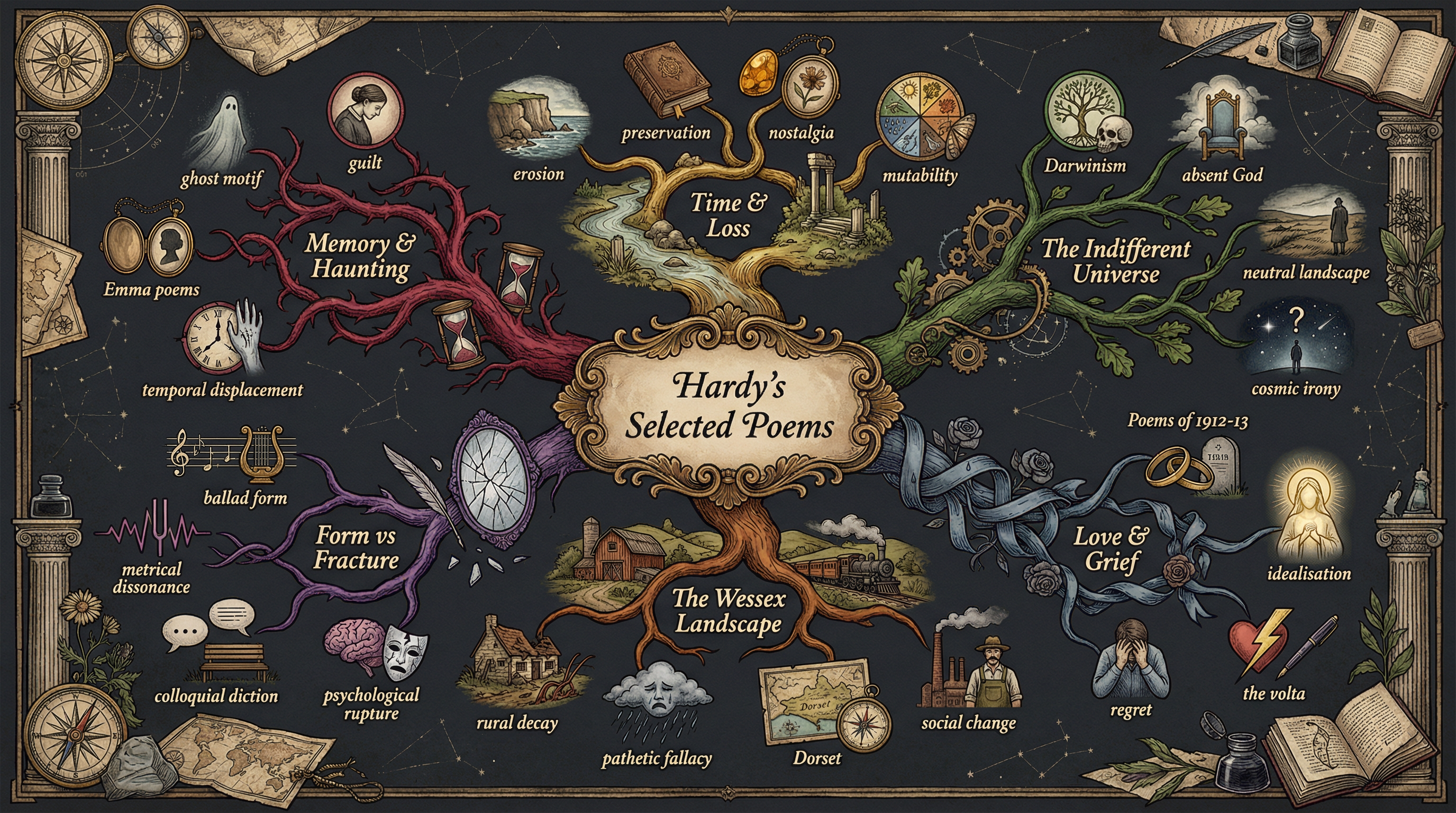
Hardy's poetry is saturated with the past. For him, memory is not a passive recollection but an active, often painful, haunting. The dead are more present than the living, and landscapes are scarred with the events they have witnessed. This is most potent in the Poems of 1912-13, where Emma's ghost is a constant, almost tangible presence.
Key Quotes:
- "Woman much missed, how you call to me, call to me" (The Voice) - The repetition (epizeuxis) and dactylic metre create a hypnotic, obsessive quality, as if the speaker is being pulled into a trance by the past.
- "Hereto I come to view a voiceless ghost" (After a Journey) - The oxymoron of a "voiceless ghost" captures the paradox of memory: it is intensely present but forever silent and inaccessible.
- "And the rotten rose is ript from the wall" (The Phantom Horsewoman) - This violent imagery suggests that memory is not a gentle fading but a destructive force.
Theme 2: The Indifferent Universe
Influenced by Darwinian thought and his own loss of faith, Hardy presents a universe that is not actively malevolent, but crushingly indifferent to human suffering. God is absent or uncaring, and events are governed by a blind, mechanical force Hardy calls the "Immanent Will."
Key Quotes:
- "The land’s sharp features seemed to be / The Century’s corpse outleant" (The Darkling Thrush) - The landscape is not just bleak; it is a dead body, reflecting the death of Victorian certainty.
- "And the Immanent Will that stirs and urges everything / Prepared a sinister mate for her" (The Convergence of the Twain) - The sinking of the Titanic is presented as a pre-ordained, almost geometric event, devoid of human tragedy.
- "The sun was white, as though chidden of God" (Neutral Tones) - Even the sun is drained of life and warmth, suggesting a universe from which divine blessing has been withdrawn.
Theme 3: Time, Change, and Loss
Time in Hardy is a dual force: it is an eroder, wearing away love, life, and landscape, but it is also a preserver, encasing moments of memory in an almost geological permanence. His speakers are often caught between a nostalgic longing for the past and a bleak awareness of its unreachability.
Key Quotes:
- "Time's unflinching rigour, in mindless rote, has ruled" (The Convergence of the Twain) - Time is personified as a merciless, unthinking force.
- "But what they were, even Time's tooth dims" (After a Journey) - The metaphor of "Time's tooth" is visceral and aggressive, suggesting a physical process of decay.
- "I see what you are doing: you are leading me on / To the spots we knew when we haunted here together" (The Haunter) - The use of the present tense collapses the decades, showing how memory can defy linear time.
Character Analysis
The Speaker / The 'Hardyan' Persona
Role: The central consciousness of the poems, a figure who is almost always a version of Hardy himself: melancholic, reflective, and haunted by the past.
Key Traits:
- Intellectually Isolated: He is often depicted as standing apart from the world, observing it with a philosophical detachment (e.g., his inability to share the thrush's hope).
- Guilt-Ridden: Particularly in the Poems of 1912-13, the speaker is consumed by regret for things done and undone.
- Nostalgic: He has a powerful, almost painful attachment to the past and to specific landscapes that hold memories.
- Skeptical: He has lost his religious faith and views the universe through a lens of scientific pessimism.
Character Arc: The arc is not one of development in a traditional sense, but of deepening introspection. In the Emma poems, the speaker moves from raw, shocked grief (The Going) to a more philosophical engagement with memory and time (At Castle Boterel). He does not find closure, but he does find a way to articulate his loss, transforming personal trauma into enduring art.
Essential Quotes:
- "I was unaware" (The Darkling Thrush) - Defines his exclusion from hope.
- "faltering forward" (The Voice) - Captures his broken, uncertain state.
- "I am just the same as when / Our days were a joy, and our paths through flowers" (The Haunter) - A quote from Emma's perspective, showing his imaginative projection of her continued presence.
Emma Gifford (The Ghost)
Role: The primary object of the speaker's grief, regret, and idealisation. She is less a character and more a powerful, shaping absence.
Key Traits:
- Idealised: In death, she is stripped of the complexities of their difficult marriage and becomes a symbol of lost youth and passion ("the original air-blue gown").
- Elusive: She is a "voiceless ghost," a "phantom," always just out of reach. The speaker can pursue her through memory but never truly grasp her.
- A Force of Nature: She is often associated with the wild, untamed landscape of Cornwall, particularly the sea.
Character Arc: As a remembered figure, her arc is dictated by the speaker's memory. He first remembers her as the vibrant young woman he met, then as the estranged wife, and finally as a ghostly presence who leads him through the landscapes of their shared past.
Essential Quotes:
- "Woman much missed" (The Voice) - The simple, profound statement of her absence.
- "That you could vanish so, / From friendship and all its glee" (The Going) - Highlights the shock of her departure.
- "Her who was all to me" (A Dream or No) - An absolute statement of her importance, erasing the years of marital strife.
Writer's Methods
Form and Structure: Hardy was a master of traditional poetic forms, particularly the ballad, the lyric, and the elegy. However, his genius lies in how he subverts these forms. He often uses rigid stanzaic structures and tight rhyme schemes (e.g., the ABAB rhyme in The Voice) to create a sense of control, which then breaks down at moments of emotional intensity. This friction between formal constraint and emotional chaos is a key technique. Look for the volta, or turn, in his poems; a shift from observation to reflection, or from past to present, is often where the poem's central argument is located.
Language: Hardy's diction is unique and often described as 'awkward' or 'craggy'. He mixes high, literary language with colloquialisms, architectural terms, and archaic words (e.g., "outleant"). This is a deliberate choice. The language feels rough-hewn, as if carved from the landscape itself. It resists easy sentimentality and grounds the philosophical ideas in a tangible, textured reality. Candidates should analyse this 'dissonance' as a method for conveying psychological fracture.
Metre and Rhythm: Pay close attention to metre. Hardy frequently uses dactyls (one stressed syllable followed by two unstressed) to create a waltz-like, hypnotic rhythm that pulls the reader into the past. The breakdown of this rhythm, as in the final stanza of The Voice, is a powerful structural enactment of the speaker's emotional collapse. Analysing the shift from metrical regularity to irregularity is a high-level AO2 skill.
The Landscape: The Wessex landscape is Hardy's most powerful symbol. It is never just a setting. It is a repository of history, a symbol of indifference ("neutral tones"), and a catalyst for memory. Pathetic fallacy is used, but often in a bleak, negative way (the landscape reflects the speaker's despair, not his joy).
Context
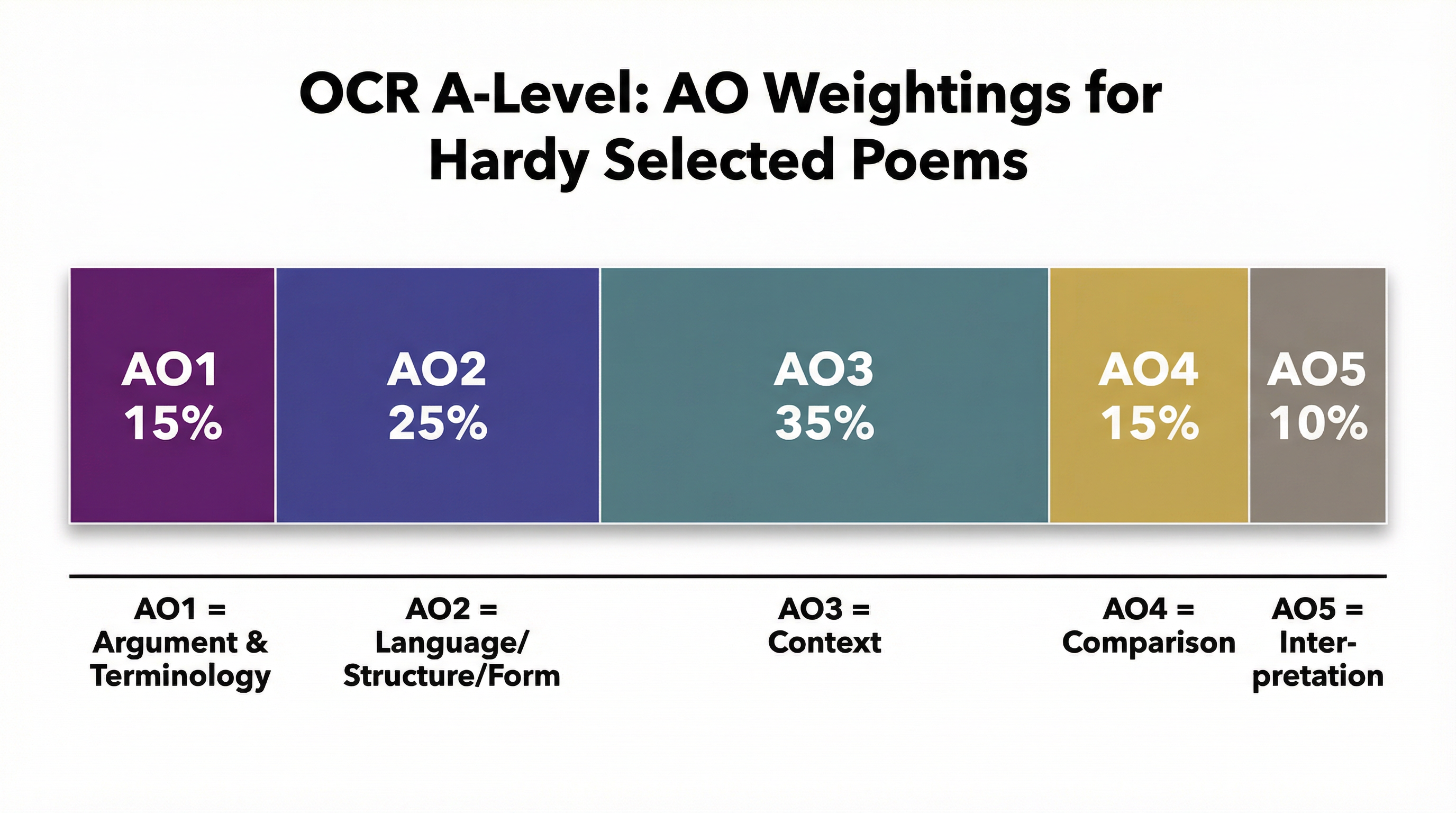
Integrating context (AO3) is crucial for a top grade. It must be woven into the analysis, not added as a separate, disconnected paragraph.
- The Victorian Crisis of Faith: The publication of Charles Darwin's On the Origin of Species (1859) and other scientific advancements shattered the certainties of the Victorian era. Hardy, who trained as an architect and had a scientific mind, lost his faith. This context is essential for understanding the 'indifferent universe' in his poetry. The absence of a benevolent God is the philosophical backdrop to poems like The Darkling Thrush and The Convergence of the Twain.
- Biographical Context (The Emma Poems): Hardy and Emma Gifford had a passionate courtship in Cornwall in 1870, but their subsequent marriage was long and difficult. They were largely estranged by the time of her sudden death in 1912. The Poems of 1912-13 are an outpouring of guilt and idealised nostalgia. While candidates must avoid the biographical fallacy (treating poems as diary entries), it is crucial to understand that this specific personal trauma was the catalyst for some of his greatest work on universal themes of time and memory.
- Social Change: Hardy lived through a period of immense social upheaval. The decline of rural life and the rise of industrialisation are recurring concerns. The 'Wessex' of his poems is a semi-fictionalised space where the old, organic way of life is being eroded by modernity. This provides a social dimension to his themes of time and loss.
- Literary Context (Victorianism vs. Modernism): Hardy is a transitional figure. His use of traditional forms and his focus on narrative connect him to Victorian poets like Browning and Tennyson. However, his skepticism, his focus on psychological fragmentation, and his metrical experimentation anticipate the work of Modernist poets like T.S. Eliot and Ezra Pound. Placing him on this cusp is a sophisticated analytical move.