Study Notes
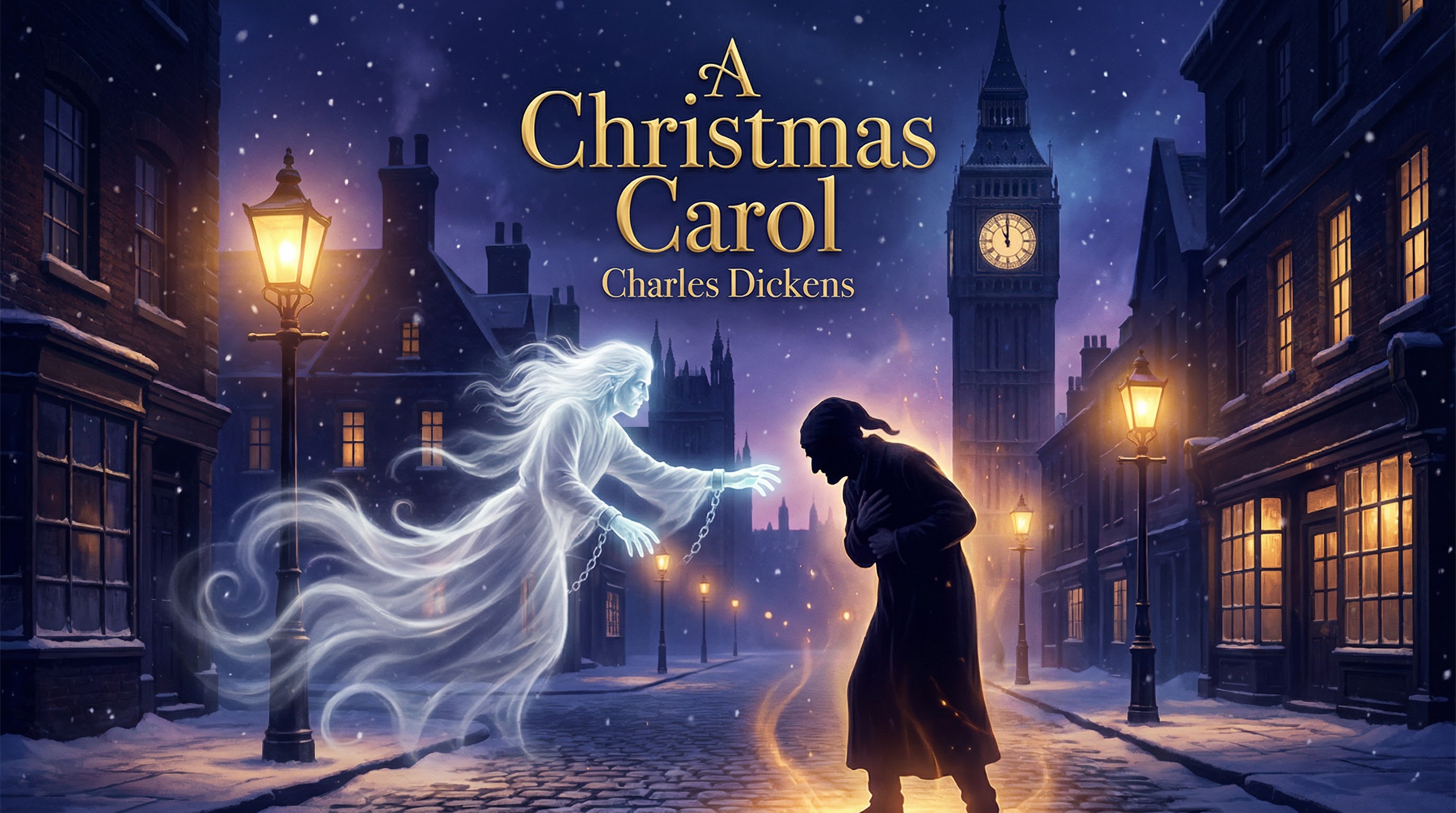
Overview
Charles Dickens' A Christmas Carol (1843) is a literary cornerstone, written with the explicit purpose of critiquing the harsh social realities of Victorian England. For the OCR GCSE (J352), examiners are not just looking for plot summary; they expect a conceptualised understanding of the novella as a piece of social protest. A successful response will demonstrate how Dickens uses the ghost story genre as a vehicle to attack the Malthusian economic theories prevalent at the time, which suggested poverty was a self-inflicted problem. Candidates must analyse the structural and linguistic methods Dickens employs to construct his allegory of redemption, focusing on Scrooge's transformation as a symbol of societal change. Credit is given for integrating contextual knowledge seamlessly, linking Scrooge's attitudes to specific historical details like the 1834 Poor Law Amendment Act and the institution of the workhouse. The key to a high-level response is to explore how Dickens crafts his narrative to persuade his middle and upper-class readers to embrace compassion and social responsibility.
Plot/Content Overview
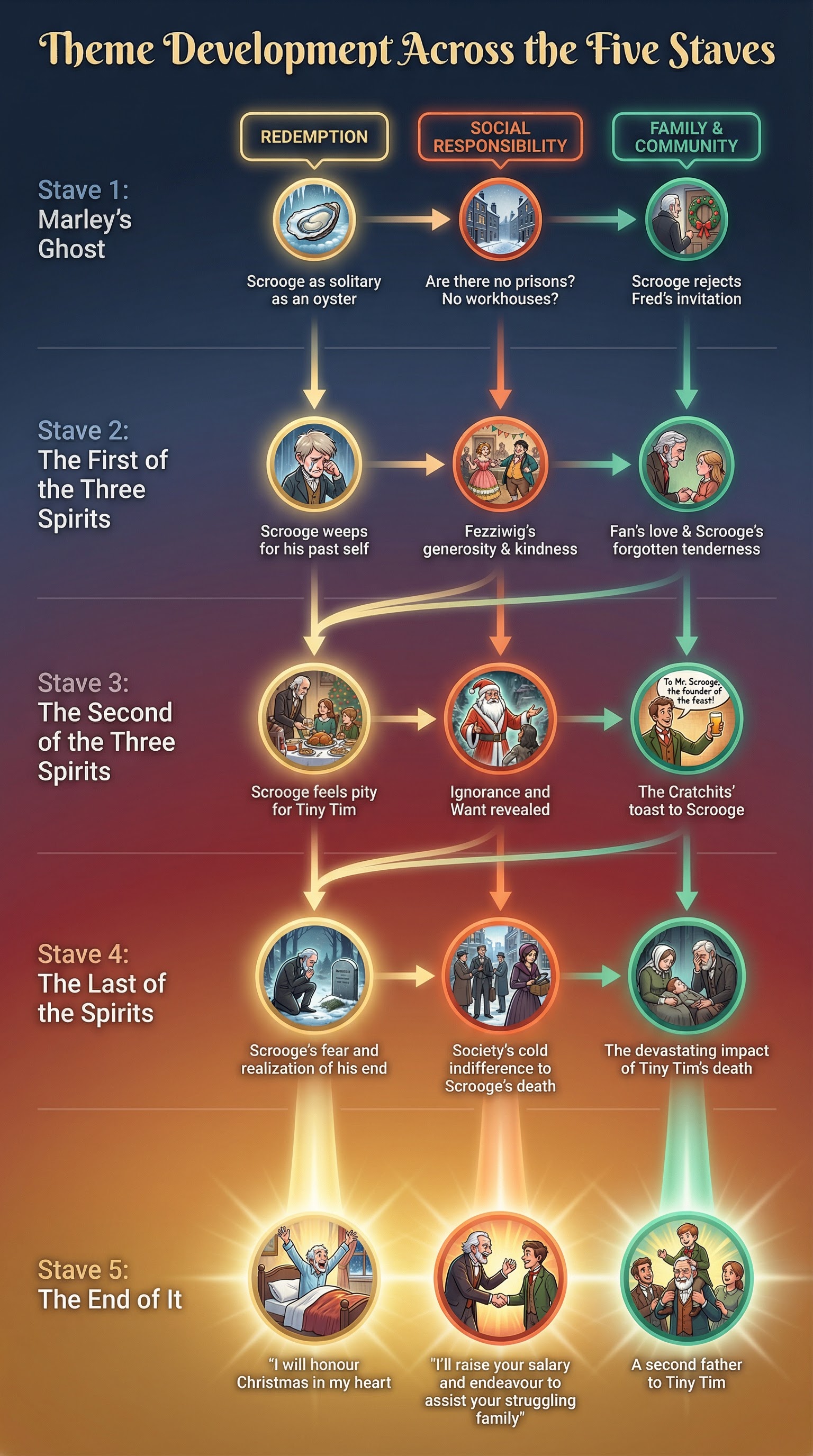
- Stave 1: Marley's Ghost: Ebenezer Scrooge, a cold-hearted miser, is visited by the ghost of his former business partner, Jacob Marley, who warns him he will be haunted by three spirits to escape a similar fate of eternal damnation.
- Stave 2: The First of the Three Spirits: The Ghost of Christmas Past takes Scrooge on a journey through his own history, showing him scenes of his lonely childhood, his joyful apprenticeship with Fezziwig, and his painful break-up with his fiancée, Belle, who leaves him due to his growing obsession with money.
- Stave 3: The Second of the Three Spirits: The Ghost of Christmas Present shows Scrooge the joy and hardship of the current Christmas. He witnesses the humble but loving celebration of his clerk, Bob Cratchit, and his family, including the frail Tiny Tim. The spirit also reveals two allegorical children, Ignorance and Want, warning Scrooge to beware them.
- Stave 4: The Last of the Spirits: The silent, ominous Ghost of Christmas Yet to Come reveals a bleak future where Scrooge has died alone and unmourned. He sees his possessions being sold off and witnesses the Cratchit family grieving for Tiny Tim, whose death was hastened by poverty.
- Stave 5: The End of It: A transformed Scrooge awakens on Christmas morning, filled with joy and a new sense of purpose. He anonymously sends a prize turkey to the Cratchits, donates generously to charity, and reconciles with his nephew, Fred. He becomes a second father to Tiny Tim and embodies the spirit of Christmas all year round.
Themes
Theme 1: Social Injustice and Poverty
Dickens uses the novella to expose the gross inequality of Victorian society. He directly challenges the prevailing Malthusian view that the poor were a surplus population who should be left to die. The Cratchit family represents the deserving poor, maintaining their dignity and love despite their hardship. Dickens contrasts their warmth with Scrooge's cold wealth to argue that moral worth is not tied to material possessions.
Key Quotes:
- "Are there no prisons? Are there no workhouses?" (Stave 1) - This reveals Scrooge's callous indifference and his belief that poverty is a crime to be punished.
- "This boy is Ignorance. This girl is Want. Beware them both... but most of all beware this boy, for on his brow I see that written which is Doom, unless the writing be erased." (Stave 3) - This powerful allegorical moment personifies the social evils Dickens believed would lead to society's downfall.
Theme 2: Redemption and Transformation
Scrooge's journey from a "covetous old sinner" to a man "glowing with his good intentions" is the central narrative arc. Dickens suggests that even the most hardened heart can be redeemed through empathy and self-reflection. The spirits do not force change upon Scrooge; they merely show him the truth of his own life, and he chooses to change himself. This offers a hopeful message that personal transformation is always possible.
Key Quotes:
- "I will honour Christmas in my heart, and try to keep it all the year." (Stave 5) - Scrooge's final declaration, showing his commitment to a permanent change of heart.
- "I am as light as a feather, I am as happy as an angel, I am as merry as a schoolboy." (Stave 5) - The series of similes contrasts sharply with his initial description as "solitary as an oyster," highlighting the extent of his transformation.
Theme 3: The Past, Present, and Future
The novella's structure, guided by the three spirits, emphasizes the interconnectedness of time. Scrooge is forced to confront how his past choices have shaped his present misery and how his present actions will determine his future fate. Dickens argues that we are not trapped by our past but can learn from it to create a better future.
Key Quotes:
- "I wear the chain I forged in life...I made it link by link, and yard by yard." (Stave 1) - Marley's ghost makes it clear that our actions in life have eternal consequences.
- "Men's courses will foreshadow certain ends, to which, if persevered in, they must lead... But if the courses be departed from, the ends will change." (Stave 4) - Scrooge begs for this to be true, showing he has understood the spirits' lesson: the future is not fixed and can be altered by present actions.
Character Analysis
Ebenezer Scrooge
Role: The protagonist, a wealthy but miserly recluse whose transformation forms the core of the novella.
Key Traits: At the start: cold, selfish, misanthropic, isolated. At the end: generous, joyful, compassionate, communal.
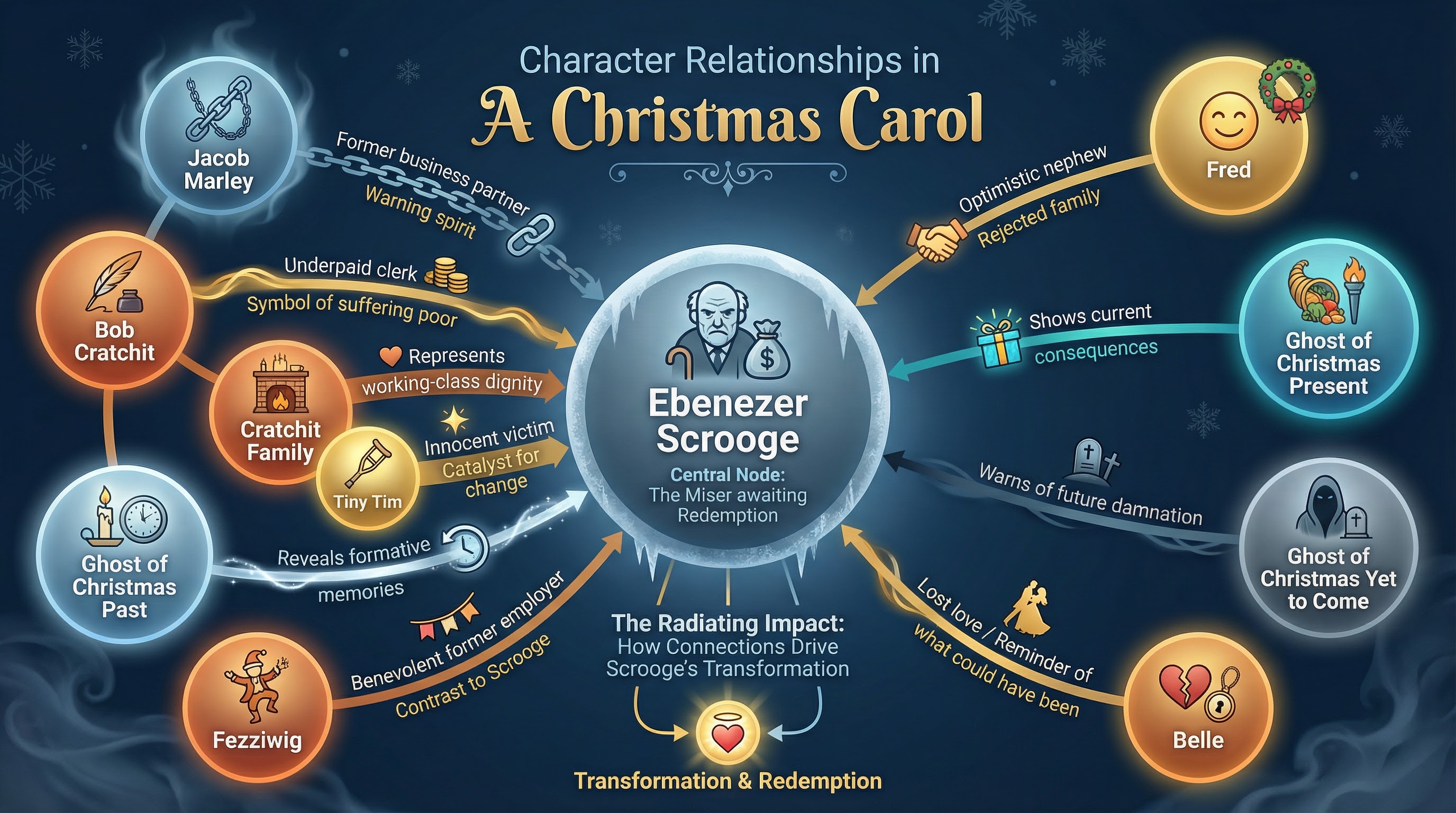
Character Arc: Scrooge's arc is one of the most famous in literature. He begins as a caricature of greed but is gradually humanized as the spirits force him to confront his own emotional wounds and the consequences of his behaviour. His redemption is not just about being nice; it's about rejoining the human race and accepting his social responsibilities.
Essential Quotes:
- "Bah! Humbug!" (Stave 1) - His iconic phrase, dismissing all forms of Christmas cheer.
- "I should like to be able to say a word or two to my clerk just now." (Stave 2) - The first crack in his hard exterior, showing a flicker of regret.
- "He became as good a friend, as good a master, and as good a man, as the good old city knew." (Stave 5) - The narrator's final summary of his complete and lasting transformation.
The Cratchit Family
Role: Represent the deserving poor and serve as the moral heart of the story.
Key Traits: Loving, resilient, dignified, forgiving.
Character Arc: The Cratchits do not change; rather, their circumstances are changed by Scrooge. They represent the constant of human decency that Scrooge must learn to embrace. Tiny Tim, in particular, acts as a catalyst for Scrooge's change, his vulnerability forcing Scrooge to feel empathy.
Essential Quotes:
- "God bless us, every one!" (Stave 3) - Tiny Tim's famous line, a universal blessing that includes even Scrooge.
- "Mr. Scrooge! I'll give you Mr. Scrooge, the Founder of the Feast!" (Stave 3) - Bob Cratchit's toast, an act of extraordinary grace and forgiveness that highlights his moral superiority.
Writer's Methods
- Allegory: The story is an allegory for social redemption. Scrooge represents the selfish individualism of the wealthy classes, and his transformation is a model for the change Dickens wished to see in society.
- Symbolism: Objects and characters carry symbolic weight. Marley's chains symbolize the burden of greed; the Ghost of Christmas Present's torch symbolizes generosity and abundance; Ignorance and Want are symbols of the social ills that threaten society.
- Structure: The five-stave structure, mirroring a musical carol, reinforces the theme of transformation from discord to harmony. The tripartite visitation of the spirits provides a clear, compelling structure for Scrooge's journey of self-discovery.
- Narrative Voice: Dickens employs an intrusive, chatty narrator who directly addresses the reader, creating a conversational and persuasive tone. The narrator guides our interpretation, ensuring we understand the moral message.
- Sensory Language: Dickens uses vivid sensory details to contrast cold and warmth, light and dark, which parallel Scrooge's emotional state. Scrooge is associated with cold and darkness, while Christmas and generosity are associated with warmth and light.
Context
- The Poor Law Amendment Act (1834): This law established the workhouse system, which was designed to be so harsh that only the truly destitute would seek help. Scrooge's question, "Are there no workhouses?" is a direct reference to this system, which Dickens saw as cruel and inhumane.
- Malthusianism: The economic theory of Thomas Malthus, who argued that population growth would always outstrip food supply and that helping the poor would only lead to more poverty. Scrooge's comment about decreasing the "surplus population" is a direct attack on this ideology.
- Sabbatarianism: The strict religious movement that sought to ban all forms of recreation on Sundays. Dickens believed this was hypocritical, as it denied the poor their only day of rest and enjoyment. The Ghost of Christmas Present criticizes this when he shows Scrooge spirits of the day visiting bakers' shops.
- The Rise of Christmas Traditions: Many of the Christmas traditions we now take for granted (like Christmas trees and cards) were becoming popular in the 1840s. Dickens' novella both reflected and hugely influenced this trend, cementing the idea of Christmas as a time for family, charity, and goodwill.