Study Notes
Overview
Shelagh Delaney’s 'A Taste of Honey' is a landmark of British 'Kitchen Sink' drama, written when the author was just nineteen. For the OCR Component 01 exam, candidates must move beyond simple plot summary and produce a critical response that demonstrates a sophisticated understanding of the play as a dramatic construct. High-level responses will integrate a confident interpretation of character and theme (AO1) with a precise analysis of Delaney’s revolutionary dramatic methods (AO2), all underpinned by a nuanced understanding of the socio-historical context of 1950s Salford (AO3). The play’s raw portrayal of working-class life, its engagement with taboo subjects like race, illegitimacy, and homosexuality, and its blend of naturalism with Brechtian devices offer fertile ground for perceptive analysis. Examiners are looking for a conceptualised argument that explores how these elements combine to create a powerful and enduring piece of theatre.
Plot/Content Overview
Act 1
- Scene 1: Helen, a self-centered single mother, and her teenage daughter Jo, move into a dilapidated flat in Salford. Their relationship is immediately shown to be volatile, defined by witty but cruel verbal sparring. Helen announces her engagement to Peter, a younger, wealthy man, and reveals her plan to leave Jo behind.
- Scene 2: Jo is left alone and begins a whirlwind romance with Jimmie, a young Black sailor. He is kind and offers Jo the affection she craves, but his time is short as his ship is due to sail. He promises to return for her. Helen leaves to marry Peter.
Act 2
- Scene 1: Several months later, Jo is pregnant with Jimmie's child and living with Geof, a gentle and caring art student who is implied to be homosexual. They have formed a platonic, supportive household, with Geof taking on a domestic, caregiving role in preparation for the baby. Their fragile stability is threatened by the looming presence of Helen.
- Scene 2: Helen returns, her marriage to Peter having failed. Finding Geof, she is initially hostile and mocking, her prejudice on full display. In a final, cruel act, she drives Geof away just as Jo goes into labour. The play ends with Jo alone, contracting in pain, as Helen offers her a dismissive, inadequate form of comfort, bringing the play’s cyclical structure to a close.
Themes
Theme 1: Class and Poverty
Delaney uses the squalid setting of the Salford flat to represent the oppressive nature of poverty. The characters are trapped not just by their physical environment but by the limited choices it affords them. Helen seeks escape through marriage to a wealthy man, while Jo dreams of a life beyond the industrial smog. The play argues that poverty is a cycle, trapping generations in a state of hopelessness.
Key Quotes:
- "I’m sick of this place. Sick of it." (Jo, Act 1, Scene 1) - Establishes Jo's deep-seated dissatisfaction with her environment and her longing for escape.
- "We’re all just looking for a bit of comfort." (Helen, Act 2, Scene 2) - Reveals the underlying motivation for the characters' often selfish actions, rooted in the harshness of their lives.
Theme 2: Motherhood and Abandonment
The play presents a deeply unconventional and critical view of motherhood. Helen is a neglectful and selfish mother who repeatedly abandons Jo. This forces Jo to become prematurely independent, yet she is still emotionally vulnerable. The play ends with the question of whether Jo will be able to break the cycle of abandonment and become a better mother to her own child.
Key Quotes:
- "You should have been drowned at birth." (Helen to Jo, Act 1, Scene 1) - A brutal, shocking line that encapsulates the cruelty at the heart of their relationship.
- "I’m not your mother. I’m your landlady." (Helen to Jo, Act 2, Scene 2) - Highlights Helen's abdication of her maternal role, reducing their relationship to a cold, transactional one.
Theme 3: Race, Gender, and Sexuality
Delaney broke new ground by placing marginalized figures at the center of her play. Jimmie, a Black sailor, and Geof, a gay man, are treated with sympathy and respect by the narrative, while the prejudice they face from characters like Helen is exposed and criticised. The play champions tolerance and understanding, challenging the rigid social norms of the 1950s.
Key Quotes:
- "I don’t like the dark. It’s too frightening." (Helen, Act 2, Scene 1) - A thinly veiled racist comment about Jo's unborn child, revealing the casual prejudice of the era.
- "You’re just like a big sister to me." (Jo to Geof, Act 2, Scene 1) - Shows the platonic, non-traditional nature of their relationship, which provides Jo with the stability and care she needs.
Character Analysis
Jo
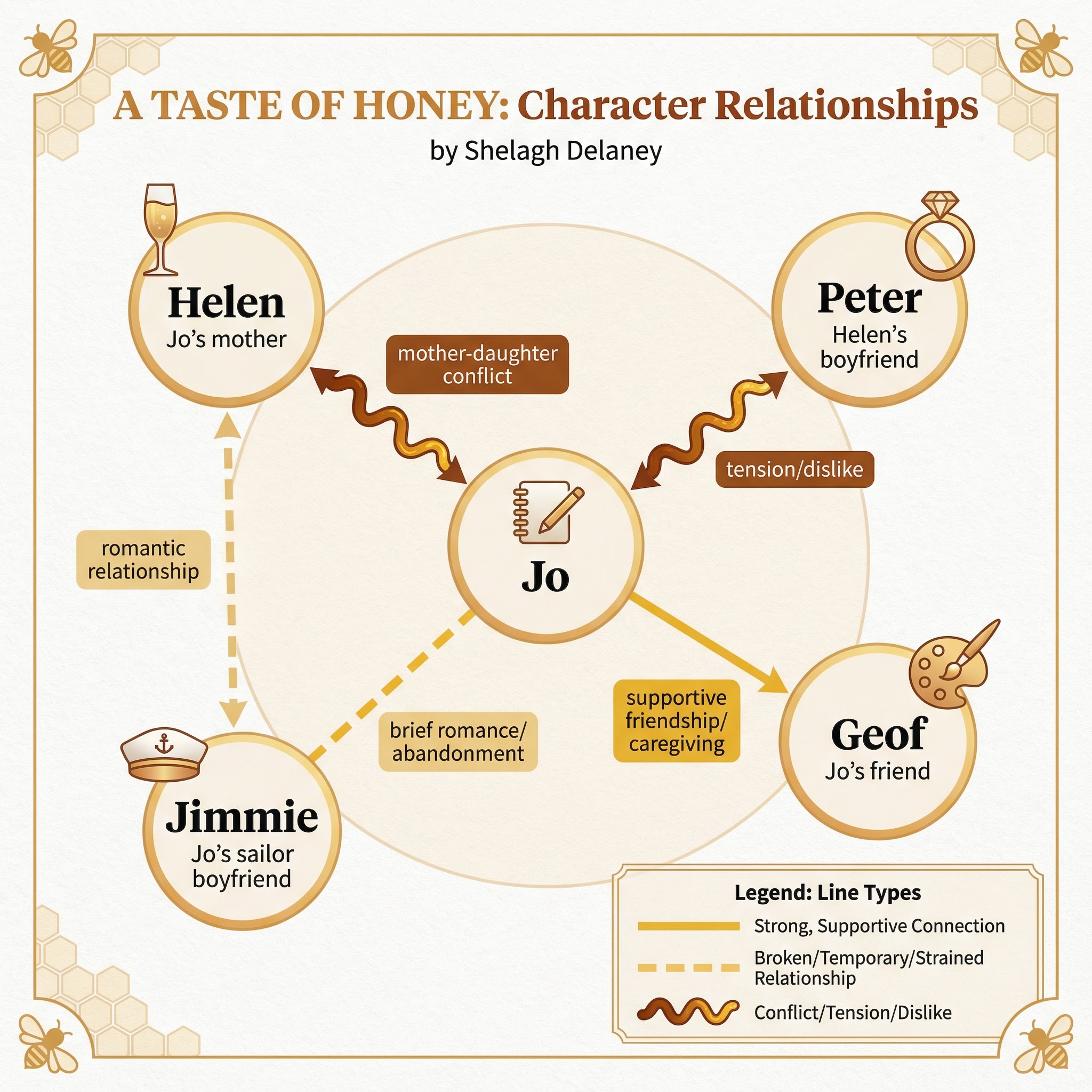
Role: The play's protagonist, a cynical yet vulnerable teenager.
Key Traits: Sharp-witted, artistic, resilient, and desperate for genuine affection.
Character Arc: Jo begins as a product of her mother's neglect, hardened and sarcastic. Her relationship with Jimmie briefly opens her up to the possibility of love, but his abandonment and her subsequent pregnancy force her into a premature and harsh adulthood. Her friendship with Geof represents a period of stability and hope, but Helen's return shatters this, leaving Jo isolated at the play's end. Her journey is cyclical, and she seems destined to repeat her mother's mistakes.
Essential Quotes:
- "I’m a contemporary. I really live at the same time as myself, don’t I?"
- "The only thing I’m afraid of is being left alone."
Helen
Role: Jo's selfish and irresponsible mother.
Key Traits: Vain, flirtatious, cruel, and ultimately pathetic.
Character Arc: Helen’s character is largely static. She is driven by a desperate need to escape poverty and loneliness, which leads her to prioritize her own desires over her daughter's welfare. Her marriage to Peter is a failed attempt at securing financial stability. Her return at the end of the play is not an act of maternal redemption but another selfish act, as she has nowhere else to go. She remains trapped in her own cycle of dependency and irresponsibility.
Essential Quotes:
- "I’m not just talented, I’m talented all over."
- "You know, I think I’ll have that baby myself."
Writer's Methods
Kitchen Sink Realism: Delaney’s play is a prime example of this movement, focusing on the gritty, everyday lives of working-class characters. The dialogue is naturalistic, capturing the rhythms and slang of Salford speech. The setting is deliberately drab and realistic.
Brechtian Devices: Delaney breaks the fourth wall to disrupt the realism. Characters occasionally deliver lines directly to the audience, and the use of a live jazz band on stage provides a commentary on the action, forcing the audience to think critically about the play's themes rather than becoming lost in the emotion. This is a key technique to analyse for AO2.
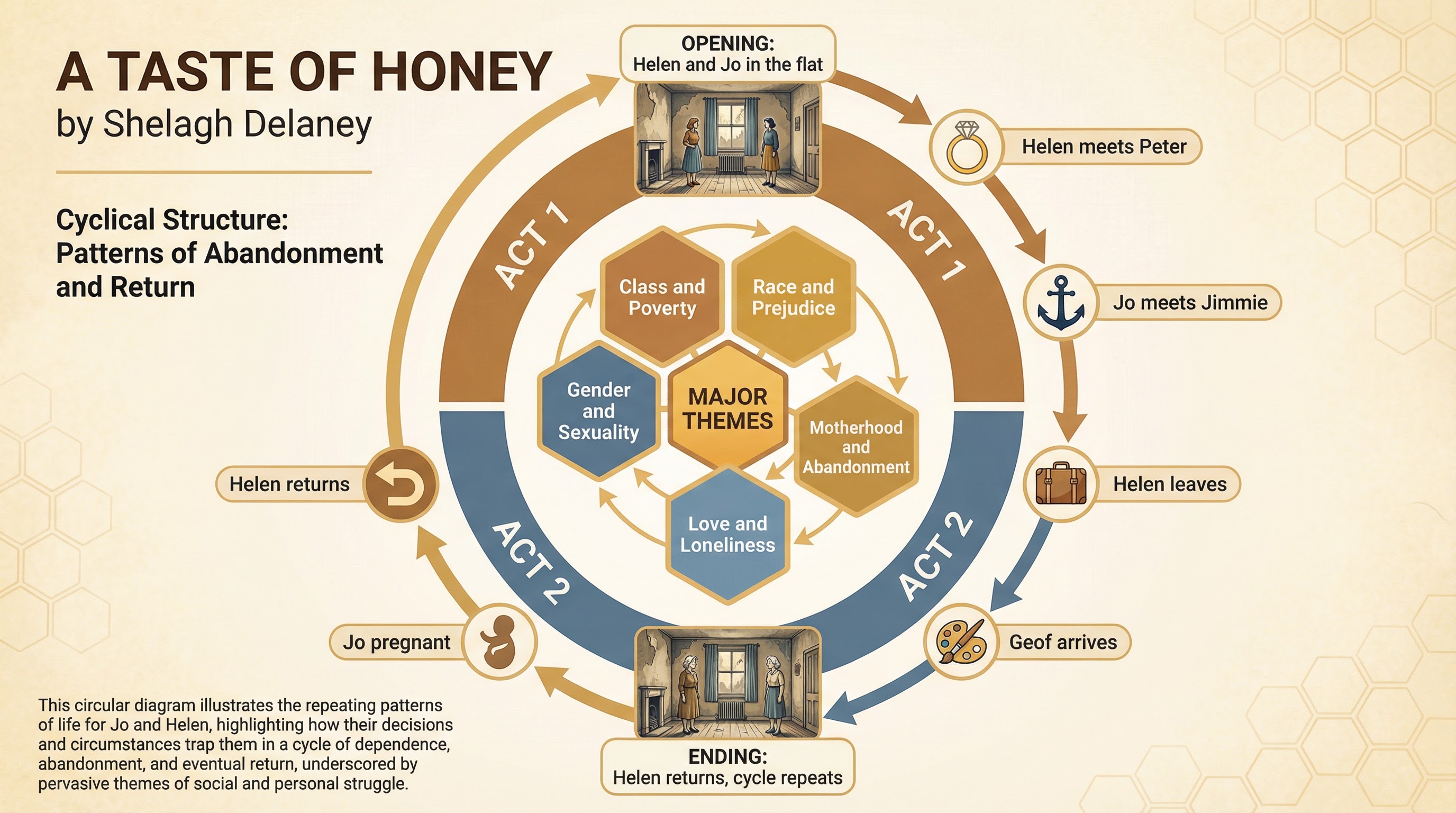
Cyclical Structure: The play begins and ends in a similar state of disarray, with Helen and Jo trapped in the same flat. This structure reinforces the theme of entrapment and the idea that social and economic forces create inescapable cycles of poverty and dysfunction. Credit is always given for analysing how this structure contributes to the play's meaning.
Context
To achieve high marks for AO3, candidates must integrate context seamlessly. Key areas include:
- Post-War Britain: The play is set in the late 1950s, a period of social change but also of significant social conservatism. The welfare state had been established, but poverty was still rife in industrial cities like Salford.
- Social Taboos: Delaney confronts issues that were rarely discussed in public, let alone on stage. Illegitimacy, interracial relationships, and homosexuality were all heavily stigmatized. Understanding this context is crucial to appreciating the play's radical and challenging nature.
- The Rise of Youth Culture: Jo represents a new generation of teenagers who are more cynical, independent, and questioning of authority than their parents. Her language, attitudes, and artistic inclinations reflect the burgeoning youth culture of the late 1950s.