Study Notes
Overview
Mary Shelley's Frankenstein; or, The Modern Prometheus (1818) is a foundational text of the Gothic and science-fiction genres. For the OCR GCSE (J352), examiners are not looking for a simple plot summary; they expect a sophisticated, critical response. Candidates must demonstrate a firm grasp of the novel's complex nested narrative structure, its engagement with Romantic and Enlightenment ideas, and its use of Gothic conventions to create horror and pathos. Credit is given for analysing how Shelley uses the epistolary form and multiple narrators (Walton, Victor, and the Creature) to explore themes of ambition, responsibility, and monstrosity. A top-band response will move beyond asserting that the Creature is a 'monster' to deconstructing how he is made monstrous by societal prejudice and his creator's abdication of duty.
Plot/Content Overview
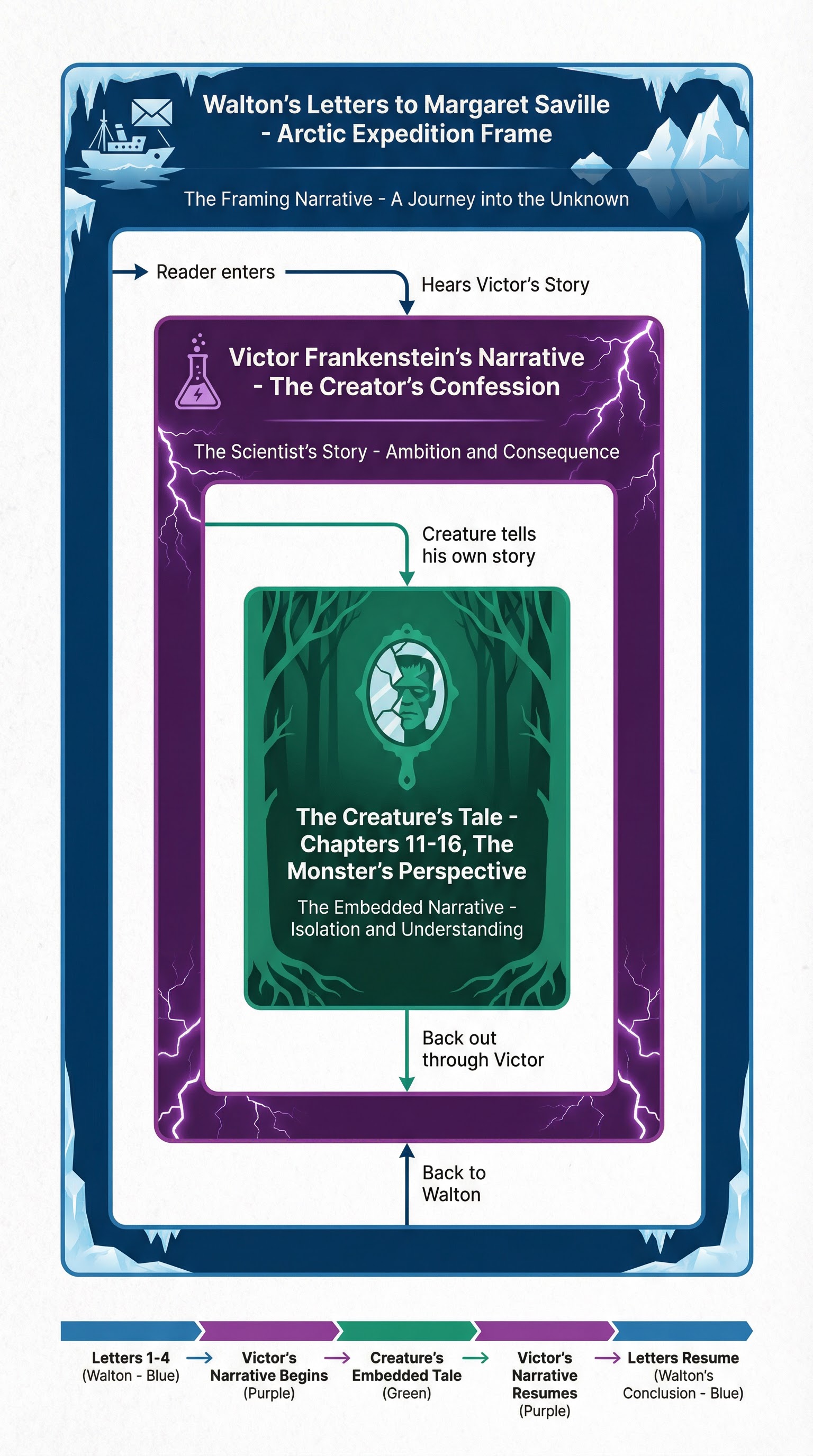
The novel unfolds through a series of letters and embedded narratives:
- Walton's Framing Narrative (Letters 1-4 & Final Letters): Robert Walton, an ambitious Arctic explorer, writes to his sister, Margaret Saville. He rescues a near-frozen Victor Frankenstein from the ice. Victor, seeing a kindred spirit in Walton's obsessive ambition, recounts his tragic story as a cautionary tale.
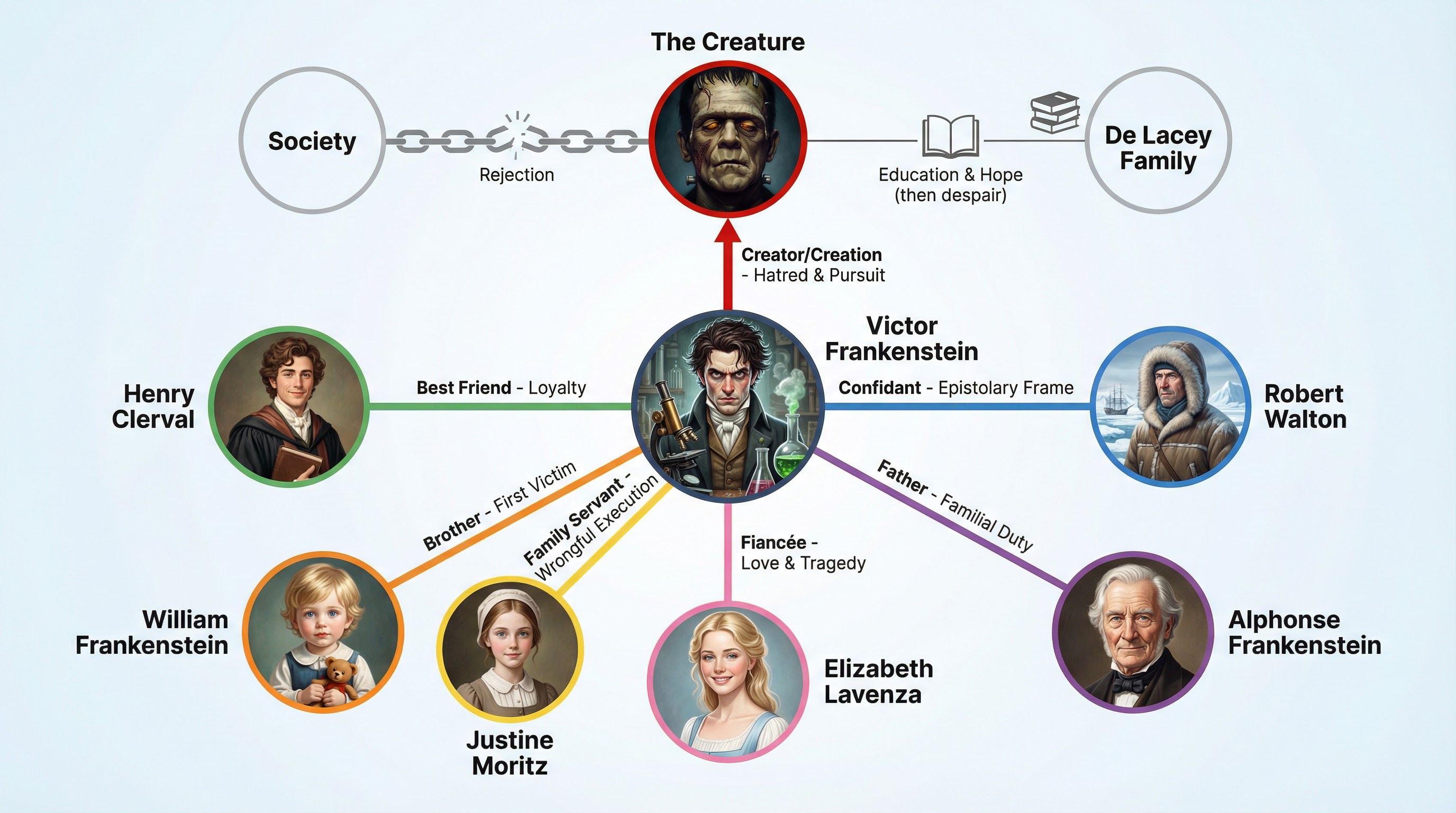
- Victor's Narrative (Chapters 1-10): Victor describes his idyllic childhood in Geneva, his fascination with outdated alchemists, and his move to the University of Ingolstadt. Driven by a desire to "bestow animation upon lifeless matter," he creates a sentient being from stolen body parts. Horrified by his creation's appearance, he abandons it instantly. This act of parental neglect is his primary transgression. The narrative follows his descent into guilt and illness, punctuated by the murder of his younger brother, William.
- The Creature's Narrative (Chapters 11-16): In a dramatic confrontation on the Mer de Glace, the Creature eloquently narrates his own story to Victor. He describes his initial sensations, his rejection by humanity, and his secret education observing the De Lacey family. He learns to read, speak, and understand human society, developing a deep capacity for love and empathy. After being violently rejected by the De Laceys, his hope turns to despair and a desire for revenge against his creator. He demands Victor create a female companion for him.
- Victor's Narrative Resumes (Chapters 17-24): Victor initially agrees but destroys the female creature, fearing a "race of devils." In revenge, the Creature murders Victor's best friend, Henry Clerval, and then his bride, Elizabeth Lavenza, on their wedding night. Devastated, Victor vows to pursue the Creature to the ends of the earth.
- Walton's Conclusion: The narrative returns to Walton's letters. Victor dies aboard the ship. Walton discovers the Creature mourning over Victor's body, filled with remorse. The Creature explains his suffering and departs to die in the Arctic wastes, leaving Walton to contemplate the destructive consequences of unchecked ambition.
Themes
Theme 1: Dangerous Knowledge and Unchecked Ambition
Shelley critiques the Enlightenment and Romantic pursuit of knowledge beyond moral limits. Victor's ambition is not to help humanity, but to achieve god-like power: "A new species would bless me as its creator and source."
- Contextual Link: This directly engages with the novel's subtitle, The Modern Prometheus. Like the Titan who stole fire from the gods and was punished, Victor usurps the female, procreative role and is punished with the destruction of his own 'family'. Candidates can also link this to contemporary debates about Galvanism and the fear that science was encroaching on the territory of God.
Key Quotes:
- "It was the secrets of heaven and earth that I desired to learn." (Chapter 2) - Establishes Victor's transgressive desire for forbidden knowledge.
- "Learn from me... how dangerous is the acquirement of knowledge." (Chapter 4) - Victor's explicit warning to Walton, framing his story as a cautionary tale.
Theme 2: Monstrosity vs. Humanity
The novel forces the reader to question who the 'real' monster is. While the Creature is physically grotesque, Victor is morally monstrous in his abandonment and cruelty.
- Analysis: Shelley uses the Creature's eloquent, educated language (learned from Paradise Lost) to contrast with his appearance. He is a being of immense intellectual and emotional depth, yet he is judged solely on his looks. Credit is given for analysing how the Creature's monstrosity is a social construct, a product of prejudice.
Key Quotes:
- "I was benevolent and good; misery made me a fiend." (Chapter 10) - The Creature's own explanation of his fall from grace, placing the blame on his suffering and isolation.
- "You, my creator, abhor me." (Chapter 10) - A direct accusation that highlights Victor's failure of parental responsibility.
Theme 3: Isolation and Companionship
Nearly every character experiences a profound sense of isolation. Victor isolates himself to create the Creature, who is then born into total isolation. Walton is isolated in the Arctic. This loneliness is presented as the primary source of misery.
- Structural Link: The nested narrative structure emphasizes this theme. Characters tell their stories to break their isolation (Victor to Walton, the Creature to Victor). The desire for a companion is the Creature's central motivation.
Key Quotes:
- "I am malicious because I am miserable. Am I not shunned and hated by all mankind?" (Chapter 17) - The Creature explicitly links his malevolence to his misery, which stems from his isolation.
- "I desired the company of a man who could sympathise with me, whose eyes would reply to mine." (Letter 2) - Walton's opening lament, which establishes the theme and foreshadows Victor's own loneliness.
Character Analysis
Victor Frankenstein
Role: The novel's protagonist and tragic hero. His actions drive the entire plot.
Key Traits: Ambitious, obsessive, arrogant, guilt-ridden, and ultimately self-absorbed. He is an unreliable narrator, often trying to justify his actions.
Character Arc: Begins as a brilliant, if arrogant, student. His creation of the Creature marks his fall. He spends the rest of the novel consumed by guilt and a desire for revenge, losing everyone he loves before dying a broken man. He learns nothing and takes no real responsibility.
Essential Quotes:
- "the spark of being into a lifeless thing that lay at my feet" (Chapter 5) - The moment of creation, described with a chilling lack of emotion.
- "I had created a fiend whose unparalleled barbarity had desolated my heart." (Chapter 22) - Victor's self-pitying perspective, blaming the Creature entirely.
The Creature
Role: The novel's antagonist, but also its most sympathetic character. He is the 'other' who exposes the prejudice of society.
Key Traits: Eloquent, intelligent, sensitive, and initially benevolent. He is driven to violence by constant rejection and loneliness.
Character Arc: 'Born' as a tabula rasa (blank slate), he is inherently good. Through observation and reading, he becomes educated and yearns for acceptance. The rejection by the De Laceys is the turning point that fuels his quest for revenge. He ends the novel filled with remorse, a more 'human' character than his creator.
Essential Quotes:
- "I ought to be thy Adam, but I am rather the fallen angel." (Chapter 10) - A direct allusion to Paradise Lost, showing his self-awareness and tragic position.
- "The fallen angel becomes a malignant devil. Yet even that enemy of God and man had friends and associates in his desolation; I am alone." (Chapter 24) - His final words to Walton, summarising his profound isolation.
Writer's Methods
- Epistolary Form: The novel is presented as a series of letters from Walton to his sister. This creates a sense of authenticity and allows for multiple perspectives. It also frames the story as a warning.
- Nested Narratives: As shown in the diagram above, the story-within-a-story structure allows Shelley to contrast the perspectives of the creator and the created, generating sympathy for the Creature and exposing Victor as an unreliable narrator.
- Gothic Conventions: Shelley uses sublime and desolate landscapes (the Arctic, the Alps), supernatural events (the reanimation), and psychological terror to create a classic Gothic atmosphere. Pathetic fallacy is used extensively, where the weather reflects the characters' inner turmoil.
- Allusion: The novel is rich with allusions, particularly to Milton's Paradise Lost, which the Creature reads. He compares himself to both Adam (the innocent creation) and Satan (the rejected outcast). This adds layers of meaning and elevates the text.
Context
- Scientific Context (Galvanism): In the late 18th century, scientists like Luigi Galvani were experimenting with electricity and muscle tissue, creating a public fascination and fear around the 'spark of life'. Shelley taps into this anxiety about science playing God.
- Romanticism: The novel is a key Romantic text. It values emotion over reason, celebrates the sublime power of nature (which Victor's science violates), and focuses on the individual's subjective experience (especially that of the outcast).
- Biographical Context: Mary Shelley's own experiences of birth and death were tragic. Her mother, the feminist writer Mary Wollstonecraft, died giving birth to her. Shelley herself lost several children in infancy. This context of creation being intrinsically linked to death and guilt permeates the novel.
- Political Context (The French Revolution): Written in the aftermath of the French Revolution, some critics read the Creature as a symbol of the revolutionary masses — a powerful force created by the ruling class (Victor) and then abandoned, leading to violent rebellion."