Study Notes
Overview
Shakespeare's Henry V, written in 1599, is the final play in the Henriad tetralogy, following Richard II, Henry IV Part 1, and Henry IV Part 2. It dramatises King Henry V's 1415 campaign in France, culminating in the Battle of Agincourt, where a vastly outnumbered English army achieved a legendary victory. However, this is not simply a patriotic celebration of English heroism. Shakespeare constructs a deeply ambiguous text that interrogates the morality of war, the performative nature of kingship, and the human cost of political ambition. For OCR Component 02, candidates must demonstrate their ability to analyse the play's language, structure, and form (AO2), integrate contextual understanding of Elizabethan politics and the Divine Right of Kings (AO3), and construct a critical, conceptualised argument (AO1). The key to success is recognising that Henry is both the 'mirror of all Christian kings' and a Machiavellian pragmatist who manipulates rhetoric, sacrifices former friends, and threatens atrocities to achieve his goals. Examiners reward nuanced, exploratory responses that balance close textual analysis with wider thematic connections.
Plot/Content Overview
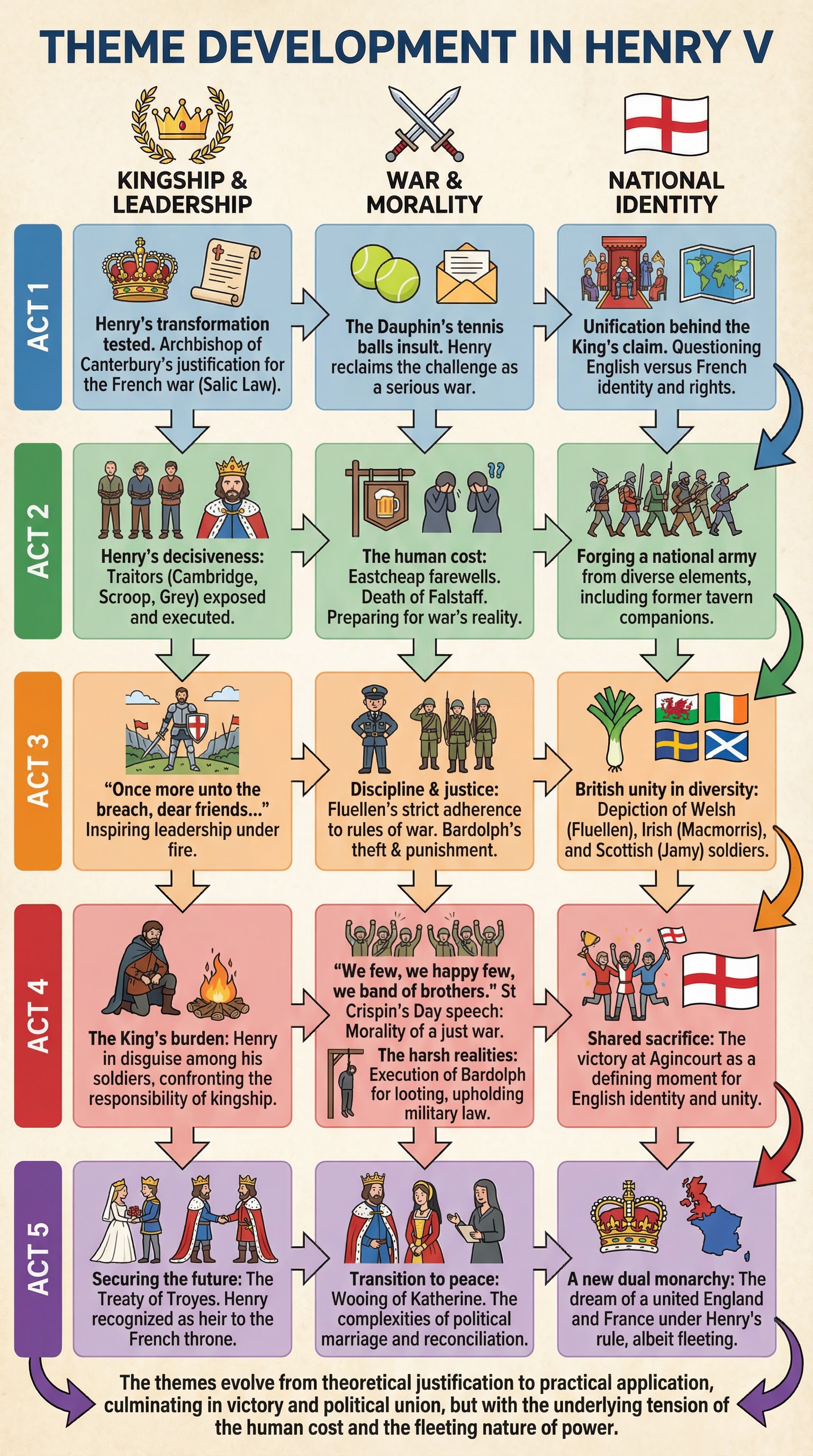
Act 1: The play opens with the Chorus apologising for the limitations of theatre and asking the audience to use their imagination to transform the stage into the 'vasty fields of France'. In the court, the Archbishop of Canterbury and the Bishop of Ely discuss a bill that threatens Church lands, and Canterbury proposes to support Henry's claim to the French throne to distract Parliament. Canterbury delivers a lengthy justification of Henry's claim using the Salic Law, a legal argument that female inheritance should not bar Henry's descent from a French princess. Henry asks, 'May I with right and conscience make this claim?'—seeking public validation for a war he likely intends to wage regardless. The French Dauphin sends Henry a mocking gift of tennis balls, insulting his youth and former wildness. Henry's response is controlled, rhetorical, and menacing: 'When we have matched our rackets to these balls, / We will in France play a set / Shall strike his father's crown into the hazard.' This extended metaphor demonstrates his transformation from Hal to Henry—he has mastered the language of kingship.
Act 2: The Chorus announces the English preparations for war, but also reveals a conspiracy: three noblemen (Cambridge, Scroop, and Grey) have been bribed by France to assassinate Henry. Meanwhile, in Eastcheap, we see the low-life characters from the Henry IV plays—Pistol, Bardolph, Nym, and Mistress Quickly—preparing to follow the army to France. We learn that Falstaff, Henry's former companion and father-figure, is dying, 'killed' metaphorically by Henry's rejection of him at the end of Henry IV Part 2. Mistress Quickly's description of Falstaff's death—'his nose was as sharp as a pen, and a' babbled of green fields'—is one of the most poignant moments in Shakespeare. Henry exposes the traitors in a public scene that demonstrates his political cunning: he hands them letters revealing their treachery and watches them condemn themselves. Scroop's betrayal particularly wounds Henry, as he was a trusted friend. The scene establishes Henry's willingness to prioritise the state over personal loyalty.
Act 3: The Chorus describes the English fleet sailing to France. The English army lays siege to Harfleur, and Henry delivers the famous rallying cry: 'Once more unto the breach, dear friends, once more; / Or close the wall up with our English dead!' This speech uses imperatives, collective pronouns ('we', 'our'), and animalistic imagery ('imitate the action of the tiger') to transform his men into instruments of war. However, the speech is immediately undercut by the comic scene of Bardolph, Nym, and Pistol reluctantly being driven into battle by the Boy, who observes their cowardice. We then meet the four captains—Gower (English), Fluellen (Welsh), Macmorris (Irish), and Jamy (Scottish)—representing the unity of Britain under Henry's leadership. Fluellen is particularly significant: fiercely disciplined, loyal, and learned, he draws comparisons between Henry and Alexander the Great. When Harfleur refuses to surrender, Henry delivers a chilling ultimatum, threatening that if the city does not yield, his soldiers will commit rape, infanticide, and atrocities: 'the filth and scum of war / Shall sully your fresh fair virgins and your flowering infants'. This is not heroic rhetoric—it is terrorism. The city surrenders, and Henry, exhausted and with his army weakened by disease, decides to march to Calais.
Act 4: This is the emotional and thematic heart of the play. The night before the Battle of Agincourt, the English are vastly outnumbered (the French have around 60,000 men; the English around 6,000). The Chorus describes the two camps: the French are confident and boastful, while the English are fearful and exhausted. Henry, disguised in a cloak, walks among his soldiers to gauge their morale. He encounters three common soldiers—Bates, Court, and Williams—who express their fears and question the king's responsibility for their deaths. Williams argues, 'if the cause be not good, the king himself hath a heavy reckoning to make'. Henry defends himself, arguing that each soldier is responsible for his own soul, but the encounter clearly troubles him. After the soldiers leave, Henry delivers a soliloquy revealing the burden of kingship: 'Upon the king! Let us our lives, our souls, our debts, our careful wives, our children, and our sins lay on the king!' He contrasts the 'ceremony' of kingship—the crown, the throne, the rituals—with the sleepless anxiety and crushing responsibility he bears. This moment humanises Henry and complicates the play's heroic narrative. Before the battle, the French offer Henry a ransom to retreat, but he refuses. He then delivers the St Crispin's Day speech, one of the most stirring pieces of rhetoric in English literature: 'We few, we happy few, we band of brothers; / For he today that sheds his blood with me / Shall be my brother'. The speech creates a sense of unity, shared purpose, and honour, transforming the soldiers' fear into pride. The English win a miraculous victory, losing only 29 men compared to 10,000 French. However, Shakespeare includes a morally troubling detail: Henry orders the execution of French prisoners when he fears a counterattack. Additionally, Bardolph is executed for looting a church, and Henry does not intervene to save his former companion, demonstrating his commitment to military discipline over personal loyalty.
Act 5: The Chorus fast-forwards through Henry's triumphant return to England. In France, Henry negotiates the Treaty of Troyes with the French King Charles VI. The treaty recognises Henry as heir to the French throne and arranges his marriage to Princess Katherine. The wooing scene between Henry and Katherine is often played as romantic comedy, but it also has a darker undertone: this is a political marriage, and Katherine has no real choice. Henry's language shifts between blunt soldier ('I cannot look greenly nor gasp out my eloquence') and coercive charm. The play ends with the Chorus returning to remind the audience that this triumphant moment was fleeting: Henry died young, and his son Henry VI lost all the French territories, plunging England into civil war. This epilogue undercuts the play's heroic narrative, reminding us of the impermanence of power and the futility of war.
Themes
Theme 1: Kingship and the Performance of Power
One of the central questions of Henry V is: what makes a good king? Shakespeare presents kingship as a performance—Henry must constantly project authority, inspire loyalty, and manipulate public perception. The Chorus is crucial to this theme: by drawing attention to the artificiality of theatre ('can this cockpit hold the vasty fields of France?'), Shakespeare reminds us that Henry's kingship is also a constructed performance. Henry is acutely aware of his audience. In Act 1, he stages the public justification for war, asking Canterbury, 'May I with right and conscience make this claim?' This is political theatre—he seeks public validation for a decision already made. His response to the Dauphin's tennis balls is a masterclass in rhetorical control: he transforms an insult into a declaration of war, demonstrating his command of language and image. However, the play also reveals the burden of this performance. In Act 4, Henry's disguise scene and subsequent soliloquy expose his isolation and anxiety. He envies the 'wretched slave' who 'sleeps in Elysium' while the king lies awake, burdened by the weight of his subjects' lives. The contrast between the public Henry—charismatic, decisive, inspiring—and the private Henry—doubtful, lonely, exhausted—is central to the play's complexity. Examiners reward candidates who recognise this duality and explore how Shakespeare uses soliloquy (private thought) and public rhetoric (performed speech) to reveal it.
Key Quotes:
- "O for a Muse of fire, that would ascend / The brightest heaven of invention" (Prologue) - The Chorus's meta-theatrical opening establishes the play's self-awareness about performance and representation.
- "May I with right and conscience make this claim?" (Act 1, Scene 2) - Henry's question reveals his concern with public legitimacy and the performance of moral authority.
- "When we have matched our rackets to these balls, / We will in France play a set / Shall strike his father's crown into the hazard" (Act 1, Scene 2) - Henry's extended metaphor demonstrates his rhetorical skill and his ability to transform insult into political capital.
- "Upon the king! Let us our lives, our souls, our debts, our careful wives, our children, and our sins lay on the king!" (Act 4, Scene 1) - Henry's soliloquy reveals the crushing psychological burden of kingship and the isolation of power.
- "I think the king is but a man, as I am: the violet smells to him as it doth to me" (Act 4, Scene 1) - Henry's disguised conversation with his soldiers explores the tension between the man and the office.
Theme 2: War and Morality
Henry V is simultaneously a celebration of military heroism and a critique of war's brutality. Shakespeare does not resolve this tension—he presents both perspectives and invites the audience to judge. On one hand, the play glorifies war through stirring rhetoric. The 'Once more unto the breach' speech uses imperatives, collective pronouns, and animalistic imagery to inspire courage: 'imitate the action of the tiger; / Stiffen the sinews, summon up the blood'. The St Crispin's Day speech creates a vision of war as a source of honour, brotherhood, and immortality: 'he today that sheds his blood with me / Shall be my brother'. These speeches are genuinely moving and have been used to inspire soldiers for centuries. However, Shakespeare also exposes war's moral horror. Henry's threat to Harfleur—'the filth and scum of war / Shall sully your fresh fair virgins and your flowering infants'—is a threat of rape and infanticide. This is not heroic; it is terrorism designed to force surrender through fear. The execution of Bardolph for looting a church demonstrates the harsh discipline required to maintain military order, but it also shows Henry's willingness to sacrifice former friends for political expediency. The killing of French prisoners at Agincourt, though historically accurate, is morally troubling—Henry orders their deaths not out of necessity but out of fear. The Boy's observation that Bardolph, Nym, and Pistol are cowards and thieves ('they will steal anything') undercuts the play's heroic narrative by showing the reality of the common soldiers. Examiners reward candidates who explore this moral ambiguity and avoid simplistic readings of Henry as either hero or villain.
Key Quotes:
- "Once more unto the breach, dear friends, once more; / Or close the wall up with our English dead!" (Act 3, Scene 1) - Henry's rallying cry uses collective identity and sacrifice to inspire his troops, but also reveals the human cost of war.
- "the filth and scum of war / Shall sully your fresh fair virgins and your flowering infants" (Act 3, Scene 3) - Henry's threat to Harfleur exposes the brutality and moral horror of war.
- "We few, we happy few, we band of brothers; / For he today that sheds his blood with me / Shall be my brother" (Act 4, Scene 3) - The St Crispin's Day speech creates a vision of war as a source of honour and unity.
- "I was not angry since I came to France / Until this instant" (Act 4, Scene 7) - Henry's order to kill the French prisoners is presented as righteous anger, but it raises moral questions about the laws of war.
- "if the cause be not good, the king himself hath a heavy reckoning to make" (Act 4, Scene 1) - Williams's challenge forces Henry (and the audience) to confront the moral responsibility of leaders who send men to die.
Theme 3: National Identity and Unity
Henry V was written in 1599, during a period of national anxiety. Elizabeth I was aging and had no heir, raising fears of civil war and foreign invasion. The play responds to these anxieties by constructing a vision of national unity under a strong, charismatic leader. The four captains—Gower (English), Fluellen (Welsh), Macmorris (Irish), and Jamy (Scottish)—represent the unity of the British Isles under Henry's leadership. Fluellen is particularly significant: his fierce loyalty, discipline, and learning make him one of Henry's most valuable officers, and his comic mispronunciations ('prave' for 'brave') are affectionate rather than mocking. His comparison of Henry to Alexander the Great elevates Henry to the status of classical hero. The St Crispin's Day speech also constructs national identity: 'we band of brothers' creates a sense of shared Englishness that transcends class divisions. However, the play also reveals tensions within this unity. Macmorris's angry question—'What ish my nation?'—suggests the fragility of British identity and the unresolved conflicts between England, Ireland, Scotland, and Wales. The Eastcheap characters—Pistol, Bardolph, Nym—represent the underclass who are conscripted into war and often exploited. The Boy's observation that they are cowards and thieves complicates the play's vision of national unity. Examiners reward candidates who recognise that Shakespeare both constructs and questions the idea of a unified English (or British) identity.
Key Quotes:
- "O England! model to thy inward greatness, / Like little body with a mighty heart" (Chorus, Act 2) - The Chorus constructs England as a small but heroic nation, appealing to national pride.
- "What ish my nation?" (Act 3, Scene 2) - Macmorris's question reveals the fragility and contested nature of British identity.
- "I am afeard there are few die well that die in a battle" (Act 4, Scene 1) - Williams's fear reflects the perspective of the common soldier, complicating the play's heroic narrative.
- "There is occasions and causes why and wherefore in all things" (Act 5, Scene 1) - Fluellen's insistence on discipline and reason represents the values that hold the army (and the nation) together.
- "we band of brothers" (Act 4, Scene 3) - The St Crispin's Day speech creates a vision of national unity that transcends class divisions.
Theme 4: Language and Rhetoric
Shakespeare uses language as a weapon and a tool of power throughout Henry V. Henry's mastery of rhetoric is central to his success as a king. He adapts his language to his audience: formal, legalistic language with the French ambassadors; stirring, martial rhetoric with his soldiers; blunt, plain speech when wooing Katherine. The Chorus uses elevated, poetic language to shape the audience's response and fill in the gaps that the stage cannot show. The shift between verse and prose is also significant: nobles speak in blank verse, while common soldiers and comic characters speak in prose, reflecting the social hierarchy. However, Henry breaks this pattern: he speaks in prose when disguised among his soldiers, suggesting his ability to move between social worlds. The wooing scene in Act 5 is particularly interesting: Henry claims he is a 'plain soldier' who cannot speak eloquently, but this is itself a rhetorical strategy—he performs plainness to appear honest and unaffected. Examiners reward candidates who analyse how Shakespeare uses form (verse vs. prose), rhetorical devices (metaphor, imperatives, collective pronouns), and register (formal vs. informal language) to reveal character and theme.
Key Quotes:
- "can this cockpit hold the vasty fields of France?" (Prologue) - The Chorus's question draws attention to the power of language to transform reality.
- "We are no tyrant, but a Christian king" (Act 1, Scene 2) - Henry's use of the royal 'we' and religious identity constructs his authority.
- "Cry 'God for Harry, England, and Saint George!'" (Act 3, Scene 1) - Henry's battle cry uses religious and national symbols to inspire his troops.
- "I cannot look greenly nor gasp out my eloquence" (Act 5, Scene 2) - Henry's claim to be a 'plain soldier' is itself a rhetorical performance designed to charm Katherine.
- "If we are marked to die, we are enough / To do our country loss" (Act 4, Scene 3) - Henry's conditional syntax and balanced phrasing demonstrate his rhetorical control even in the face of overwhelming odds.
Character Analysis
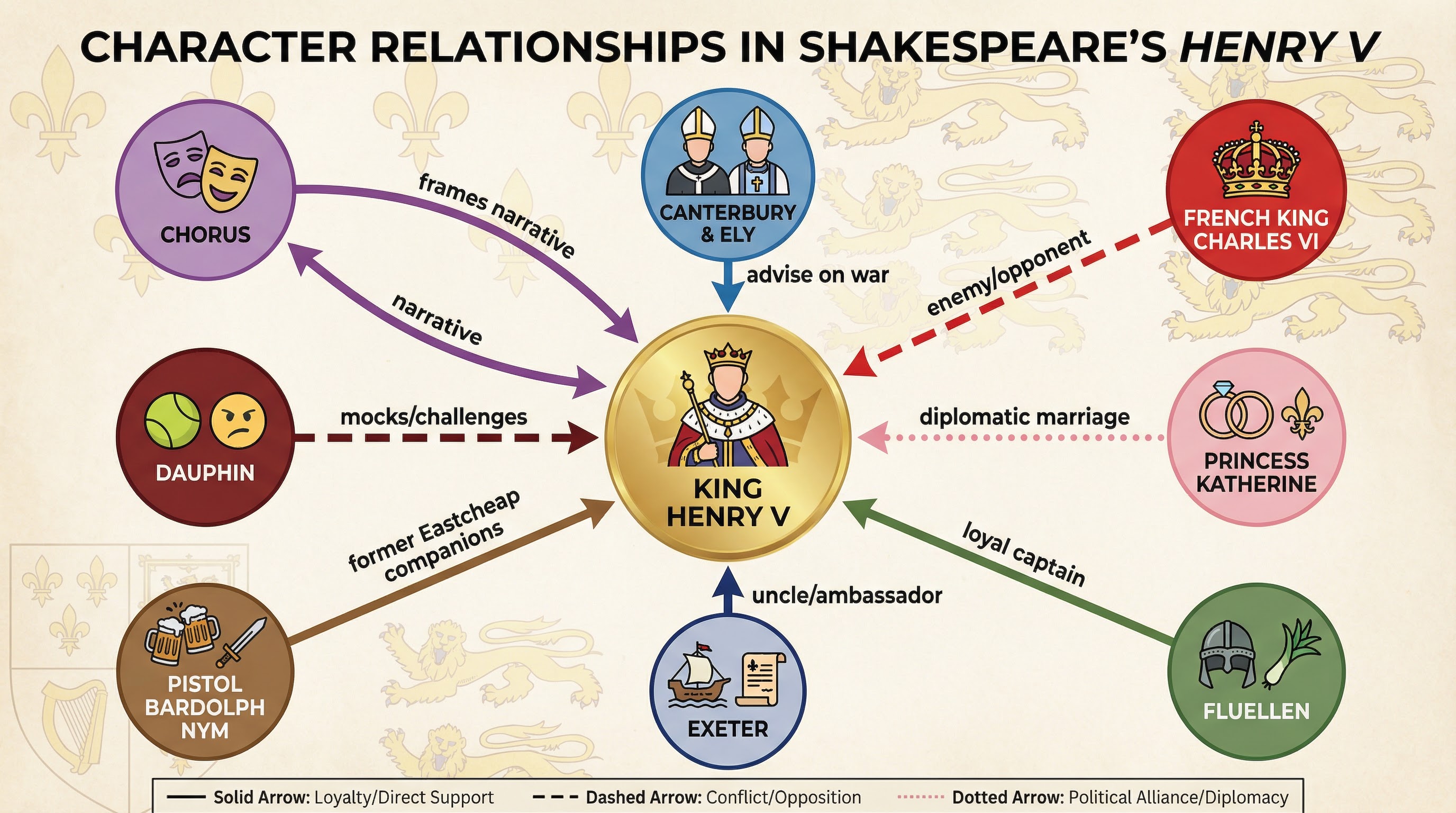
King Henry V
Role: Protagonist and title character; King of England; military leader; political strategist.
Key Traits: Charismatic, rhetorically skilled, politically astute, ruthless, burdened by responsibility, morally ambiguous.
Character Arc: Henry has already transformed from the 'wild' Prince Hal of the Henry IV plays into a king by the start of Henry V, but the play shows him consolidating and performing that transformation. In Act 1, he seeks public validation for the war, demonstrating his awareness of the need for political legitimacy. In Acts 2-3, he exposes traitors, inspires his troops, and threatens atrocities, showing both his charisma and his ruthlessness. In Act 4, the disguise scene and soliloquy reveal his private doubts and the burden of kingship, humanising him and complicating the heroic narrative. By Act 5, he has achieved his political goals—victory, treaty, marriage—but the Chorus's epilogue reminds us that his success was temporary. Henry is not a straightforward hero or villain; he is a complex, contradictory figure who embodies both the ideals and the moral compromises of leadership.
Essential Quotes:
- "May I with right and conscience make this claim?" (Act 1, Scene 2) - Reveals his concern with legitimacy and moral authority.
- "Once more unto the breach, dear friends, once more" (Act 3, Scene 1) - Demonstrates his ability to inspire and unite his troops.
- "Upon the king! Let us our lives, our souls, our debts, our careful wives, our children, and our sins lay on the king!" (Act 4, Scene 1) - Exposes the psychological burden of kingship.
- "We few, we happy few, we band of brothers" (Act 4, Scene 3) - The St Crispin's Day speech is the pinnacle of his rhetorical power.
The Chorus
Role: Narrator; meta-theatrical commentator; audience guide.
Key Traits: Self-aware, apologetic, patriotic, poetic.
Character Arc: The Chorus appears at the start of each act (and in the epilogue) to set the scene, apologise for the limitations of theatre, and guide the audience's response. The Chorus is not a neutral narrator—it is patriotic and pro-Henry, describing him as 'the mirror of all Christian kings'. However, by drawing attention to the artificiality of theatre, the Chorus also invites the audience to question the constructed nature of Henry's heroism. The epilogue's reminder that Henry's achievements were fleeting complicates the Chorus's earlier celebration.
Essential Quotes:
- "O for a Muse of fire, that would ascend / The brightest heaven of invention" (Prologue) - Establishes the meta-theatrical frame.
- "can this cockpit hold the vasty fields of France?" (Prologue) - Draws attention to the gap between reality and representation.
- "Small time, but in that small most greatly lived / This star of England" (Epilogue) - Celebrates Henry but also acknowledges the brevity of his success.
Fluellen
Role: Welsh captain; loyal officer; voice of discipline and reason.
Key Traits: Fiercely loyal, disciplined, learned, comic (through his accent and mispronunciations), morally upright.
Character Arc: Fluellen represents the ideal of the loyal, disciplined soldier. He insists on military order, defends Henry's honour, and draws learned comparisons between Henry and Alexander the Great. His comic mispronunciations ('prave' for 'brave') might seem like mockery, but Shakespeare actually gives him some of the play's most insightful observations. His confrontation with Pistol in Act 5, where he forces Pistol to eat a leek, is both comic and morally serious—it punishes Pistol's disrespect and cowardice.
Essential Quotes:
- "There is occasions and causes why and wherefore in all things" (Act 5, Scene 1) - Reveals his insistence on reason and discipline.
- "I think Alexander the Great was born in Macedon; his father was called Philip of Macedon, as I take it" (Act 4, Scene 7) - His learned comparison elevates Henry to classical heroism.
Pistol, Bardolph, and Nym
Role: Comic characters; former companions of Prince Hal; common soldiers.
Key Traits: Cowardly, opportunistic, comic, vulgar.
Character Arc: These characters represent the underclass who are conscripted into war. They are not heroic—they are cowards, thieves, and braggarts. The Boy observes, 'they will steal anything'. Bardolph's execution for looting a church is a turning point: it demonstrates Henry's commitment to military discipline over personal loyalty. Pistol's humiliation by Fluellen in Act 5 completes his degradation. These characters provide a counterpoint to the play's heroic rhetoric, showing the reality of the common soldiers who fight and die in wars they did not choose.
Essential Quotes:
- "Let us to France, like horse-leeches, my boys, to suck, to suck, the very blood to suck!" (Act 2, Scene 3) - Pistol's vulgar language reveals his opportunism.
- "I would give all my fame for a pot of ale and safety" (Act 3, Scene 2) - The Boy's observation exposes the gap between heroic rhetoric and the reality of fear.
Princess Katherine
Role: French princess; Henry's bride; symbol of political alliance.
Key Traits: Innocent, obedient, charming, politically powerless.
Character Arc: Katherine appears in two scenes: Act 3, Scene 4, where she learns English in a comic lesson with her maid Alice, and Act 5, Scene 2, where Henry woos her. The English lesson is comic but also poignant—she is preparing for her future as Henry's wife and Queen of England, a role she has no choice in. The wooing scene is often played as romantic comedy, but it also has a darker undertone: Katherine has no real power to refuse Henry. His language shifts between blunt soldier ('I cannot look greenly nor gasp out my eloquence') and coercive charm. Katherine's limited English and her reliance on Alice to translate emphasise her vulnerability.
Essential Quotes:
- "O bon Dieu! les langues des hommes sont pleines de tromperies" (Act 5, Scene 2) - Katherine's observation that 'the tongues of men are full of deceits' reveals her awareness of Henry's rhetorical manipulation.
Writer's Methods
Shakespeare employs a range of dramatic and linguistic methods to construct the play's themes and characters. The Chorus is the most distinctive structural device: by appearing at the start of each act to apologise for the limitations of theatre and guide the audience's response, the Chorus creates a meta-theatrical frame that draws attention to the constructed nature of the narrative. This is crucial for understanding the play's exploration of performance and representation. The shift between verse and prose reflects social hierarchy: nobles speak in blank verse, while common soldiers and comic characters speak in prose. However, Henry breaks this pattern when disguised among his soldiers, suggesting his ability to move between social worlds. Shakespeare uses soliloquy to reveal Henry's private thoughts and doubts, contrasting with his public rhetoric. The St Crispin's Day speech is a masterclass in rhetoric: it uses collective pronouns ('we', 'our'), imperatives ('proclaim it'), repetition ('we few, we happy few'), and metaphor ('band of brothers') to create unity and inspire courage. Henry's threat to Harfleur uses violent imagery ('filth and scum of war', 'sully your fresh fair virgins') to terrorise the citizens into surrender. The wooing scene in Act 5 shifts to prose and a more informal register, with Henry claiming to be a 'plain soldier', but this is itself a rhetorical performance. Shakespeare also uses dramatic irony: the audience knows from the epilogue that Henry's achievements will be lost by his son, which undercuts the play's triumphant narrative. Examiners reward candidates who identify these methods and analyse their effects, always linking back to the question.
Context
Henry V was written in 1599, during the final years of Elizabeth I's reign. Elizabeth was aging and had no direct heir, raising fears of civil war and foreign invasion. The play responds to these anxieties by constructing a vision of national unity under a strong, charismatic leader. The Divine Right of Kings—the belief that monarchs were God's representatives on earth—was a central Elizabethan political doctrine, and the play explores both the power and the burden of this belief. Henry's concern with legitimacy ('May I with right and conscience make this claim?') reflects contemporary anxieties about succession and rightful rule. The play also engages with Machiavellian political theory: Machiavelli's The Prince (1532) argued that effective rulers must be willing to use deception, violence, and pragmatism to maintain power. Henry embodies this: he manipulates rhetoric, exposes traitors, threatens atrocities, and executes former friends. The play was written during the Nine Years' War in Ireland (1594-1603), and the Chorus's reference to the Earl of Essex's Irish campaign ('the general of our gracious empress') connects the play to contemporary military concerns. The four captains (English, Welsh, Scottish, Irish) reflect the Elizabethan project of constructing a unified British identity under English rule, though Macmorris's question ('What ish my nation?') reveals the tensions within this project. The play's ambiguity about war—simultaneously celebrating and critiquing it—may reflect the Elizabethan experience of costly, inconclusive military campaigns. Examiners reward candidates who integrate context into their analysis of Shakespeare's methods, showing how the play reflects and responds to its historical moment.
Podcast: Henry V Study Guide
Listen to the 10-minute podcast episode above for an engaging audio summary of the key themes, characters, and exam techniques for Henry V. The podcast covers:
- The big picture: transformation, leadership, and the cost of war
- The role of the Chorus and meta-theatricality
- Key themes: kingship and performance, war and morality, national identity
- Exam technique: how to structure your response and avoid common mistakes
- Quick-fire recall quiz to test your knowledge
Podcast Script: The full script for this episode is included in the podcast_script field of this study guide.