Study Notes
Overview
Lord Byron's "She Walks in Beauty" is a short, lyrical poem that has captivated readers for over two centuries. For the OCR GCSE English Literature specification (J352), this poem is a cornerstone of the Component 02 Poetry anthology, where it is studied for comparative analysis. The poem appears simple, describing a beautiful woman the speaker has just seen, but its genius lies in its sophisticated construction and its profound exploration of what constitutes true beauty. Examiners are not looking for biographical details about Byron or the woman who inspired the poem; instead, credit is awarded for a candidate's ability to analyse the poem's language, form, and structure (AO2) and to build a sustained, conceptualised comparison with another poem from the anthology (AO1). This guide will deconstruct Byron's methods, providing you with the analytical vocabulary and structural understanding needed to excel. We will explore how the poem masterfully balances opposites—dark and light, physical and spiritual—to create a vision of perfect, harmonious beauty that is both awe-inspiring and deeply moving.
Plot/Content Overview
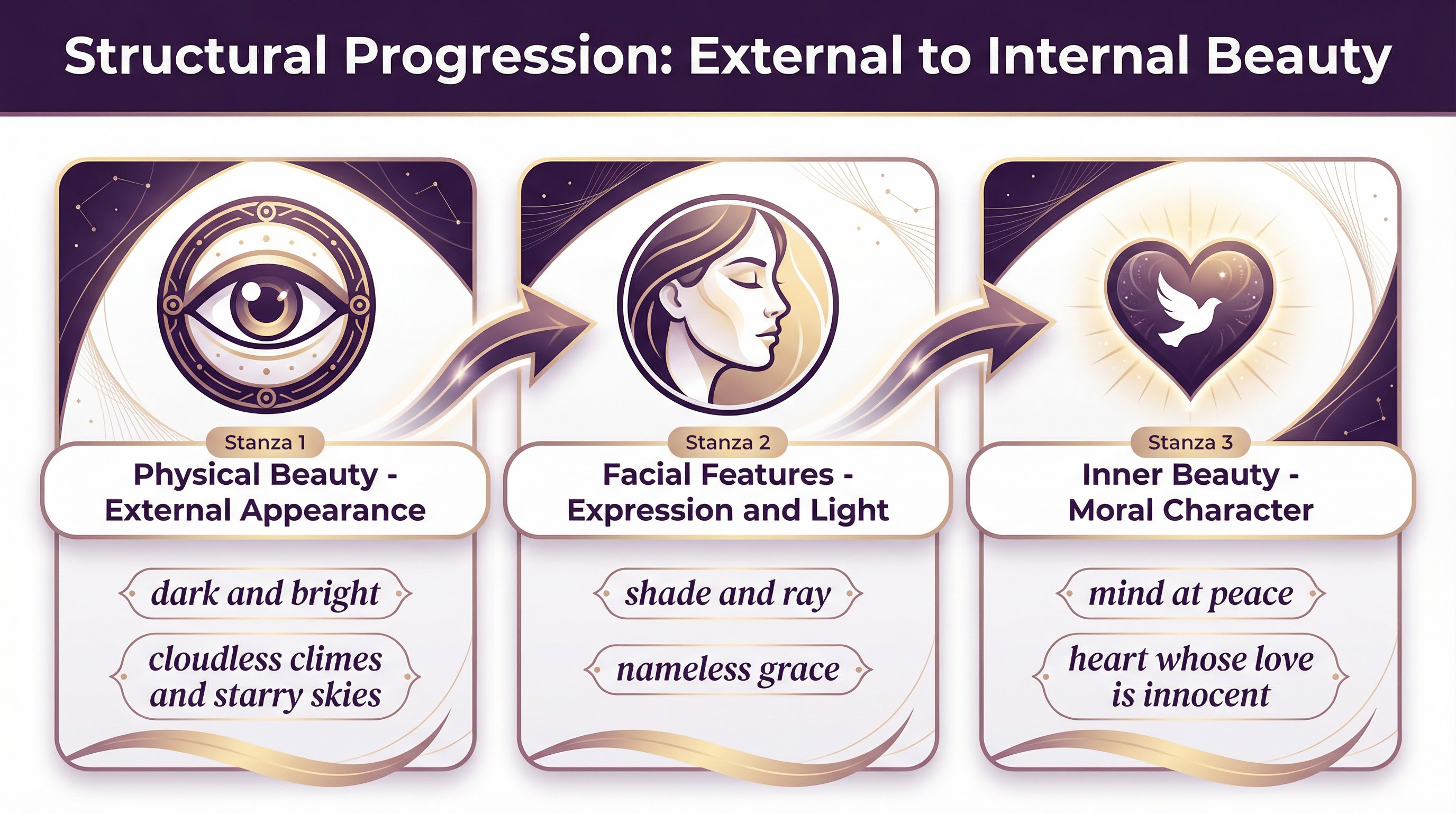
The poem does not have a traditional plot but unfolds as a descriptive meditation on a woman's beauty. It can be broken down into a clear three-part progression, with each stanza shifting the focus of the speaker's admiration.
-
Stanza 1: The speaker begins with a holistic impression of the woman, famously comparing her beauty to a "starry" night. This stanza establishes the central theme of balance, stating that "all that's best of dark and bright" meets in her eyes. The focus is on her overall presence and the harmonious blend of opposing qualities that define her appearance.
-
Stanza 2: The focus narrows to the woman's face. The speaker reflects on the delicate balance of light and shade, suggesting that even the slightest change would diminish her perfection. He describes the "nameless grace" that plays on her features, linking her physical appearance to her inner thoughts and suggesting her beauty is a reflection of her serene mind.
-
Stanza 3: The poem moves from the physical to the spiritual, completing the definition of her beauty. The speaker praises her "mind at peace" and her "heart whose love is innocent." Her external beauty is presented as the direct result of her inner goodness and moral purity. The poem concludes that her captivating appearance is an outward sign of a virtuous and tranquil soul.
Themes
Theme 1: The Nature of Beauty
Byron presents a complex and idealized definition of beauty that transcends the purely physical. The poem argues that true beauty is a holistic quality, a perfect synthesis of external appearance and internal virtue. The speaker is captivated not just by the woman's looks but by the way her appearance seems to express her inner character. This is not a poem about fleeting attraction but a meditation on a profound and lasting form of beauty.
Key Quotes:
- "And all that's best of dark and bright / Meet in her aspect and her eyes" - This use of antithesis is the core of the poem's argument. Beauty is not one thing but a harmonious balance of opposites.
- "a mind at peace with all below, / A heart whose love is innocent!" - This directly links her physical beauty to her moral and spiritual qualities, making it clear that her goodness is the source of her appeal.
Theme 2: Harmony and Balance
The poem is obsessed with the idea of perfect equilibrium. This is evident in the central motif of balancing "dark and bright," but it is also woven into the very fabric of the poem's structure and sound. The unwavering iambic tetrameter and the consistent ABABAB rhyme scheme create a sense of calm, effortless grace that mirrors the subject herself. The speaker suggests that her beauty is so perfect because nothing is out of place; every element exists in a state of flawless harmony.
Key Quotes:
- "One shade the more, one ray the less, / Had half impaired the nameless grace" - This highlights the fragility and precision of this perfect balance. Any deviation would shatter the effect.
- "So soft, so calm, yet eloquent" - This phrase itself is an example of balance, combining gentle qualities (soft, calm) with a more active, expressive one (eloquent).
Writer's Methods
Language
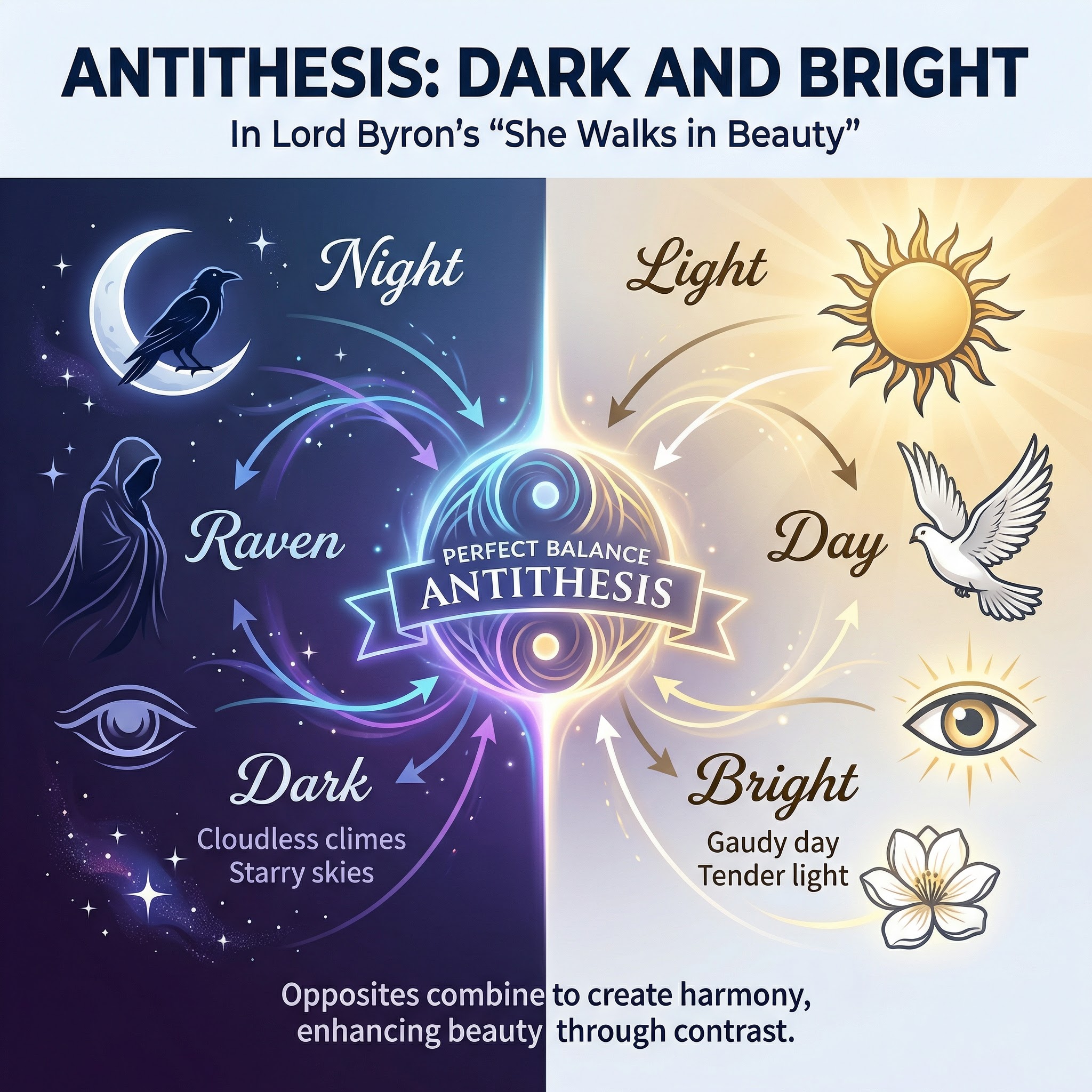
- Antithesis: This is the most important technique in the poem. Byron constantly places contrasting ideas together (e.g., "dark and bright," "night" and "starry skies") to create a sense of perfect balance. This reinforces the idea that the woman's beauty is a harmonious fusion of opposites, making it more complex and profound than simple prettiness.
- Simile: The opening line, "She walks in beauty, like the night," is a powerful simile that immediately establishes the poem's tone. It associates the woman with the majesty and serenity of a clear, starry night, avoiding the more conventional comparison to a sunny day (which the poem dismisses as "gaudy").
- Personification: The line "Where thoughts serenely sweet express / How pure, how dear their dwelling-place" personifies her thoughts, suggesting they have a life of their own and are responsible for the beauty of her face. This strengthens the link between her inner and outer self.
Form and Structure
- Iambic Tetrameter: The poem is written in a consistent iambic tetrameter (four pairs of unstressed and stressed syllables per line: da-DUM da-DUM da-DUM da-DUM). This creates a smooth, musical rhythm that mimics the graceful way the woman walks. It contributes to the overall feeling of calm and harmony.
- Rhyme Scheme: The poem follows a regular ABABAB rhyme scheme in each of its three stanzas. This consistent and predictable pattern reinforces the sense of order, balance, and perfection that the speaker attributes to the woman.
- Three-Stanza Structure: The poem's argument develops logically across the three stanzas, moving from a general impression of her physical beauty to a focus on her face, and finally to an appreciation of her inner, moral beauty. This structural progression from the external to the internal is key to understanding Byron's holistic definition of beauty.
Context
For the OCR exam, AO3 (Context) is not assessed for this comparative poetry question. Marks are awarded for AO1 (comparison) and AO2 (analysis of methods). While it is interesting to know that Byron was inspired by his cousin, Anne Wilmot, who was in mourning, mentioning this in an exam response will not gain credit and will waste valuable time. Your entire focus should be on the words on the page and how they compare to your chosen second poem. The only "context" that matters is the literary context of the poem itself—how its language, form, and structure work together to create meaning.