Unseen Poetry: Analysis and Comparison

    This guide provides a comprehensive, exam-focused toolkit for mastering OCR GCSE Unseen Poetry. It demystifies the analysis process, focusing on the precise skills required to earn top marks by deconstructing language, form, and structure while avoiding common pitfalls.

    5
    Min Read
    2
    Examples
    4
    Questions
    8
    Key Terms
    🎙 Podcast Episode
    Unseen Poetry: Analysis and Comparison
    0:00-0:00

    Study Notes

    Header image for OCR GCSE Unseen Poetry.

    Overview

    The Unseen Poetry component of the OCR GCSE English Literature exam (J352, Component 02) is a unique challenge that tests pure analytical skill. Unlike other sections, it requires candidates to engage with a poem they have never encountered before, making it a true measure of their ability to think critically under pressure. Examiners are looking for a sustained, informed personal response (AO1) supported by detailed analysis of the writer's methods (AO2). This section is worth 50% of the paper's marks, split equally between these two objectives. Success here is not about prior knowledge of the poem, but about the rigorous application of an analytical toolkit. Candidates who can dissect language, form, and structure with precision, while avoiding the common traps of comparison (AO4) and context (AO3), will find this a rewarding opportunity to demonstrate their literary expertise. This guide will equip you with the strategies to do just that.

    Podcast: Mastering OCR Unseen Poetry

    The Analytical Process: A Step-by-Step Guide

    Approaching an unseen poem requires a methodical process to ensure no marks are left behind. The most effective strategy is the 'Three-Read' method, which allows for a layered understanding of the poem's complexities.
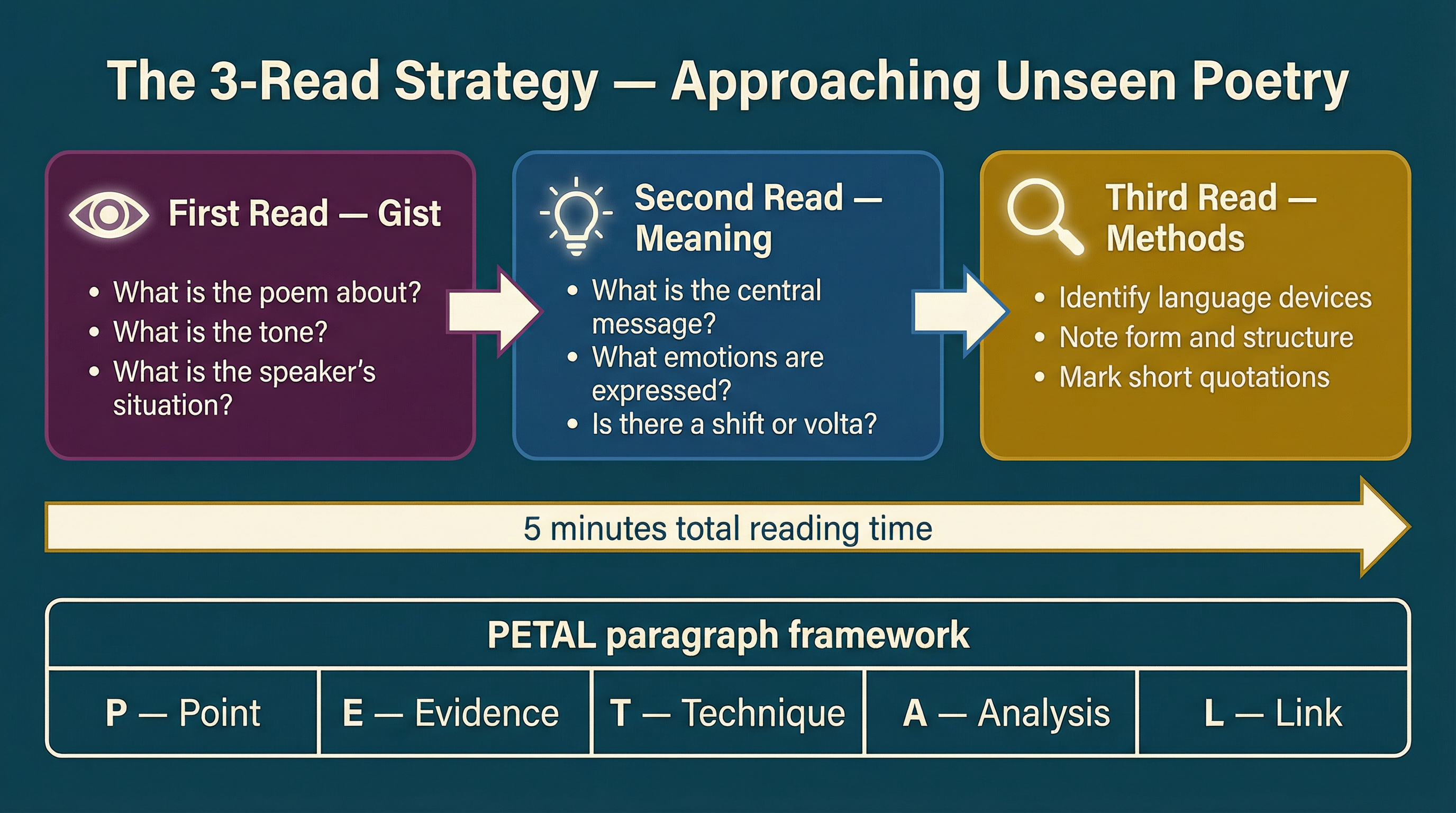
    The Three-Read Strategy and PETAL Framework.

    1. First Read: The Gist (1 minute): Read the poem from top to bottom without making any notes. The goal is to get a general sense of the poem's subject matter and tone. Ask yourself: What is the situation? Who is the speaker? What is the overall mood?

    2. Second Read: The Meaning (2 minutes): Read the poem again, this time focusing on the deeper message. What is the central idea or argument? What emotions are being explored? Is there a 'volta' or a turn in the poem where the argument or tone shifts?

    3. Third Read: The Methods (2 minutes): This is your annotation read. With a pen in hand, actively mark the poem, identifying the specific techniques the poet is using to create meaning. Look for patterns in imagery, interesting word choices, structural features like enjambment or caesura, and the poem's overall form.

    Writer's Methods: The Core of AO2

    Your ability to analyse the writer's methods is the cornerstone of a high-level response. This goes beyond simply 'feature-spotting'. For every technique you identify, you must explore its specific effect on the reader and its contribution to the poem's overall meaning.
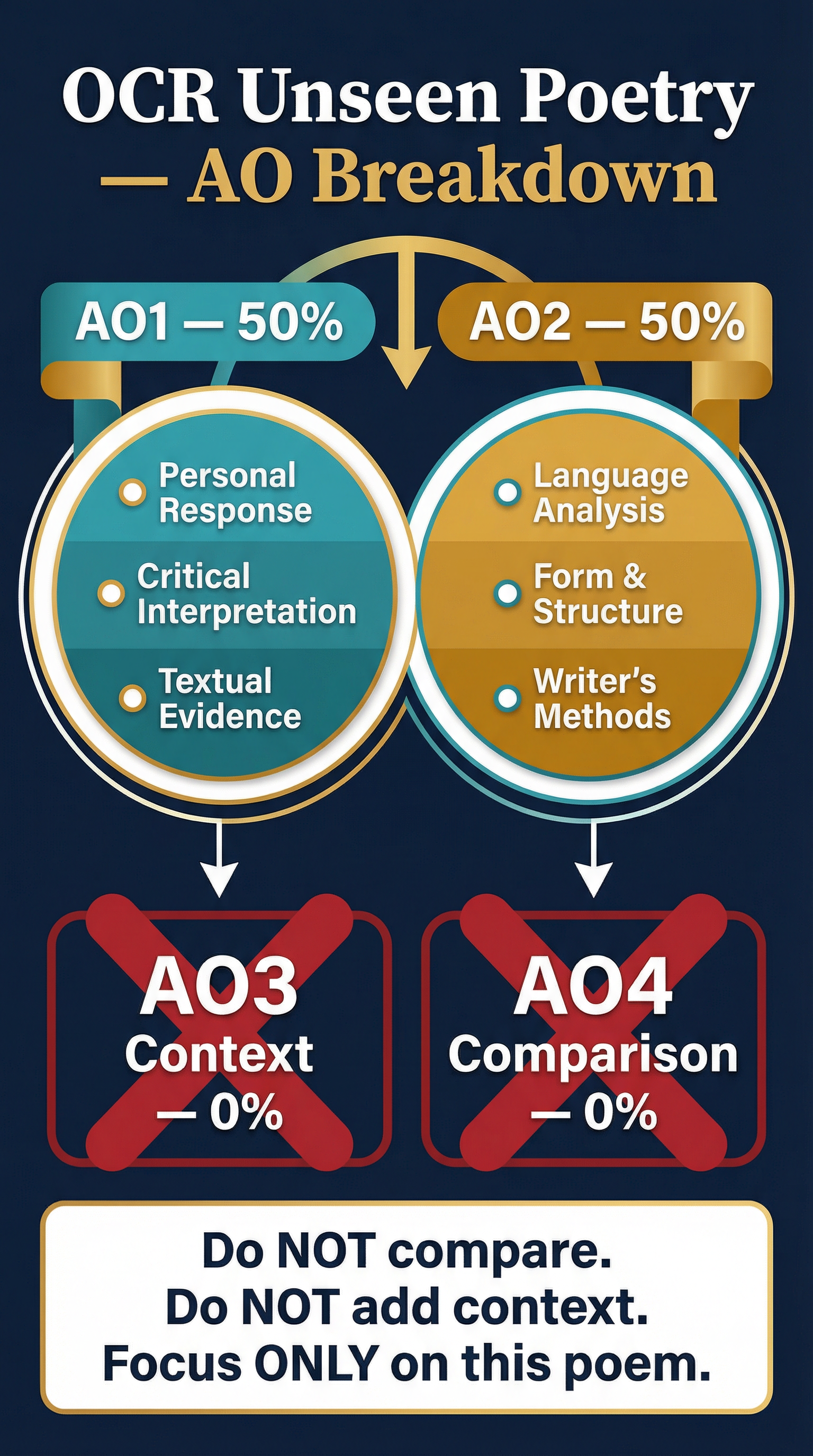
    Assessment Objective Breakdown for OCR Unseen Poetry.

    Language

    Language analysis involves looking at the poet's specific word choices (diction), imagery (metaphors, similes, personification), and sound devices (alliteration, assonance, onomatopoeia).

    • Diction: Why has the poet chosen this specific word? What are its connotations? For example, describing a house as 'imposing' versus 'welcoming' creates entirely different effects.
    • Imagery: How does the imagery create a sensory experience for the reader? A metaphor doesn't just create a comparison; it transfers the qualities of one thing onto another, deepening our understanding.
    • Sound Devices: How does the sound of the poem contribute to its tone? Harsh alliterative 'k' or 't' sounds might create a sense of aggression, while soft 's' sounds (sibilance) could suggest secrecy or intimacy.

    Form

    Form refers to the overall shape and type of the poem. Is it a sonnet, with its traditional 14 lines and strict rhyme scheme? Is it a ballad, telling a story in regular quatrains? Or is it written in free verse, with no set rules?

    • Sonnets: Often used for themes of love or intense emotion. The strict form can suggest a speaker trying to control their feelings.
    • Free Verse: The lack of a set structure can mirror a speaker's feelings of freedom, chaos, or confusion.
    • Stanza Length: Regular stanza lengths (e.g., quatrains) can create a sense of order and predictability, while irregular stanzas might reflect an unsettled state of mind.

    Structure

    Structure refers to how the poem is organised and how it unfolds for the reader. This includes elements like rhyme scheme, rhythm, enjambment, and caesura.

    • Rhyme Scheme: A regular rhyme scheme (e.g., AABB) can create a simple, song-like quality. An irregular or broken rhyme scheme might create a sense of unease or fragmentation.
    • Rhythm (Metre): A regular rhythm, like the iambic pentameter, can create a sense of control or formality. A broken rhythm can feel jarring and disruptive.
    • Enjambment: When a line of poetry runs onto the next line without a pause, it can create a sense of urgency, breathlessness, or overflowing emotion.
    • Caesura: A pause within a line of poetry, created by punctuation. It can force the reader to slow down and reflect on a particular word or idea, or it can create a sense of fragmentation and broken thought.

    Visual Resources

    2 diagrams and illustrations

    Assessment Objective Breakdown for OCR Unseen Poetry.
    Assessment Objective Breakdown for OCR Unseen Poetry.
    The Three-Read Strategy and PETAL Framework.
    The Three-Read Strategy and PETAL Framework.

    Interactive Diagrams

    1 interactive diagram to visualise key concepts

    'Response''Annotation'Read 1: GistRead 2: MeaningRead 3: MethodsPlan EssayWrite PETAL Paragraphs

    A workflow diagram showing the process from initial reading to final written response for Unseen Poetry.

    Worked Examples

    2 detailed examples with solutions and examiner commentary

    Practice Questions

    Test your understanding — click to reveal model answers

    Q1

    Explore how the poet presents the experience of memory in the poem below. (24 marks)

    24 marks
    standard

    Hint: Consider how the poet uses sensory details and structure to show how memory feels to the speaker. Is it comforting or painful?

    Q2

    How does the poet present the speaker's attitude towards the city? (24 marks)

    24 marks
    standard

    Hint: Track the speaker's feelings from the beginning to the end of the poem. Do they change? Look for contrasting imagery.

    Q3

    Explore how the poet presents a moment of change. (24 marks)

    24 marks
    challenging

    Hint: Locate the 'volta' or turning point in the poem. How do the language and structure before this point differ from the language and structure after it?

    Q4

    How does the poet make the everyday object seem strange or unfamiliar? (24 marks)

    24 marks
    challenging

    Hint: This is a question about 'defamiliarization'. How does the poet use unusual metaphors, similes, or perspectives to make you see something common in a new light?

    Key Terms

    Essential vocabulary to know

    More English Literature Study Guides

    View all

    Nettles (Vernon Scannell)

    OCR
    GCSE

    Vernon Scannell's 'Nettles' is a powerful allegory for the futility of parental protection, using military metaphor to transform a simple garden injury into a meditation on the unwinnable war against life's inevitable pains. This poem rewards candidates who can sustain a conceptual comparison with another Conflict Cluster text while analysing Scannell's methods with precision.

    Lord of the Flies

    OCR
    GCSE

    William Golding's *Lord of the Flies* is a stark, allegorical tale of schoolboys stranded on a desert island, a descent into savagery that ruthlessly examines the dark heart of human nature. For OCR candidates, mastering this text is about understanding how Golding uses character, symbolism, and structure to question the very foundations of society.

    The Strange Case of Dr Jekyll and Mr Hyde

    OCR
    GCSE

    Unlock the secrets of Stevenson's Gothic masterpiece. This guide provides a comprehensive analysis of The Strange Case of Dr Jekyll and Mr Hyde, focusing on the key themes, characters, and literary methods needed to achieve top marks in your OCR GCSE English Literature exam."

    An Inspector Calls

    OCR
    GCSE

    J.B. Priestley's 'An Inspector Calls' is a gripping morality play that dissects the hypocrisy of the pre-war upper classes. Studying it is rewarding as it offers a masterclass in dramatic irony, characterisation as social commentary, and the power of theatre to provoke moral reflection.

    Great Expectations

    OCR
    GCSE

    Unlock top marks in your OCR GCSE English Literature exam with this comprehensive guide to *Great Expectations*. This guide provides a deep dive into Dickens' classic novel, focusing on the key themes, characters, and literary methods you need to know to impress the examiners. It is packed with worked examples, memory hooks, and exam-style questions to help you revise effectively and write with confidence."

    Remember (Christina Rossetti)

    OCR
    GCSE

    Christina Rossetti's 'Remember' is a masterful Petrarchan sonnet that moves from a desperate plea to be remembered after death to a profound, selfless act of love, urging the beloved to forget rather than grieve. This guide will unpack how Rossetti uses form, tone, and imagery to explore the complex relationship between memory, love, and mortality, giving you the tools to ace your OCR exam."