Study Notes
Overview
In the OCR J352 Component 02, 'Valentine' stands as a cornerstone of the 'Love and Relationships' poetry cluster. It is a poem that deliberately subverts the reader's expectations. Instead of the conventional symbols of love, Carol Ann Duffy presents an onion, using it as an extended metaphor to explore the multifaceted nature of love in all its honesty, intensity, and even brutality. Examiners are looking for candidates who can move beyond a surface-level reading and engage with the poem's complex, often unsettling, layers of meaning. A successful analysis will focus on how Duffy uses form, structure, and language to challenge traditional notions of romance, and will compare these ideas thoughtfully with another poem from the anthology. Credit is given for a clear understanding that the poem is not anti-love, but rather a powerful argument for a more authentic and realistic portrayal of it.
Plot/Content Overview
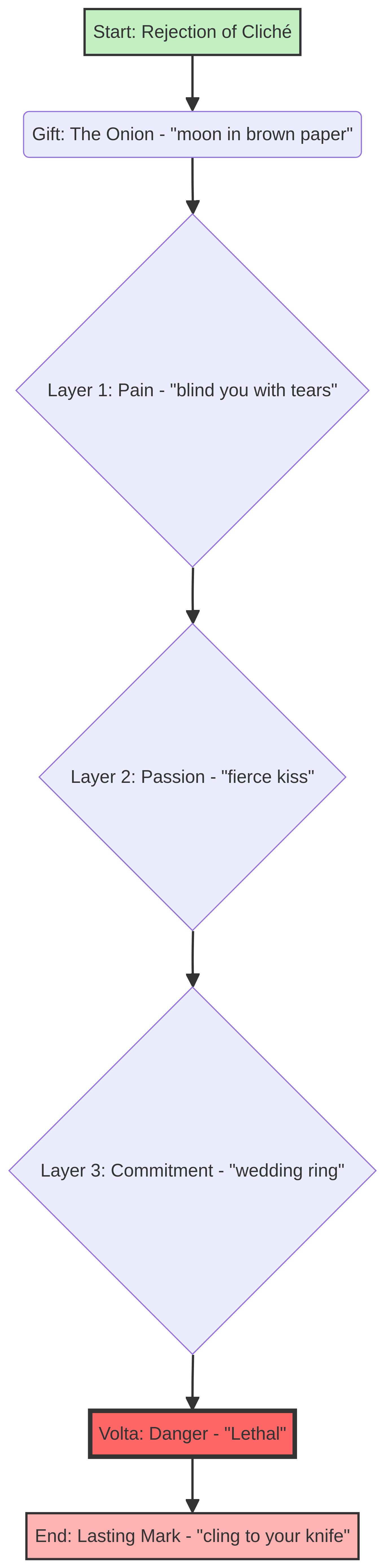
The poem unfolds as a direct address from the speaker to their lover. It follows a clear, argumentative structure as the speaker presents and deconstructs the onion metaphor.
- Rejection of Convention: The poem opens with a blunt refusal of typical Valentine's gifts: "Not a red rose or a satin heart."
- The Gift Offered: The speaker offers an onion, describing it as a "moon wrapped in brown paper," mixing romantic imagery with the mundane.
- The First Revelation - Pain: The onion's ability to make one cry is linked to the pain of love: "It will blind you with tears / like a lover."
- The Second Revelation - Intensity: The onion's potent scent and taste are compared to a "fierce kiss," which is both "possessive and faithful."
- The Third Revelation - Commitment: The onion's circular layers are likened to a wedding ring, but with an ambiguous warning: "Its platinum loops shrink to a wedding ring, / if you like." The word "shrink" introduces a sense of constraint.
- The Final Revelation - Danger: The poem concludes with a dark turn. A single-word stanza, "Lethal," is followed by the lingering, inescapable scent of the onion, which clings not just to the fingers but to a "knife," implying betrayal, separation, or the potential for love to cause deep harm.
Themes
Theme 1: The Nature of True Love
Duffy argues that true love is not the sanitised, commercialised version sold to us. It is complex, messy, and multifaceted. The onion, with its many layers, its ability to cause both joy and pain, and its mundane reality, becomes the perfect symbol for this authentic love.
Key Quotes:
- "Not a red rose or a satin heart." - Directly rejects cliché and establishes the poem's unconventional stance.
- "I give you an onion. / It is a moon wrapped in brown paper." - Juxtaposes the romantic (moon) with the ordinary (brown paper), suggesting that true love is found in the real world, not in fantasy.
- "I am trying to be truthful." - A direct statement of intent from the speaker, which examiners expect candidates to see as the core of the poem's message.
Theme 2: Pain and Danger in Love
The poem does not shy away from the darker aspects of relationships. Duffy explores how love can lead to grief, possessiveness, and even destruction. The onion metaphor is used to convey this with brutal honesty.
Key Quotes:
- "It will blind you with tears / like a lover." - A powerful simile that directly connects the onion's chemical effect to the emotional pain a lover can inflict.
- "A wobbling photo of grief." - This striking image captures the distorted perception and sorrow that can come from a relationship.
- "Lethal. / Its scent will cling to your fingers, / cling to your knife." - The final lines are the most menacing. The word "Lethal" is stark and shocking, while the lingering scent and the final image of the "knife" suggest that love's effects are permanent and potentially violent or destructive.
Writer's Methods
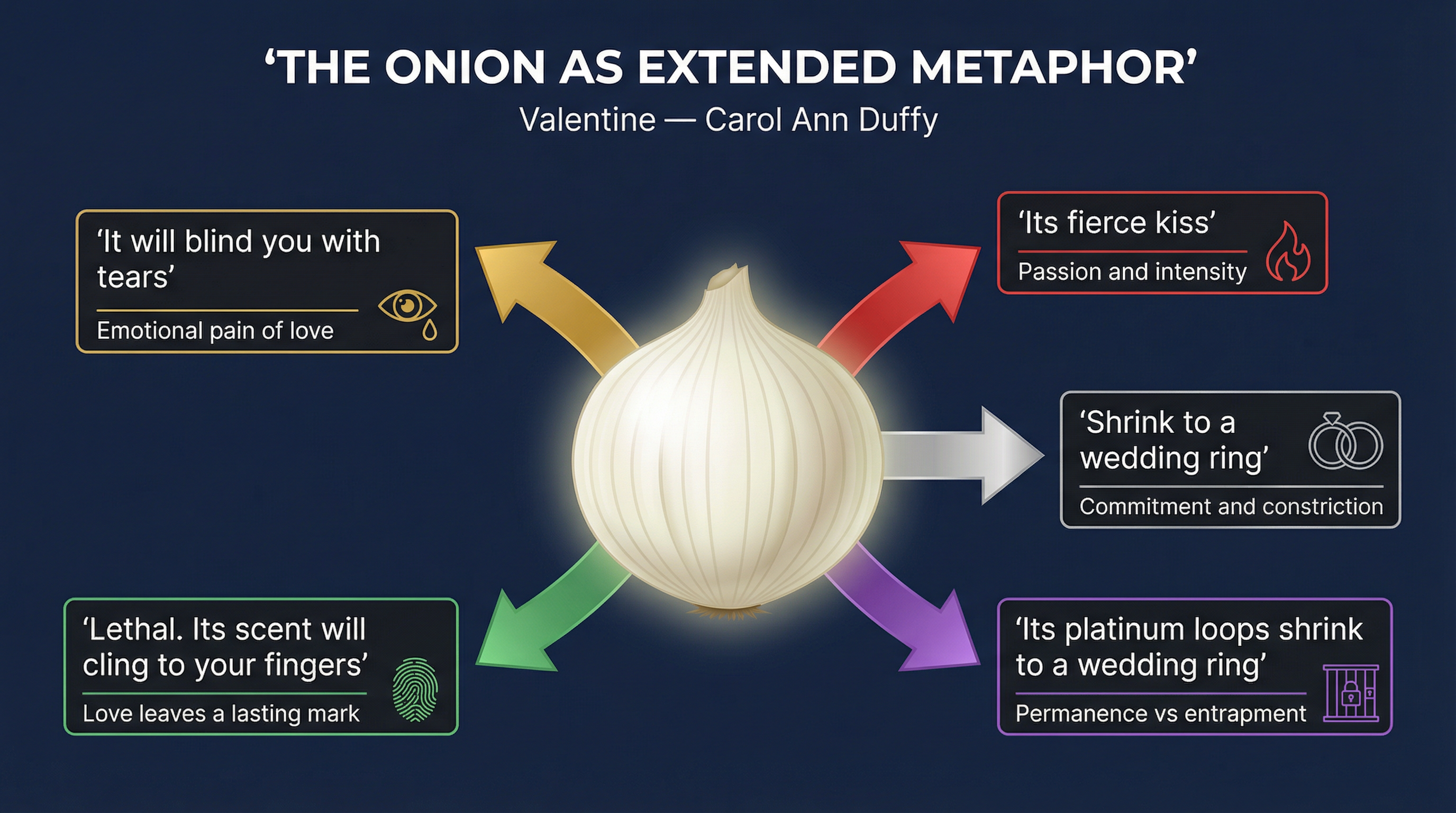
Extended Metaphor: This is the central device of the poem. The onion is not just a one-off comparison; its different qualities are explored throughout the poem to represent the different facets of love. Marks are awarded for tracing the development of this metaphor from a simple gift to a symbol of pain, commitment, and danger.
Form and Structure: 'Valentine' is written in free verse, meaning it has no regular rhyme scheme or meter. This rejection of traditional poetic form mirrors the speaker's rejection of traditional romantic conventions. The stanzas are irregular in length, creating a conversational, almost hesitant, yet direct tone. The use of short, single-line stanzas (e.g., "I give you an onion.", "I am trying to be truthful.", "Lethal.") creates emphasis and forces the reader to pause and consider the weight of these statements.
Sensory Language: Duffy uses vivid sensory details to make the onion metaphor tangible. We have the visual of the "moon wrapped in brown paper," the feeling of the "fierce kiss," and the lingering "scent" at the end. This makes the speaker's argument more powerful and immediate.
Ambiguous Language: Top-level candidates will explore the poem's ambiguity. Words like "possessive" and "shrink" can be interpreted in both positive and negative ways. Does "possessive" mean faithful and loyal, or controlling and jealous? Does the wedding ring "shrink" to represent a focused, intimate commitment, or a restrictive, suffocating one? Analysing these dual meanings is key to a sophisticated reading.
Context
Carol Ann Duffy: As the first female Poet Laureate of the United Kingdom (2009-2019), Duffy often writes from a feminist perspective, challenging patriarchal norms and giving voice to marginalised or silenced figures. In 'Valentine', she challenges the patriarchal and commercialised traditions surrounding love and romance. Her poetry is known for its use of simple, accessible language to explore complex, profound ideas.
Postmodernism: The poem can be seen as a postmodern text in its rejection of grand narratives and universal truths. Instead of presenting a single, idealised version of love, it offers a subjective, fragmented, and more personal perspective. It plays with language and form and subverts the reader's expectations, which are all hallmarks of postmodern literature.