Study Notes
Overview
The theme of Travel and Tourism is a cornerstone of the AQA GCSE Spanish specification, frequently appearing in all papers: Paper 1 (Listening), Paper 2 (Speaking), Paper 3 (Reading), and Paper 4 (Writing). Mastery of this topic is essential for candidates aiming for higher grades. This guide will equip you with the vocabulary, grammar, and exam techniques needed to confidently tackle questions on holidays, transport, accommodation, and tourist activities. Credit is awarded for demonstrating a range of language, using different tenses, and expressing justified opinions.
📖 Essential Vocabulary
Tier 1 — Foundation Core
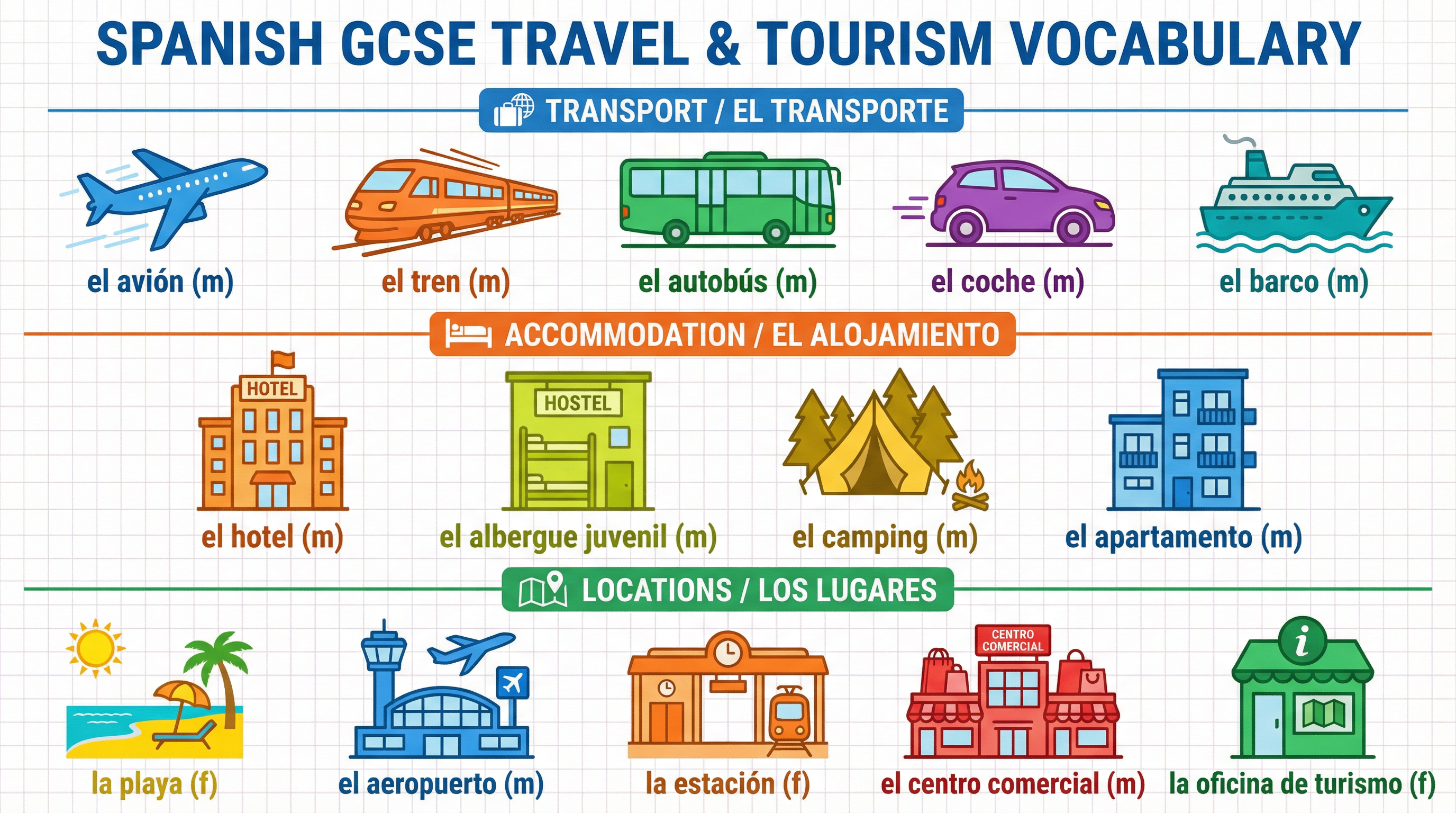
| Spanish | English | Gender | Example Sentence |
|---|---|---|---|
| el viaje | trip, journey | m | Mi viaje a España fue inolvidable. (My trip to Spain was unforgettable.) |
| las vacaciones | holidays | f | ¿Adónde fuiste de vacaciones el año pasado? (Where did you go on holiday last year?) |
| el hotel | hotel | m | Nos alojamos en un hotel de cinco estrellas. (We stayed in a five-star hotel.) |
| la playa | beach | f | Me encanta tomar el sol en la playa. (I love to sunbathe on the beach.) |
| el billete | ticket | m | Compré un billete de ida y vuelta a Madrid. (I bought a return ticket to Madrid.) |
| el aeropuerto | airport | m | El avión despega del aeropuerto a las diez. (The plane takes off from the airport at ten.) |
| la estación | station | f | La estación de tren está en el centro de la ciudad. (The train station is in the city centre.) |
| el pasaporte | passport | m | No olvides tu pasaporte y tu tarjeta de embarque. (Don't forget your passport and your boarding pass.) |
| la maleta | suitcase | f | Hice la maleta anoche. (I packed my suitcase last night.) |
| el turista | tourist | m/f | La ciudad está llena de turistas en verano. (The city is full of tourists in summer.) |
| visitar | to visit | n | El verano que viene, voy a visitar a mis abuelos. (Next summer, I'm going to visit my grandparents.) |
| viajar | to travel | n | Me gustaría viajar por todo el mundo. (I would like to travel all over the world.) |
| alojarse | to stay | n | ¿Dónde os alojasteis durante vuestra visita? (Where did you stay during your visit?) |
| el mar | sea | m | Nadamos en el mar todos los días. (We swam in the sea every day.) |
| el sol | sun | m | Es importante protegerse del sol. (It's important to protect yourself from the sun.) |
Tier 2 — Higher Tier
| Spanish | English | Gender | Example Sentence |
|---|---|---|---|
| el alojamiento | accommodation | m | El alojamiento estaba incluido en el precio del paquete. (The accommodation was included in the package price.) |
| el paisaje | landscape | m | El paisaje desde la montaña era impresionante. (The landscape from the mountain was impressive.) |
| inolvidable | unforgettable | n | Fue una experiencia inolvidable. (It was an unforgettable experience.) |
| la tarjeta de embarque | boarding pass | f | Necesitas la tarjeta de embarque para subir al avión. (You need the boarding pass to get on the plane.) |
| el retraso | delay | m | Nuestro vuelo tuvo un retraso de dos horas. (Our flight had a two-hour delay.) |
| el extranjero | abroad | m | Me encanta viajar al extranjero para conocer otras culturas. (I love travelling abroad to get to know other cultures.) |
| la temporada alta/baja | high/low season | f | Viajar en temporada baja es mucho más barato. (Travelling in low season is much cheaper.) |
| el folleto | brochure | m | Cogí un folleto en la oficina de turismo. (I picked up a brochure at the tourist office.) |
| la gastronomía | gastronomy | f | La gastronomía española es famosa por sus tapas. (Spanish gastronomy is famous for its tapas.) |
| el patrimonio cultural | cultural heritage | m | Es vital proteger el patrimonio cultural de un país. (It is vital to protect a country's cultural heritage.) |
High-Frequency Words & Phrases
| Phrase | English | Usage Context |
|---|---|---|
| ¿Adónde fuiste? | Where did you go? | Asking about past holidays. |
| Fui a... | I went to... | Responding about past holidays. |
| ¿Qué hiciste? | What did you do? | Asking about activities on holiday. |
| Hice turismo. | I went sightseeing. | Describing holiday activities. |
| Lo pasé bomba. | I had a great time. | Expressing enjoyment (idiomatic). |
| Fue un desastre. | It was a disaster. | Describing a bad experience. |
| Me gustaría... | I would like... | Expressing future desires (conditional). |
| Quisiera reservar... | I would like to book... | Polite phrase for making reservations. |
| ¿Cuánto cuesta? | How much does it cost? | Asking for prices. |
| Está incluido. | It's included. | Checking what is part of a package/price. |
📝 Grammar Focus
Key Structure 1: The Preterite Tense (El Pretérito Indefinido)
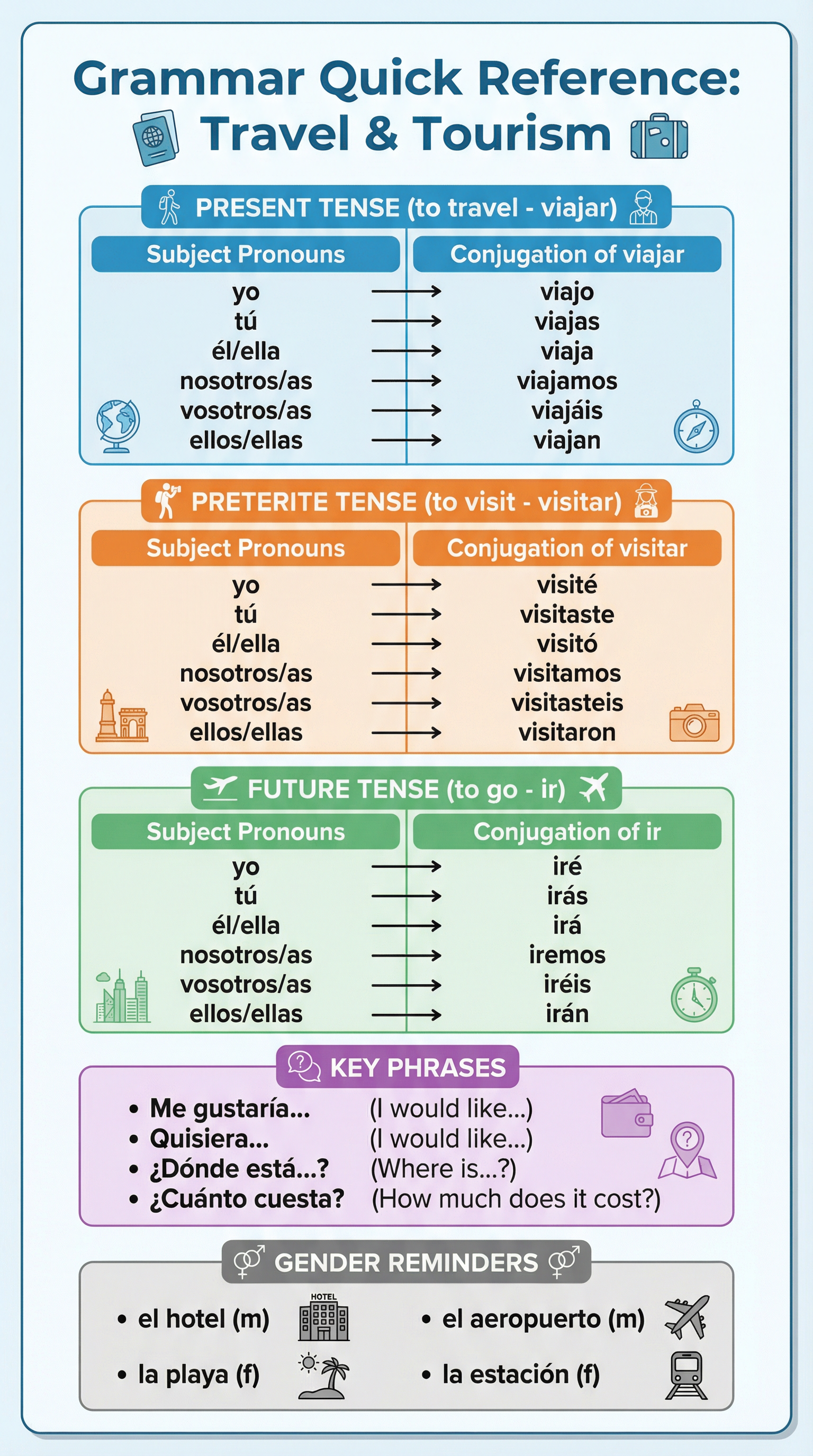
When to use it: For completed actions in the past. This is your go-to tense for describing what you did on holiday. Examiners expect to see this used accurately.
Conjugation Table (Regular -AR verb: viajar)
| Subject | Verb Form | English |
|---|---|---|
| yo | viajé | I travelled |
| tú | viajaste | you travelled |
| él/ella/usted | viajó | he/she/you (formal) travelled |
| nosotros/as | viajamos | we travelled |
| vosotros/as | viajasteis | you (plural, informal) travelled |
| ellos/ellas/ustedes | viajaron | they/you (plural, formal) travelled |
Irregulars to learn: ir (to go) -> fui, fuiste, fue..., hacer (to do) -> hice, hiciste, hizo..., ver (to see) -> vi, viste, vio...
Key Structure 2: The Imperfect Tense (El Pretérito Imperfecto)
When to use it: To describe what things were like in the past (description, weather, feelings) or for repeated/habitual actions. Using this alongside the preterite shows grammatical range.
Conjugation Table (Regular -AR verb: estar)
| Subject | Verb Form | English |
|---|---|---|
| yo | estaba | I was |
| tú | estabas | you were |
| él/ella/usted | estaba | he/she/you (formal) was |
| nosotros/as | estábamos | we were |
| vosotros/as | estabais | you (plural, informal) were |
| ellos/ellas/ustedes | estaban | they/you (plural, formal) were |
Example: Hacía sol y la playa estaba llena de gente. (It was sunny and the beach was full of people.) - This sets the scene.
Key Structure 3: The Simple Future (El Futuro Simple)
When to use it: To talk about what will happen. Essential for answering questions about future holiday plans. Higher-tier candidates should aim to use this instead of just the immediate future (ir a + infinitive).
Conjugation Table (Regular -AR verb: visitar)
| Subject | Verb Form | English |
|---|---|---|
| yo | visitaré | I will visit |
| tú | visitarás | you will visit |
| él/ella/usted | visitará | he/she/you (formal) will visit |
| nosotros/as | visitaremos | we will visit |
| vosotros/as | visitaréis | you (plural, informal) will visit |
| ellos/ellas/ustedes | visitarán | they/you (plural, formal) will visit |
Irregulars to learn: ir -> iré, hacer -> haré, tener -> tendré, salir -> saldré.
🎧 Listening Skills
What to Expect
In the listening exam, travel and tourism questions often involve announcements (at an airport or station), booking accommodation, or people describing their holidays. You will hear the audio twice. Questions can be in English or Spanish.
Listening Strategies
- Predict the content: Before you listen, read the questions and underline key words. What vocabulary do you expect to hear? If the question is about booking a hotel, listen for words like
habitación,reservar,precio,noche. - Listen for cognates and near-cognates: Words like
turista,hotel,aeropuertoare your friends. But be careful of false friends! - Note down key details: Write down any numbers, dates, times, or prices you hear in the margin. You can check them on the second listening.
Common Listening Traps
- Distractors: The audio might mention two different destinations or dates. Listen carefully to identify the correct one. For example, "I was going to go to Madrid, but then I decided to go to Barcelona." The answer is Barcelona.
- Negatives: Listen for
no. "No me gustó el hotel" (I didn't like the hotel) is the opposite of "Me gustó el hotel" (I liked the hotel). It's a small word with a huge impact. - Similar-sounding words: Be careful with words like
catorce(14) andcuarenta(40).
🗣️ Speaking Skills
Role Play Scenarios
Scenario 1: At the tourist office
- You ask for a map of the city. (
Quisiera un mapa de la ciudad, por favor.) - You ask what there is to do. (
¿Qué se puede hacer aquí?) - You ask about museum opening times. (
¿A qué hora abren los museos?) - The examiner says something you don't understand. (
Perdón, no entiendo. ¿Puede repetir, por favor?)
Scenario 2: Booking a hotel room
- You say you want to book a room. (
Quisiera reservar una habitación individual para dos noches.) - You ask how much it costs. (
¿Cuánto cuesta por noche?) - You ask if breakfast is included. (
¿El desayuno está incluido?) - You ask if it has Wi-Fi. (
¿Tiene wifi el hotel?)
Photo Card Practice
Model Photo Card Response (Image of a family on a beach):
- Qu 1 (Description):
En la foto hay una familia en la playa. Parece que hace buen tiempo porque brilla el sol. Los padres están relajándose mientras los niños juegan en la arena.(In the photo there is a family on the beach. It seems like the weather is good because the sun is shining. The parents are relaxing while the children play in the sand.) - Qu 2 (Opinion):
En mi opinión, las vacaciones en la playa son las mejores porque me encanta nadar en el mar y tomar el sol. Son muy relajantes.(In my opinion, beach holidays are the best because I love to swim in the sea and sunbathe. They are very relaxing.) - Qu 3 (Related topic):
Normalmente, voy de vacaciones con mi familia. Solemos ir a España o a Italia porque nos gusta la comida y el buen tiempo.(Normally, I go on holiday with my family. We usually go to Spain or Italy because we like the food and the good weather.) - Qu 4 (Past/Future):
El año pasado, fui a Portugal y lo pasé fenomenal. Hice surf y comí mucho pescado. El año que viene, me gustaría ir a Grecia.(Last year, I went to Portugal and I had a great time. I went surfing and ate a lot of fish. Next year, I would like to go to Greece.) - Qu 5 (Unpredictable):
Si tuviera mucho dinero, daría la vuelta al mundo. Sería una experiencia inolvidable.(If I had a lot of money, I would travel around the world. It would be an unforgettable experience.)
General Conversation Questions
| Question (Spanish) | Model Answer | English Translation |
|---|---|---|
| ¿Adónde fuiste de vacaciones el año pasado? | El año pasado fui a la costa de España con mis amigos. Alquilamos un apartamento cerca de la playa. ¡Fue genial! | Where did you go on holiday last year? |
| ¿Qué te gusta hacer cuando estás de vacaciones? | Me gusta mucho explorar la ciudad y probar la comida local. También me encanta relajarme y no hacer nada. | What do you like to do when you are on holiday? |
| ¿Prefieres las vacaciones en la playa o en la ciudad? | Prefiero las vacaciones en la playa porque son más relajantes. Sin embargo, también me gusta la cultura y la historia de las ciudades. | Do you prefer beach holidays or city holidays? |
| ¿Cómo serían tus vacaciones ideales? | Mis vacaciones ideales serían en un país exótico, como Tailandia. Me alojaría en un hotel de lujo y probaría toda la comida. | What would your ideal holiday be like? |
| ¿Por qué es importante viajar? | Creo que es importante viajar para abrir la mente, conocer otras culturas y aprender sobre el mundo. También es una buena manera de crear recuerdos. | Why is it important to travel? |
✍️ Writing Skills
Translation Practice
English → Spanish:
| English | Spanish | Key Grammar |
|---|---|---|
| Last summer I went to Spain. | El verano pasado fui a España. | Preterite tense of ir. |
| I love to travel because it is fun. | Me encanta viajar porque es divertido. | gustar verbs, justification with porque. |
| We stayed in a hotel that was near the beach. | Nos alojamos en un hotel que estaba cerca de la playa. | Preterite of alojarse, imperfect of estar. |
| Next year I will visit South America. | El año que viene visitaré Sudamérica. | Simple future tense. |
| If I had more money, I would travel more. | Si tuviera más dinero, viajaría más. | Imperfect subjunctive + conditional. |
Extended Writing
Model 90-word response (Foundation):
El verano pasado fui de vacaciones a España con mi familia. Viajamos en avión. Nos alojamos en un hotel en la costa. Hizo buen tiempo y tomé el sol en la playa todos los días. También, nadé en el mar. Por la noche, comimos en restaurantes. Me gustó mucho porque la comida era deliciosa. El año que viene, quiero ir a Italia.
(Translation: Last summer I went on holiday to Spain with my family. We travelled by plane. We stayed in a hotel on the coast. The weather was good and I sunbathed on the beach every day. Also, I swam in the sea. In the evenings, we ate in restaurants. I liked it a lot because the food was delicious. Next year, I want to go to Italy.)
Model 150-word response (Higher):
Para mí, las vacaciones son muy importantes para relajarse. El año pasado, tuve la oportunidad de ir a Barcelona con mis amigos y fue una experiencia inolvidable. Nos alojamos en un albergue juvenil en el centro, lo que era muy conveniente. Durante el día, visitamos los monumentos famosos como la Sagrada Familia y por la tarde, disfrutábamos de la playa. Lo que más me gustó fue la vida nocturna y la gastronomía increíble. Probé las tapas y me encantaron. Si tuviera la oportunidad, volvería sin dudarlo. El año que viene, hemos decidido que iremos a Portugal para aprender a hacer surf. Espero que haga buen tiempo y que sea tan divertido como nuestro viaje a Barcelona. Viajar te abre la mente y te permite crear recuerdos para toda la vida.
(Translation: For me, holidays are very important for relaxing. Last year, I had the opportunity to go to Barcelona with my friends and it was an unforgettable experience. We stayed in a youth hostel in the centre, which was very convenient. During the day, we visited the famous monuments like the Sagrada Familia and in the afternoon, we enjoyed the beach. What I liked most was the nightlife and the incredible gastronomy. I tried tapas and I loved them. If I had the opportunity, I would return without hesitation. Next year, we have decided that we will go to Portugal to learn to surf. I hope the weather is good and that it is as fun as our trip to Barcelona. Travelling opens your mind and allows you to create memories for life.)
Writing Checklist
- ✅ Three tenses used? (Past, Present, Future/Conditional)
- ✅ Opinions with reasons? (
porque,ya que) - ✅ Connectives and conjunctions? (
y,pero,sin embargo,además) - ✅ Adjective agreements correct? (e.g.,
la playa bonita,los hoteles caros) - ✅ Range of vocabulary? (Foundation and Higher tier words)
📚 Reading Skills
Key Strategies
- Skim for gist: Read the text quickly first to get a general idea of what it's about.
- Scan for specific information: Once you've read the questions, scan the text for the key words or phrases you need.
- Deduce meaning from context: You won't know every word. Use the words you DO know to guess the meaning of the ones you don't.
- Look out for negatives and qualifiers: Words like
nunca(never),siempre(always),a veces(sometimes) can change the meaning of a sentence completely.
False Friends & Tricky Words
| Word | Looks Like | Actually Means |
|---|---|---|
| la carpeta | carpet | folder |
| el éxito | exit | success |
| la librería | library | bookshop |
| realizar | to realise | to carry out / to achieve |
| actualmente | actually | currently |
| soportar | to support | to put up with / to bear |
🌍 Cultural Knowledge
Understanding cultural context can enrich your answers, especially in speaking and writing. For Spain, tourism is a massive part of the economy. Many coastal areas, like the Costa del Sol, are heavily developed for tourism. In cities like Barcelona, there has been a debate about 'overtourism'. Mentioning this shows a deeper understanding. Also, be aware of regional differences. The food, climate, and even language can vary hugely between Galicia in the north and Andalusia in the south. Knowing about famous festivals like La Tomatina or San Fermín can also add a great cultural dimension to your work.