
Study Notes

Overview
Cash flow forecasting is a fundamental skill in business management and a topic that AQA examiners scrutinize closely. A cash flow forecast is a forward-looking statement that predicts the cash movements (inflows and outflows) of a business over a future period. It is not just a mathematical exercise; it is a vital tool for decision-making, identifying potential liquidity problems, and ensuring business survival. Candidates are expected to demonstrate precision in constructing forecasts and, crucially, to provide insightful analysis of what the figures mean for the business. High marks are awarded to students who can distinguish between cash and profit, diagnose the causes of cash flow problems, and evaluate the suitability of different solutions within a specific business context. This guide will equip you to tackle calculation and analysis questions with confidence.
The Core Components: Building a Cash Flow Forecast
A cash flow forecast is built from several key components. Mastering these is the first step to earning marks.
1. Cash Inflows
What they are: All sources of cash received by the business. This is the money coming in.
Examples:
- Cash from sales to customers
- Payments from debtors (customers who bought on credit)
- Bank loans received
- Owner's capital investment
- Sale of assets
2. Cash Outflows
What they are: All cash payments made by the business. This is the money going out.
Examples:
- Payments to suppliers for materials
- Rent, rates, and utility bills
- Wages and salaries
- Marketing costs
- Purchasing new equipment (capital expenditure)
- Loan repayments
3. Net Cash Flow
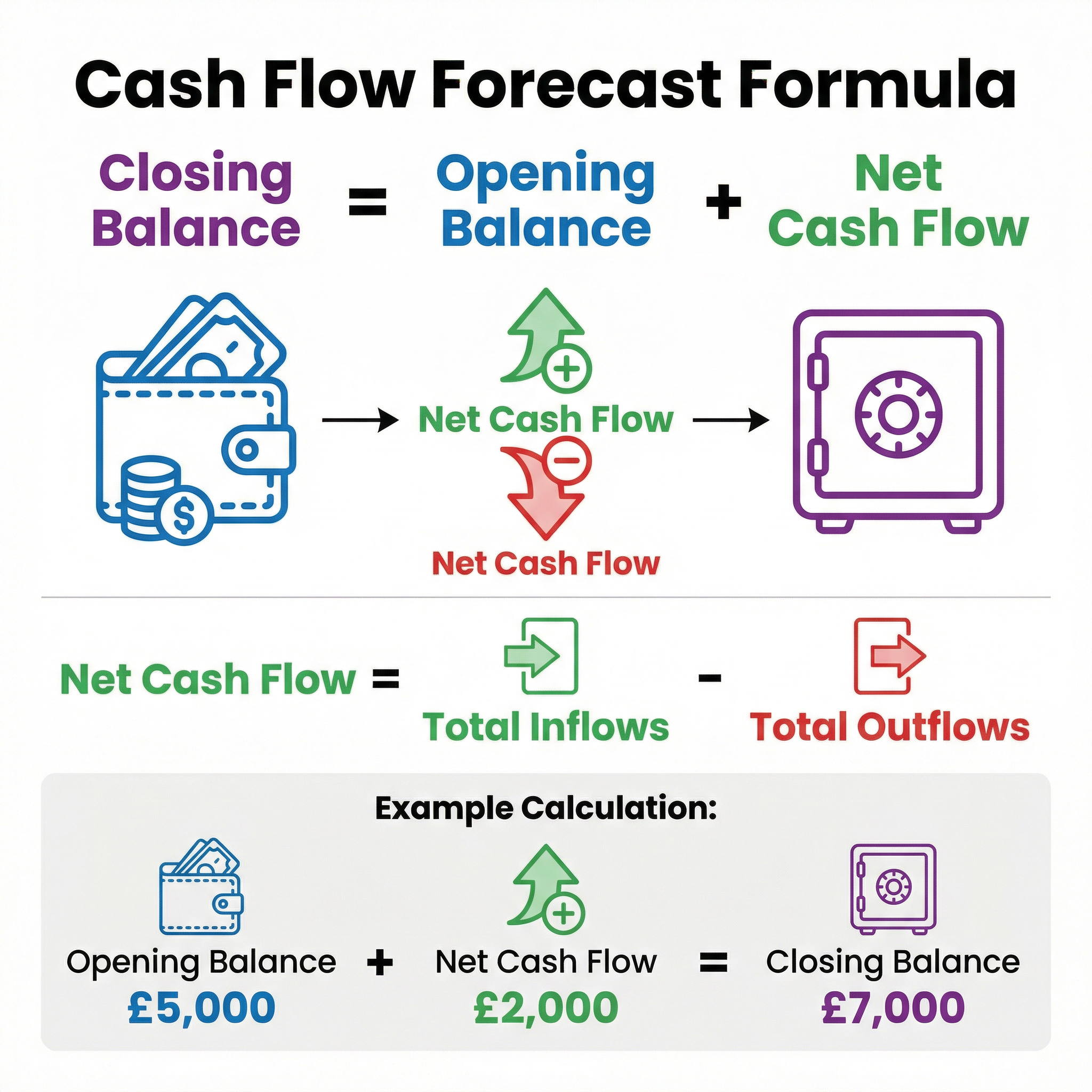
What it is: The difference between total cash inflows and total cash outflows for a specific period.
The Formula: Net Cash Flow = Total Inflows - Total Outflows
A positive net cash flow means more cash came in than went out. A negative net cash flow means the opposite, which can be a warning sign.
4. Opening and Closing Balances
Opening Balance: The amount of cash the business has at the start of the period.
Closing Balance: The amount of cash the business has at the end of the period.
The Crucial Formula: Closing Balance = Opening Balance + Net Cash Flow
Examiner's Tip: The closing balance of one month becomes the opening balance for the next month. Forgetting this is a very common mistake that costs candidates easy marks.
Cash vs. Profit: The Essential Distinction
This is a concept that frequently separates high-achieving candidates from the rest. Examiners love to test this.
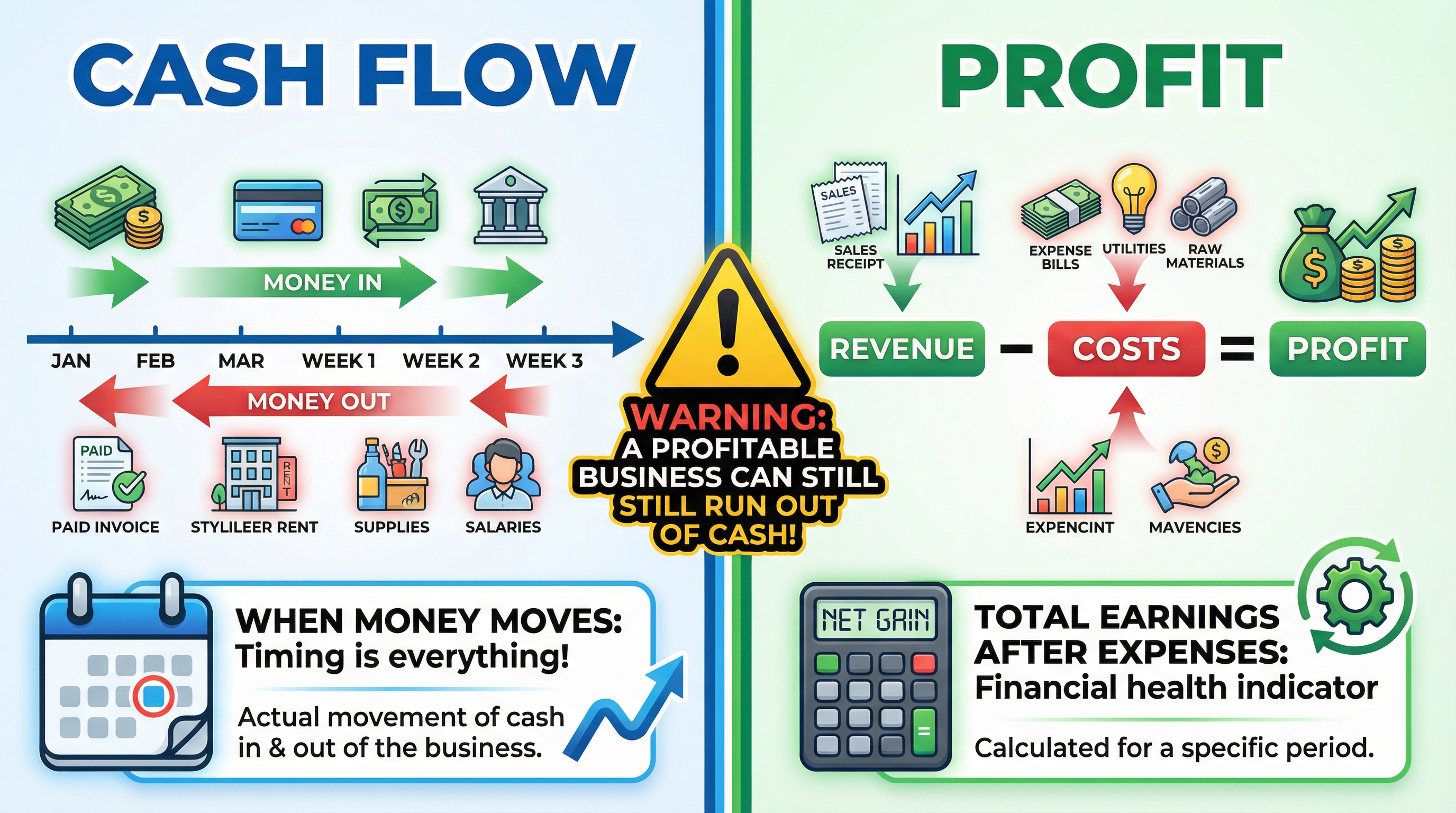
| Feature | Cash Flow | Profit |
|---|---|---|
| What it measures | The actual movement of money in and out of a bank account. | The surplus of revenue over costs (Revenue - Costs). |
| Timing | Records money when it is actually received or paid. | Records sales when they are made, not necessarily when the cash arrives (e.g., credit sales). |
| Focus | Liquidity and the ability to pay bills. | Financial performance and efficiency. |
| Key Question | Can the business survive day-to-day? | Is the business model successful over the long term? |
A business can be highly profitable but still face insolvency if it runs out of cash. For example, if it makes a large credit sale, profit is recorded immediately, but if the customer doesn't pay for 90 days, the business has no cash from that sale to pay its own bills.
The Risk of Insolvency
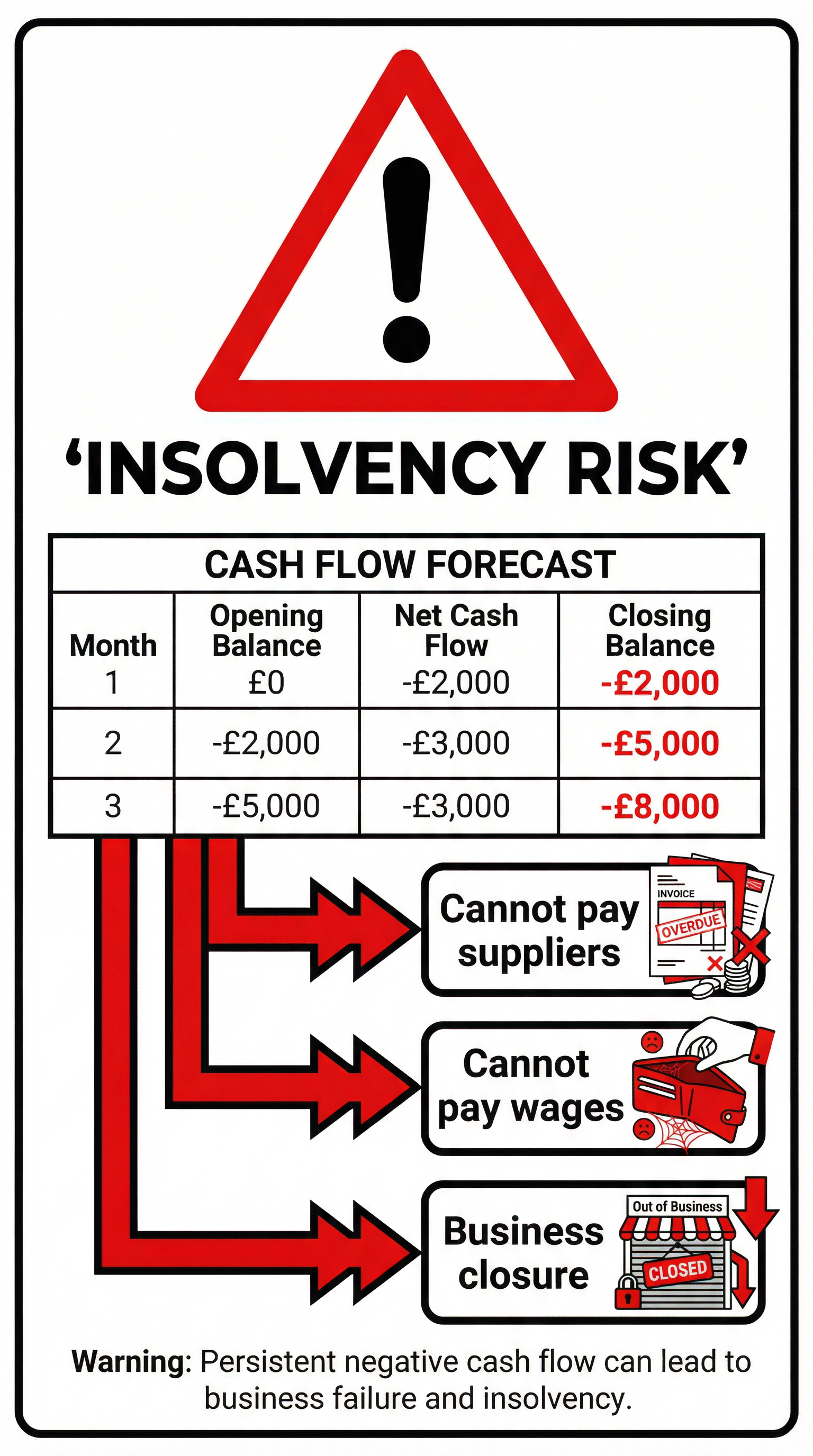
When a business has persistent negative net cash flow and its closing balance becomes negative, it faces a liquidity crisis. If it cannot find the cash to pay its debts (like wages or supplier bills) as they fall due, it is insolvent. This is a primary cause of business failure. Examiners expect you to link a poor cash flow position directly to the risk of insolvency and business failure.
Improving Cash Flow
When a forecast predicts a cash shortfall, the business must act. Candidates need to suggest and evaluate suitable solutions.
Reducing Outflows
- Delay payments to suppliers: Negotiate for longer credit terms.
- Cut costs: Reduce variable costs (e.g., find cheaper suppliers) or fixed costs (e.g., move to cheaper premises).
- Lease instead of buy: Leasing assets reduces large initial cash outflows.
- Reduce stock levels: Less cash is tied up in inventory (only for businesses holding stock).
Increasing Inflows
- Chase debtors: Encourage customers who owe money to pay faster.
- Increase sales: Run a promotion to boost cash sales.
- Arrange an overdraft: A short-term, flexible loan from the bank to cover temporary shortfalls.
- Factoring: Sell invoices (debtors) to a factoring company for immediate cash, though at a discount.
- Sell surplus assets: Generate cash from assets the business no longer needs.