Study Notes
Overview
Welcome to your deep dive into one of the most crucial skills for Edexcel GCSE Business (1BS0): Evaluating Business Decisions. This topic is not just about knowing business theory; it's about applying it like a real-world consultant to weigh up options, analyse data, and make a final, justified judgement. Examiners are looking for candidates who can move beyond simple descriptions and construct a well-reasoned argument that considers multiple perspectives. Mastery in this area is what separates a good answer from a great one, particularly in the high-stakes 9-mark 'Justify' and 12-mark 'Evaluate' questions. This guide will equip you with the frameworks, techniques, and confidence to tackle any decision-making scenario the exam throws at you, showing you how to build chains of reasoning, use context effectively, and structure your answers for maximum credit.
Key Concepts for Evaluation
The Role of Assessment Objectives (AOs)
Understanding how marks are awarded is the first step to winning them. For evaluation questions, the marks are split across three AOs:
- AO1: Knowledge (35%): Demonstrating your understanding of business concepts, terms, and theories.
- AO2: Application (35%): Applying your knowledge to the specific business context provided in the case study. This is vital – generic answers are heavily penalised.
- AO3: Analysis and Evaluation (30%): Developing logical chains of reasoning to explore the causes, consequences, and trade-offs of a decision, leading to a substantiated judgement.
Building Chains of Reasoning: The BLT Framework
Examiners want to see developed arguments. The most effective way to achieve this is by using the BLT (Because, Leading to, Therefore) framework. This structure ensures your points are not just stated but are fully explained, linking a cause to its effect and ultimate consequence for the business.
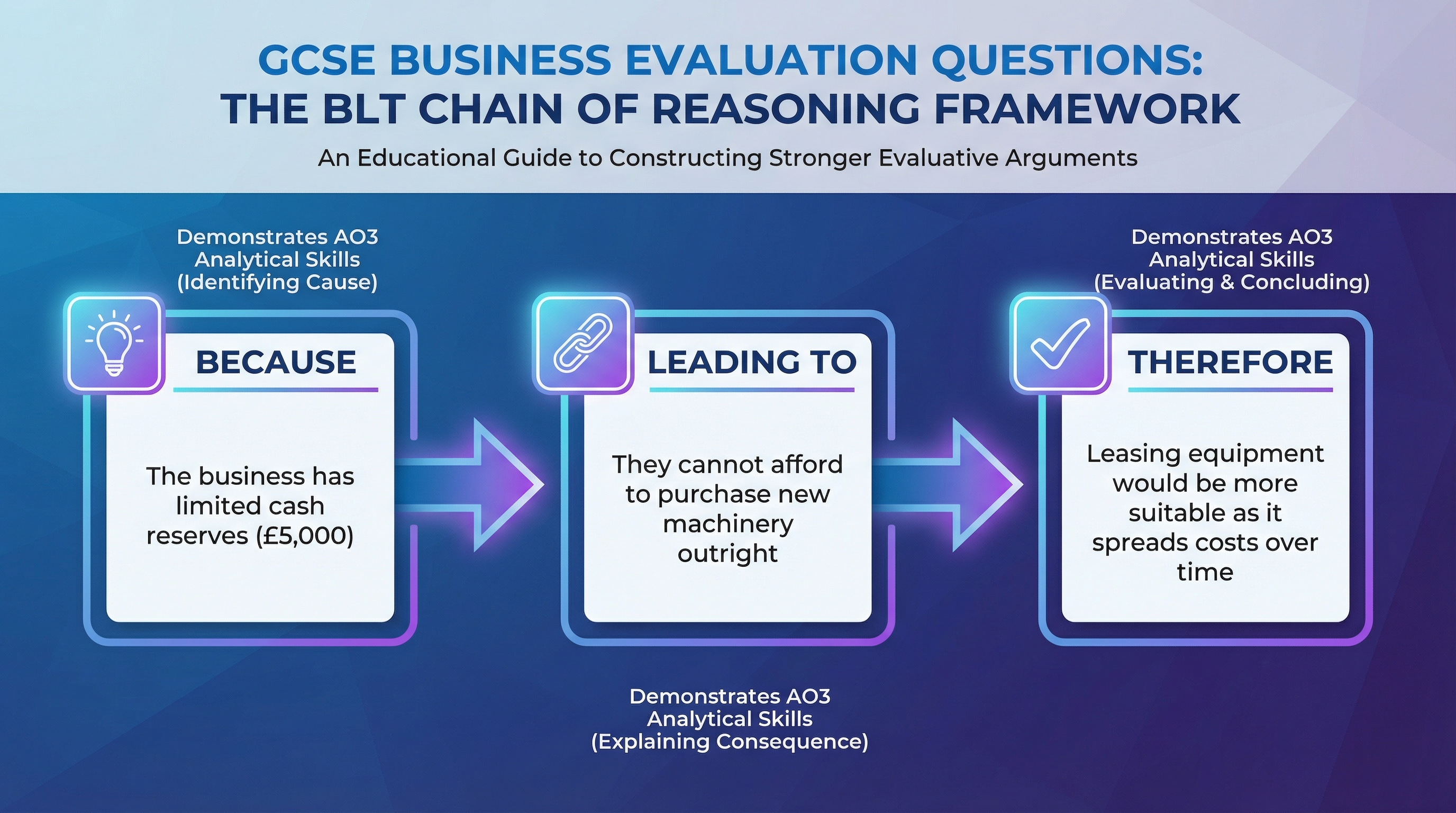
- Because: Start with a piece of evidence or a reason, often taken directly from the case study (AO2).
- Leading to: Explain the immediate impact or effect of that reason (AO3 Analysis).
- Therefore: Conclude with the overall consequence or implication for the business, linking back to the question (AO3 Evaluation).
Integrating Quantitative Skills (QS)
Where a case study provides numerical data (e.g., revenue, costs, market share), you MUST use it to support your arguments. Higher-level candidates go a step further by performing calculations. For instance, if given revenue and profit figures, calculate the profit margin. If given sales data over two years, calculate the percentage change. This is a powerful way to demonstrate deep application (AO2) and analysis (AO3).
Command Word Strategy
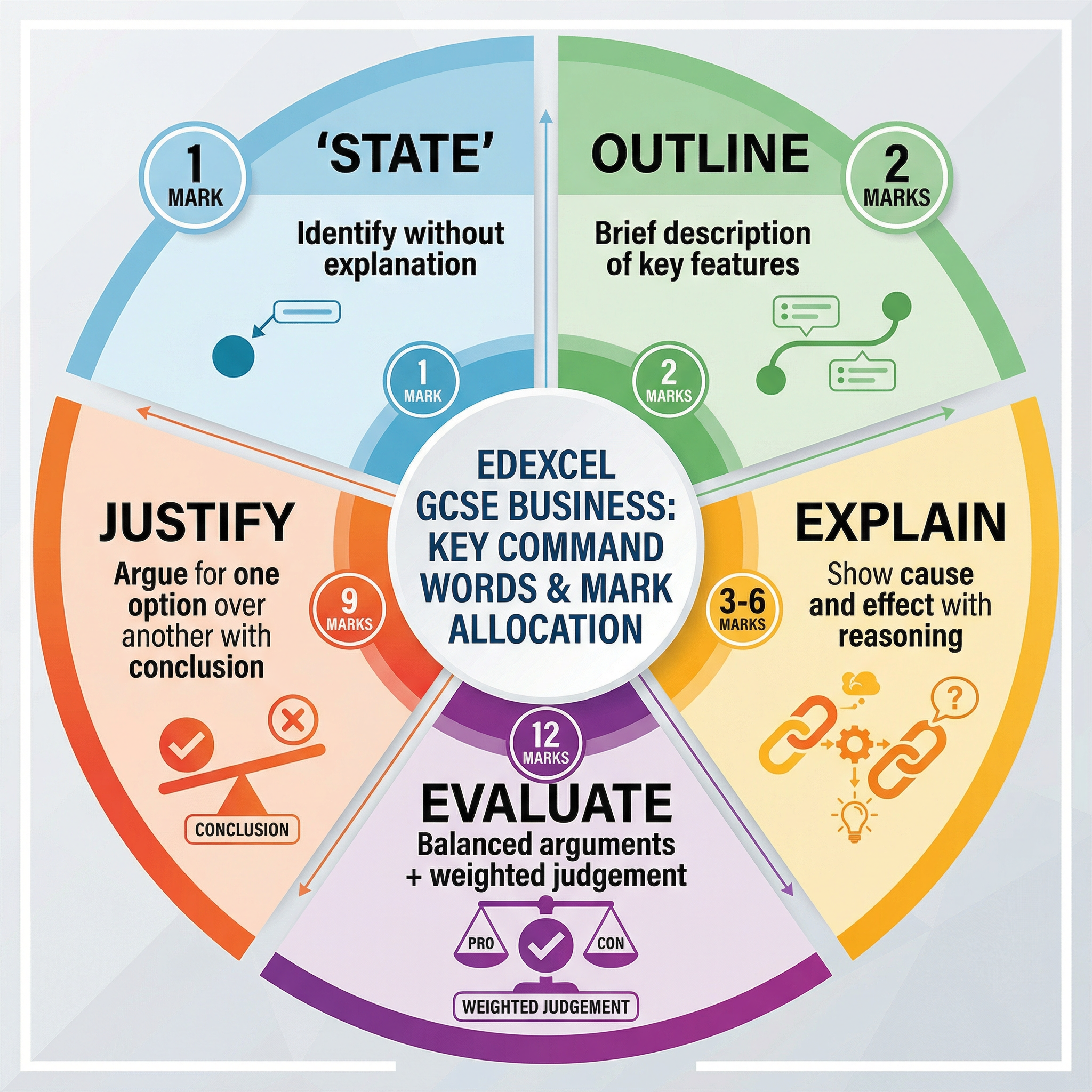
Not all questions are created equal. Understanding the command word is essential for pitching your answer correctly and managing your time. Here is a breakdown of the key command words you will encounter.
Answer Structure for High-Mark Questions
Justify Questions (9 Marks)
The goal is to argue for one option over another. A good structure is:
- Argument for Option 1: A developed paragraph using the BLT framework and context.
- Argument for Option 2 (or Counter-Argument): A second developed paragraph analysing the alternative.
- Decisive Conclusion: A final paragraph that weighs up the two arguments and makes a clear, justified choice. You must commit to one option.
Evaluate Questions (12 Marks)
This requires a more balanced approach, culminating in a nuanced judgement. Use the following four-part structure:
{{asset:evaluation_structure.png