Technology in Business — AQA GCSE study guide illustration

    Technology in Business

    AQA
    GCSE
    Business

    Technology is the engine of modern business, transforming how companies operate, market their products, and manage their people. This guide breaks down exactly what you need to know about E-commerce, automation, and remote working to secure top marks in your AQA GCSE Business exam, focusing on the critical analysis and evaluation skills examiners are looking for.

    5
    Min Read
    3
    Examples
    5
    Questions
    6
    Key Terms
    🎙 Podcast Episode
    Technology in Business
    0:00-0:00

    Study Notes

    Header image for Technology in Business

    Overview

    Technology is a recurring and vital theme in the AQA GCSE Business specification. Examiners expect candidates to move beyond generic statements and demonstrate a clear understanding of how specific technologies impact the functional areas of a business: Marketing, Operations, and Human Resources. This involves analysing the trade-off between the high initial fixed costs of investment and the potential for long-term efficiency gains, such as lower unit costs and improved quality. A strong answer must always be grounded in the context of the business provided in the exam Item, showing a clear chain of reasoning (AO2 and AO3) that links a technological change to its ultimate impact on business objectives like profit, competitiveness, and growth. This guide will equip you with the specific terminology, analytical frameworks, and evaluation skills needed to confidently tackle any question on this topic.

    Podcast: AQA GCSE Business - Technology in Business

    Key Technological Applications

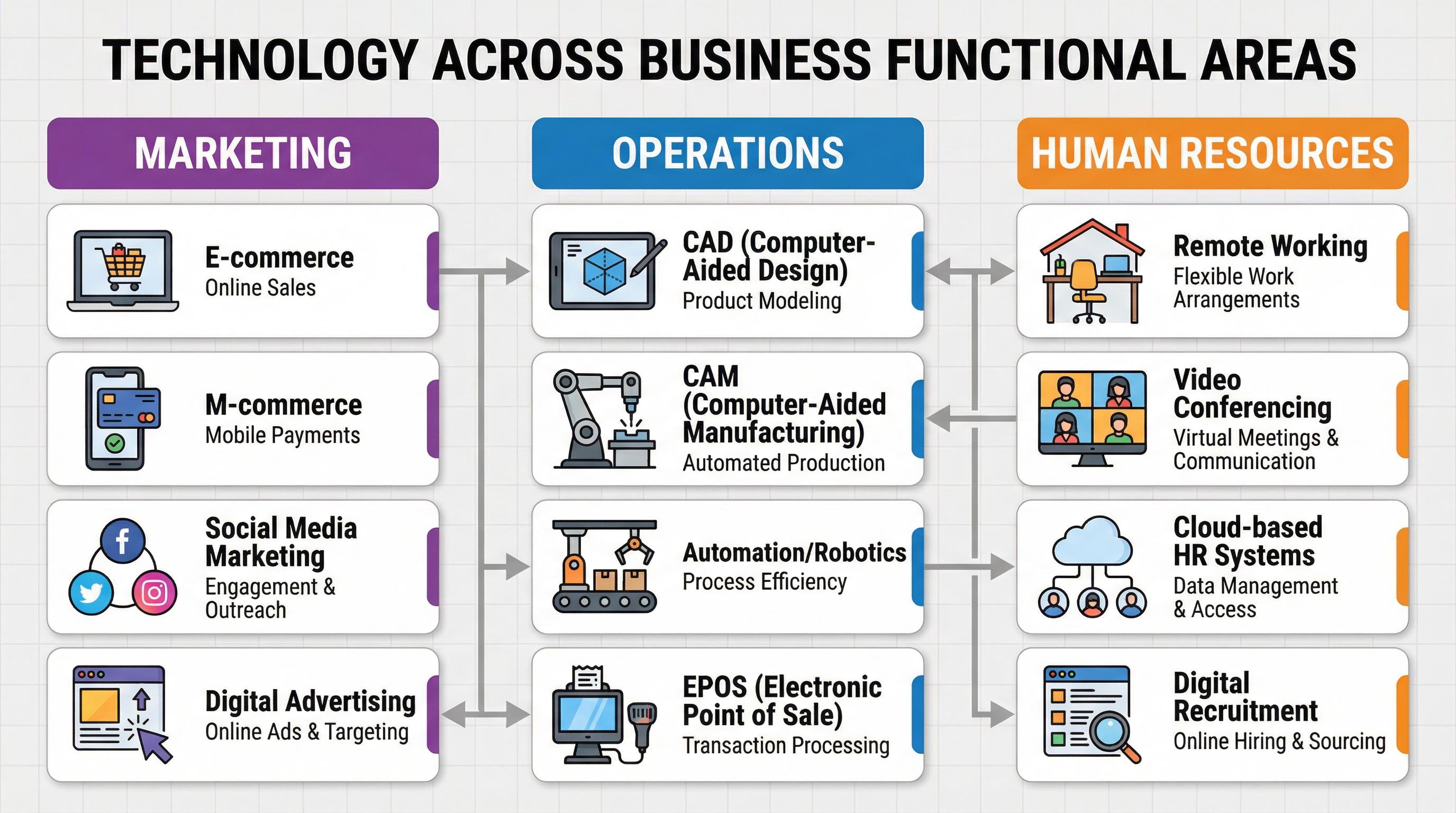
    Marketing Technology

    What it is: This area focuses on how businesses use technology to identify, anticipate, and satisfy customer needs more effectively. The two core technologies are E-commerce and M-commerce, supplemented by digital marketing techniques.

    • E-commerce: The use of online platforms (websites) to sell products to a national or even global market, 24/7. This drastically reduces the need for expensive physical stores.
    • M-commerce: A subset of e-commerce, focusing on transactions made through mobile devices like smartphones and tablets, often via dedicated apps.
    • Digital Marketing: Includes social media campaigns, search engine optimisation (SEO), and targeted online advertising to reach specific customer demographics.

    Why it matters: For the exam, you must link these technologies to marketing objectives. For example, e-commerce increases the potential market size (Place), while targeted social media adverts make promotional spending more efficient (Promotion).
    Technology Across Business Functional Areas

    Operations Technology

    What it is: This involves the use of machinery and computer systems to improve the production process. Key examples include CAD, CAM, and automation.

    • CAD (Computer-Aided Design): Software used to create detailed 2D or 3D models of products before they are made. This allows for rapid prototyping and testing, reducing waste.
    • CAM (Computer-Aided Manufacturing): The use of computers to control the machinery that manufactures the product, such as robotic arms on a production line.
    • Automation/Robotics: The wholesale replacement of human labour with machinery, leading to a highly capital-intensive production process. This results in high speed, precision, and consistency.
    • EPOS (Electronic Point of Sale): Computerised tills that automatically update stock levels when a sale is made, providing real-time sales and stock data.

    Why it matters: Credit is given for explaining how these technologies lead to greater efficiency. For example, CAM leads to lower variable costs per unit, improved quality consistency, and faster production times. EPOS improves cash flow by optimising stock levels.

    Human Resources (HR) Technology

    What it is: This concerns the use of technology to manage employees and working practices.

    • Remote Working: The practice of employees working from home, enabled by cloud computing, collaboration software (e.g., Microsoft Teams), and video conferencing.
    • Cloud-Based Systems: Software that allows for shared access to files and data from any location, facilitating flexible working.

    Why it matters: Candidates should analyse the costs and benefits. Remote working can reduce a business's overhead costs (e.g., rent on office space) and potentially increase employee motivation. However, it can also create challenges in terms of communication, monitoring productivity, and maintaining a strong team culture.

    Second-Order Concepts: The Core Trade-Off

    Cost vs. Benefit

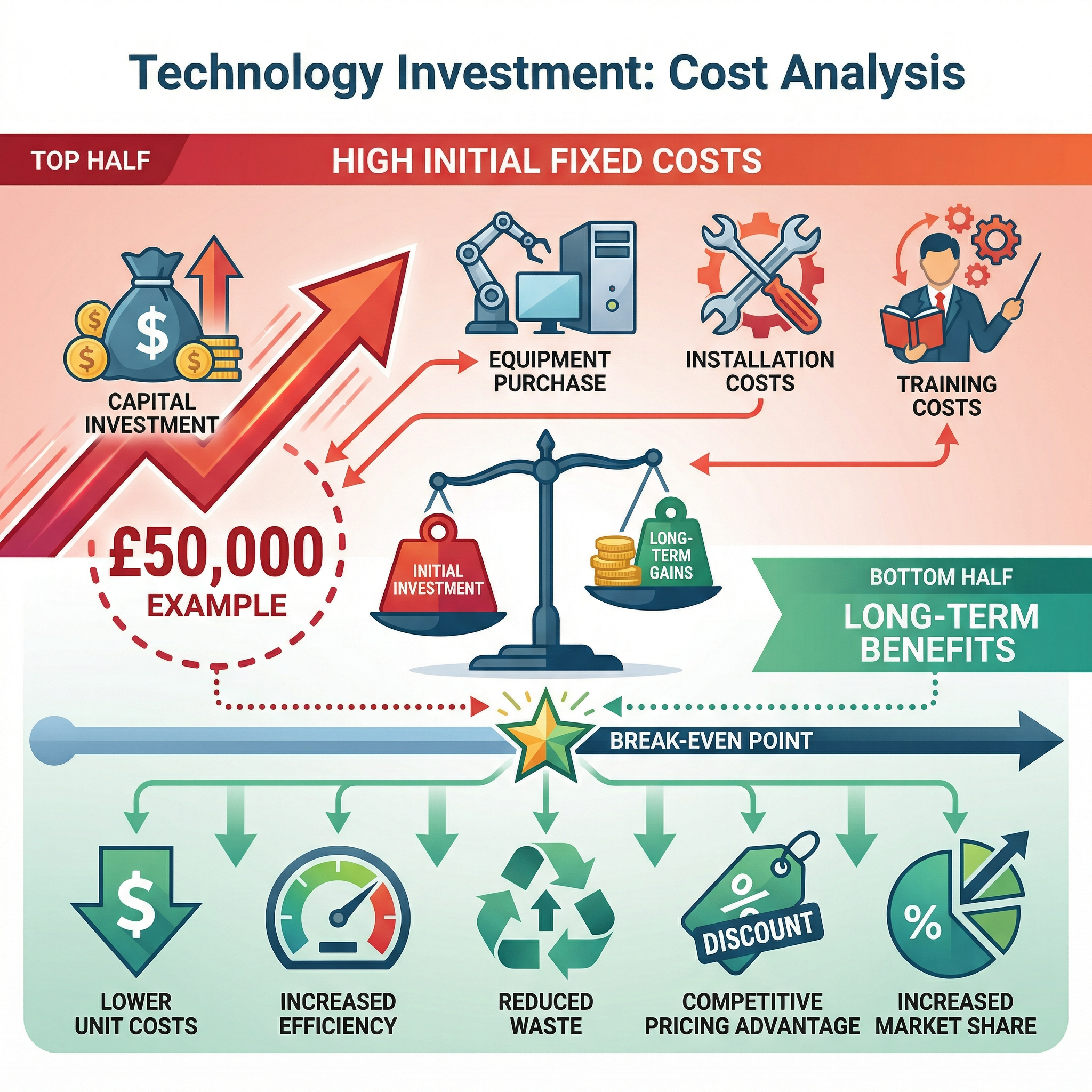
    At the heart of every technology question is a financial trade-off. Investing in technology almost always involves high initial fixed costs (e.g., buying the equipment, installation, training) but offers the promise of long-term benefits (e.g., lower variable costs, higher productivity, less waste). Evaluation questions (12 marks) require you to weigh these up in the context of the specific business. A small business with limited cash reserves will view this trade-off very differently from a large multinational corporation.
    Technology Investment: Cost Analysis

    Impact on Stakeholders

    Technology impacts various stakeholder groups:

    • Owners/Shareholders: Benefit from increased profitability and long-term growth.
    • Employees: May face redundancy due to automation, or benefit from flexible working arrangements. They may also require retraining.
    • Customers: Often benefit from lower prices, better quality products, and the convenience of e-commerce.

    Worked Examples

    3 detailed examples with solutions and examiner commentary

    Practice Questions

    Test your understanding — click to reveal model answers

    Q1

    Analyse how a clothing retailer could use e-commerce to increase its sales. (9 marks)

    9 marks
    standard

    Hint: Think about the limitations of a physical store. How does an online store overcome these? Develop two separate points.

    Q2

    Explain two drawbacks of a business relying on automation in its production process. (6 marks)

    6 marks
    standard

    Hint: Consider the costs and what happens if something goes wrong.

    Q3

    Explain one benefit and one drawback of a business allowing its employees to work from home. (4 marks)

    4 marks
    easy

    Hint: Think from the perspective of the business - costs and control.

    Q4

    To what extent is the high cost of investment the main barrier for a small business when adopting new technology? (12 marks)

    12 marks
    hard

    Hint: This is an evaluation question. Argue that cost IS the main barrier, then argue that OTHER factors can also be significant barriers. Come to a justified conclusion.

    Q5

    Analyse the impact of EPOS technology on a supermarket. (9 marks)

    9 marks
    standard

    Hint: Think about stock and customers. Develop two clear points.

    Key Terms

    Essential vocabulary to know

    More Business Study Guides

    View all

    Problems of growth

    WJEC
    GCSE

    This guide dissects the critical challenges businesses face during expansion, a key topic for WJEC GCSE Business. It moves beyond the simple idea that 'growth is good' to explore the real-world problems of diseconomies of scale and overtrading, providing the analytical skills needed to secure top marks.

    The role of technology in production

    OCR
    GCSE

    This study guide provides a comprehensive, exam-focused breakdown of the role of technology in production for OCR GCSE Business (J204). It moves beyond generic statements to deliver the specific analysis, evaluation, and contextual understanding required to achieve top marks.

    Extended Writing (Arguments, Judgements, Recommendations)

    Edexcel
    GCSE

    This study guide is your key to mastering the high-stakes extended writing questions in Edexcel GCSE Business. We'll deconstruct the 9-mark 'Justify' and 12-mark 'Evaluate' questions, giving you the examiner's perspective on how to build arguments, apply context, and make winning judgements to secure top marks.

    Evaluating Business Decisions

    Edexcel
    GCSE

    Master the art of making justified business decisions and ace your Edexcel GCSE Business exam. This guide breaks down the essential evaluation skills, from building powerful arguments to securing top marks in 12-mark questions, turning complex scenarios into a clear path to success.

    Making Operational Decisions

    Edexcel
    GCSE

    Making Operational Decisions is the practical heart of business operations, where candidates learn how businesses balance cost, quality, and speed to deliver goods and services. This topic is critical for Edexcel exams because it demands application to real business contexts and evaluation of trade-offs—skills that secure AO2 and AO3 marks worth 65% of your grade.

    Setting business aims and objectives

    OCR
    GCSE

    Setting business aims and objectives is the foundation of strategic planning and operational success. This topic explores how businesses translate broad ambitions into measurable targets using SMART criteria, how objectives vary by ownership type and life cycle stage, and how financial goals often conflict with non-financial priorities. Mastering this distinction is essential for exam success, as OCR examiners consistently reward candidates who apply context-specific objectives and demonstrate analytical chains of reasoning.