
Interpreting Business Data — Edexcel GCSE study guide illustration

    Interpreting Business Data

    Edexcel
    GCSE
    Business

    Mastering the art of interpreting business data is your secret weapon for top marks in Edexcel GCSE Business. This guide will transform you from a data describer into a data analyst, showing you how to use financial and market information to make powerful, context-rich arguments that examiners love.

    5
    Min Read
    3
    Examples
    5
    Questions
    6
    Key Terms
    🎙 Podcast Episode
    Interpreting Business Data
    0:00-0:00

    Study Notes

    Header image for Interpreting Business Data.

    Overview

    Interpreting business data is a fundamental skill for Edexcel GCSE Business (1BS0). It's not just about reading numbers; it's about understanding the story they tell about a business's performance, its position in the market, and its future prospects. Examiners are looking for candidates who can move beyond simple descriptions (AO1) to perform calculations (AO2) and, crucially, analyse the data in context to explain its consequences and support judgements (AO3). This involves handling both quantitative (numerical) and qualitative (descriptive) data, from financial statements to customer feedback. A strong response will always link the data directly to the specific business in the case study, explaining the implications of the trends and figures identified. For example, simply stating 'sales have increased' will earn minimal credit. A top-level response would state, 'The 15% increase in sales revenue for business X in the last quarter, likely driven by their recent social media campaign, will increase their gross profit, allowing for greater potential reinvestment into stock.

    Podcast: Mastering Business Data Interpretation.

    Key Data Types

    Quantitative Data

    What it is: Numerical data that can be measured. This is the backbone of business decision-making.

    Why it matters: It provides objective, measurable evidence of performance. Examiners expect you to be confident in calculating and interpreting this data.

    Specific Knowledge: You must know key financial data points like Revenue, Cost of Sales, Gross Profit, and Net Profit. You also need to be fluent in calculating and interpreting financial ratios and understanding data presented in charts and graphs.
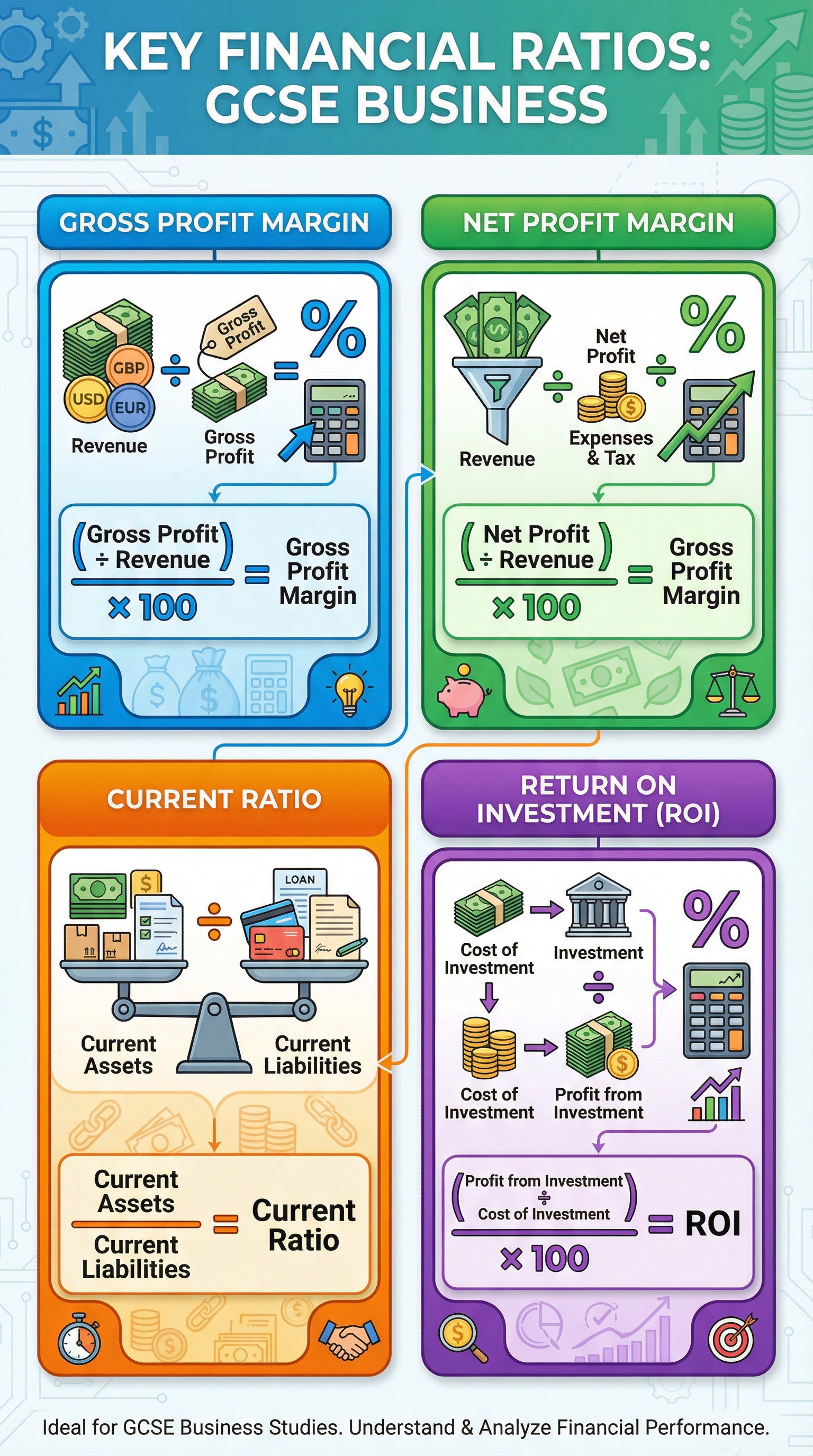
    Key Financial Ratios for GCSE Business.

    Qualitative Data

    What it is: Descriptive, non-numerical data, often based on opinions, attitudes, and beliefs.

    Why it matters: It provides the 'why' behind the numbers. It can reveal customer satisfaction, brand perception, and market trends that numbers alone cannot.

    Specific Knowledge: Examples include customer comments, focus group transcripts, and interview responses. When using qualitative data, examiners want you to consider its reliability – is it just one person's opinion, or a representative view? This shows evaluative skill.

    Second-Order Concepts

    Causation

    Data interpretation is about finding the cause behind a trend. If profit has fallen, was it due to rising costs (internal cause) or a new competitor (external cause)? Your analysis must connect the 'what' with the 'why'.

    Consequence

    Once you've identified a trend, you must explain its effect on the business. A falling Gross Profit Margin has the consequence of reducing the funds available for paying expenses, which could threaten the business's net profitability and long-term survival.

    Change & Continuity

    Track data over time. Has performance improved, worsened, or stayed the same? A single data point is a snapshot; a series of data points reveals a trend, which is far more useful for analysis and is a skill examiners reward.

    Significance

    How important is a piece of data? A 2% increase in sales for a multi-million-pound business is highly significant in monetary terms, whereas a 50% increase for a small start-up might be less significant in absolute terms but shows a strong growth trajectory. You must assess the data's importance in the given context.

    Source Skills

    When presented with a chart, table, or graph, use the following approach:

    1. Identify: What does the source show? What are the units? What is the time period?
    2. Calculate: Are there any calculations you can perform? Percentage changes, differences, or key ratios?
    3. Analyse: What is the main trend or pattern? Are there any anomalies?
    4. Contextualise: How does this data relate to the business in the case study? What does it mean for them?
    5. Evaluate: How reliable is this data? Is the sample size mentioned? Is it recent? This is crucial for hitting the top marks in evaluation questions.
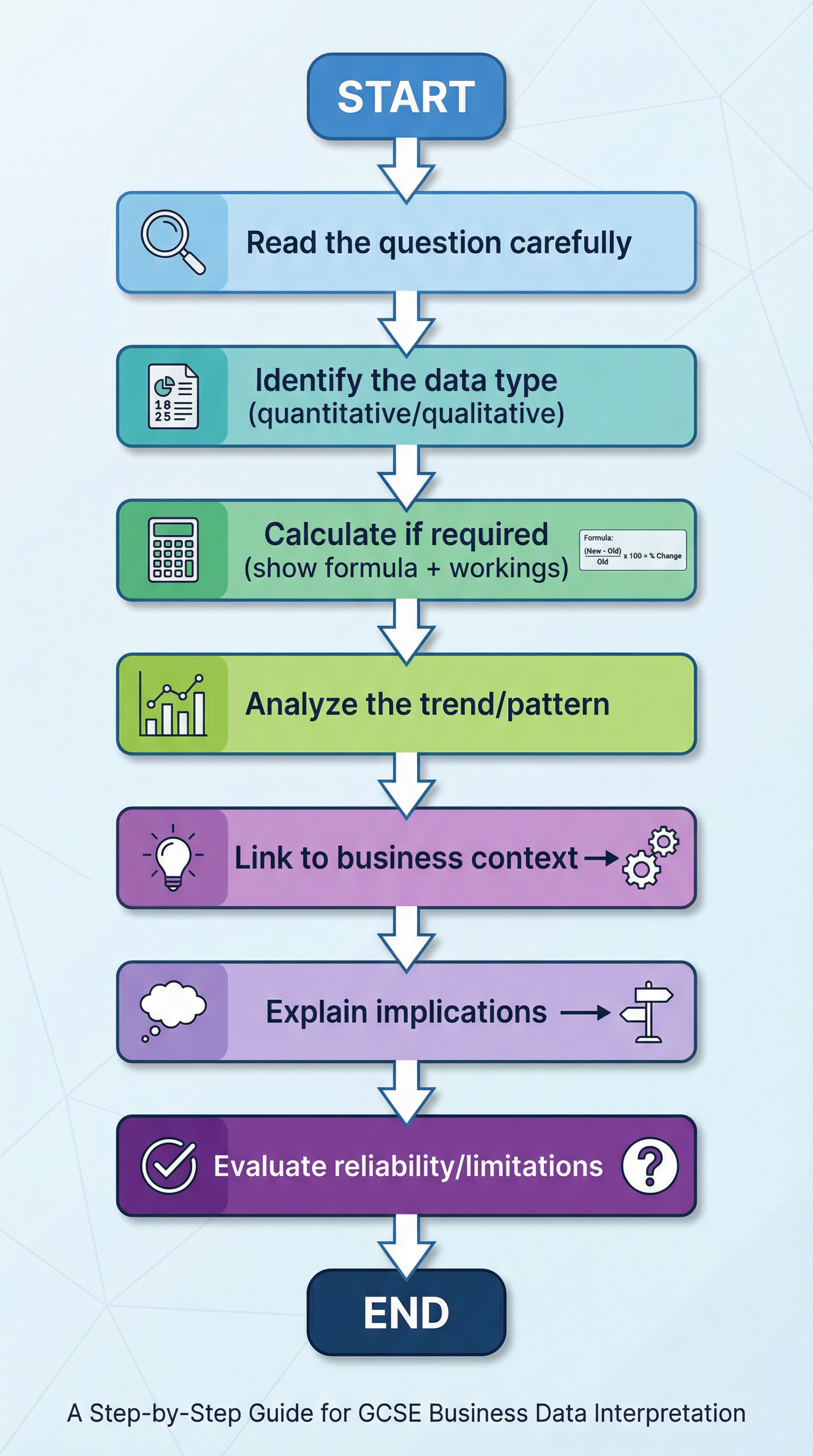
    A Step-by-Step Guide for GCSE Business Data Interpretation.

    Worked Examples

    3 detailed examples with solutions and examiner commentary

    Practice Questions

    Test your understanding — click to reveal model answers

    Q1

    A business sold 10,000 units at £5 each. The cost of sales was £20,000. Calculate the Gross Profit. (2 marks)

    2 marks
    standard

    Hint: First calculate the total revenue.

    Q2

    Explain one reason why a business might want to analyse its sales data from the last three years. (3 marks)

    3 marks
    standard

    Hint: Think about what trends the data might show.

    Q3

    Analyse the usefulness of market research data for a business that wants to launch a new product. (6 marks)

    6 marks
    hard

    Hint: Think about what market research can and cannot tell a business.

    Q4

    A business has a Net Profit of £40,000 and Revenue of £500,000. Calculate the Net Profit Margin. (2 marks)

    2 marks
    standard

    Hint: Use the formula: (Net Profit / Revenue) x 100.

    Q5

    Evaluate the importance of financial data compared to non-financial data when assessing a business's performance. (9 marks)

    9 marks
    hard

    Hint: Consider what each type of data tells you and what it misses. Make a judgement on which is more important.

    Key Terms

    Essential vocabulary to know

    More Business Study Guides

    View all

    Problems of growth

    WJEC
    GCSE

    This guide dissects the critical challenges businesses face during expansion, a key topic for WJEC GCSE Business. It moves beyond the simple idea that 'growth is good' to explore the real-world problems of diseconomies of scale and overtrading, providing the analytical skills needed to secure top marks.

    The role of technology in production

    OCR
    GCSE

    This study guide provides a comprehensive, exam-focused breakdown of the role of technology in production for OCR GCSE Business (J204). It moves beyond generic statements to deliver the specific analysis, evaluation, and contextual understanding required to achieve top marks.

    Extended Writing (Arguments, Judgements, Recommendations)

    Edexcel
    GCSE

    This study guide is your key to mastering the high-stakes extended writing questions in Edexcel GCSE Business. We'll deconstruct the 9-mark 'Justify' and 12-mark 'Evaluate' questions, giving you the examiner's perspective on how to build arguments, apply context, and make winning judgements to secure top marks.

    Evaluating Business Decisions

    Edexcel
    GCSE

    Master the art of making justified business decisions and ace your Edexcel GCSE Business exam. This guide breaks down the essential evaluation skills, from building powerful arguments to securing top marks in 12-mark questions, turning complex scenarios into a clear path to success.

    Making Operational Decisions

    Edexcel
    GCSE

    Making Operational Decisions is the practical heart of business operations, where candidates learn how businesses balance cost, quality, and speed to deliver goods and services. This topic is critical for Edexcel exams because it demands application to real business contexts and evaluation of trade-offs—skills that secure AO2 and AO3 marks worth 65% of your grade.

    Setting business aims and objectives

    OCR
    GCSE

    Setting business aims and objectives is the foundation of strategic planning and operational success. This topic explores how businesses translate broad ambitions into measurable targets using SMART criteria, how objectives vary by ownership type and life cycle stage, and how financial goals often conflict with non-financial priorities. Mastering this distinction is essential for exam success, as OCR examiners consistently reward candidates who apply context-specific objectives and demonstrate analytical chains of reasoning.