Study Notes

Overview
Investment appraisal is the process of analysing the financial viability of a potential investment or project. For WJEC A-Level Business candidates, this is a cornerstone of financial management, testing your ability to handle quantitative data (AO2) and use it to build a persuasive business case (AO3 and AO4). Examiners are looking for more than just correct calculations; they want to see that you understand the strategic implications of each method. This means not only knowing the formulas but also appreciating the strengths and weaknesses of Payback, Accounting Rate of Return (ARR), and Net Present Value (NPV). A strong candidate can confidently recommend a course of action, justifying their choice by weighing the quantitative results against crucial qualitative factors like brand image, market risk, and corporate objectives. This guide will equip you with the skills to move beyond simple calculation and into the realm of strategic financial analysis.
Key Investment Appraisal Methods
1. Payback Period
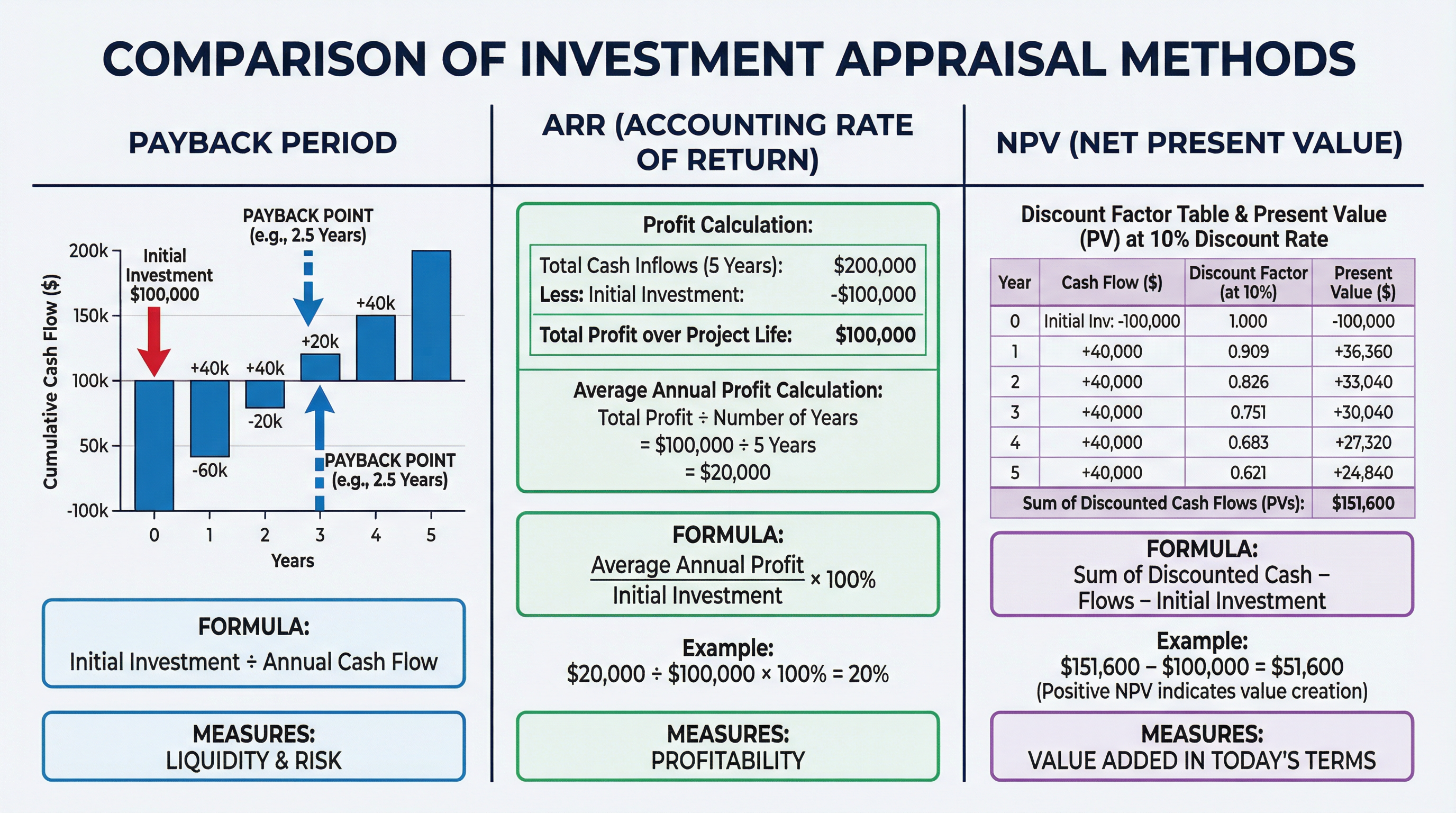
What it is: The Payback Period is the simplest method of investment appraisal. It measures the time required for the cash inflows from a project to equal the initial investment. It is a measure of how quickly a project will return the money invested in it.
Why it matters: This method is a key indicator of liquidity and risk. A shorter payback period means the business's capital is at risk for a shorter time, and the funds are returned more quickly, ready to be used for other purposes. Examiners expect candidates to use the Payback result to comment on the speed of return and the associated risk exposure.
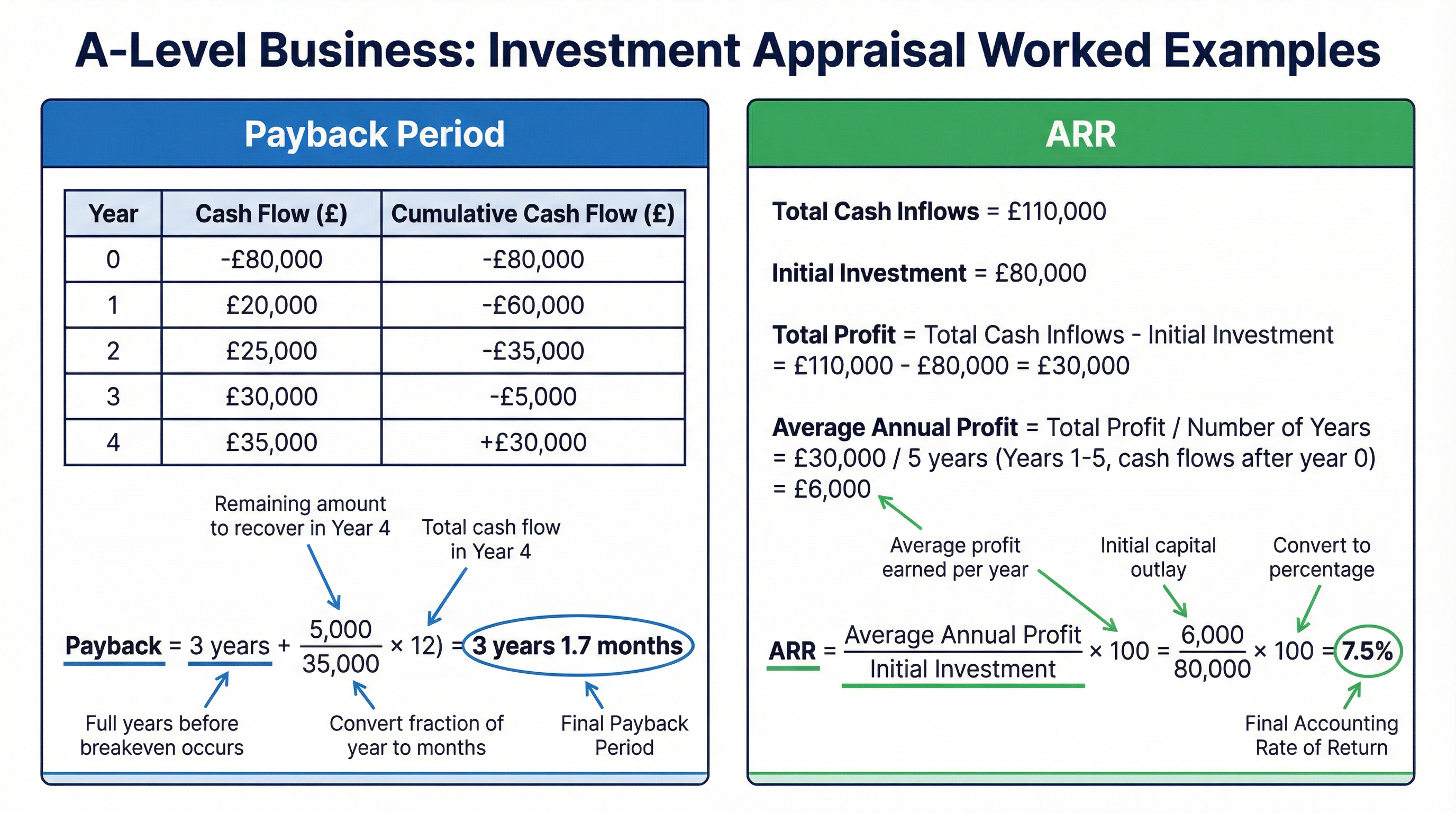
Specific Knowledge: You must be able to calculate payback for projects with both even and uneven cash flows. For uneven flows, you'll need to calculate the cumulative cash flow year by year until the initial investment is recovered.
2. Accounting Rate of Return (ARR)
What it is: ARR calculates the average annual profit of a project as a percentage of the initial investment. The formula is: (Average Annual Profit / Initial Investment) x 100%.
Why it matters: ARR provides a measure of profitability. It allows for a direct comparison with a target rate of return set by the business or with the returns available from other investments, such as interest from a bank. It helps to answer the question: 'Is the profit from this project better than what we could get elsewhere?'
Specific Knowledge: A very common mistake is to forget to deduct the initial capital outlay from the total cash inflows when calculating the total profit. Remember: Total Profit = Total Cash Inflows - Initial Investment. You then divide this by the project's lifespan to find the average annual profit.
3. Net Present Value (NPV)
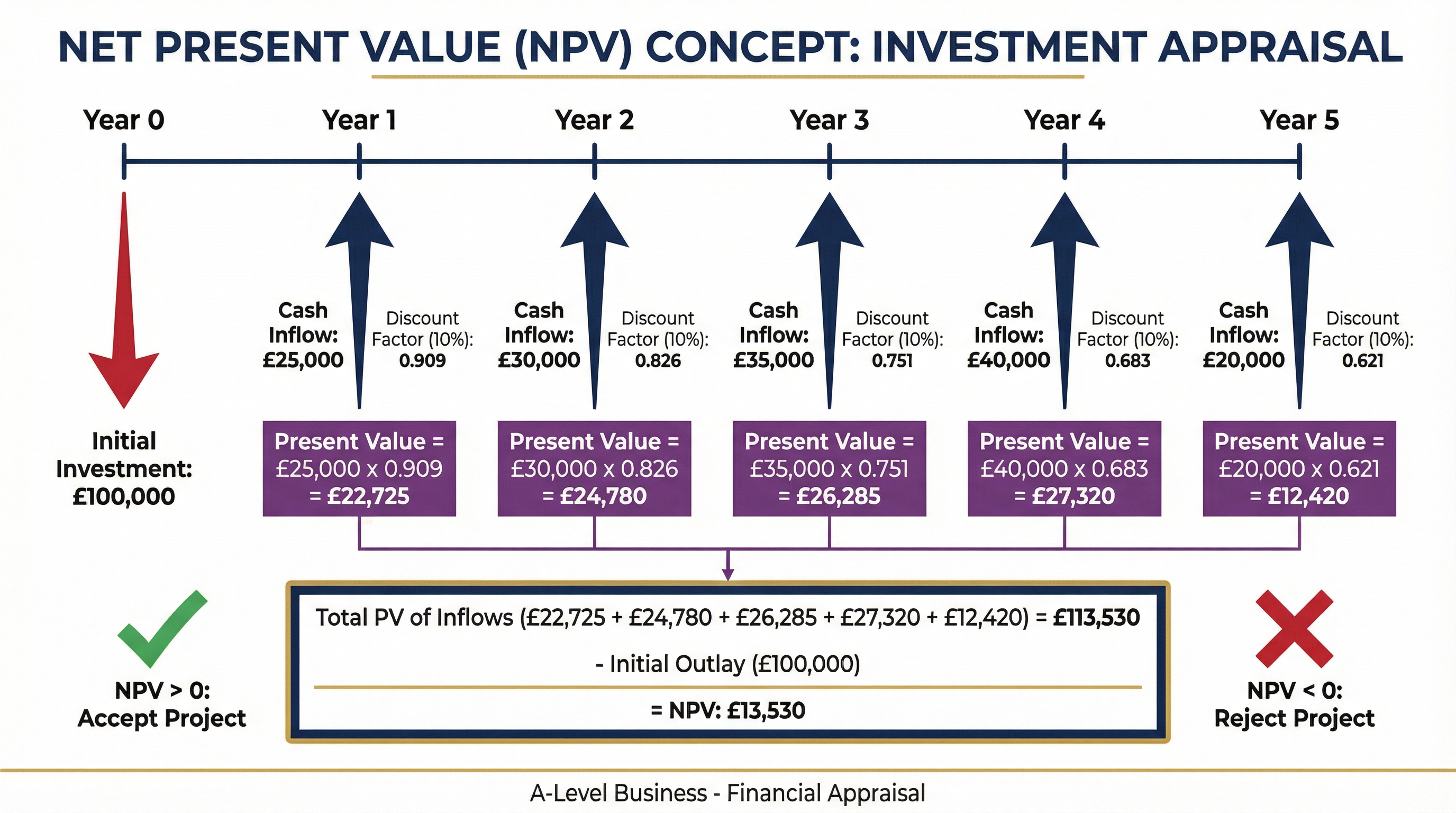
What it is: NPV is a discounted cash flow technique that calculates the present-day value of all future cash flows from a project. It does this by applying a 'discount factor' to each future cash flow, which accounts for the time value of money – the principle that money today is worth more than the same amount in the future.
Why it matters: NPV is considered the most sophisticated and reliable method because it directly addresses the time value of money. A positive NPV indicates that the project is expected to generate a return greater than the company's cost of capital (the discount rate), thereby adding value to the business. A negative NPV suggests the project should be rejected.
Specific Knowledge: In the exam, you will be given the discount factors. Your task is to correctly multiply each year's net cash flow by its corresponding discount factor to find the Present Value (PV) for that year. You then sum all the PVs and subtract the initial investment to find the NPV.
Second-Order Concepts in Investment Appraisal
Causation
Decisions made using these appraisal methods have direct causal effects on a business's future. A decision to invest in a new factory (based on a positive NPV) will cause changes in production capacity, employment levels, and market position. Conversely, a decision to reject a project can be caused by high perceived risk (short payback desired) or low forecast profitability (low ARR).
Consequence
The consequences of investment decisions are far-reaching. A successful investment can lead to increased market share, higher profits, and enhanced brand reputation. A poor investment can have severe negative consequences, including cash flow problems, reduced profitability, and even business failure. Your analysis should always consider the potential long-term consequences.
Change & Continuity
Investment appraisal is a catalyst for change. It drives the evolution of a business by guiding which new products, processes, and markets to pursue. However, it also operates within a framework of continuity, where decisions must align with the company's ongoing mission and strategic objectives. A project may be financially viable but rejected if it doesn't fit the company's brand or long-term goals.
Significance
The significance of investment appraisal lies in its power to shape the future of a business. It provides a structured, evidence-based framework for making high-stakes decisions. For an examiner, a candidate who appreciates the significance of these tools – as instruments of strategy, not just calculation exercises – is demonstrating a higher level of understanding.