
Purpose of business plans — WJEC GCSE study guide illustration

    Purpose of business plans

    WJEC
    GCSE
    Business

    This guide provides a comprehensive, exam-focused breakdown of the purpose of business plans for WJEC GCSE Business. It is designed to help students secure top marks by understanding the business plan not just as a document, but as a strategic tool for success.

    4
    Min Read
    3
    Examples
    5
    Questions
    6
    Key Terms
    🎙 Podcast Episode
    Purpose of business plans
    0:00-0:00

    Study Notes

    Header image for WJEC GCSE Business: Purpose of Business Plans

    Overview

    A business plan is a fundamental document for any new or existing business. For the WJEC GCSE Business exam, candidates are expected to demonstrate a thorough understanding of its components, its purpose for different stakeholders, and its role in monitoring business performance. Examiners are looking for more than just a list of what a business plan includes; they want to see that you can analyse its importance in different business contexts. This guide will walk you through the key areas you need to know, from securing that crucial bank loan to using the plan as a benchmark for success. We will explore how to structure your answers to gain maximum credit and avoid common pitfalls that cost candidates marks.

    Podcast: Mastering the Business Plan

    Key Components of a Business Plan

    A well-structured business plan is essential. Examiners will award AO1 marks for correctly identifying the key sections. These sections are interconnected and provide a complete picture of the business.
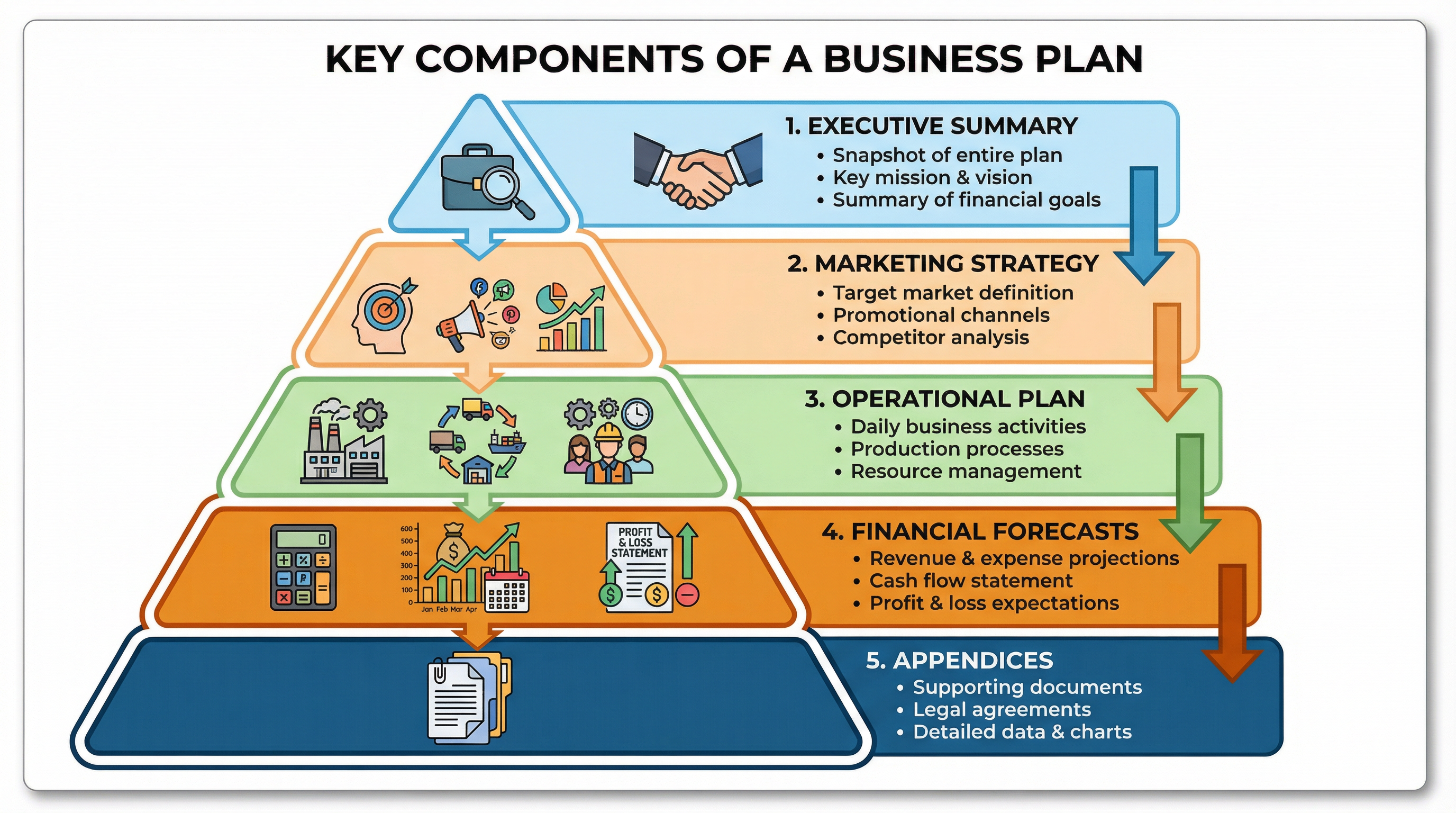
    Key Components of a Business Plan

    1. Executive Summary

    This is a concise overview of the entire business plan. It should be written last, but it appears first in the document. Its purpose is to grab the reader's attention and provide a snapshot of the business concept, financial highlights, and key goals. For a bank manager or investor with limited time, this is the most important section.

    2. Marketing Strategy

    This section details how the business will attract and retain customers. It includes:

    • Market Research: Analysis of the target market, industry trends, and competitors.
    • Marketing Mix (4 Ps): Product, Price, Place, and Promotion strategies.
    • Sales Forecasts: Realistic projections of sales revenue.

    3. Operational Plan

    This describes the day-to-day running of the business. It covers:

    • Production Process: How the product will be made or the service delivered.
    • Premises and Equipment: The physical location and resources needed.
    • Suppliers: Who will provide the raw materials or stock.
    • Legal Requirements: Necessary licenses, permits, and compliance with regulations.

    4. Financial Forecasts

    This is the numerical part of the plan and is critical for securing finance. It includes:

    • Cash Flow Forecast: Predicts the monthly inflows and outflows of cash.
    • Profit and Loss Account: Forecasts the business's profitability over a period (usually the first year).
    • Break-Even Analysis: Calculates the point at which the business's total costs equal its total revenue.

    The Purpose of a Business Plan for Different Stakeholders

    Different stakeholders use a business plan for different reasons. Understanding this is key to achieving AO2 and AO3 marks.
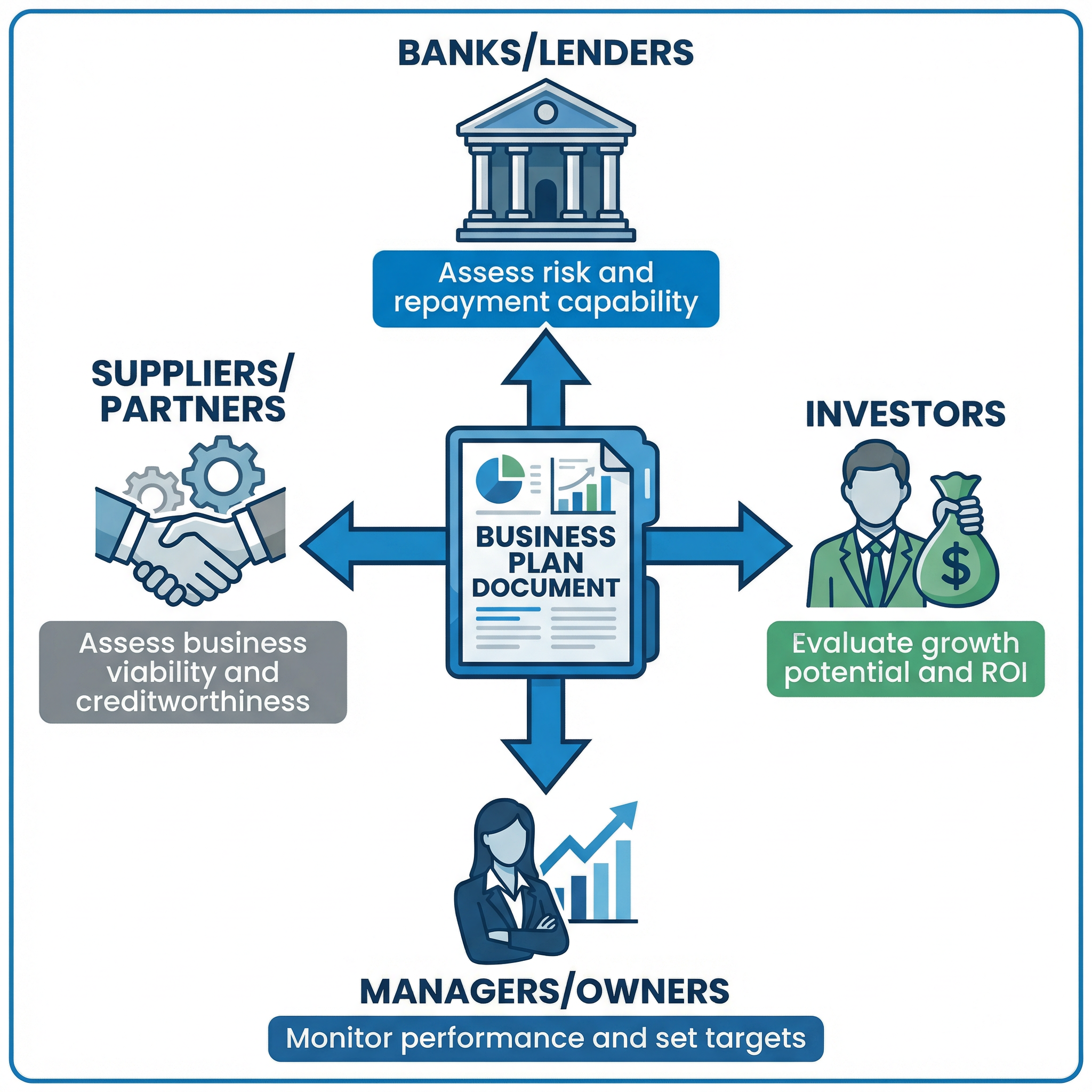
    Stakeholder Purposes for a Business Plan

    • For Entrepreneurs/Managers: It acts as a roadmap, forcing them to think critically about every aspect of the business. It helps to identify potential problems early and provides a benchmark to monitor performance against targets.
    • For Banks and Lenders: They use it to assess the risk of lending money. The financial forecasts, in particular, help them to judge the business's ability to repay a loan.
    • For Investors: They are interested in the potential for growth and a return on their investment (ROI). The marketing strategy and financial forecasts are crucial for this.
    • For Suppliers: They may want to see a business plan to assess the creditworthiness of a new business before offering trade credit.

    Worked Examples

    3 detailed examples with solutions and examiner commentary

    Practice Questions

    Test your understanding — click to reveal model answers

    Q1

    Describe two sections of a business plan. (4 marks)

    4 marks
    easy

    Hint: Think about the key components. For each one, state what it is and what it includes.

    Q2

    Explain one reason why an entrepreneur creates a business plan. (3 marks)

    3 marks
    easy

    Hint: Think about the main purposes of a business plan from the entrepreneur's perspective.

    Q3

    Analyse how a business plan can help a business to monitor its performance. (6 marks)

    6 marks
    standard

    Hint: Think about the forecasts and objectives in the plan and how they can be used for comparison.

    Q4

    Explain the importance of the financial section of a business plan to a potential investor. (9 marks)

    9 marks
    standard

    Hint: Use the BLT structure. What does an investor want to know? How does the financial section provide this information?

    Q5

    To what extent is a business plan more useful for a new business than for an established business? (16 marks)

    16 marks
    hard

    Hint: This is an evaluation question. You need to consider both sides of the argument and make a supported judgement.

    Key Terms

    Essential vocabulary to know

    More Business Study Guides

    View all

    Problems of growth

    WJEC
    GCSE

    This guide dissects the critical challenges businesses face during expansion, a key topic for WJEC GCSE Business. It moves beyond the simple idea that 'growth is good' to explore the real-world problems of diseconomies of scale and overtrading, providing the analytical skills needed to secure top marks.

    The role of technology in production

    OCR
    GCSE

    This study guide provides a comprehensive, exam-focused breakdown of the role of technology in production for OCR GCSE Business (J204). It moves beyond generic statements to deliver the specific analysis, evaluation, and contextual understanding required to achieve top marks.

    Extended Writing (Arguments, Judgements, Recommendations)

    Edexcel
    GCSE

    This study guide is your key to mastering the high-stakes extended writing questions in Edexcel GCSE Business. We'll deconstruct the 9-mark 'Justify' and 12-mark 'Evaluate' questions, giving you the examiner's perspective on how to build arguments, apply context, and make winning judgements to secure top marks.

    Evaluating Business Decisions

    Edexcel
    GCSE

    Master the art of making justified business decisions and ace your Edexcel GCSE Business exam. This guide breaks down the essential evaluation skills, from building powerful arguments to securing top marks in 12-mark questions, turning complex scenarios into a clear path to success.

    Making Operational Decisions

    Edexcel
    GCSE

    Making Operational Decisions is the practical heart of business operations, where candidates learn how businesses balance cost, quality, and speed to deliver goods and services. This topic is critical for Edexcel exams because it demands application to real business contexts and evaluation of trade-offs—skills that secure AO2 and AO3 marks worth 65% of your grade.

    Setting business aims and objectives

    OCR
    GCSE

    Setting business aims and objectives is the foundation of strategic planning and operational success. This topic explores how businesses translate broad ambitions into measurable targets using SMART criteria, how objectives vary by ownership type and life cycle stage, and how financial goals often conflict with non-financial priorities. Mastering this distinction is essential for exam success, as OCR examiners consistently reward candidates who apply context-specific objectives and demonstrate analytical chains of reasoning.