Economic Resources (Factors of Production)

    OCR
    GCSE
    Economics

    This study guide provides a comprehensive, exam-focused breakdown of Economic Resources (Factors of Production) for OCR GCSE Economics. It clarifies the four essential factors, their rewards, and how they are combined to address scarcity, ensuring candidates can secure maximum marks on this fundamental topic.

    6
    Min Read
    3
    Examples
    3
    Questions
    6
    Key Terms
    🎙 Podcast Episode
    Economic Resources (Factors of Production)
    0:00-0:00

    Study Notes

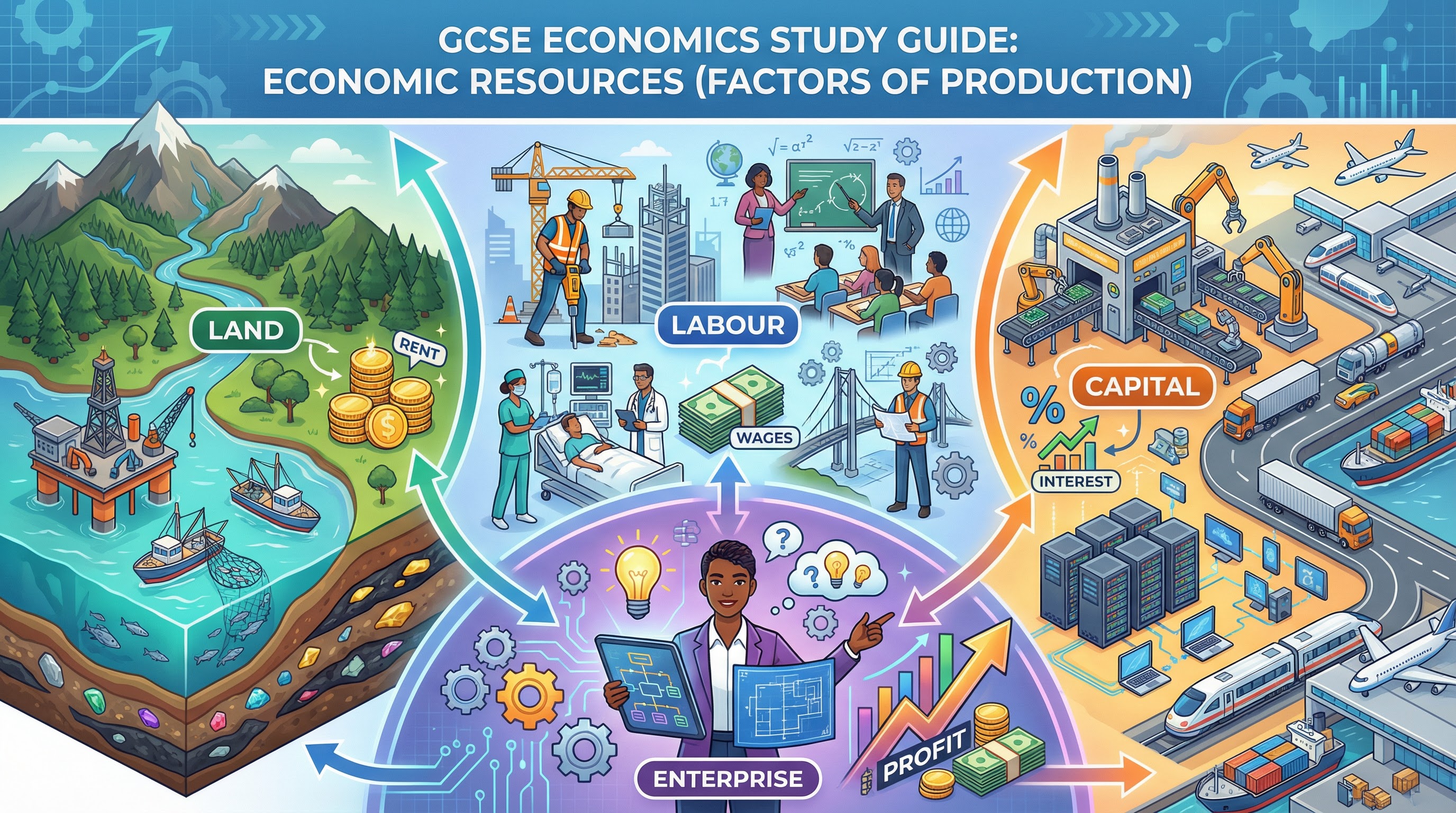
    The Four Factors of Production: Land, Labour, Capital, and Enterprise.

    Overview

    This topic, Economic Resources (also known as the Factors of Production), is a cornerstone of the OCR GCSE Economics specification (J205). It explores the fundamental inputs required to produce all goods and services in an economy. Examiners expect candidates to demonstrate a precise understanding of the four factors: Land, Labour, Capital, and Enterprise. A mastery of this topic is crucial as it forms the basis for analysing business behaviour, market dynamics, and government policy. Candidates must not only define each factor but also identify its corresponding reward, analyse how entrepreneurs combine these resources to solve the basic economic problem of scarcity, and apply this knowledge to real-world case studies. Credit is consistently awarded for distinguishing between related concepts, such as capital goods and consumer goods, and for analysing the impact of factor mobility on productive efficiency. This guide will equip you with the specific knowledge and analytical skills required to excel.

    Listen to our 10-minute podcast guide on the Factors of Production.

    The Four Factors of Production

    1. Land

    Definition: In economics, Land refers to all natural resources used in production. This is a much broader definition than the everyday use of the word.

    What it includes: It encompasses not just physical territory or agricultural fields, but also raw materials and resources found on and under the earth. This includes:

    • Minerals: Oil, natural gas, coal, diamonds.
    • Forests: Timber, rubber.
    • Water: Rivers, seas, and the fish within them.
    • Agricultural Land: Soil used for growing crops.
    • Other Natural Elements: Air, sunlight, and climate.

    Reward: The reward for owning and providing the factor of Land is Rent. This is the income received by the owner of the natural resource.

    Examiner Tip: A common mistake is to limit the definition of Land to just fields. Marks are awarded for explicitly stating that it includes all natural resources. For example, in a case study about the fishing industry, the fish are the 'Land' resource, while the fishing boat is 'Capital'.

    2. Labour

    Definition: Labour is the human effort, both mental and physical, that goes into the production of goods and services.

    What it includes: It covers the work done by all individuals in the economy, from a construction worker building a house (physical effort) to a software developer writing code (mental effort). The quality of labour is a critical determinant of a country's productivity and can be improved through education, training, and healthcare.

    Reward: The reward for providing Labour is Wages or a Salary.

    Specific Knowledge: Examiners credit candidates who can analyse the mobility of labour:

    • Occupational Mobility: The ease with which a worker can move from one type of job to another. This is high for jobs with transferable skills (e.g., administrative roles) and low for highly specialized professions (e.g., a brain surgeon cannot easily become a pilot).
    • Geographical Mobility: The ease with which a worker can move from one location to another for work. This can be affected by factors like family ties, housing costs, and language barriers.
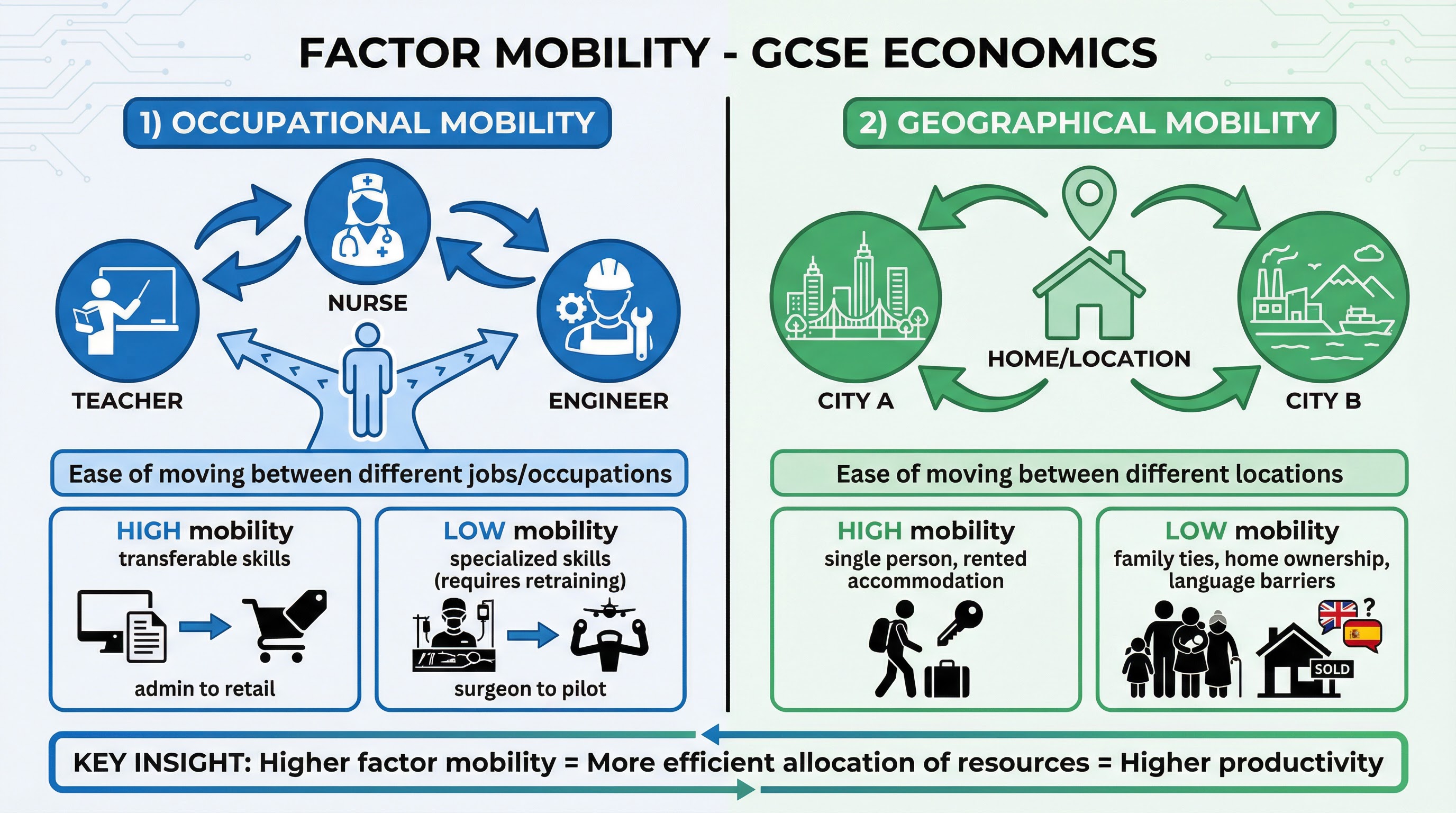
    Understanding Occupational and Geographical mobility of labour.

    3. Capital

    Definition: Capital consists of man-made aids to production. These are goods that are not consumed for their own sake but are used to produce other goods and services.

    What it includes: This is the area where candidates most frequently make errors. Capital is NOT money. It refers to physical assets such as:

    • Machinery and Equipment: Factory assembly lines, tractors, computers.
    • Tools: Hammers, drills, software.
    • Infrastructure: Roads, railways, ports, internet cables.
    • Buildings: Factories, offices, schools.

    Reward: The reward for providing Capital is Interest. This is the payment made to those who lend money to firms to purchase capital goods.

    Distinction: It is vital to distinguish between Capital Goods and Consumer Goods.

    • Capital Goods: Used to produce other goods (e.g., a delivery van, an oven in a bakery).
    • Consumer Goods: Used to satisfy wants and needs directly (e.g., a personal car, a pizza).
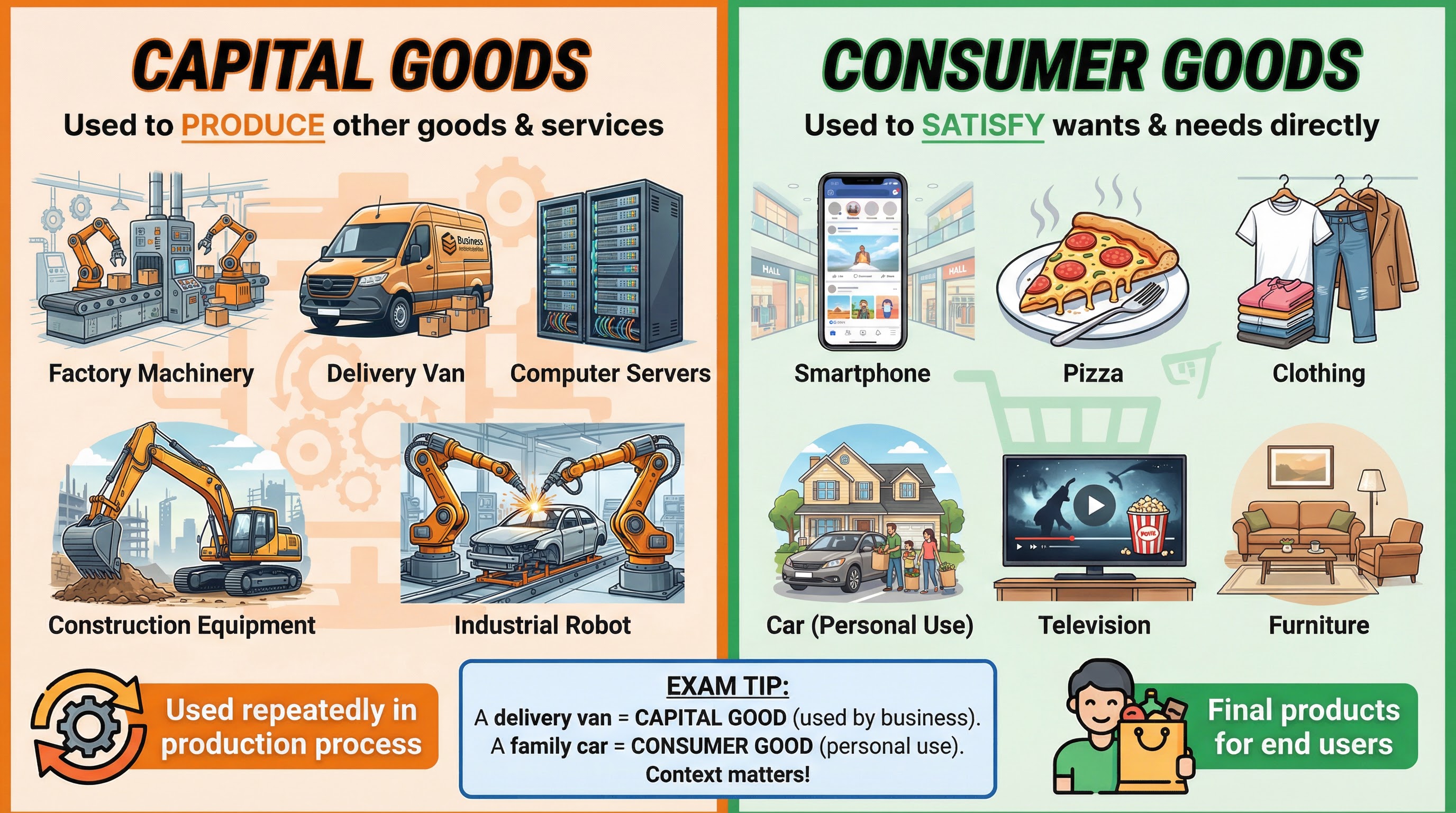
    The crucial distinction between Capital Goods and Consumer Goods.

    4. Enterprise

    Definition: Enterprise is the factor that organises the other three factors of production and, crucially, takes the risks associated with the business venture.

    What it includes: The entrepreneur is the individual or group who:

    • Organises Production: Brings together Land, Labour, and Capital in a productive process.
    • Makes Business Decisions: Decides what to produce, how to produce it, and for whom.
    • Bears Risk: Takes the financial risk of the business failing. If the business is unsuccessful, the entrepreneur may lose their personal investment.
    • Innovates: Develops new products, services, or production methods.

    Reward: The reward for Enterprise is Profit. This is the residual income left over after all other costs (rent, wages, interest) have been paid. It is an uncertain reward for successful risk-taking.

    Examiner Tip: High-level answers will always emphasise the dual function of the entrepreneur: organising production AND bearing risk. Simply stating they 'manage' the business is not enough for top marks.
    Visual Resources

    3 diagrams and illustrations

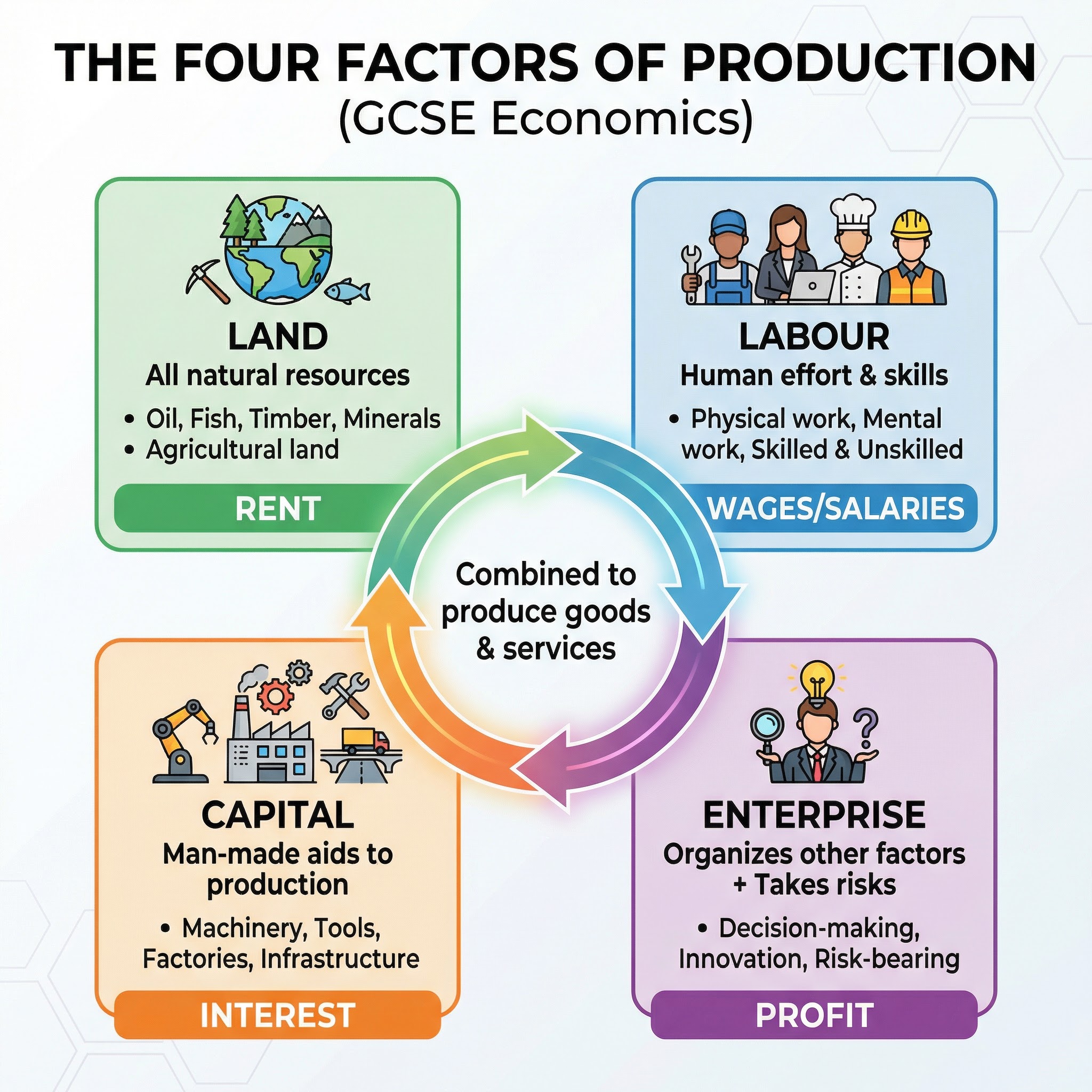
    A summary of the four factors of production and their respective rewards.
    A summary of the four factors of production and their respective rewards.
    Understanding Occupational and Geographical mobility of labour.
    Understanding Occupational and Geographical mobility of labour.
    The crucial distinction between Capital Goods and Consumer Goods.
    The crucial distinction between Capital Goods and Consumer Goods.

    Interactive Diagrams

    1 interactive diagram to visualise key concepts

    Takes RiskBasic Economic Problem: ScarcityWhat to produce?How to produce?For whom to produce?EntrepreneurOrganises FactorsLandLabourCapitalProduction of Goods & ServicesAddresses Economic ProblemReceives Profit

    Flowchart showing how Enterprise combines the factors of production to address the Basic Economic Problem.

    Worked Examples

    3 detailed examples with solutions and examiner commentary

    Practice Questions

    Test your understanding — click to reveal model answers

    Q1

    Explain the difference between a capital good and a consumer good, using an example for each. (4 marks)

    4 marks
    standard

    Hint: Focus on the purpose for which the good is used.

    Q2

    Analyse how an improvement in the geographical mobility of labour could benefit an economy. (6 marks)

    6 marks
    hard

    Hint: Think about efficiency, unemployment, and business costs.

    Q3

    Identify the factor of production and its reward in each of the following scenarios: (a) A software engineer is paid £50,000 a year. (b) A farmer receives a payment for the use of his field. (4 marks)

    4 marks
    easy

    Hint: Pair the factor with its specific income.

    Key Terms

    Essential vocabulary to know

    More Economics Study Guides

    View all

    Poverty and Inequality

    OCR
    GCSE

    This study guide provides a comprehensive overview of Poverty and Inequality for OCR GCSE Economics (J205). It is designed to help students master the key concepts, analytical tools, and evaluation skills required to achieve top marks in their exams.

    Unemployment and its Causes

    OCR
    GCSE

    This study guide provides a comprehensive analysis of unemployment and its causes, a core topic for OCR GCSE Economics (J205). It is designed to equip candidates with the precise knowledge and analytical skills required to achieve high marks, focusing on measurement methods, the four main types of unemployment, and the crucial concept of derived demand for labour.

    International Trade

    OCR
    GCSE

    This study guide for OCR GCSE Economics (J205) provides a comprehensive overview of International Trade, a topic crucial for understanding the UK's role in the global economy. It is designed to be exam-focused, breaking down complex concepts like the Balance of Payments, exchange rates, and protectionism into manageable sections to help students secure top marks.

    Specialisation and Trade

    OCR
    GCSE

    Unlock the secrets of global trade and production with this comprehensive guide to Specialisation and Trade for OCR GCSE Economics. Discover how focusing on specific tasks supercharges efficiency and why countries trade, all while mastering the exam techniques needed to secure top marks.

    Development Economics (Poverty, Aid, Debt)

    OCR
    GCSE

    This study guide delves into the critical issues of poverty, aid, and debt within Development Economics for OCR GCSE. It is designed to equip candidates with the analytical skills and specific knowledge required to distinguish between economic growth and development, evaluate the effectiveness of different aid types, and understand the complexities of international debt, thereby maximizing their exam performance.

    Supply and Factors Influencing Supply

    OCR
    GCSE

    This study guide provides a comprehensive overview of the concept of supply in OCR GCSE Economics (J205). It focuses on the critical distinction between movements along the supply curve and shifts in the curve, equipping students with the knowledge to analyse how producers make decisions and to secure high marks in the exam.