Study Notes
Overview
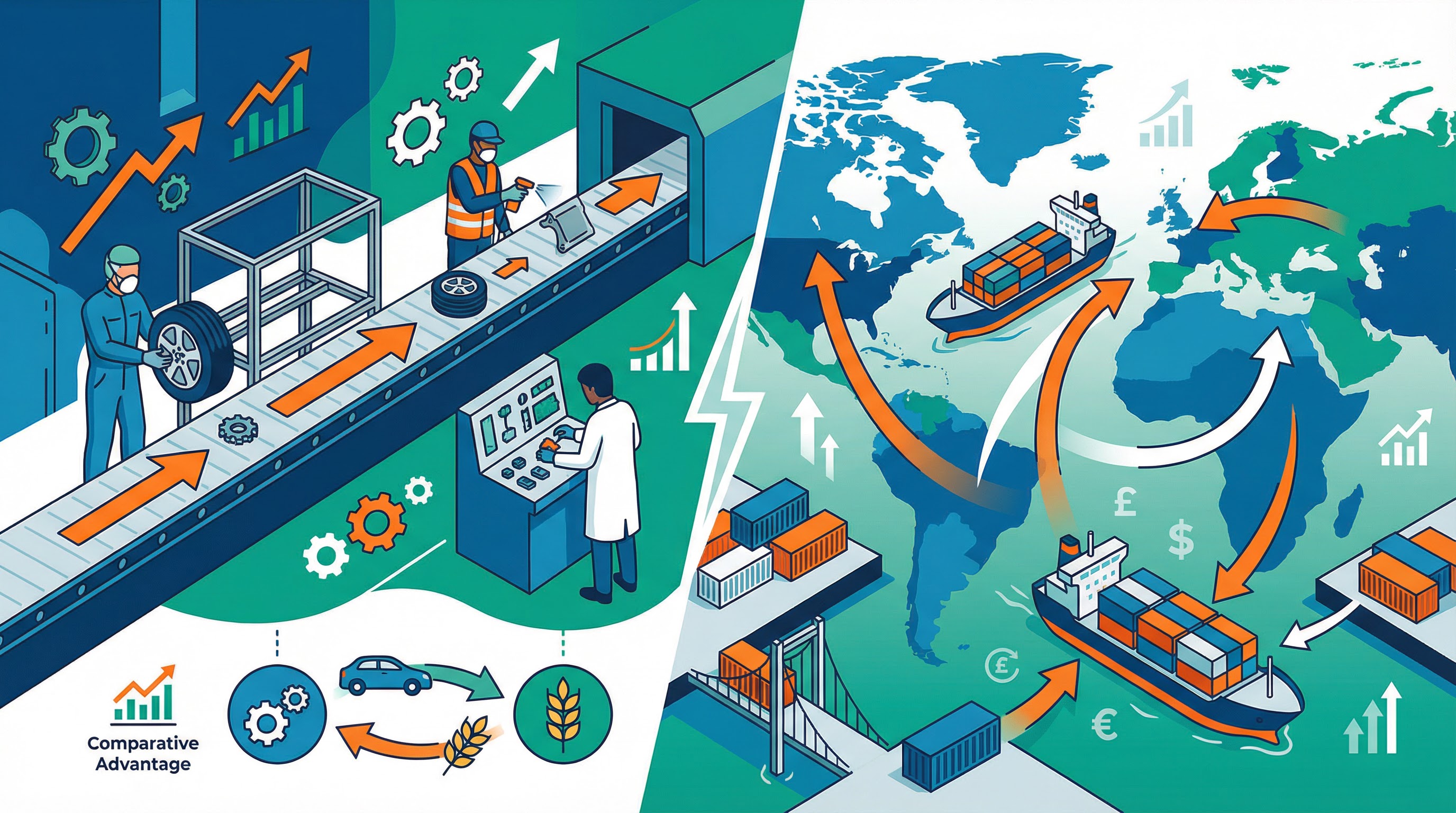
Specialisation and trade are foundational concepts in economics, explaining how our modern global economy functions. For the OCR J205 specification, candidates must understand how specialisation and the division of labour drive efficiency within firms and entire economies. This involves analysing the powerful theory of comparative advantage, which underpins international trade. Examiners expect you to not only explain the significant benefits—such as lower costs, increased output, and greater consumer choice—but also to critically evaluate the substantial risks. These include the potential for structural unemployment, the dangers of over-dependence on other nations, and the human cost of repetitive work. A strong response will move beyond simple definitions, using precise terminology and applying concepts to real-world data provided in the exam, demonstrating a clear understanding of the trade-offs involved in a specialised, interconnected world.
Key Concepts & Developments
The Division of Labour
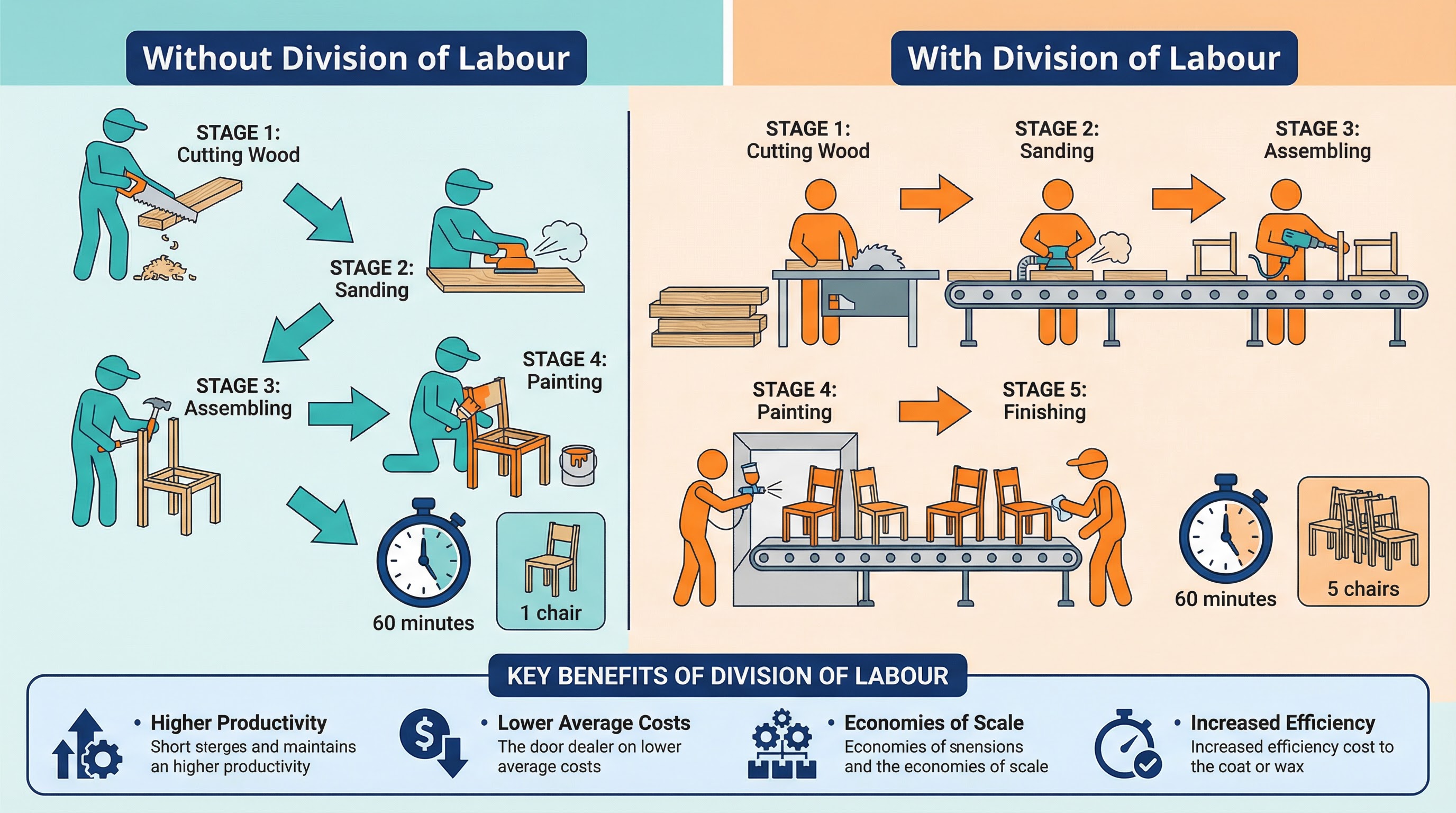
What it is: This is specialisation at the micro level, within a firm. Instead of one worker completing all tasks to make a product, the process is broken down into small, separate stages. Each worker then concentrates on one specific task.
Why it matters: As famously described by Adam Smith with his pin factory example, the division of labour leads to a massive increase in productivity (output per worker per hour). Workers become highly skilled at their single task, waste less time switching between jobs, and can use specialised machinery more effectively. This raises output, lowers average production costs, and allows firms to benefit from economies of scale.
Specific Knowledge: For your exam, you must be able to link the division of labour directly to increased productivity and efficiency. Credit is given for explaining how this happens (practice, less time switching, use of machinery).
Comparative Advantage
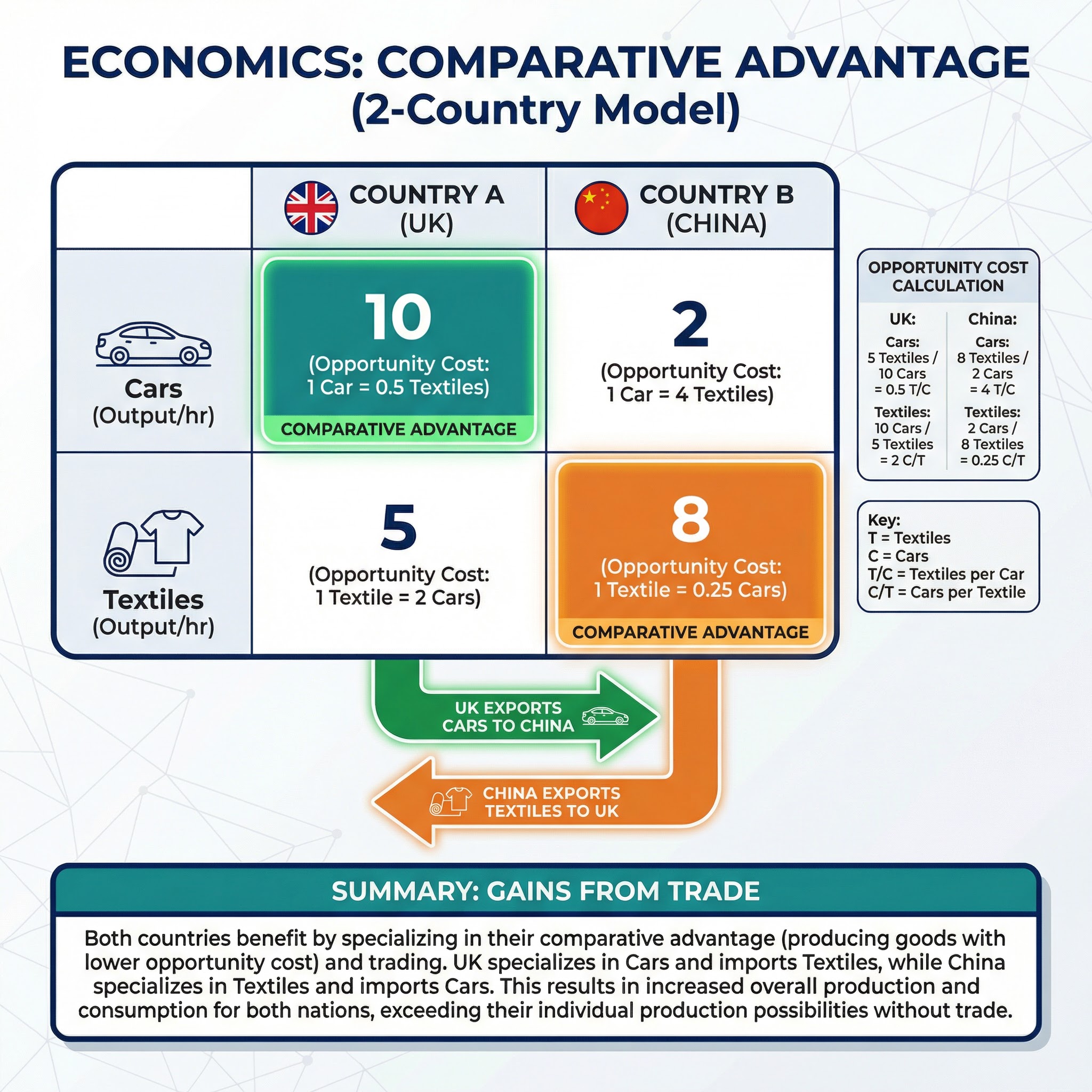
What it is: This is the principle that underpins international trade. A country has a comparative advantage in producing a good if it can do so at a lower opportunity cost than another country. Opportunity cost is the next best alternative given up when making a choice.
Why it matters: Even if one country (Country A) is better at producing everything than another country (Country B)—a situation called absolute advantage—it still benefits both to trade. Each country should specialise in the good where it has the lowest opportunity cost. By specialising and trading, total global output increases, and both countries can consume beyond their individual production possibility frontiers.
Specific Knowledge: Candidates must be able to calculate simple opportunity costs from data to identify comparative advantage. For example, if the UK can make 10 cars or 5 textiles, and China can make 2 cars or 8 textiles, you must be able to work out the opportunity cost for each country to determine who should specialise in what.
The Risks of Over-Specialisation
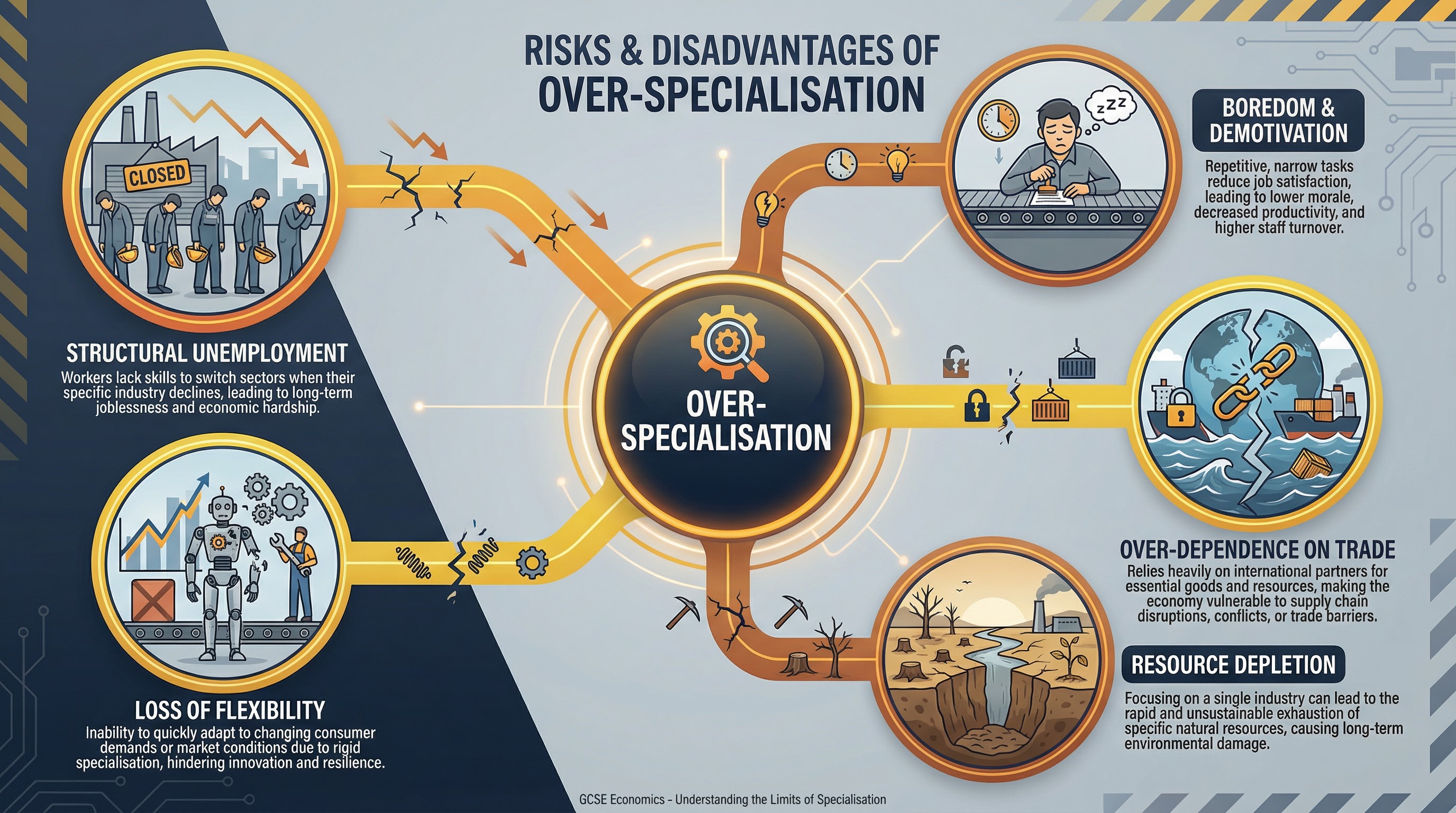
What it is: While specialisation brings benefits, relying too heavily on a narrow range of industries or products creates significant vulnerabilities for a country's economy.
Why it matters: For high-level evaluation (AO3), you must weigh the pros of specialisation against these cons. Key risks include:
- Structural Unemployment: If a country's specialised industry goes into decline (e.g., due to foreign competition or changing technology), workers' skills may not be transferable to new industries, leading to long-term unemployment.
- Over-Dependence: Relying on other countries for essential goods (like food or energy) can be risky if political conflicts or global events (like a pandemic) disrupt supply chains.
- Resource Depletion: Specialising in primary products (like mining or farming) can lead to the exhaustion of non-renewable resources.
- Boredom and Demotivation: For workers, performing the same repetitive task can lead to poor job satisfaction and lower quality output.
Second-Order Concepts
Causation
Specialisation is a direct cause of increased productivity. The need for resources a country cannot produce itself is a primary cause of international trade. Technological advancements in transport and communications have been a key causal factor in the growth of global trade.
Consequence
The immediate consequence of the division of labour is higher output. A long-term consequence of over-specialisation can be structural unemployment. A key consequence of international trade is lower prices for consumers and greater choice.
Change & Continuity
Change: The pattern of global trade changes constantly. For example, the rise of manufacturing in Asia has changed the UK's trade patterns, moving more towards services. Continuity: The fundamental principle of comparative advantage has remained a constant driver of trade for centuries.
Significance
The significance of specialisation is that it is the primary method by which living standards are raised. It allows us to produce more from the same limited resources, which is the fundamental economic problem.
Source Skills
In an OCR exam, you might be given a data table showing production possibilities for two countries, or an extract discussing the decline of a specific industry in the UK. When approaching these:
- Identify the core topic: Is this about comparative advantage, or the risks of specialisation?
- Extract the key data: Quote specific figures. For example, "The data shows that in one hour, Brazil can produce 10 tonnes of coffee or 2 cars."
- Perform the calculation (if needed): If it's a comparative advantage question, calculate the opportunity costs for both countries.
- Use the data to support your analysis: Don't just state the data, explain what it means in the context of the economic theory. "This data demonstrates that Brazil has a comparative advantage in coffee production because its opportunity cost of producing one tonne of coffee is only 0.2 cars, whereas the USA's is 0.5 cars."