
Study Notes
Overview
Welcome to your deep-dive study guide for AQA GCSE English Language, focusing on the crucial skill of Communicating Clearly. This skill is the bedrock of both Paper 1 and Paper 2 writing tasks, governed by Assessment Objective 5 (AO5) for communication and organisation, and Assessment Objective 6 (AO6) for technical accuracy. Together, they account for 100% of the marks in the writing sections, making mastery of this area non-negotiable for achieving a high grade. This guide will equip you with the analytical frameworks, writing strategies, and examiner insights needed to craft responses that are not just understood, but are also convincing, sophisticated, and impactful.
Reading Skills
While this guide focuses on writing, strong reading skills are the foundation upon which good writing is built. The ability to deconstruct and analyse how professional writers communicate is essential for developing your own technique.
Identifying Information & Ideas
This is the first step in analysis. You must be able to read an unseen text and extract both explicit information (what is directly stated) and implicit information (what is suggested or implied). For example, a writer might explicitly state "the house was old," but implicitly suggest it is neglected and unloved through descriptions of "peeling paint" and "a garden choked with weeds."
Analysing Language
This is a high-reward skill. It involves moving beyond simply identifying language features to analysing their specific effect on the reader. An examiner is not interested in a list of metaphors; they want to know why the writer chose that specific metaphor and what it contributes to the overall meaning and tone of the text.
Key Language Features to Identify
| Feature | Definition | Effect on Reader | Example |
|---|---|---|---|
| Metaphor | A figure of speech stating one thing is another to create a powerful comparison. | Creates a vivid, often complex image in the reader's mind, layering meaning. | "The city was a jungle, its skyscrapers the towering trees." |
| Simile | A comparison using "like" or "as". | Makes an unfamiliar concept more relatable or an ordinary one more vivid. | "The silence was as heavy as a blanket." |
| Personification | Giving human qualities or actions to inanimate objects or abstract ideas. | Creates a specific mood or atmosphere; can make the environment feel like an active character. | "The wind whispered secrets through the trees." |
| Pathetic Fallacy | A type of personification where the weather or natural world reflects the mood of a character or scene. | Intensifies the emotional atmosphere and foreshadows events. | A character's despair is matched by relentless, driving rain. |
| Alliteration | Repetition of the same initial consonant sound in a series of words. | Can create a specific soundscape (harsh or soft), draw attention to key words, and create rhythm. | "The slippery, slithering snake silently slipped away." |
| Sibilance | Repetition of 's' or 'sh' sounds. | Often used to create a sinister, secretive, or soothing effect, depending on the context. | "The soft hiss of the sea soothed his soul." |
| Juxtaposition | Placing two contrasting ideas, images, or concepts side-by-side. | Highlights the differences between them, creating tension, irony, or a deeper meaning. | The juxtaposition of a wealthy mansion next to a slum. |
| Oxymoron | A phrase that combines two contradictory terms. | Creates a surprising and thought-provoking effect, often revealing a deeper truth. | "A deafening silence." |
Analysing Structure
Structure is the writer's blueprint. It's how they organise and shape the text to guide the reader's journey. When analysing structure, you should look for:
- Openings: How does the writer hook the reader in the first paragraph?
- Shifts in Focus: Where does the perspective or topic change? Look for discourse markers or changes in paragraph length.
- Narrative Perspective: Is it first-person ("I"), third-person limited (following one character), or third-person omniscient (all-knowing)? How does this choice affect what the reader knows?
- Sentence and Paragraph Length: Long, complex sentences can create a sense of breathlessness or detail, while short, simple sentences can create tension or clarity. Long paragraphs can be immersive; short ones can be punchy and dramatic.
- Cyclical Structure: Does the ending link back to the beginning? This can provide a sense of finality or inevitability.
- Flashback/Foreshadowing: Does the writer manipulate time to reveal information or build suspense?
Evaluating Critically
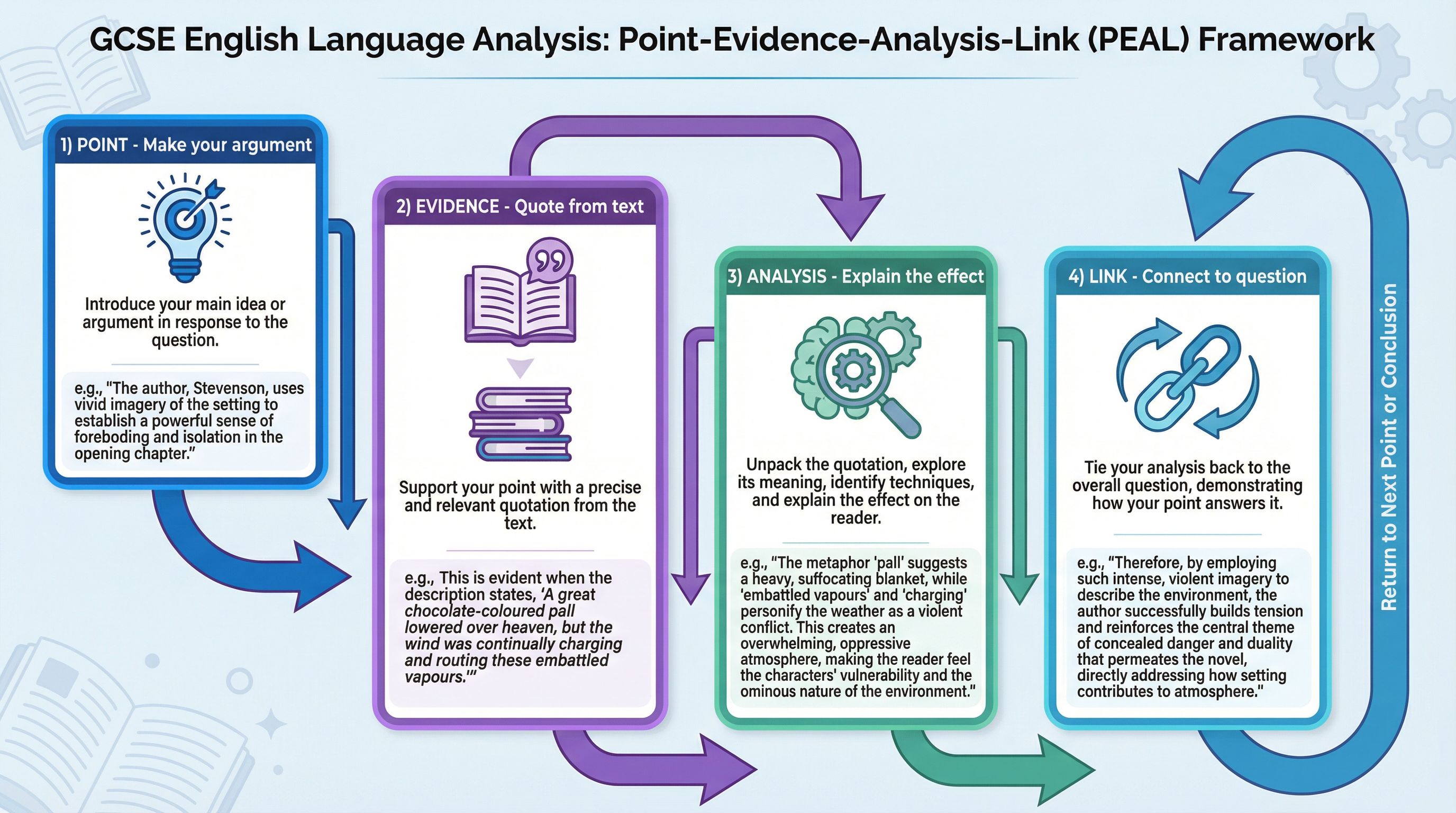
This is a top-level skill, primarily for Question 4 on Paper 1. It requires you to form a judgement on how successfully the writer has achieved their aims. You must express a personal opinion, but it must be rooted in textual evidence. The key is to explore the extent to which you agree with a statement. A good structure is:
- Statement: Begin with your point, agreeing or disagreeing with the prompt.
- Evidence: Select a short, embedded quotation to support your view.
- Analysis: Analyse the language or structure of your evidence, explaining its effect.
- Link: Connect your analysis back to the initial statement, reinforcing your evaluation.
Comparing Writers' Viewpoints
For Paper 2, Question 4, you must compare how two writers present their viewpoints and perspectives. A successful comparison does not just list similarities and differences. It synthesises them. A good framework is:
- Identify Viewpoints: What is the core attitude or opinion of each writer towards the topic?
- Compare Methods: How do they use language and structural techniques to convey their viewpoint? Compare their choices directly.
- Evaluate Effectiveness: Which writer do you find more convincing or impactful, and why? Justify your judgement with close reference to their methods.
Writing Skills
This is where you apply what you've learned from your reading. The examiner is looking for creativity, control, and technical precision.
Creative Writing (Paper 1, Question 5)
This task asks for a description or narrative. The key is to create a vivid and engaging piece of writing.
- Show, Don't Tell: Instead of telling the reader "the man was angry," show it: "The man's knuckles whitened as he gripped the table, his jaw a tight line of fury."
- Sensory Description: Appeal to all five senses – sight, sound, smell, touch, and taste – to immerse your reader in the scene.
- Varied Sentence Structures: Use a mix of simple, compound, and complex sentences to control the pace and rhythm of your writing.
- Engaging Openings: Start in media res (in the middle of the action) or with a powerful image to hook the reader.
- Satisfying Endings: A good ending provides a sense of closure, perhaps through a cyclical return to the opening image or a final, thought-provoking sentence.
- The One-Scene Rule: For a short task, it's often best to focus on a single, detailed moment in time rather than trying to tell a long, complex story.
Transactional/Non-Fiction Writing (Paper 2, Question 5)
This task requires you to write for a specific purpose, audience, and form (e.g., a letter, article, speech, or leaflet). The key is to adapt your style convincingly.
- Purpose-Form-Audience (PFA): This is your holy trinity. Your tone, register, and structural choices must all be appropriate for the PFA specified in the question.
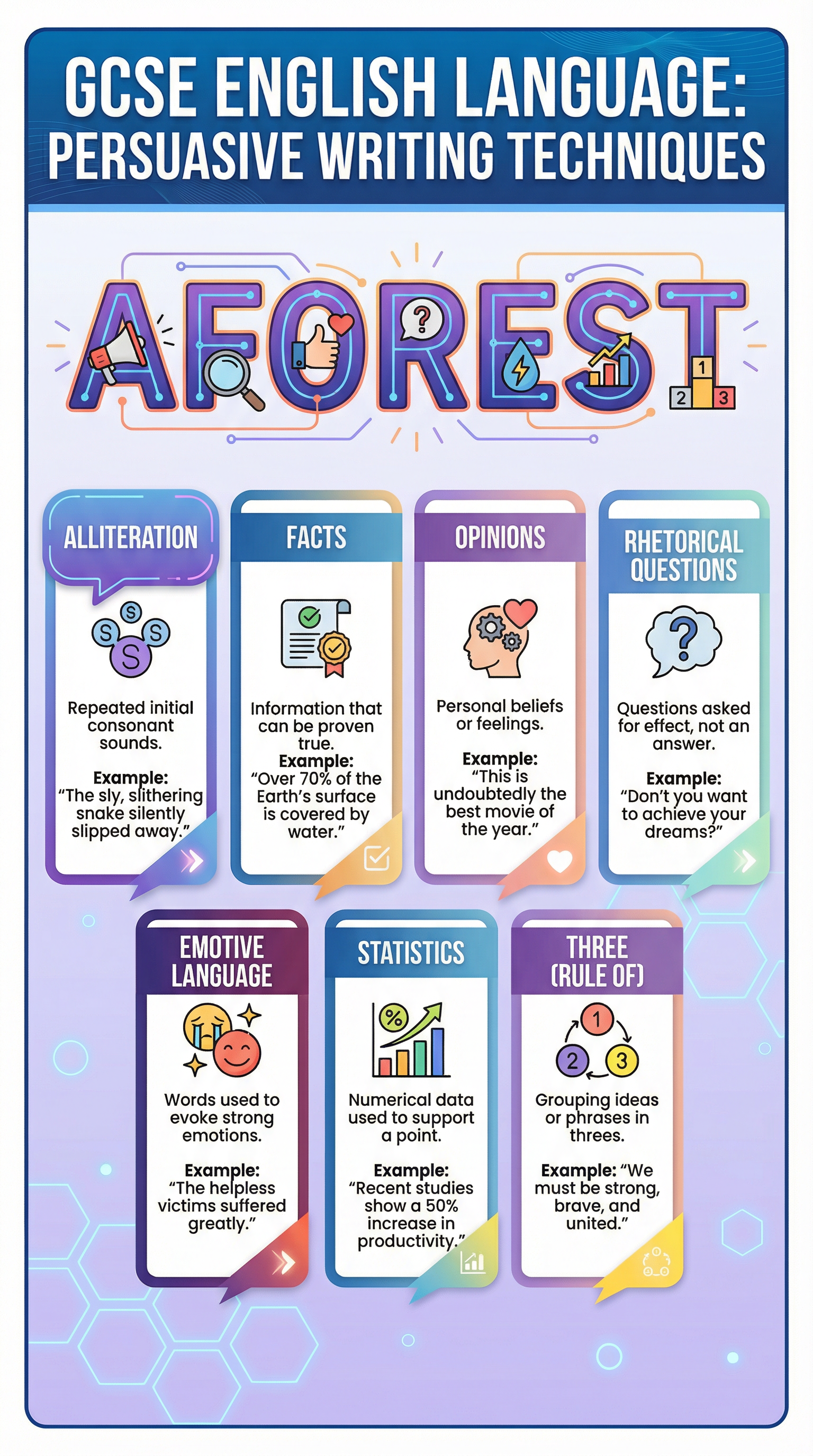
- AFOREST Persuasive Techniques: This acronym is a powerful tool for persuasive writing. While you don't need to use all of them, they are a great starting point for making your writing more forceful and convincing.
Technical Accuracy (SPaG)
Spelling, Punctuation, and Grammar (SPaG) are assessed under AO6. They are not just about avoiding errors; they are about using language with control and precision to enhance your meaning. Poor technical accuracy will cap your mark, no matter how creative your ideas are.
- Ambitious Punctuation: To hit the top bands, you need to use a variety of punctuation correctly. This includes:
- Semicolons (;) to link two closely related independent clauses.
- Colons (:) to introduce a list, an explanation, or a quotation.
- Dashes (-) to create a dramatic pause or add extra information.
- Parenthetical Commas (,) to embed a subordinate clause within a sentence.
- Paragraph Cohesion: Use discourse markers and clear topic sentences to ensure your paragraphs flow logically and build a coherent argument or narrative.