Using a range of sentence structures — AQA GCSE study guide illustration

    Using a range of sentence structures

    This study guide focuses on mastering sentence structures for AQA GCSE English Language, a key skill for both reading analysis (AO2) and writing accuracy (AO6). It covers how to identify, analyse, and consciously use different sentence forms to boost your exam performance.

    5
    Min Read
    3
    Examples
    5
    Questions
    8
    Key Terms
    🎙 Podcast Episode
    Using a range of sentence structures
    0:00-0:00

    Study Notes

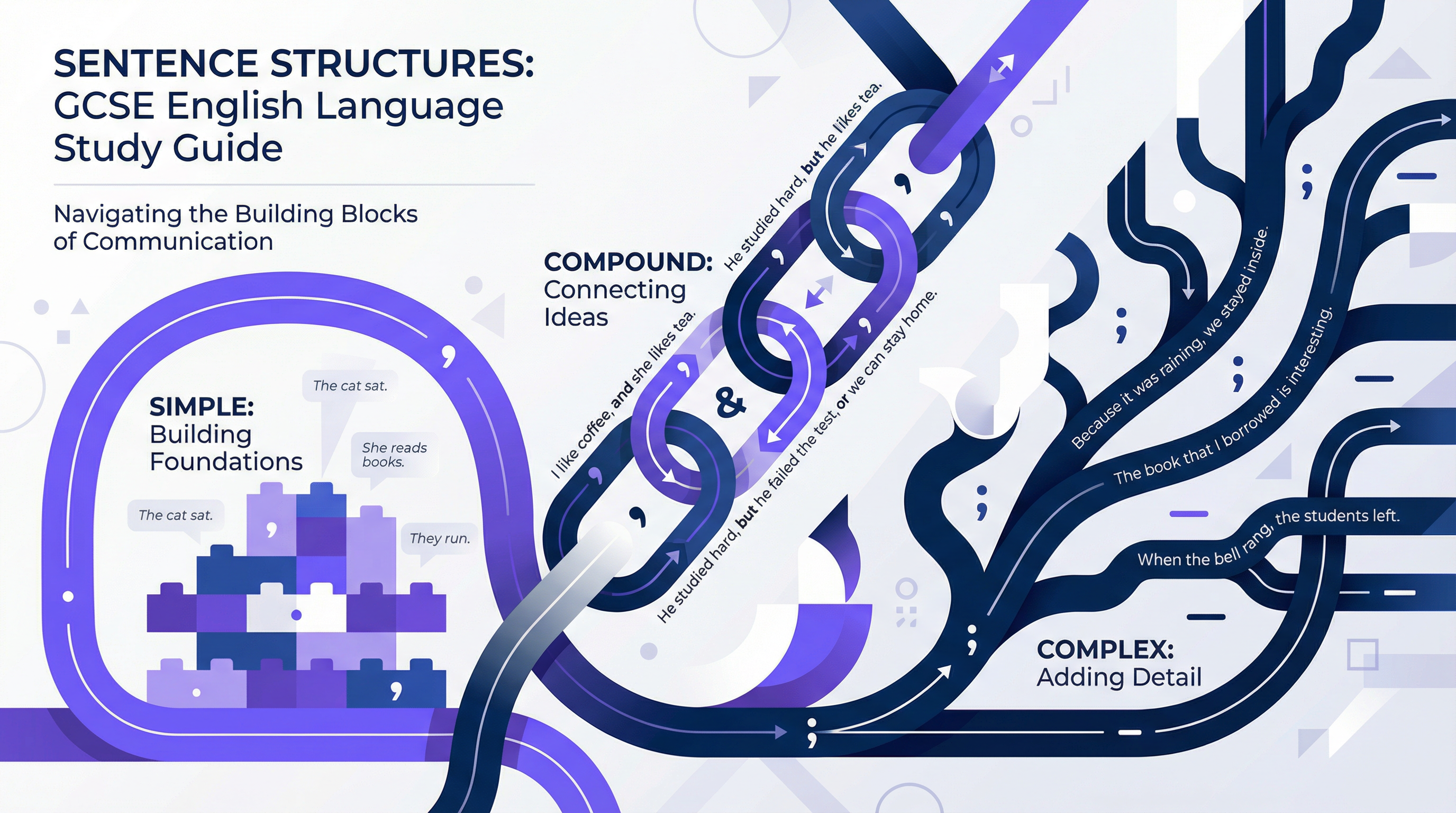
    Header image for the Sentence Structures Study Guide.

    Overview

    Sentence structure is a pivotal dual-skill assessed under AO2 (analysis of writer's methods) and AO6 (technical accuracy). In reading sections, candidates must analyse how syntax influences pacing, tone, and emphasis, while in writing sections, they must demonstrate conscious manipulation of sentence forms to shape meaning and achieve cohesion. This guide will equip you with the skills to both deconstruct a writer's choices and construct your own sophisticated sentences for maximum marks.

    Reading Skills

    Analysing Sentence Structures

    When you analyse a text, identifying the sentence type is only the first step. The real marks are awarded for explaining the effect of that choice on the reader. How does it shape their understanding, the pace of the narrative, or the tone of thepiece? Use the following framework to structure your analysis.
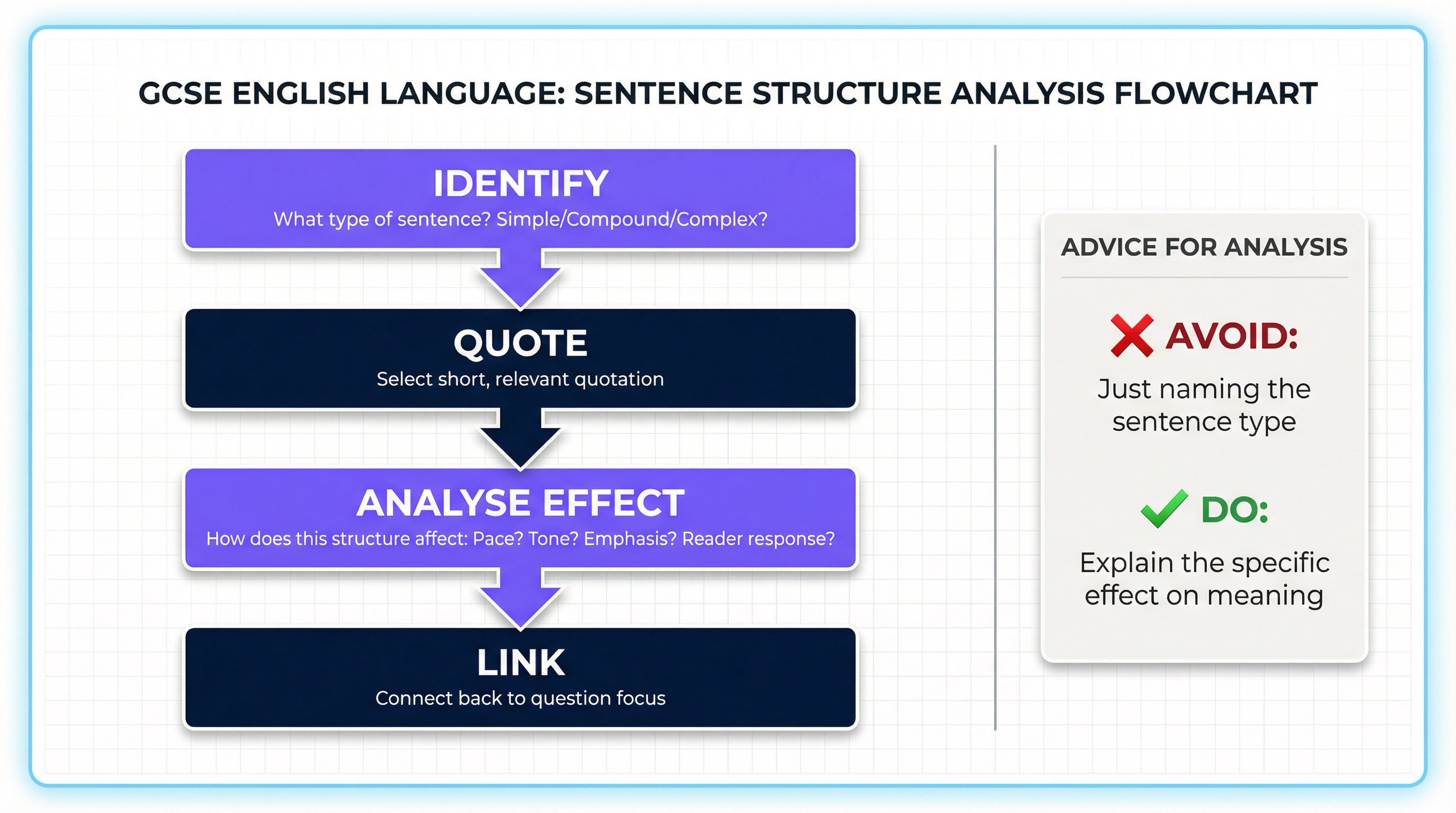
    The P.E.A.L. framework for sentence structure analysis.

    Key Sentence Structures & Their Effects

    StructureDefinitionPotential Effects on the ReaderExample
    Simple SentenceA single independent clause.Creates impact, tension, or clarity. Can speed up the pace.The car exploded.
    Compound SentenceTwo independent clauses joined by a coordinating conjunction (e.g., 'and', 'but', 'so').Creates balance, shows a relationship between two equal ideas, maintains a steady pace.He was tired, but he kept running.
    Complex SentenceAn independent clause and one or more dependent clauses.Adds detail and sophistication, can slow the pace, explains relationships between ideas (cause/effect, contrast).Although she was exhausted, she finished the race.
    Minor/Fragmented SentenceAn incomplete sentence, used for stylistic effect.Creates a dramatic pause, reflects disjointed thoughts, builds tension or suspense.Silence. Then a scream.
    PolysyndetonUsing multiple conjunctions in close succession.Can slow the pace, create a sense of being overwhelmed, or build a rhythmic, flowing feel.He packed his bag and his coat and his boots and his hat.
    AsyndetonOmitting conjunctions between words, phrases, or clauses.Speeds up the pace, creates a sense of urgency or breathlessness.I came, I saw, I conquered.

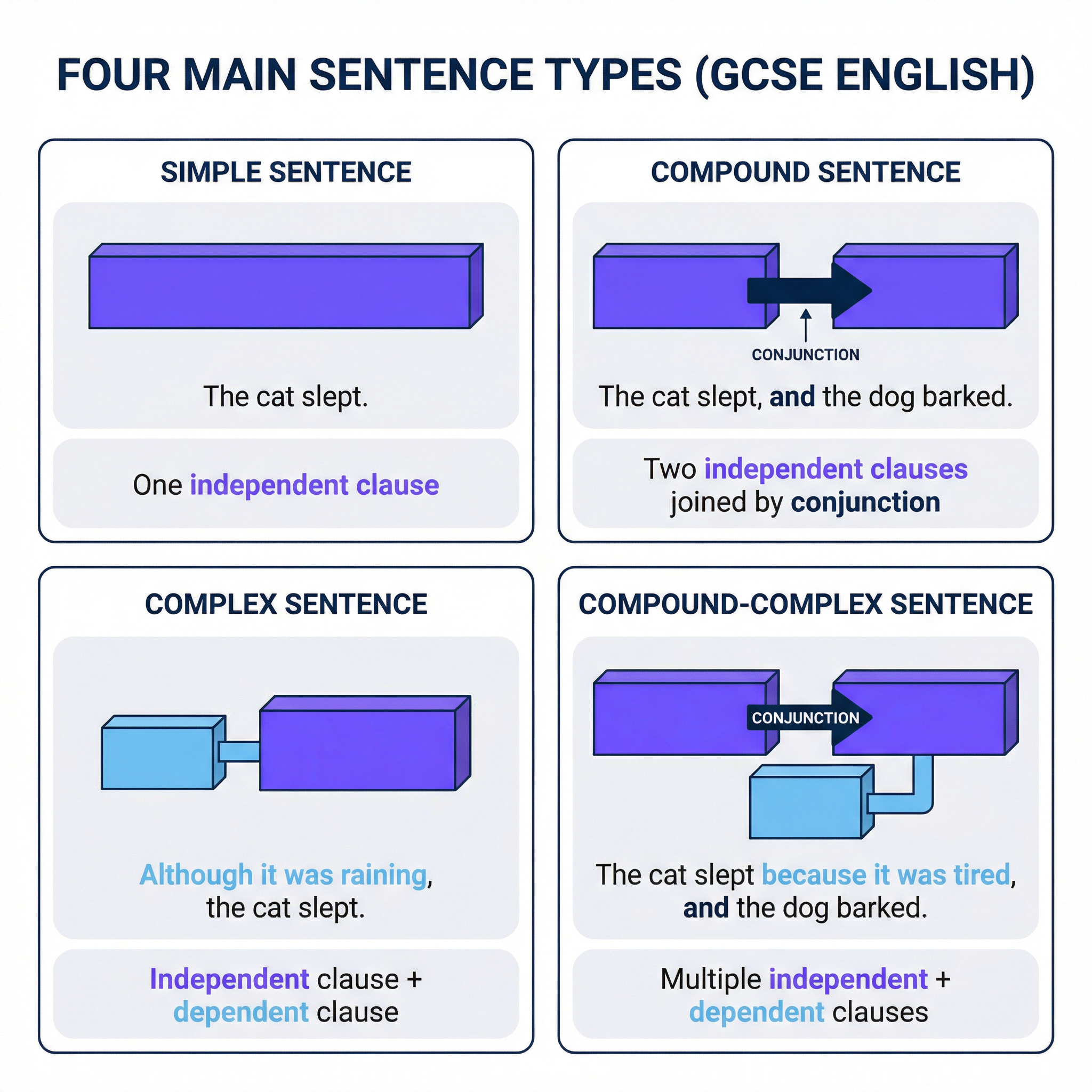
    Diagram of the Four Main Sentence Types.

    Writing Skills

    Crafting Sentences for Effect

    In your own writing (Paper 1 Q5 and Paper 2 Q5), you are assessed on your ability to use a range of sentence structures for effect (AO6). Examiners want to see that you are in control of your writing and making conscious choices.

    Vary Your Sentence Openings: Avoid starting every sentence with 'The' or a character's name. Try these alternatives:

    • Adverb: Suddenly, the lights went out.
    • -ing Verb: Running for the bus, he dropped his wallet.
    • -ed Verb: Exhausted, she collapsed onto the bed.
    • Subordinate Clause: Because the fog was so thick, the cars drove slowly.
    • Prepositional Phrase: In the middle of the night, a floorboard creaked.

    Use Punctuation to Shape Sentences: Higher-level punctuation is a direct route to higher marks in AO6.

    • Semicolon (;): Joins two closely related independent clauses. It shows a more sophisticated link than a simple conjunction. The presentation was a success; the client was delighted.
    • Colon (:): Introduces a list, an explanation, or a quotation. He had one goal in mind: victory.
    • Dash (-): Can be used to add extra information, create a dramatic pause, or show an interruption. The answer – if you could call it that – was completely nonsensical.

    Technical Accuracy (SPaG)

    Avoiding errors is just as important as using sophisticated structures. The most common and heavily penalised error is the comma splice. This is where two independent clauses are joined with only a comma, which is grammatically incorrect.

    • INCORRECT (Comma Splice): The dog barked, the cat ran away.
    • CORRECT (Conjunction): The dog barked, and the cat ran away.
    • CORRECT (Semicolon): The dog barked; the cat ran away.
    • CORRECT (New Sentence): The dog barked. The cat ran away.

    Worked Examples

    3 detailed examples with solutions and examiner commentary

    Practice Questions

    Test your understanding — click to reveal model answers

    Q1

    Identify the sentence type: 'After the party ended, we went home, but the music was still ringing in our ears.'

    2 marks
    foundation

    Hint: Look for independent and dependent clauses, and how they are joined.

    Q2

    Rewrite the following sentence to make it more engaging by changing the opening: 'The boy ran across the field to catch the ball.'

    4 marks
    standard

    Hint: Try starting with an '-ing' verb, an adverb, or a prepositional phrase.

    Q3

    Analyse how the writer uses sentence structure to create a sense of calm in this extract: 'The lake was still. Sunlight dappled the surface, and a gentle breeze whispered through the reeds. Everything was peaceful.'

    6 marks
    standard

    Hint: Comment on the length and type of sentences and link them to the feeling of peacefulness.

    Q4

    Correct the following passage, which contains two comma splices: 'The film was brilliant, I really enjoyed it. My favourite character was the hero, he was very brave.'

    4 marks
    challenging

    Hint: Use a semicolon, a conjunction, or a full stop to fix the splices.

    Q5

    Write a short paragraph describing a busy market scene. You must use at least one simple, one compound, and one complex sentence, as well as a piece of higher-level punctuation (semicolon, colon, or dash).

    8 marks
    challenging

    Hint: Plan your sentences to create a varied and engaging rhythm that reflects the chaotic energy of a market.

    Key Terms

    Essential vocabulary to know

    More English Language Study Guides

    View all

    Analyzing language

    OCR
    GCSE

    This guide focuses on the crucial skill of analyzing language and structure for OCR GCSE English Language. It provides a deep dive into the techniques required to excel in AO2-focused questions, helping candidates move beyond simple feature-spotting to develop insightful, mark-scoring analysis.

    Communicating clearly

    AQA
    GCSE

    This study guide focuses on the essential skill of 'Communicating Clearly' for AQA GCSE English Language. It covers how to adapt your writing for different audiences and purposes (AO5) and how to use grammar, spelling, and punctuation accurately and ambitiously (AO6) to maximise your marks in the writing sections of both exam papers.

    Adapting language for different situations

    OCR
    GCSE

    This guide focuses on the crucial skill of adapting language for different situations (OCR J351, 3.4), which accounts for up to 50% of your exam marks. You will learn to manipulate tone, style, and register for specific audiences and purposes in your own writing (AO5/AO6) and analyse how professional writers achieve these effects (AO2).

    Structuring a presentation effectively

    OCR
    GCSE

    This guide focuses on structuring a presentation effectively for OCR GCSE English Language (Component 02, Section B). It breaks down the key skills of organisation (AO5) and technical accuracy (AO6) needed to achieve top marks by crafting a cohesive, convincing, and rhetorically powerful speech.

    Delivering a Formal Presentation

    WJEC
    GCSE

    This guide focuses on the crucial skill of writing for a specific audience and purpose, as assessed in WJEC GCSE English Language Unit 3.1. Candidates will learn how to craft a formal presentation that sounds authentic, persuasive, and structurally sophisticated, securing top marks in AO5 and AO6.

    Evaluating the effectiveness of writing

    Edexcel
    GCSE

    This study guide focuses on the crucial skill of critically evaluating a writer's methods, a key component of Edexcel GCSE English Language Paper 1, Question 4. It provides a framework for constructing a perceptive, high-level response that earns maximum marks by moving beyond simple analysis to sustained, critical judgment.