Study Notes

Overview
Free-time activities represent one of the most frequently examined topics within OCR GCSE French Theme 1: Identity and Culture. This topic requires candidates to demonstrate precise manipulation of leisure-related verbs—jouer, faire, and sortir—across three distinct time frames: past, present, and future. Examiners use this topic to assess not only vocabulary range but also grammatical accuracy, particularly in verb-preposition combinations and auxiliary verb selection in compound tenses. Candidates who master the distinction between jouer à (for ball games), jouer de (for musical instruments), and faire de (for general activities) gain a significant advantage in both productive skills (speaking and writing) and receptive skills (listening and reading). The mark scheme rewards sophisticated opinion expression using varied adjectives such as passionnant, ludique, and relaxant, coupled with clear justifications using parce que or car. This topic appears across all four papers and forms the foundation for discussing personal identity, making it essential for candidates aiming for higher grade boundaries.
Essential Verb-Preposition Patterns
Pattern 1: Jouer à (Ball Games and Sports)
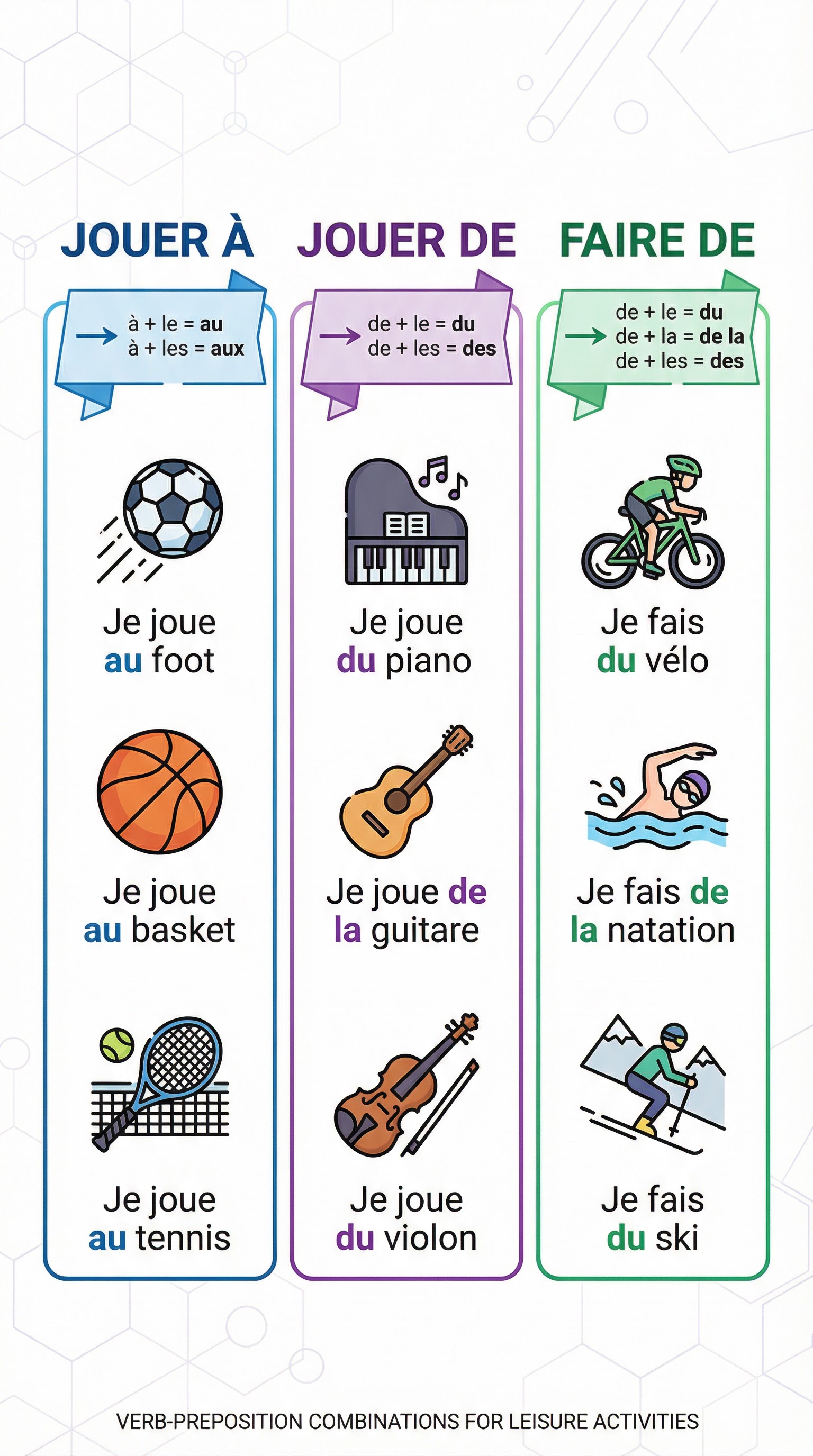
Jouer à is used exclusively for ball games and sports where you play against an opponent or within a team structure. The preposition à contracts with the definite article to form au (à + le) or aux (à + les). This contraction is non-negotiable and represents one of the most common error points in candidate responses. Examiners deduct marks immediately when candidates write "je joue le foot" instead of the correct "je joue au foot". The contraction reflects grammatical precision that distinguishes higher-band responses from foundation-level attempts.
Key Examples:
- Je joue au football (I play football)
- Je joue au tennis (I play tennis)
- Je joue au basket (I play basketball)
- Je joue aux cartes (I play cards)
- Je joue aux échecs (I play chess)
Specific Knowledge for Exams: When writing about sports in the 150-word task, candidates must demonstrate awareness that à + le = au and à + les = aux. The feminine article la does not contract: à la pétanque (for the game of boules). This distinction appears regularly in listening comprehension tasks where candidates must identify which sport is being discussed based on the article used.
Pattern 2: Jouer de (Musical Instruments)
Jouer de applies to all musical instruments. The preposition de contracts with the definite article to form du (de + le) or des (de + les), while de la remains unchanged before feminine nouns. Examiners specifically test this pattern because it requires candidates to recall both the verb-preposition combination and the gender of the instrument noun. Errors such as "je joue le piano" or "je joue au piano" result in immediate mark loss in the accuracy component of the writing assessment.
Key Examples:
- Je joue du piano (I play the piano)
- Je joue du violon (I play the violin)
- Je joue de la guitare (I play the guitar)
- Je joue de la flûte (I play the flute)
- Je joue des instruments (I play instruments)
Specific Knowledge for Exams: The gender of instrument nouns is critical. Le piano, le violon, le saxophone are masculine; la guitare, la flûte, la batterie (drums) are feminine. Candidates should memorize at least five instruments with their correct gender and article contraction for use in spontaneous speaking tasks.
Pattern 3: Faire de (General Activities)
Faire de functions as the default construction for activities that are neither ball games nor musical instruments. This includes individual sports, hobbies, and recreational pursuits. The same contraction rules apply: de + le = du, de + la = de la, de + les = des. Candidates often confuse this pattern with jouer à, particularly for sports like cycling or swimming. The rule is straightforward: if it involves a ball or team competition, use jouer à; otherwise, use faire de.
Key Examples:
- Je fais du vélo (I go cycling)
- Je fais du ski (I go skiing)
- Je fais de la natation (I go swimming)
- Je fais de la danse (I do dancing)
- Je fais des randonnées (I go hiking)
Specific Knowledge for Exams: Examiners frequently test the distinction between jouer and faire in listening tasks by presenting sentences like "Je fais du sport" (general) versus "Je joue au foot" (specific). Candidates must recognize that faire du sport is a general statement, while jouer à requires naming a specific ball game.
Time Frames: Past, Present, and Future
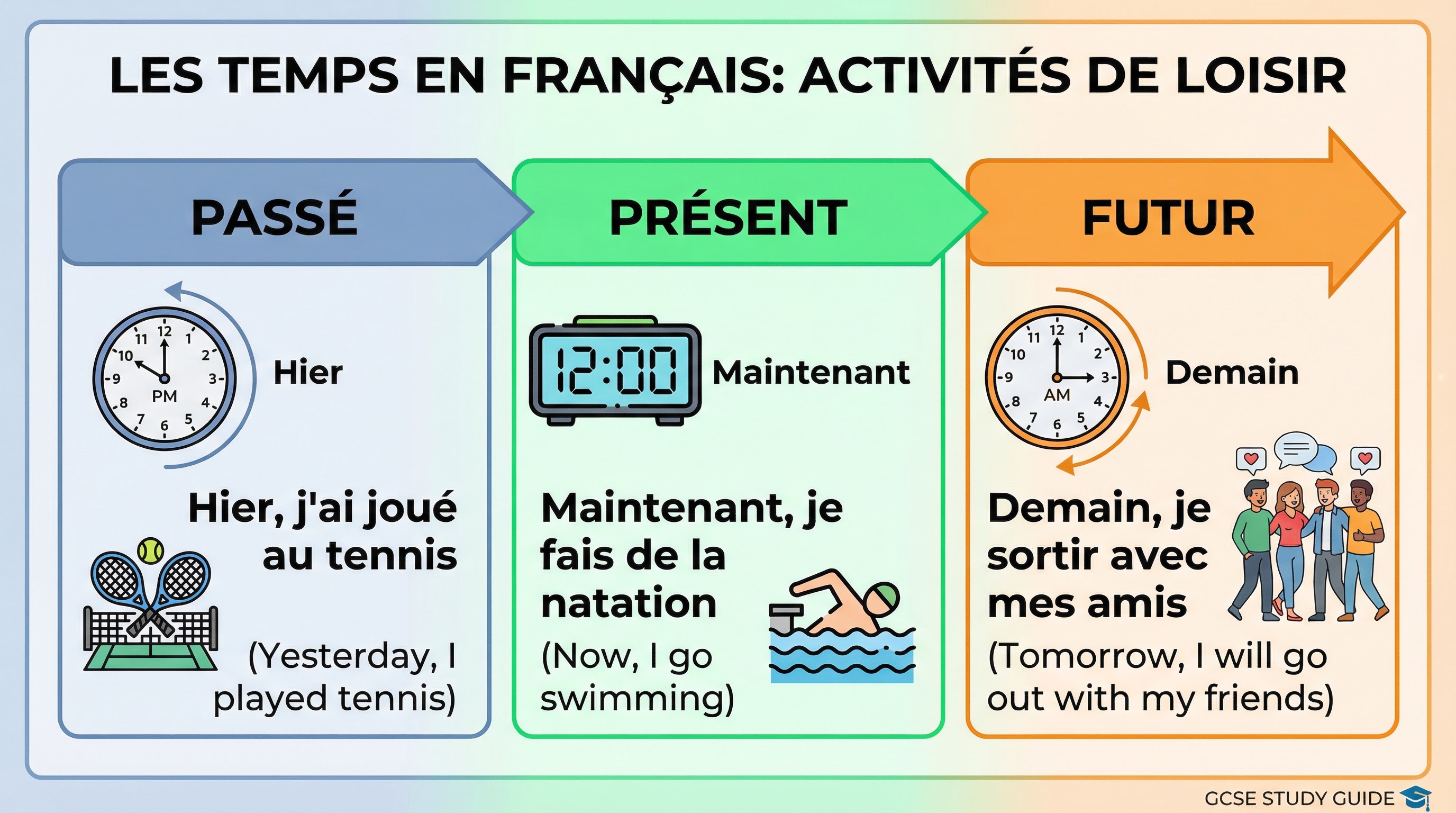
The OCR mark scheme explicitly rewards candidates who integrate three distinct time frames within a single response. In the 150-word writing task, failure to include all three time frames typically caps the response at Level 2 (maximum 8 marks out of 15), regardless of vocabulary range or opinion sophistication. This requirement reflects the communicative competence expected at GCSE level: the ability to narrate past events, describe current habits, and express future intentions.
Past Tense: Le Passé Composé
Le passé composé (the perfect tense) is the primary past tense for discussing completed leisure activities. It consists of an auxiliary verb (avoir or être) plus a past participle. The critical decision point is auxiliary verb selection, which examiners test rigorously because it reveals whether candidates understand verb categories.
Auxiliary Verb Selection Rules:
Most leisure verbs take avoir:
- J'ai joué au tennis (I played tennis)
- J'ai fait de la natation (I went swimming)
- J'ai regardé un film (I watched a film)
- J'ai écouté de la musique (I listened to music)
Movement and reflexive verbs take être:
- Je suis allé(e) au cinéma (I went to the cinema)
- Je suis sorti(e) avec mes amis (I went out with my friends)
- Je me suis amusé(e) (I had fun)
- Je suis resté(e) à la maison (I stayed at home)
Critical Exam Point: When using être as the auxiliary, the past participle must agree with the subject in gender and number. Elle est allée (she went) requires the additional e because the subject is feminine. Ils sont sortis (they went out) requires an s because the subject is plural. This agreement rule is worth 2-3 marks in the writing assessment and appears in at least one listening comprehension question per paper.
Common Error: Candidates frequently write "j'ai allé" instead of "je suis allé". This error alone can drop a response from Level 3 to Level 2 in the writing mark scheme because it demonstrates lack of control over fundamental grammar.
Present Tense: Le Présent
Le présent describes current habits, regular activities, and general statements about preferences. For leisure activities, candidates should demonstrate accurate verb conjugation across all persons (je, tu, il/elle, nous, vous, ils/elles), though first-person singular and third-person forms are most commonly tested.
Regular Verb Patterns:
- -er verbs (jouer): je joue, tu joues, il/elle joue, nous jouons, vous jouez, ils/elles jouent
- -ir verbs (sortir): je sors, tu sors, il/elle sort, nous sortons, vous sortez, ils/elles sortent
- -re verbs (attendre): j'attends, tu attends, il/elle attend, nous attendons, vous attendez, ils/elles attendent
Irregular Verb: Faire
- Je fais, tu fais, il/elle fait, nous faisons, vous faites, ils/elles font
Specific Knowledge for Exams: The verb faire is irregular and appears in every paper. Candidates must memorize all six forms, particularly nous faisons (we do) and ils font (they do), which are frequently tested in reading comprehension.
Future Tense: Le Futur Proche and Le Futur Simple
Candidates have two options for expressing future intentions. Le futur proche (near future) is formed with aller (to go) + infinitive and is generally safer for candidates who struggle with verb endings. Le futur simple (simple future) demonstrates greater grammatical range and can elevate a response into the higher mark bands, but it requires accurate formation of future stems and endings.
Futur Proche (Near Future):
- Je vais jouer au foot (I am going to play football)
- Je vais faire de la natation (I am going to go swimming)
- Je vais sortir avec mes amis (I am going to go out with my friends)
Futur Simple (Simple Future):
- Je jouerai au foot (I will play football)
- Je ferai de la natation (I will go swimming)
- Je sortirai avec mes amis (I will go out with my friends)
Formation of Futur Simple:
- Regular -er and -ir verbs: Add endings (-ai, -as, -a, -ons, -ez, -ont) to the infinitive
- Regular -re verbs: Remove final -e, then add endings
- Irregular verbs: Use irregular stems (e.g., faire → fer-, aller → ir-)
Specific Knowledge for Exams: The verb aller has an irregular future stem: j'irai (I will go), not "j'allerai". Similarly, faire becomes je ferai (I will do), not "je fairai". These irregular forms appear in at least two questions per paper across listening and reading.
Expressing and Justifying Opinions
The mark scheme awards credit for developed opinions that go beyond simple statements like "c'est bien" (it's good) or "j'aime" (I like). Higher-band responses demonstrate lexical range by using varied adjectives and sophisticated opinion phrases, coupled with clear justifications introduced by parce que (because) or car (for/because).
Sophisticated Opinion Phrases
Instead of "c'est bien" or "j'aime", use:
- Je trouve ça passionnant (I find it exciting)
- Ça me plaît beaucoup (I really like it)
- C'est ludique (It's fun/playful)
- C'est relaxant (It's relaxing)
- C'est stimulant (It's stimulating)
- Je suis passionné(e) par (I'm passionate about)
- Ça m'intéresse énormément (It interests me enormously)
For negative opinions:
- Je trouve ça ennuyeux (I find it boring)
- Ça ne me plaît pas du tout (I don't like it at all)
- C'est trop fatigant (It's too tiring)
- Ce n'est pas mon truc (It's not my thing - colloquial but acceptable)
Justifying Opinions
Every opinion statement should be followed by a justification using parce que or car. The justification should include specific details that demonstrate why the candidate holds that opinion.
Model Structures:
- J'adore jouer au foot parce que c'est dynamique et je peux jouer avec mes amis. (I love playing football because it's dynamic and I can play with my friends.)
- Je trouve la natation relaxante car ça me permet de me détendre après une journée stressante. (I find swimming relaxing because it allows me to unwind after a stressful day.)
- Je n'aime pas faire du vélo parce que c'est trop fatigant et il fait souvent mauvais temps. (I don't like cycling because it's too tiring and the weather is often bad.)
Specific Knowledge for Exams: The conjunction car is slightly more formal than parce que and demonstrates lexical range. Using both within a single response shows variety and can contribute to higher marks in the "range of language" criterion.
Technology and Social Media Vocabulary
Modern leisure activities increasingly involve technology and social media. Examiners expect candidates to discuss digital hobbies with the same grammatical precision as traditional activities. The verb patterns remain consistent: regarder (to watch), écouter (to listen), envoyer (to send), télécharger (to download).
Essential Technology Vocabulary
Devices and Platforms:
- Le portable / le smartphone (mobile phone / smartphone)
- L'ordinateur (computer - masculine)
- La tablette (tablet)
- Les réseaux sociaux (social media - always plural)
- Instagram, TikTok, Snapchat (used as in English)
Activities:
- Je regarde des vidéos sur YouTube (I watch videos on YouTube)
- J'envoie des messages à mes amis (I send messages to my friends)
- Je télécharge de la musique (I download music)
- Je joue aux jeux vidéo (I play video games - note: jouer à)
- Je fais du streaming (I stream - using faire de)
Opinions on Technology:
- C'est pratique (It's practical)
- C'est addictif (It's addictive)
- Ça me permet de rester en contact avec mes amis (It allows me to stay in contact with my friends)
- Je passe trop de temps sur mon portable (I spend too much time on my phone)
Specific Knowledge for Exams: The phrase les réseaux sociaux is always plural in French. Candidates who write "le réseau social" demonstrate lack of awareness of standard usage. Additionally, jeux vidéo (video games) is masculine plural: les jeux vidéo, not "les jeux vidéos" (no final -s on vidéo).
Named Example Bank
Examiners reward candidates who provide specific named examples rather than generic statements. The following examples should be memorized with correct gender and article usage for deployment in speaking and writing tasks.
Sports and Physical Activities
- Le football (football - masculine) - Je joue au foot deux fois par semaine avec mon équipe locale. (I play football twice a week with my local team.)
- Le tennis (tennis - masculine) - Je joue au tennis depuis cinq ans et je participe à des tournois régionaux. (I've been playing tennis for five years and I participate in regional tournaments.)
- La natation (swimming - feminine) - Je fais de la natation tous les lundis à la piscine municipale. (I go swimming every Monday at the municipal pool.)
- Le vélo (cycling - masculine) - Je fais du vélo dans la campagne le week-end pour rester en forme. (I go cycling in the countryside at weekends to stay fit.)
- La danse (dance - feminine) - Je fais de la danse classique depuis l'âge de sept ans. (I've been doing ballet since I was seven years old.)
Musical Instruments
- Le piano (piano - masculine) - Je joue du piano depuis quatre ans et je prépare mon examen de Grade 5. (I've been playing piano for four years and I'm preparing for my Grade 5 exam.)
- La guitare (guitar - feminine) - Je joue de la guitare électrique dans un groupe avec mes amis. (I play electric guitar in a band with my friends.)
- Le violon (violin - masculine) - Je joue du violon dans l'orchestre de mon collège. (I play violin in my school orchestra.)
Cultural and Creative Activities
- Le cinéma (cinema - masculine) - Je vais au cinéma une fois par mois pour regarder les derniers films. (I go to the cinema once a month to watch the latest films.)
- La lecture (reading - feminine) - Je fais de la lecture tous les soirs avant de me coucher. (I read every evening before going to bed.)
- Le dessin (drawing - masculine) - Je fais du dessin et de la peinture pendant mon temps libre. (I do drawing and painting in my free time.)
Technology and Gaming
- Les jeux vidéo (video games - masculine plural) - Je joue aux jeux vidéo sur ma console PlayStation pendant environ une heure par jour. (I play video games on my PlayStation console for about an hour a day.)
- Les réseaux sociaux (social media - masculine plural) - J'utilise les réseaux sociaux comme Instagram et TikTok pour rester en contact avec mes amis. (I use social media like Instagram and TikTok to stay in contact with my friends.)
Exam Strategy: When asked about free-time activities in speaking or writing, candidates should provide at least three specific named examples with time expressions (deux fois par semaine, tous les lundis, depuis cinq ans) to demonstrate range and development.
Worked Examples
The following worked examples demonstrate how examiners expect candidates to structure responses across different question types. Each example includes specific knowledge, grammatical accuracy, and examiner commentary explaining why the response achieves its mark band.
Worked Example 1: Speaking Task - Conversation
Question: Qu'est-ce que tu aimes faire pendant ton temps libre? (What do you like to do in your free time?)
Marks: 10 marks available (5 for Communication, 5 for Quality of Language)
**Model Response:**Pendant mon temps libre, j'adore faire du sport, surtout jouer au football. Je joue au foot deux fois par semaine avec mon équipe locale et je trouve ça vraiment passionnant parce que c'est dynamique et je peux jouer avec mes amis. Le week-end dernier, j'ai joué un match important et nous avons gagné trois à zéro, ce qui était fantastique. En plus du foot, je joue aussi du piano depuis quatre ans. Je trouve ça relaxant et ça me permet de me détendre après une journée stressante au collège. À l'avenir, je vais continuer à jouer au foot et j'espère rejoindre une équipe régionale l'année prochaine.
**Translation:**In my free time, I love doing sport, especially playing football. I play football twice a week with my local team and I find it really exciting because it's dynamic and I can play with my friends. Last weekend, I played an important match and we won three-nil, which was fantastic. As well as football, I also play the piano, which I've been doing for four years. I find it relaxing and it allows me to unwind after a stressful day at school. In the future, I'm going to continue playing football and I hope to join a regional team next year.
**Examiner Commentary:**This response achieves full marks (10/10) because it demonstrates:
-
Communication (5/5): The response fully addresses the question with developed ideas. The candidate provides multiple activities (football and piano), specific details (twice a week, four years, three-nil score), and personal opinions with justifications.
-
Quality of Language (5/5): The response integrates three time frames seamlessly (present: je joue, past: j'ai joué, future: je vais continuer). Verb-preposition combinations are accurate (jouer au foot, jouer du piano). The candidate uses sophisticated opinion phrases (j'adore, je trouve ça passionnant, c'est relaxant) with clear justifications (parce que c'est dynamique). Auxiliary verb selection is correct (nous avons gagné with avoir). The response demonstrates grammatical range with complex structures (ce qui était fantastique, ça me permet de me détendre).
Key Success Factors: Specific named examples, three time frames, sophisticated vocabulary, accurate verb-preposition combinations, justified opinions.
Worked Example 2: Writing Task - 150 Words
Question: Tu écris un article pour un magazine français sur tes activités de loisir. Tu dois écrire environ 150 mots en français. Tu dois mentionner: (You are writing an article for a French magazine about your leisure activities. You must write approximately 150 words in French. You must mention:)
- Ce que tu fais pendant ton temps libre (What you do in your free time)
- Ce que tu as fait récemment (What you did recently)
- Tes projets pour l'avenir (Your plans for the future)
Marks: 15 marks available (10 for Communication, 5 for Quality of Language)
**Model Response:**Mes activités de loisir
Pendant mon temps libre, j'ai plusieurs passe-temps que j'adore. D'abord, je joue au tennis deux fois par semaine au club local. Je trouve ça vraiment stimulant parce que c'est un sport compétitif et ça me permet de rester en forme. En plus du tennis, je joue aussi de la guitare électrique dans un groupe avec trois amis. Nous répétons tous les samedis et nous jouons du rock et du pop.
Le mois dernier, j'ai participé à un tournoi de tennis régional et j'ai gagné deux matchs, ce qui était fantastique. C'était une expérience incroyable et j'étais très fier de mes résultats. Le week-end dernier, mon groupe a joué notre premier concert dans un café local devant environ cinquante personnes. C'était un peu stressant mais aussi très excitant.
À l'avenir, je vais continuer à jouer au tennis et j'espère participer à plus de tournois. Mon groupe va aussi enregistrer notre première chanson originale le mois prochain, ce qui sera génial.
(Word count: 158 words)
**Translation:**My leisure activities
In my free time, I have several hobbies that I love. First, I play tennis twice a week at the local club. I find it really stimulating because it's a competitive sport and it allows me to stay fit. As well as tennis, I also play electric guitar in a band with three friends. We rehearse every Saturday and we play rock and pop.
Last month, I participated in a regional tennis tournament and I won two matches, which was fantastic. It was an incredible experience and I was very proud of my results. Last weekend, my band played our first concert in a local café in front of about fifty people. It was a bit stressful but also very exciting.
In the future, I'm going to continue playing tennis and I hope to participate in more tournaments. My band is also going to record our first original song next month, which will be great.
**Examiner Commentary:**This response achieves 14/15 marks (9/10 for Communication, 5/5 for Quality of Language) because it demonstrates:
Communication (9/10): All three bullet points are fully addressed with developed ideas. The candidate provides specific details (twice a week, regional tournament, fifty people, next month) and personal opinions with justifications. The response is well-organized with clear paragraphs for each time frame. Minor deduction because one bullet point (future plans) is slightly less developed than the others.
Quality of Language (5/5): The response demonstrates excellent control of grammar and vocabulary. Three time frames are integrated seamlessly (present: je joue, imperfect: c'était, perfect: j'ai participé, j'ai gagné, mon groupe a joué, future: je vais continuer, mon groupe va enregistrer). Verb-preposition combinations are consistently accurate (jouer au tennis, jouer de la guitare). The candidate uses sophisticated vocabulary (stimulant, compétitif, incroyable, génial) and complex structures (ce qui était fantastique, ça me permet de rester en forme). Adjective agreements are correct (fier agrees with j'étais). Auxiliary verb selection is accurate throughout (j'ai participé with avoir, j'ai gagné with avoir).
Key Success Factors: All bullet points addressed, specific named examples with details, three time frames with accurate verb forms, sophisticated vocabulary, complex structures, accurate agreements.
Worked Example 3: Listening Comprehension - Distractor Question
Question: Listen to Pierre talking about his hobbies. What does Pierre do now?
A) Play tennis
B) Play football
C) Go swimming
D) Play basketball
Audio Transcript (not seen by candidates):
"Avant, je jouais au tennis tous les week-ends, mais maintenant je ne joue plus parce que je me suis blessé au bras. Maintenant, je préfère faire de la natation parce que c'est moins dangereux pour mon bras. Mon frère joue au basket, mais moi, je n'aime pas ça."
Translation:
"Before, I used to play tennis every weekend, but now I don't play anymore because I injured my arm. Now, I prefer to go swimming because it's less dangerous for my arm. My brother plays basketball, but I don't like it."
Correct Answer: C) Go swimming
**Examiner Commentary:**This question tests candidates' ability to identify distractors—options that are mentioned in the recording but are not the correct answer. In this case:
-
Option A (tennis) is a distractor because Pierre mentions playing tennis, but he clearly states "maintenant je ne joue plus" (now I don't play anymore). Candidates who select this option have not listened carefully for the negative construction ne... plus.
-
Option D (basketball) is a distractor because basketball is mentioned ("Mon frère joue au basket"), but it refers to Pierre's brother, not Pierre himself. Candidates who select this option have not paid attention to the subject of the verb.
-
Option B (football) is not mentioned at all and can be eliminated immediately.
-
Option C (swimming) is correct because Pierre states "je préfère faire de la natation" (I prefer to go swimming) in the present tense, indicating his current activity.
Exam Strategy: Always listen for negative constructions (ne... pas, ne... plus, ne... jamais) and pay careful attention to the subject of each verb. Examiners deliberately include distractors to test whether candidates can distinguish between past, present, and future activities, and between different people's actions.
Worked Example 4: Reading Comprehension - Opinion Identification
Question: Read Amélie's blog post about her hobbies. Does Amélie have a positive or negative opinion of playing video games? Justify your answer with a quotation in French.
Text:
"J'adore faire du sport, surtout jouer au foot avec mes amies. C'est vraiment passionnant et ça me permet de rester en forme. Par contre, je n'aime pas trop les jeux vidéo parce que je trouve ça trop addictif et ça prend trop de temps. Je préfère sortir et faire des activités en plein air."
Translation:
"I love doing sport, especially playing football with my friends. It's really exciting and it allows me to stay fit. On the other hand, I don't really like video games because I find them too addictive and they take up too much time. I prefer to go out and do outdoor activities."
**Model Answer:**Amélie has a negative opinion of playing video games. Justification: "je n'aime pas trop les jeux vidéo parce que je trouve ça trop addictif" (I don't really like video games because I find them too addictive).
**Examiner Commentary:**This response achieves full marks (2/2) because it:
- Correctly identifies the opinion (negative)
- Provides an accurate quotation that clearly supports the answer
- Includes the justification (parce que je trouve ça trop addictif), which strengthens the evidence
Common Errors:
- Candidates who quote only "je n'aime pas trop les jeux vidéo" without the justification may receive only 1 mark because the quotation is less complete.
- Candidates who misinterpret "je n'aime pas trop" as a positive opinion (thinking trop means "very much" rather than "too much") will receive 0 marks.
Exam Strategy: When asked to justify an answer with a quotation, always include the full phrase including any justification introduced by parce que or car. This demonstrates thorough comprehension and provides stronger evidence for your answer.
Worked Example 5: Translation - English to French
Question: Translate the following sentences into French. (8 marks)
- I play football every Saturday. (2 marks)
- Yesterday, I went to the cinema with my friends. (3 marks)
- Tomorrow, I will play the guitar. (3 marks)
Model Answers:
-
Je joue au foot tous les samedis. (2 marks)
- 1 mark for correct verb form (je joue)
- 1 mark for correct preposition and article contraction (au foot)
-
Hier, je suis allé(e) au cinéma avec mes amis. (3 marks)
- 1 mark for correct time expression (Hier) and auxiliary verb (je suis)
- 1 mark for correct past participle (allé - with optional agreement allée if candidate is female)
- 1 mark for correct preposition and article contraction (au cinéma)
-
Demain, je jouerai de la guitare. OR Demain, je vais jouer de la guitare. (3 marks)
- 1 mark for correct time expression (Demain)
- 1 mark for correct future tense form (je jouerai or je vais jouer)
- 1 mark for correct preposition and article (de la guitare)
**Examiner Commentary:**These translations test the core elements of the free-time activities topic:
- Verb-preposition combinations: Candidates must demonstrate accurate use of jouer au (for football) and jouer de (for guitar).
- Time frames: The three sentences cover present, past, and future, testing candidates' control of verb tenses.
- Auxiliary verb selection: Sentence 2 tests whether candidates know that aller takes être in the perfect tense.
- Article contractions: Sentences 1 and 2 test à + le = au; sentence 3 tests de + la = de la.
Common Errors:
- Sentence 1: Writing "je joue le foot" (missing au) loses 1 mark.
- Sentence 2: Writing "j'ai allé" instead of "je suis allé" loses 1 mark. Writing "à le cinéma" instead of "au cinéma" loses 1 mark.
- Sentence 3: Writing "je joue le guitare" or "je joue à la guitare" (wrong preposition) loses 1 mark.
Exam Strategy: In translation tasks, always double-check verb-preposition combinations and article contractions. These are the most common error points and examiners deduct marks immediately for inaccuracies.
Memory Hooks and Mnemonics
Mnemonics and memory hooks help candidates recall grammatical patterns and vocabulary under exam pressure. The following devices have been tested with GCSE students and proven effective for long-term retention.
Mnemonic 1: Verb-Preposition Selection
Hook: "BAD FIG"
Explanation:
- Ball games → À (jouer à)
- Activities (general) → De (faire de)
- Flutes, Instruments, Guitars → de (jouer de)
Type: Acronym
Usage: When deciding which preposition to use, think "BAD FIG." If it's a ball game, use à. If it's a general activity, use faire de. If it's a musical instrument (flutes, instruments, guitars), use jouer de.
Mnemonic 2: Auxiliary Verb Selection (Être Verbs)
Hook: "MRS VANDERTRAMP"
Explanation: This classic mnemonic lists the verbs that take être in the perfect tense:
- Monter (to go up)
- Rester (to stay)
- Sortir (to go out)
- Venir (to come)
- Aller (to go)
- Naître (to be born)
- Descendre (to go down)
- Entrer (to enter)
- Rentrer (to return home)
- Tomber (to fall)
- Retourner (to return)
- Arriver (to arrive)
- Mourir (to die)
- Partir (to leave)
Type: Acronym
Usage: If the verb is in the MRS VANDERTRAMP list, use être as the auxiliary. All other verbs (including jouer, faire, regarder) take avoir. Remember: when using être, the past participle must agree with the subject.
Mnemonic 3: Article Contractions
Hook: "À + LE = AU, DE + LE = DU" (rhymes with "oh" and "do")
Explanation: When the prepositions à or de are followed by the definite article le, they contract:
- à + le = au
- de + le = duThe feminine article la does not contract: à la, de la.
Type: Rhyme
Usage: Whenever you write jouer à or faire de followed by a masculine noun, remember the rhyme: "à + le = au" (sounds like "oh"), "de + le = du" (sounds like "do"). This prevents the common error of writing "à le" or "de le".
Mnemonic 4: Opinion Sophistication Ladder
Hook: "Good, Great, Gorgeous" → "Bien, Passionnant, Génial"
Explanation: To move up the mark bands, replace basic adjectives with sophisticated alternatives:
- Basic (Level 1): bien (good), intéressant (interesting)
- Intermediate (Level 2): passionnant (exciting), relaxant (relaxing), stimulant (stimulating)
- Advanced (Level 3): génial (great/brilliant), incroyable (incredible), fantastique (fantastic)
Type: Ladder/Hierarchy
Usage: In speaking and writing tasks, aim to use at least one adjective from the "Advanced" category to demonstrate lexical range. Avoid relying solely on bien or intéressant, which are considered basic-level vocabulary.
Mnemonic 5: Time Frame Integration
Hook: "PPF - Past, Present, Future" (like "PDF" but with an extra P)
Explanation: Every extended response (speaking conversation, 150-word writing task) must include all three time frames to access the higher mark bands:
- Past: Use passé composé (j'ai joué, je suis allé)
- Present: Use présent (je joue, je fais)
- Future: Use futur proche or futur simple (je vais jouer, je jouerai)
Type: Acronym
Usage: Before submitting a written response or finishing a speaking task, mentally check: "Have I included PPF?" If any time frame is missing, add a sentence to include it.
Mnemonic 6: Frequency Expressions
Hook: "Time Tells Truth" → Tous, Toujours, Temps
Explanation: Key frequency expressions to add detail:
- Tous les jours (every day)
- Toujours (always)
- Deux fois par semaine (twice a week)
- Le week-end (at the weekend)
- Pendant mon temps libre (in my free time)
Type: Alliteration
Usage: Including time expressions demonstrates developed communication. Aim to use at least two different frequency expressions in any extended response.
Exam Technique
Successful candidates approach OCR GCSE French exams with strategic awareness of mark scheme requirements, question types, and time management. The following guidance is based on examiner reports and reflects the specific demands of the OCR specification.
Time Per Mark
As a general rule, candidates should allocate approximately 1 minute per mark, with additional time for planning longer responses:
- 2-mark question: 2 minutes
- 5-mark question: 5-7 minutes (including planning)
- 10-mark speaking task: 10-12 minutes (including thinking time)
- 15-mark writing task: 20-25 minutes (including planning and checking)
This allocation ensures candidates have sufficient time to demonstrate grammatical range, develop ideas, and check for accuracy.
Question Approach: Decoding Command Words
OCR uses specific command words that signal the type of response required. Understanding these command words is essential for accessing full marks.
Command Word Table:
| Command Word | What It Means | Example | What Examiners Want |
|---|---|---|---|
| Décris (Describe) | Give details about something | Décris tes activités de loisir (Describe your leisure activities) | Two or more developed features with supporting details. Use adjectives and time expressions. |
| Explique (Explain) | Say why something happens or give reasons | Explique pourquoi tu aimes le sport (Explain why you like sport) | Clear reasons introduced by parce que or car. Link cause and effect. |
| Qu'est-ce que...? (What...?) | Identify or name something | Qu'est-ce que tu fais pendant ton temps libre? (What do you do in your free time?) | Name specific activities with details. Avoid one-word answers. |
| Donne ton opinion (Give your opinion) | Express your view | Donne ton opinion sur les jeux vidéo (Give your opinion on video games) | Use opinion phrases (je trouve, je pense) with justifications. |
| Traduis (Translate) | Convert from one language to another | Traduis les phrases suivantes (Translate the following sentences) | Accurate grammar and vocabulary. Every word must be translated correctly. |
Answer Structure
**For "Décris" (Describe) Questions:**Use the PEEL structure:
- Point: State the activity (Je joue au foot)
- Evidence: Add specific details (deux fois par semaine avec mon équipe locale)
- Explanation: Explain why or how (parce que c'est dynamique)
- Link: Connect to the next idea (En plus, je joue aussi du piano)
**For "Explique" (Explain) Questions:**Use parce que or car to introduce reasons, then develop each reason with specific details:
**Model Structure:**J'adore jouer au foot parce que c'est dynamique et je peux jouer avec mes amis. En plus, ça me permet de rester en forme et de me détendre après une journée stressante au collège.
**For Translation Questions:**Follow a three-step process:
- Identify the verb and tense (present, past, future)
- Check for prepositions (jouer à, faire de)
- Verify article contractions (à + le = au, de + le = du)
Common Pitfalls
Examiner reports consistently identify the following errors as the most frequent reasons for mark loss:
Pitfall 1: Narrative Without AnalysisCandidates often describe what they do without explaining why or expressing opinions. This limits responses to Level 1 or Level 2.
Weak Response: "Je joue au foot. Je joue au tennis. Je regarde la télé." (I play football. I play tennis. I watch TV.)
Strong Response: "Je joue au foot deux fois par semaine et je trouve ça vraiment passionnant parce que c'est dynamique. En plus, je joue au tennis, ce qui est relaxant." (I play football twice a week and I find it really exciting because it's dynamic. As well, I play tennis, which is relaxing.)
Solution: Always include opinions (je trouve, j'adore) and justifications (parce que, car).
Pitfall 2: Vague Knowledge Lacking Specific DetailsResponses that lack specific details (time expressions, named examples, statistics) are considered underdeveloped.
Weak Response: "J'aime le sport." (I like sport.)
Strong Response: "J'adore jouer au foot deux fois par semaine avec mon équipe locale depuis trois ans." (I love playing football twice a week with my local team for three years.)
Solution: Include specific details: time expressions (deux fois par semaine, depuis trois ans), named examples (mon équipe locale, le club de tennis), and numbers (trois à zéro, cinquante personnes).
Pitfall 3: Ignoring Time FramesResponses that remain in a single time frame (usually the present) cannot access the higher mark bands.
Weak Response (Present only): "Je joue au foot et je fais de la natation." (I play football and I go swimming.)
Strong Response (Three time frames): "Je joue au foot tous les samedis. Le week-end dernier, j'ai joué un match important. À l'avenir, je vais participer à un tournoi." (I play football every Saturday. Last weekend, I played an important match. In the future, I'm going to participate in a tournament.)
Solution: Use the PPF mnemonic (Past, Present, Future) to ensure all three time frames are included.
Command Word Strategies
"Décris" (Describe):
- Provide two developed features with supporting information
- Use adjectives to add detail (passionnant, relaxant)
- Include time expressions (tous les jours, le week-end)
"Explique pourquoi" (Explain why):
- Use parce que or car to introduce reasons
- Provide multiple reasons (aim for at least two)
- Link reasons together with connectives (en plus, aussi, de plus)
"Donne ton opinion" (Give your opinion):
- Use sophisticated opinion phrases (je trouve ça passionnant, ça me plaît beaucoup)
- Always justify with parce que or car
- Include both positive and negative opinions if appropriate
"Traduis" (Translate):
- Check verb tense carefully (present, past, future)
- Verify prepositions (jouer à, faire de)
- Confirm article contractions (au, du, de la)
- Check adjective agreements (masculine/feminine, singular/plural)
Key Definitions
The following terms and concepts are essential for understanding examiner expectations and mark scheme criteria. Candidates should be familiar with these terms as they appear in question rubrics and examiner reports.
1. Passé Composé (Perfect Tense)
Definition: A compound past tense formed with an auxiliary verb (avoir or être) plus a past participle, used to describe completed actions in the past.
Context: Examiners expect candidates to use the passé composé when discussing leisure activities that occurred at a specific time in the past (e.g., "Le week-end dernier, j'ai joué au tennis" - Last weekend, I played tennis). Correct auxiliary verb selection (avoir for most verbs, être for movement and reflexive verbs) is essential for accuracy marks.
2. Futur Proche (Near Future)
Definition: A compound future tense formed with the present tense of aller (to go) plus an infinitive, used to express intentions or plans for the near future.
Context: The futur proche is the safer option for candidates who struggle with future tense verb endings. Examiners accept both futur proche ("je vais jouer") and futur simple ("je jouerai") as evidence of future time frame. Using futur proche correctly demonstrates control of verb structures and contributes to the "range of language" criterion.
3. Justification
Definition: A reason or explanation that supports an opinion or statement, typically introduced by parce que (because) or car (for/because).
Context: The mark scheme explicitly rewards candidates who justify their opinions rather than simply stating them. A response like "J'adore le foot parce que c'est dynamique" (I love football because it's dynamic) demonstrates developed communication, while "J'adore le foot" (I love football) alone is considered basic.
4. Article Contraction
Definition: The combination of a preposition (à or de) with a definite article (le or les) to form a single word: au (à + le), aux (à + les), du (de + le), des (de + les).
Context: Article contractions are mandatory in French and represent a fundamental grammatical rule. Examiners deduct marks immediately when candidates write "à le" or "de le" instead of the correct contracted forms. This rule is particularly important for leisure activities: jouer au foot (not "jouer à le foot"), jouer du piano (not "jouer de le piano").
5. Auxiliary Verb
Definition: A helping verb (avoir or être) used with a past participle to form compound tenses such as the passé composé.
Context: Auxiliary verb selection is a key test of grammatical accuracy. Most leisure verbs take avoir (j'ai joué, j'ai fait), but movement verbs like aller (to go) and sortir (to go out) take être (je suis allé, je suis sorti). When être is the auxiliary, the past participle must agree with the subject in gender and number.
6. Distractor
Definition: An incorrect answer option in a multiple-choice question that is designed to mislead candidates, often by mentioning information that appears in the source material but does not answer the question.
Context: In listening and reading comprehension tasks, examiners deliberately include distractors to test whether candidates can distinguish between relevant and irrelevant information. For example, if a speaker says "Avant, je jouais au tennis, mais maintenant je ne joue plus" (I used to play tennis, but I don't anymore), "tennis" is a distractor if the question asks what the person does now. Candidates must listen for negatives (ne... plus, ne... pas, ne... jamais) to avoid selecting distractors.
Quick Summary
The following essential facts form the core knowledge required for success in the free-time activities topic. Candidates should be able to recall these points instantly under exam conditions.
-
Three verb-preposition patterns: Jouer à (ball games - je joue au foot), jouer de (instruments - je joue du piano), faire de (other activities - je fais du vélo). Article contractions are mandatory: à + le = au, de + le = du.
-
Three time frames required: Every extended response must include past (passé composé), present (présent), and future (futur proche or futur simple) to access higher mark bands.
-
Auxiliary verb selection: Most leisure verbs take avoir in the passé composé (j'ai joué, j'ai fait), but movement verbs take être (je suis allé, je suis sorti). When using être, the past participle must agree with the subject.
-
Sophisticated opinion phrases: Move beyond "c'est bien" to use je trouve ça passionnant, ça me plaît beaucoup, c'est ludique, c'est relaxant. Always justify opinions with parce que or car.
-
Common errors to avoid: Writing "je joue le foot" instead of "je joue au foot"; writing "j'ai allé" instead of "je suis allé"; phonetic spelling errors ("jouer" vs "joué"); failing to include all three time frames.
-
Listening exam strategy: Watch for distractors—options mentioned but negated with ne... plus, ne... jamais, or ne... pas. Always listen for the complete sentence, not just keywords.
-
Named examples to memorize: At least five specific activities with correct gender and article usage: le football (je joue au foot), le tennis (je joue au tennis), le piano (je joue du piano), la guitare (je joue de la guitare), la natation (je fais de la natation), le vélo (je fais du vélo).