Study Notes

Overview
This study guide focuses on Theme 3 of the OCR GCSE French specification: Current and future study and employment. Specifically, we will cover the sub-topic of 'Life at school/college'. Examiners expect candidates to be able to discuss their school, subjects, rules, and future plans with a high degree of accuracy and complexity. This involves not just knowing vocabulary, but also deploying a range of grammatical structures, including different tenses and complex sentences. Marks are awarded for demonstrating the ability to give and justify opinions, describe people and places, and narrate events in the past, present, and future. This guide will equip you with the specific knowledge and skills required to excel in all four assessment objectives (AOs) for this topic.
Key Language & Structures
Describing Your School & Subjects
What you need to know: Candidates must be able to name their school subjects and provide detailed opinions on them. You should also be able to describe the school's facilities.
Why it matters: This is a foundational skill for this topic. It allows you to showcase your vocabulary range and your ability to construct sentences with adjectival agreements and connectives. High credit is given for justified opinions.
Specific Knowledge:
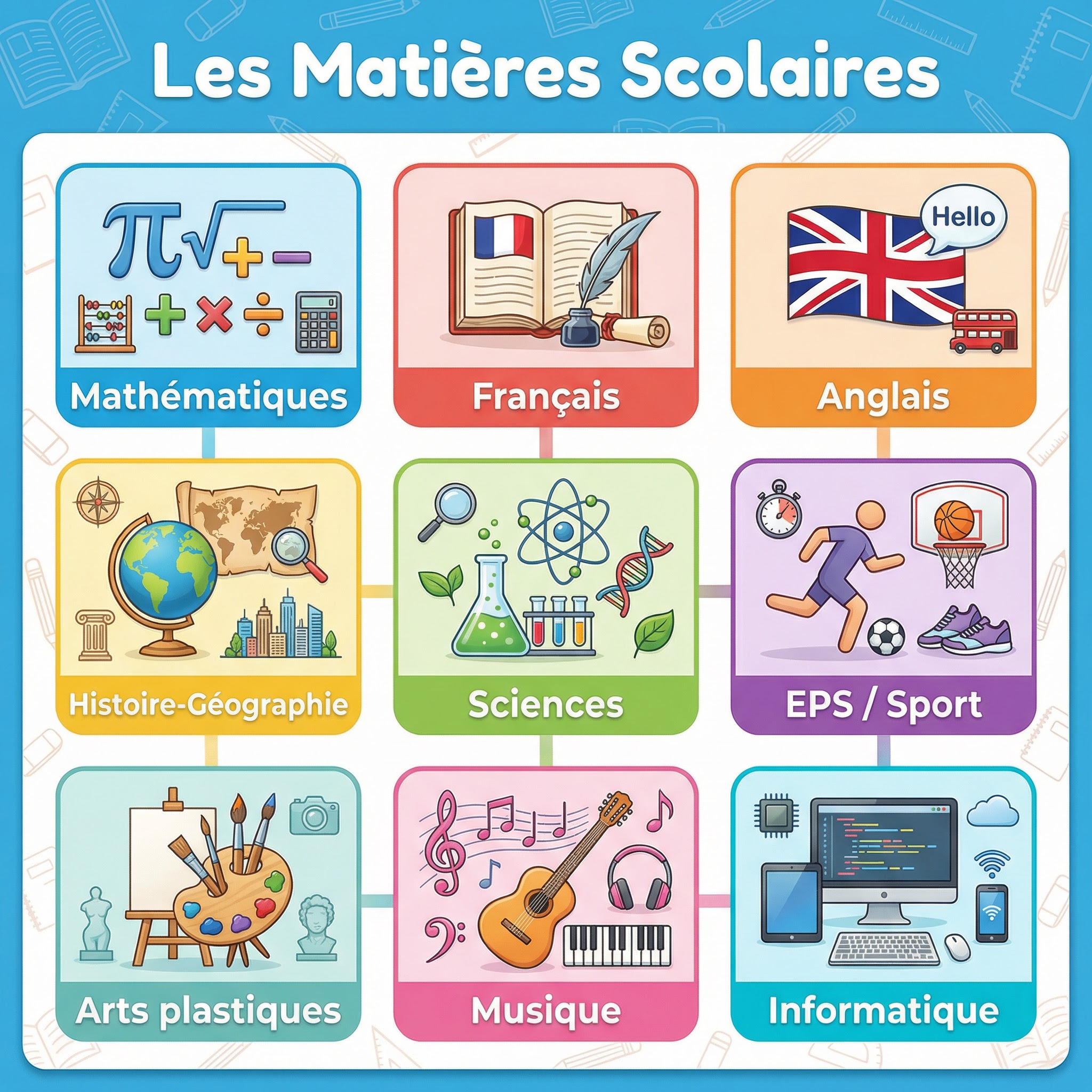
- Subjects (Les matières): le français, l'anglais, les mathématiques (les maths), les sciences, l'histoire-géographie, l'EPS (l'éducation physique et sportive), la musique, le dessin, la technologie.
- Opinions: J'adore, j'aime, je n'aime pas, je déteste, je suis fort(e) en, je suis faible en, je trouve ça fascinant/ennuyeux/difficile/facile.
- Justifications: car, parce que, puisque, étant donné que c'est... (because, since, given that it is...)
- Facilities (Les installations): la salle de classe, la bibliothèque, le laboratoire, la cantine, le gymnase, la cour de récréation, le terrain de sport.
Discussing School Rules
What you need to know: You must be able to understand and express school rules, both what is obligatory and what is forbidden.
Why it matters: This is a prime opportunity to use high-level grammatical structures that impress examiners, such as modal verbs and impersonal verbs.
Specific Knowledge:
- Structures: Il faut + infinitive (One must...), Il est interdit de + infinitive (It is forbidden to...), On doit + infinitive (We have to...), On ne peut pas + infinitive (We cannot...).
- Example Rules: Il faut porter l'uniforme scolaire. Il est interdit d'utiliser son portable en classe. On ne doit pas mâcher de chewing-gum.
Narrating School Events in Three Tenses
What you need to know: A key requirement for higher marks is the ability to use the past, present, and future tenses accurately and appropriately.
Why it matters: This demonstrates grammatical control and allows for more sophisticated and detailed responses in both speaking and writing tasks.
Specific Knowledge:
- Present (Le présent): For routines and current situations. Normalement, j'ai cinq cours par jour. (Normally, I have five lessons a day.)
- Past (Le passé composé): For specific, completed events. Hier, j'ai passé un examen de maths. (Yesterday, I took a maths exam.)
- Imperfect (L'imparfait): For descriptions and habitual actions in the past. Quand j'étais plus jeune, mon école était plus petite. (When I was younger, my school was smaller.)
- Future (Le futur simple / Le futur proche): For future plans and aspirations. L'année prochaine, je vais étudier la biologie. Plus tard, je serai médecin. (Next year, I'm going to study biology. Later, I will be a doctor.)

Second-Order Concepts (Language Skills Focus)
Justification & Elaboration
[Instead of causation, language learning requires justification. Candidates must move beyond simple statements to explaining why. For example, instead of 'J'aime le français', a better response is 'J'aime le français parce que c'est une belle langue et j'espère visiter Paris un jour.' This demonstrates a greater command of the language.]
Accuracy
[Grammatical accuracy is paramount. This includes correct verb conjugations, adjectival agreements (e.g., la prof est sympa vs le prof est sympa), and correct use of articles (le/la/les). Marks are explicitly awarded for Quality of Language.]
Variety & Range
[To access the highest marks, candidates must demonstrate a wide range of vocabulary and grammatical structures. Avoid repeating the same simple phrases. Instead of always using 'c'est bien', use synonyms like 'c'est super, c'est génial, c'est chouette'.]
Spontaneity & Fluency (Speaking)
[In the speaking exam, examiners are looking for a natural flow of conversation. While preparation is key, avoid sounding robotic. Use fillers like 'alors', 'euh', and 'ben' to sound more authentic.]
Source Skills (Text Handling)
[In French, 'sources' are authentic texts, such as articles, emails, or blog posts that appear in the reading exam. To handle these effectively, first, skim the text to understand the gist (overall meaning). Second, read the questions carefully and underline the key words. Third, scan the text to locate the specific information needed to answer each question. Beware of 'distractors' – words or phrases in the text designed to mislead you. The answer is often a synonym or paraphrase of the text, not a direct lift.]"