Structuring sentences and paragraphs

    OCR
    GCSE
    French

    This study guide focuses on mastering sentence and paragraph structure for the OCR GCSE French writing exam (J720). It provides a detailed breakdown of how to use complex grammatical structures, manipulate time frames, and use idiomatic language to achieve top marks in the 90-word and 150-word tasks.

    3
    Min Read
    3
    Examples
    5
    Questions
    6
    Key Terms
    🎙 Podcast Episode
    Structuring sentences and paragraphs
    0:00-0:00

    Study Notes

    Header image for Structuring Sentences and Paragraphs

    Overview

    This guide is designed to equip candidates with the skills to excel in the OCR GCSE French Writing component (J720), which is weighted at 100% for Assessment Objective 4 (AO4): Quality of language. Examiners are looking for candidates who can demonstrate a confident manipulation of grammar and syntax to produce clear, coherent, and complex written French. This involves moving beyond simple sentence structures to incorporate a variety of tenses, complex clauses, and idiomatic expressions. Mastery in this area is the key to unlocking the top mark bands in both the 90-word and 150-word tasks.

    Key Grammatical Concepts

    The Tick-Tock Method: Mastering Time Frames

    To demonstrate linguistic range, candidates MUST show they can write accurately in the past, present, and future. This is a non-negotiable requirement for higher marks.

    What to do: Ensure your written work contains at least one clear example of each time frame.

    Why it matters: It shows the examiner you can control verb conjugations across different temporal contexts, a core component of AO4.
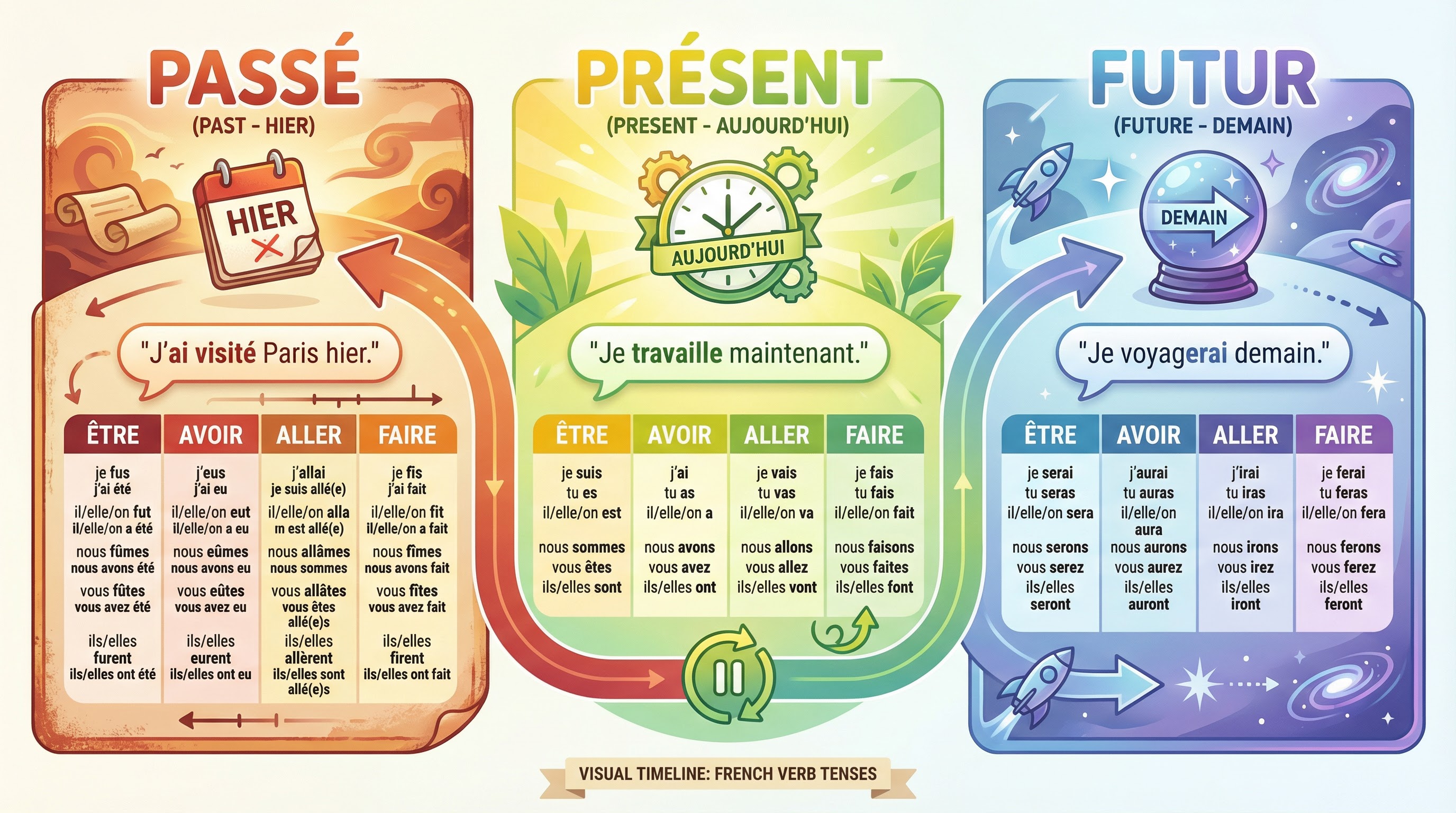
    French Verb Tense Timeline

    Building Complexity: Beyond Simple Sentences

    Credit is given for using structures that show a higher level of linguistic competence. These are your tools for adding flair and sophistication.

    Key Structures:

    • avant de + infinitive: e.g., Avant de sortir, j'ai fini mes devoirs. (Before going out, I finished my homework.)
    • si clauses: e.g., Si j'ai le temps, je visiterai le musée. (If I have time, I will visit the museum.)
    • Relative Pronouns (qui, que): e.g., J'ai un ami qui habite à Lyon. (I have a friend who lives in Lyon.)
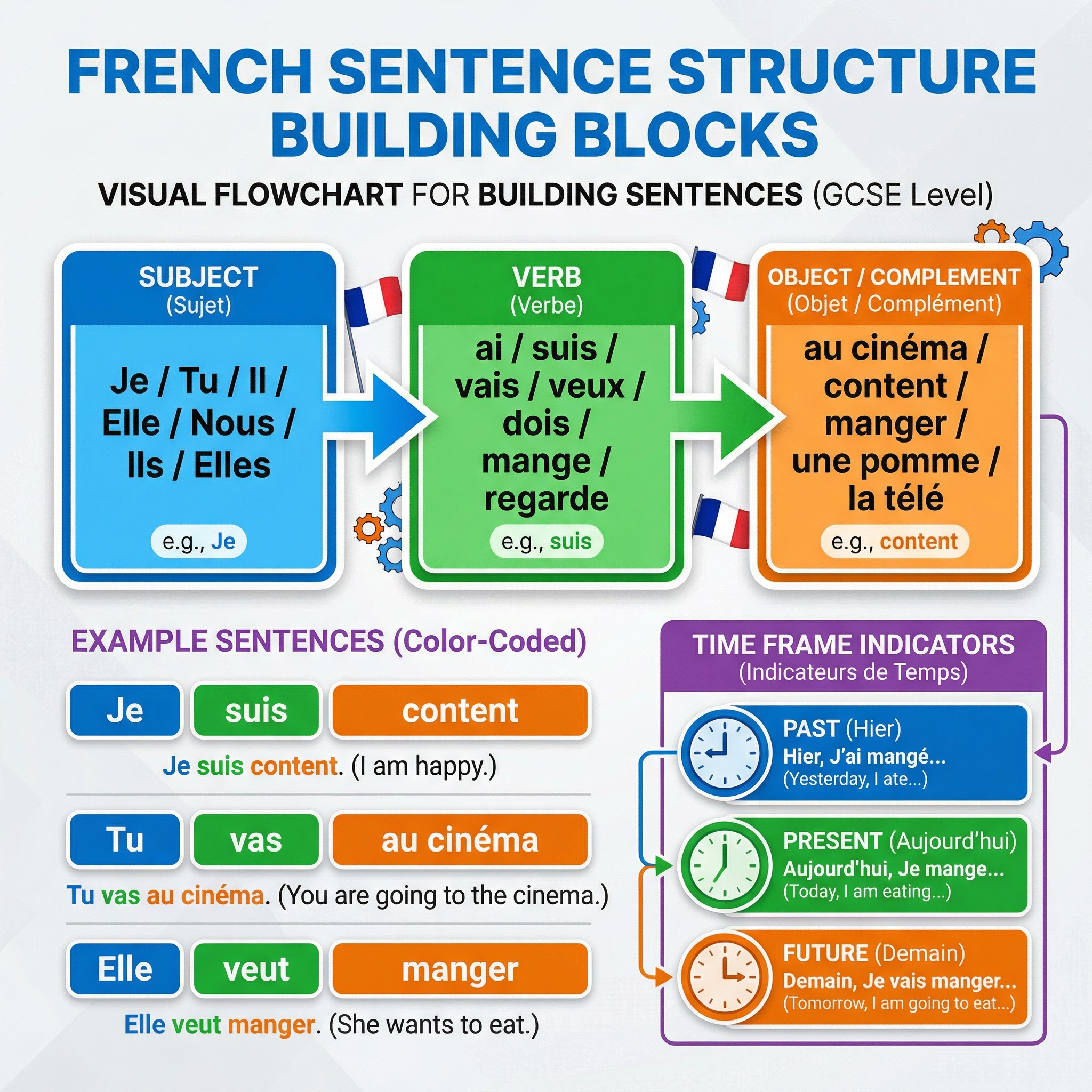
    French Sentence Building Blocks

    Key Individuals: The Irregular Verbs

    Aller, Avoir, Être, Faire

    Role: These are the most common and most important irregular verbs in French.

    Key Actions: Candidates must be able to conjugate them accurately in the present, perfect, and near future tenses.

    Impact: Failure to conjugate these correctly is a major red flag for examiners and will cap your mark. Conversely, accurate use is a strong indicator of competence.

    Visual Resources

    2 diagrams and illustrations

    French Sentence Building Blocks
    French Sentence Building Blocks
    French Verb Tense Timeline
    French Verb Tense Timeline

    Interactive Diagrams

    1 interactive diagram to visualise key concepts

    Diagram could not be rendered

    Flowchart for Achieving Top Marks in Writing

    Worked Examples

    3 detailed examples with solutions and examiner commentary

    Practice Questions

    Test your understanding — click to reveal model answers

    Q1

    Votre ami français va visiter votre région. Qu'est-ce qu'il y a à faire? (90 mots)

    16 marks
    standard

    Hint: Remember to use the Tick-Tock method and include an opinion.

    Q2

    Parlez-moi de votre week-end idéal. (90 mots)

    16 marks
    standard

    Hint: Use the conditional tense (`je voudrais`, `j'aimerais`) to talk about your ideal weekend.

    Q3

    L'importance de parler une langue étrangère. Discutez. (150 mots)

    25 marks
    hard

    Hint: Structure your answer with clear paragraphs: introduction, advantages for travel, advantages for work, conclusion.

    Q4

    Comment était votre vie quand vous étiez plus jeune? (90 mots)

    16 marks
    hard

    Hint: This question requires the imperfect tense to describe past habits and states. Contrast it with the present.

    Q5

    Les problèmes de l'environnement. Que peut-on faire? (150 mots)

    25 marks
    hard

    Hint: Use impersonal structures like 'il faut' and 'on peut' to suggest solutions.

    Explore this topic further

    View Topic PageAll French Topics

    Key Terms

    Essential vocabulary to know

    More French Study Guides

    View all

    Life at school/college

    OCR
    GCSE

    Master the OCR GCSE French topic of 'Life at School/College' (La Vie Scolaire). This guide provides examiner-level insights, multi-modal resources, and cognitive science-based learning tools to help you secure top marks by effectively communicating about school life, academic preferences, and future aspirations."

    Responding to questions confidently

    OCR
    GCSE

    Mastering the OCR GCSE French Paper 3 Speaking exam is about confident, spontaneous communication across three time frames. This guide equips you with strategies to handle any question type, extend your answers with justified opinions, and demonstrate the linguistic range that examiners reward with top marks.

    Adjectives and adverbs

    OCR
    GCSE

    Mastering French adjectives and adverbs is a game-changer for your OCR GCSE. This guide breaks down the essential rules of agreement and placement, giving you the tools to boost your AO4 (Quality of Language) marks and write with confidence and accuracy.

    Identifying key information in spoken French

    OCR
    GCSE

    Identifying key information in spoken French is a critical skill that accounts for 25% of your OCR GCSE French grade. This study guide equips you with strategic listening techniques, examiner insights, and practical methods to navigate distractors, interpret complex grammatical structures, and extract precise information from audio sources. Mastering this skill will transform you from a passive listener into an active, analytical candidate who consistently earns top marks.

    Identity and culture: Me, my family and friends

    OCR
    GCSE

    This study guide for OCR GCSE French (Theme 1: Identity and Culture) provides a comprehensive, exam-focused resource for mastering the topic of 'Me, my family and friends'. It is designed to help students secure top marks by focusing on key vocabulary, grammatical structures, and exam techniques.

    Using appropriate vocabulary and grammar

    OCR
    GCSE

    Mastering vocabulary and grammar is the key to unlocking top grades in OCR GCSE French. This guide moves beyond basic language, providing the specific tools, complex structures, and idiomatic expressions that examiners reward, turning good answers into outstanding ones.