Study Notes

Overview
OCR GCSE French Paper 1 (Listening) is the gateway to demonstrating your comprehension of authentic spoken French. This paper accounts for 25% of your total GCSE grade and is entirely focused on Assessment Objective 1: understanding and responding to different types of spoken language. Candidates are required to listen to recordings featuring native speakers at natural speeds, covering topics from the prescribed themes of Identity and Culture, Local Area and Wider World, and Current and Future Study and Employment. The exam is divided into two sections: Section A, where questions and answers are in English, and Section B, where both are in French. Examiners are looking for precise decoding of details, recognition of time frames (past, present, future), identification of the agent of the action (who is doing what), and the ability to filter out distractors while honing in on the correct information signaled by connective words like "mais" or "cependant." This guide will arm you with the cognitive strategies, linguistic knowledge, and exam techniques necessary to achieve top marks.
Core Listening Skills
Understanding Distractors and Signpost Words
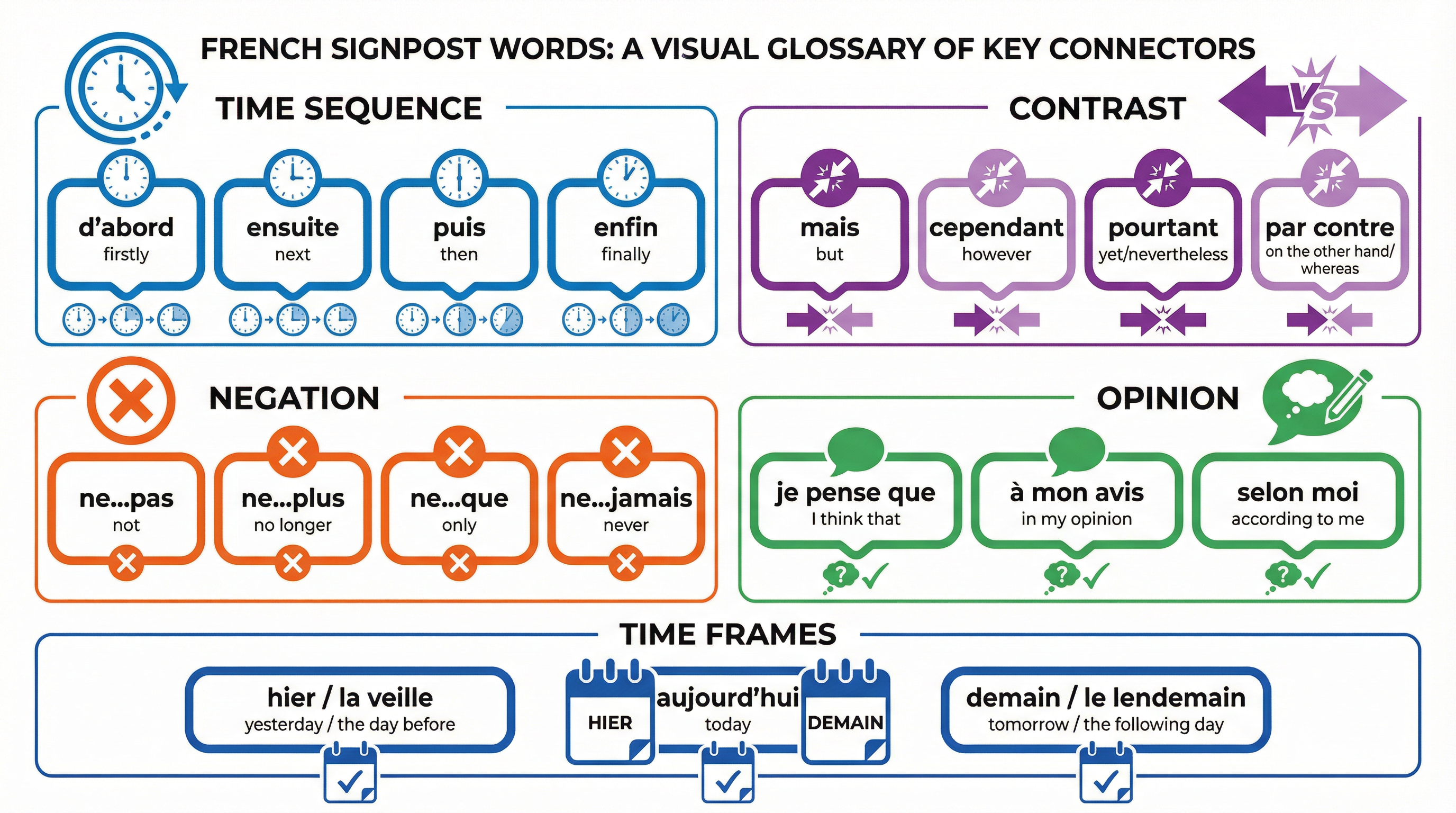
The OCR listening exam is designed to test not just your vocabulary, but your ability to process information critically. Examiners deliberately plant distractors early in the audio—plausible-sounding details that seem correct but are later negated or contradicted. The real answer typically follows a signpost word such as "mais" (but), "cependant" (however), "pourtant" (yet), or "par contre" (on the other hand). Candidates who write down the first detail they hear often fall into this trap and lose marks. For example, if the audio states, "Au début, je détestais mon nouveau collège. Mais maintenant, je l'adore!" (At first, I hated my new school. But now, I love it!), the distractor is "je détestais" (I hated), and the correct answer is "je l'adore" (I love it). The signpost "mais maintenant" (but now) is the critical pivot. Training your ear to recognize these connectives is essential. Other key signpost words include time sequence markers like "d'abord" (firstly), "ensuite" (next), "puis" (then), and "enfin" (finally), which help you track the narrative structure of the recording.
Recognizing Time Frames
Time frame recognition is a high-frequency test area. Examiners want to see if you can distinguish between past, present, and future actions. Listen carefully for time indicators such as "hier" (yesterday), "la veille" (the day before), "aujourd'hui" (today), "demain" (tomorrow), and "le lendemain" (the following day). Additionally, verb tenses are crucial. "J'ai mangé" (I ate) is passé composé (past). "Je mange" (I eat) is present. "Je vais manger" (I am going to eat) or "je mangerai" (I will eat) are future. If a question asks what someone did yesterday and you hear a future tense verb, that answer is incorrect. Candidates frequently confuse "la veille" and "le lendemain," so memorize these distinctions. A useful mnemonic: "Veille" sounds like "veil," which covers the past; "lendemain" contains "demain" (tomorrow), pointing to the future.
Identifying the Agent of the Action
Another common pitfall is misidentifying who is performing the action. The question might ask, "What did Pierre do?" but the audio says, "Sa sœur a fait les courses" (His sister did the shopping). If you write "shopping" without noting that it was his sister, not Pierre, you receive zero marks. Pay close attention to subject pronouns: "je" (I), "tu" (you, singular informal), "il/elle" (he/she), "nous" (we), "vous" (you, plural or formal), "ils/elles" (they). In the stress of the exam, candidates often hear a verb and assume it applies to the person named in the question, but the audio may have shifted to a different subject. Always cross-reference the subject pronoun with the question.
Avoiding Phonetic Traps
French is rich in homophones and near-homophones—words that sound similar but have entirely different meanings. Classic examples include "cheveux" (hair) vs. "chevaux" (horses), "dessert" (dessert) vs. "désert" (desert), "poison" (poison) vs. "poisson" (fish), and "verre" (glass) vs. "vert" (green) vs. "vers" (towards) vs. "ver" (worm). Examiners exploit these phonetic traps to test your contextual understanding. If someone is describing a meal, "dessert" is logical; if they're describing a landscape, "désert" fits. Context is your safeguard. Practice listening to authentic French media (podcasts, YouTube, news broadcasts) to train your ear to distinguish these nuances.
Understanding Harmful Additions
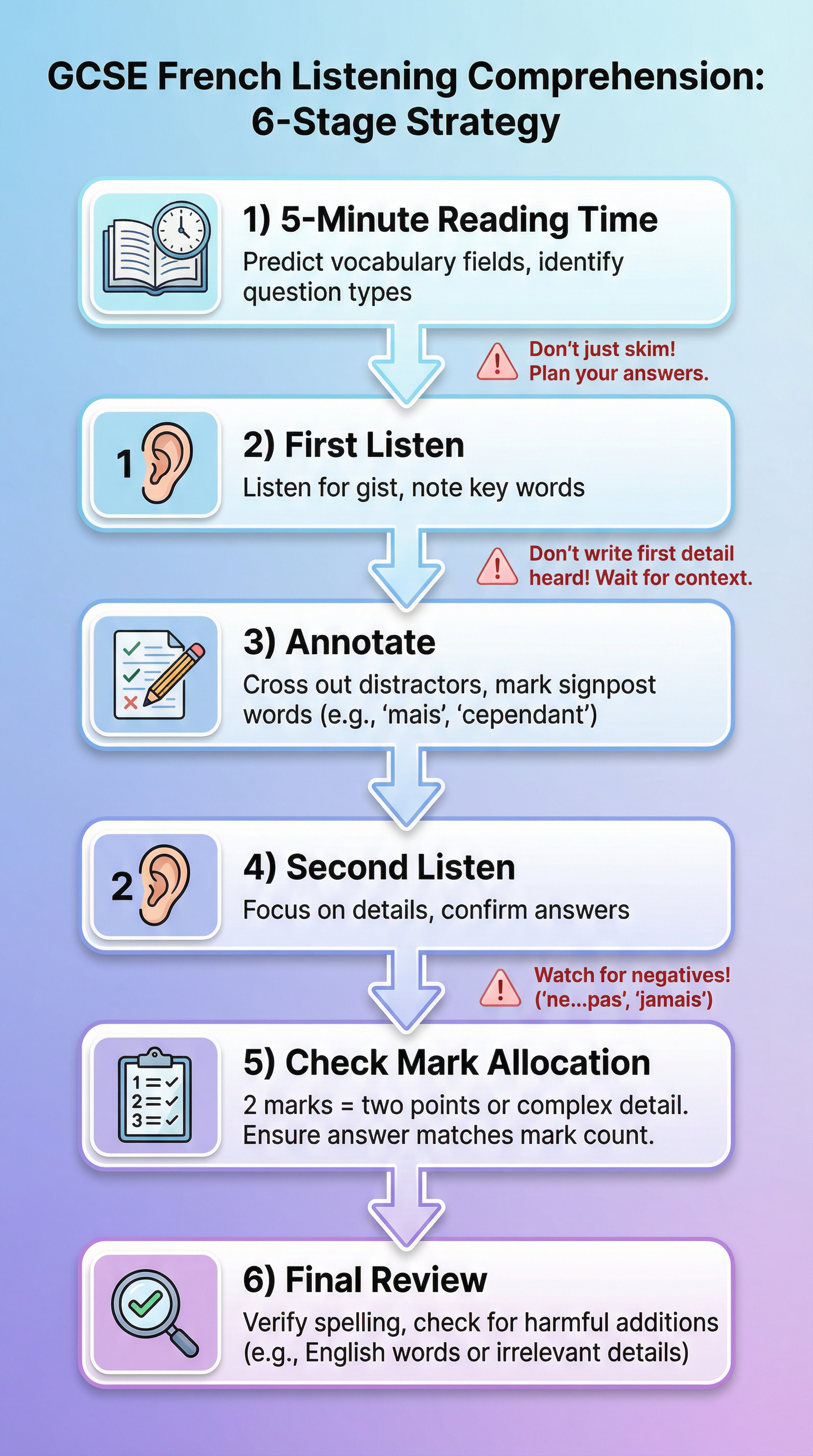
The OCR mark scheme explicitly penalizes harmful additions—extra information that contradicts or distorts the correct answer. For instance, if the correct answer is "He likes football," and you write "He likes football but prefers rugby," you have added information not present in the audio. Even though the first part is correct, the harmful addition nullifies the mark. Keep your answers clean and precise. Only write what you hear, without embellishment or inference beyond what is explicitly stated.
Exam Strategy and Technique
The 5-Minute Reading Time
Before the audio begins, you are given five minutes of reading time. This is not time to daydream or panic—it is strategic preparation time. Use it to:
- Predict vocabulary fields: If a question is about holidays, expect words like "plage" (beach), "montagne" (mountain), "hôtel" (hotel), "vacances" (holidays). If it's about school, anticipate "professeur" (teacher), "cours" (lesson), "devoirs" (homework), "récréation" (break). This primes your brain to recognize these words when they appear.
- Identify question types: Note whether questions ask for opinions, facts, reasons, or sequences. This helps you listen with purpose.
- Check mark allocations: A 1-mark question requires one clear point. A 2-mark question demands two distinct points or one complex detail with a qualifier (e.g., "Paris, because it's beautiful" or "Paris and Lyon").
Active Annotation During the Audio
Your question paper should be a battlefield by the end of the exam. As you listen:
- Cross out distractors the moment they are negated.
- Circle signpost words like "mais," "cependant," "d'abord," "enfin."
- Underline time indicators such as "hier," "demain," "la veille."
- Mark subject pronouns to track who is doing what.
This active engagement keeps you focused and prevents you from writing down incorrect first impressions.
Checking Spelling and Grammar
The mark scheme states that imperfect spelling is acceptable as long as it does not alter meaning. For example, "il aime" written as "il aim" is fine. However, if you write "mange" (eats) as "manger" (to eat), you have changed the verb form, which could cost you the mark. Similarly, "il a mangé" (he ate) vs. "il mange" (he eats) vs. "il va manger" (he is going to eat) are different tenses. Double-check verb forms, agreements, and accents where they change meaning (e.g., "ou" = or, "où" = where).
Section A vs. Section B
Section A questions are in English, so you answer in English. Section B questions are in French, so you answer in French. Mixing these up results in zero marks for that question. Before you write, glance at the question language to confirm.
Never Leave a Question Blank
Even if you are unsure, write something plausible. Examiners cannot award marks for blank spaces, but they may give partial credit for a reasonable attempt. If you missed a detail, use context and common sense to make an educated guess.
Key Vocabulary and Phrases
Signpost Words (Connectives)
| Category | French | English | Function |
|---|---|---|---|
| Time Sequence | d'abord | firstly | Introduces the first point in a sequence |
| ensuite | next | Signals the second point | |
| puis | then | Continues the sequence | |
| enfin | finally | Concludes the sequence | |
| Contrast | mais | but | Signals a reversal or contradiction |
| cependant | however | Introduces a contrasting idea | |
| pourtant | yet/nevertheless | Emphasizes an unexpected contrast | |
| par contre | on the other hand | Presents an alternative view | |
| Negation | ne...pas | not | Standard negation |
| ne...plus | no longer | Indicates cessation | |
| ne...que | only | Restrictive negation | |
| ne...jamais | never | Absolute negation | |
| Opinion | je pense que | I think that | Introduces a personal opinion |
| à mon avis | in my opinion | States a viewpoint | |
| selon moi | according to me | Expresses a perspective |
Time Indicators
| French | English | Usage |
|---|---|---|
| hier | yesterday | Simple past reference |
| la veille | the day before | Narrative past (often in reported speech) |
| aujourd'hui | today | Present reference |
| demain | tomorrow | Simple future reference |
| le lendemain | the following day | Narrative future (often in reported speech) |
| maintenant | now | Present moment |
| plus tard | later | Future reference |
| autrefois | in the past/formerly | General past |
Common Phonetic Traps
| Word 1 | Meaning 1 | Word 2 | Meaning 2 | Context Clue |
|---|---|---|---|---|
| cheveux | hair | chevaux | horses | Describing a person vs. animals |
| dessert | dessert | désert | desert | Meal context vs. landscape |
| poison | poison | poisson | fish | Danger vs. food |
| verre | glass | vert | green | Object vs. color |
| verre | glass | vers | towards | Object vs. direction |
| verre | glass | ver | worm | Object vs. creature |
| mer | sea | mère | mother | Location vs. person |
| pain | bread | pin | pine tree | Food vs. tree |
Worked Examples
Example 1: Distractor and Signpost Word (Section A)
Question: What does Sophie think of her new job? (2 marks)
Audio Transcript: "Au début, je trouvais mon nouveau travail très stressant. Mais maintenant, je l'adore parce que mes collègues sont sympas."
Translation: "At first, I found my new job very stressful. But now, I love it because my colleagues are nice."
Incorrect Answer: "She finds it stressful."
Why It's Wrong: This is the distractor. The candidate heard "très stressant" and wrote it down without waiting for the signpost "mais maintenant."
Correct Answer: "She loves it because her colleagues are nice."
Why It's Correct: The signpost "mais maintenant" (but now) signals the reversal. The answer includes two points (loves it + reason), earning both marks.
Examiner Commentary: Candidates must resist the urge to write the first detail. The phrase "au début" (at first) is a red flag that the opinion will change. The connective "mais" introduces the current, correct opinion. The mark allocation of 2 marks indicates that a reason or additional detail is required, which is provided by "parce que mes collègues sont sympas."
Example 2: Time Frame Recognition (Section B)
Question: Qu'est-ce que Marc a fait hier? (1 mark)
Audio Transcript: "Hier, j'ai joué au football avec mes amis. Demain, je vais aller à la piscine."
Translation: "Yesterday, I played football with my friends. Tomorrow, I am going to go to the pool."
Incorrect Answer: "Il va aller à la piscine."
Why It's Wrong: This is the future action ("demain, je vais aller"), not what he did yesterday.
Correct Answer: "Il a joué au football (avec ses amis)."
Why It's Correct: The question asks what Marc did yesterday ("hier"). The passé composé "j'ai joué" matches the past time frame.
Examiner Commentary: Time frame errors are among the most common mistakes. Candidates hear "piscine" (pool) and write it down because it's a concrete noun they recognize, ignoring the tense and time indicator. The verb "a joué" (played) is in the passé composé, matching "hier." The verb "va aller" (is going to go) is future, matching "demain." Always cross-check the verb tense with the time indicator in the question.
Example 3: Identifying the Agent (Section A)
Question: What did Claire do last weekend? (1 mark)
Audio Transcript: "Le week-end dernier, ma sœur est allée au cinéma. Moi, je suis restée à la maison."
Translation: "Last weekend, my sister went to the cinema. Me, I stayed at home."
Incorrect Answer: "She went to the cinema."
Why It's Wrong: The question asks about Claire, but the audio says "ma sœur est allée" (my sister went). If Claire is the speaker, then "moi, je suis restée" (me, I stayed) is what Claire did.
Correct Answer: "She stayed at home."
Why It's Correct: The speaker (Claire) says "je suis restée à la maison," which is the action she performed.
Examiner Commentary: This is a classic agent-of-action error. Candidates hear "cinéma" and assume it's the answer because it's a recognizable activity. However, the subject of "est allée" is "ma sœur" (my sister), not Claire. The pronoun "je" (I) in "je suis restée" indicates Claire's action. Always identify the subject pronoun before writing the answer.
Example 4: Harmful Addition (Section A)
Question: What sport does Luc play? (1 mark)
Audio Transcript: "Je joue au rugby."
Translation: "I play rugby."
Incorrect Answer: "He plays rugby and football."
Why It's Wrong: The audio only mentions rugby. Adding "and football" is a harmful addition that contradicts the audio (by implying he plays both when only one is mentioned).
Correct Answer: "Rugby."
Why It's Correct: This is the only sport mentioned. No additional information is provided or needed.
Examiner Commentary: Harmful additions often occur when candidates try to "fill out" their answer or recall information from earlier in the audio that doesn't apply to this specific question. Write only what is explicitly stated in the relevant part of the recording.
Example 5: Negation (Section B)
Question: Est-ce que Julie aime les maths? (1 mark)
Audio Transcript: "Je n'aime plus les maths. Maintenant, je préfère l'histoire."
Translation: "I no longer like maths. Now, I prefer history."
Incorrect Answer: "Oui, elle aime les maths."
Why It's Wrong: The negation "ne...plus" (no longer) reverses the meaning. She used to like maths, but not anymore.
Correct Answer: "Non, elle n'aime plus les maths." OR "Non."
Why It's Correct: The negation is recognized and accurately reported.
Examiner Commentary: Negatives are high-stakes. Missing "ne...plus," "ne...pas," "ne...que," or "ne...jamais" flips the entire meaning of the sentence. Train your ear to catch the "ne" at the start and anticipate the second part of the negation.
Memory Hooks and Mnemonics
Mnemonic 1: Signpost Words for Contrast (MBCP)
Hook: "Mais, Cependant, Pourtant, Par Contre = My Brain Catches Pivots"
Explanation: These four words signal a reversal or contrast. When you hear any of them, the information that follows is likely the correct answer, negating what came before.
Type: Acronym
Mnemonic 2: Time Sequence (DEEP)
Hook: "D'abord, Ensuite, Puis, Enfin = Don't Ever Panic, Examiners!"
Explanation: These words structure a narrative in order. Recognizing them helps you track the sequence of events and avoid mixing up first, second, and final points.
Type: Acronym
Mnemonic 3: Negation Structures (PPPJ)
Hook: "Pas, Plus, Que, Jamais = Please Pause, Question Judgments"
Explanation: These are the second parts of French negations (ne...pas, ne...plus, ne...que, ne...jamais). Hearing any of these after "ne" means the meaning is reversed or restricted.
Type: Acronym
Mnemonic 4: Time Frames (Yesterday vs. Tomorrow)
Hook: "Veille = Veil over the past; Lendemain = Later (contains 'demain' = tomorrow)"
Explanation: "La veille" refers to the day before (past). "Le lendemain" refers to the following day (future). The word "demain" (tomorrow) is embedded in "lendemain," making it easier to remember.
Type: Rhyme/Association
Mnemonic 5: Phonetic Trap (Cheveux vs. Chevaux)
Hook: "Cheveux on your head, Chevaux in the shed."
Explanation: "Cheveux" (hair) is something on your head. "Chevaux" (horses) are animals you might keep in a shed. The rhyme helps distinguish them.
Type: Rhyme
Mnemonic 6: Agent of Action (Je vs. Il/Elle)
Hook: "Je = Just me; Il/Elle = It's Elsewhere"
Explanation: "Je" means the speaker is doing the action. "Il" or "Elle" means someone else is. This helps you avoid attributing actions to the wrong person.
Type: Association
Practice Questions with Model Answers
Question 1: Distractor and Contrast (Section A)
Question: What does Thomas think of his French teacher? (2 marks)
Difficulty: Standard
Hint: Listen for a signpost word that signals a change of opinion.
Model Answer: "He thinks she is strict but fair."
Mark Scheme Breakdown:
- Level 1 (0 marks): No relevant information or harmful addition.
- Level 2 (1 mark): One correct point (e.g., "strict" OR "fair").
- Level 3 (2 marks): Two correct points or one point with a qualifier (e.g., "strict but fair").
Common Wrong Answers:
- "He thinks she is too strict" (distractor; misses the "but fair" reversal).
- "He doesn't like her" (inference not supported by audio).
Question 2: Time Frame (Section B)
Question: Qu'est-ce qu'Emma va faire demain? (1 mark)
Difficulty: Standard
Hint: Listen for future tense markers like "je vais" or "je ferai."
Model Answer: "Elle va faire du shopping." OR "Elle va aller en ville."
Mark Scheme Breakdown:
- 1 mark: Correct future action mentioned in the audio.
- 0 marks: Past or present action, or no relevant information.
Common Wrong Answers:
- "Elle a fait du shopping" (past tense; candidate confused "hier" with "demain").
- "Elle fait ses devoirs" (present tense; not what she will do tomorrow).
Question 3: Negation (Section A)
Question: Does Antoine still play the guitar? (1 mark)
Difficulty: Standard
Hint: Listen for "ne...plus" or "ne...pas."
Model Answer: "No, he no longer plays the guitar." OR "No."
Mark Scheme Breakdown:
- 1 mark: Correct recognition of negation.
- 0 marks: "Yes" or any answer that ignores the negation.
Common Wrong Answers:
- "Yes, he plays the guitar" (missed the "ne...plus").
- "He plays the piano now" (additional information that may or may not be correct, but doesn't answer the yes/no question).
Question 4: Agent of Action (Section B)
Question: Qui a préparé le dîner hier soir? (1 mark)
Difficulty: Standard
Hint: Identify the subject pronoun carefully.
Model Answer: "Sa mère." OR "La mère de Paul."
Mark Scheme Breakdown:
- 1 mark: Correct identification of the person who prepared dinner.
- 0 marks: Incorrect person (e.g., Paul, when it was his mother).
Common Wrong Answers:
- "Paul" (candidate assumed the question subject was the agent, but the audio said "ma mère a préparé").
- "Son père" (misheard "mère" as "père").
Question 5: Phonetic Trap (Section A)
Question: What did Camille see on holiday? (1 mark)
Difficulty: Standard
Hint: Context will help you distinguish between similar-sounding words.
Model Answer: "Horses." OR "Wild horses."
Mark Scheme Breakdown:
- 1 mark: Correct identification of "chevaux" (horses).
- 0 marks: "Hair" (confused "chevaux" with "cheveux").
Common Wrong Answers:
- "Hair" (phonetic trap; candidate didn't use context—seeing hair on holiday doesn't make sense).
- "Fish" (misheard "chevaux" as "poisson").
Question 6: Complex Detail (Section A)
Question: Why does Léa prefer living in the countryside? Give two reasons. (2 marks)
Difficulty: Standard
Hint: You need two distinct reasons to earn both marks.
Model Answer: "It is quiet and there is lots of space."
Mark Scheme Breakdown:
- 2 marks: Two distinct reasons (e.g., quiet + space, or fresh air + nature).
- 1 mark: One reason only.
- 0 marks: No relevant information or harmful addition.
Common Wrong Answers:
- "It is nice" (too vague; not a specific reason).
- "It is quiet and peaceful" (these are synonyms, so only count as one reason).
Question 7: Opinion with Justification (Section B)
Question: Pourquoi est-ce que Julien aime le sport? (2 marks)
Difficulty: Standard
Hint: Look for "parce que" or "car" to introduce the reason.
Model Answer: "Parce que c'est bon pour la santé et c'est amusant." OR "Car il peut voir ses amis."
Mark Scheme Breakdown:
- 2 marks: Two reasons or one detailed reason.
- 1 mark: One reason.
- 0 marks: No relevant information.
Common Wrong Answers:
- "Il aime le sport" (restates the question without giving a reason).
- "Parce qu'il joue au football" (describes what he does, not why he likes it).
Quick Summary: Essential Facts for Exam Success
-
OCR Paper 1 is 100% AO1: You are tested solely on understanding and responding to spoken French. No writing or speaking skills are assessed here.
-
Distractors come first: The first detail you hear is often wrong. Wait for signpost words like "mais," "cependant," or "pourtant" to signal the real answer.
-
Time frames are critical: Distinguish between "hier/la veille" (past), "aujourd'hui" (present), and "demain/le lendemain" (future). Match verb tenses to time indicators.
-
Identify the agent: "Je" = I, "Il/Elle" = he/she, "Nous" = we, "Ils/Elles" = they. Don't assume the question subject is the agent—check the audio.
-
Negations reverse meaning: "Ne...pas" (not), "ne...plus" (no longer), "ne...que" (only), "ne...jamais" (never). Missing these costs you marks.
-
Phonetic traps are deliberate: "Cheveux" vs. "chevaux," "dessert" vs. "désert," "poison" vs. "poisson." Use context to distinguish.
-
Harmful additions lose marks: Only write what is explicitly stated. Adding extra information that contradicts the audio results in zero marks.
-
Use the 5-minute reading time: Predict vocabulary fields, identify question types, and check mark allocations.
-
Annotate actively: Cross out distractors, circle signpost words, underline time indicators. Your question paper should be heavily marked up.
-
Check spelling and tense: "Il aime" vs. "il aimait" vs. "il aimera." Verb forms matter. Spelling is flexible unless it changes meaning.
-
Section A = English answers; Section B = French answers: Mixing these up is an instant zero.
-
Never leave a question blank: Even a guess might earn partial credit. Examiners can't mark what isn't there.
Retrieval Practice: Cover and Recall
Retrieval Cue 1
Prompt: Without looking, list four French signpost words that signal contrast or reversal, and explain what each one means.
Difficulty: Standard
Expected Answer Points:
- "Mais" = but
- "Cependant" = however
- "Pourtant" = yet/nevertheless
- "Par contre" = on the other hand
Retrieval Cue 2
Prompt: Explain the difference between "la veille" and "le lendemain," and give an example sentence for each.
Difficulty: Standard
Expected Answer Points:
- "La veille" = the day before (past)
- "Le lendemain" = the following day (future)
- Example: "La veille, j'ai visité Paris" (The day before, I visited Paris) vs. "Le lendemain, je vais visiter Lyon" (The following day, I am going to visit Lyon)
Retrieval Cue 3
Prompt: What is a "harmful addition" in the OCR mark scheme, and why does it result in zero marks? Give an example.
Difficulty: Standard
Expected Answer Points:
- A harmful addition is extra information that contradicts or distorts the correct answer.
- It results in zero marks because it shows the candidate has misunderstood or added information not present in the audio.
- Example: Correct answer is "He likes football." Harmful addition: "He likes football but prefers rugby" (if "prefers rugby" was not stated).
Retrieval Cue 4
Prompt: List the four main types of negation in French (ne + second part) and translate each into English.
Difficulty: Standard
Expected Answer Points:
- "Ne...pas" = not
- "Ne...plus" = no longer / not anymore
- "Ne...que" = only
- "Ne...jamais" = never
Retrieval Cue 5
Prompt: You have 5 minutes of reading time before the audio starts. List three strategic actions you should take during this time.
Difficulty: Standard
Expected Answer Points:
- Predict vocabulary fields based on question topics.
- Identify question types (opinion, fact, reason, sequence).
- Check mark allocations to understand how many points are needed per question.
Retrieval Cue 6
Prompt: Explain why "au début" (at first) is a red flag in a listening passage, and what you should do when you hear it.
Difficulty: Standard
Expected Answer Points:
- "Au début" signals that the initial opinion or situation will likely change.
- You should wait for a signpost word like "mais" or "maintenant" that introduces the current, correct answer.
- Don't write down the first detail—it's probably a distractor.
Synoptic Links Across the Specification
Link 1: Listening and Speaking (Papers 1 and 3)
Related Topic: Pronunciation and intonation in spoken French.
Connection: The phonetic traps you encounter in listening (e.g., "cheveux" vs. "chevaux") are the same pronunciation challenges you must master for the speaking exam. Practicing listening comprehension improves your ability to produce accurate spoken French, as you internalize correct pronunciation, intonation, and stress patterns. Conversely, speaking practice helps you recognize these sounds more quickly in listening tasks.
Exam Relevance: In Paper 3 (Speaking), you may be asked to discuss topics like hobbies, school, or holidays—the same themes tested in Paper 1 (Listening). Familiarity with vocabulary and structures from listening passages gives you a bank of authentic phrases to use in your speaking responses. Examiners reward natural, fluent language, which comes from exposure to native speakers.
Link 2: Listening and Reading (Papers 1 and 2)
Related Topic: Identifying time frames and verb tenses.
Connection: Both listening and reading comprehension require you to distinguish between past, present, and future tenses. In Paper 2 (Reading), you analyze written texts for tense markers like "hier," "aujourd'hui," and "demain," just as you do in listening. The same grammatical knowledge underpins both skills. Additionally, signpost words ("mais," "cependant," "d'abord," "enfin") appear in both audio and written texts to structure arguments and narratives.
Exam Relevance: A question in Paper 2 might ask, "When did this event happen?" requiring you to identify a passé composé or imparfait verb form. This is identical to the time frame recognition tested in Paper 1. Strengthening your grammar knowledge benefits both papers.
Link 3: Listening and Writing (Papers 1 and 4)
Related Topic: Using connectives and complex sentences.
Connection: The signpost words you learn to recognize in listening ("mais," "cependant," "pourtant," "d'abord," "ensuite," "enfin") are the same connectives you should use in your writing to structure essays and achieve higher marks. In Paper 4 (Writing), examiners award credit for varied and sophisticated language, including the use of connectives to link ideas. By internalizing these words through listening practice, you build a mental bank of phrases to deploy in your own writing.
Exam Relevance: A high-level essay in Paper 4 might include sentences like, "D'abord, j'aime le sport parce que c'est bon pour la santé. Ensuite, c'est une bonne occasion de voir mes amis. Cependant, je n'ai pas toujours le temps de jouer." (Firstly, I like sport because it's good for health. Next, it's a good opportunity to see my friends. However, I don't always have time to play.) These structures mirror the narrative sequences and contrasts you hear in listening passages.
Link 4: Thematic Links Across All Papers
Related Topic: Identity and Culture, Local Area and Wider World, Current and Future Study and Employment.
Connection: The three prescribed themes are tested across all four papers. A listening passage about holidays (Theme 2: Local Area and Wider World) might be followed by a reading text about travel, a speaking question about your last vacation, and a writing task describing a trip. Vocabulary and ideas from one paper reinforce and enrich your performance in others.
Exam Relevance: Examiners design the papers to be thematically coherent. If you revise vocabulary for "holidays" (plage, montagne, hôtel, vacances, voyage), you are simultaneously preparing for listening, reading, speaking, and writing tasks on that topic. This synoptic approach maximizes efficiency and depth of understanding.
Elaboration Questions: Deepen Your Understanding
-
**Why do examiners deliberately plant distractors early in listening passages, and how does this reflect real-world communication challenges?**In authentic conversations, speakers often change their minds, correct themselves, or present contrasting viewpoints. By including distractors, examiners test whether you can process information critically and adjust your understanding as new information emerges. This mirrors real-world scenarios where you might hear, "I thought the film was boring, but actually, it was quite good," and you need to extract the final, accurate opinion. The skill of filtering distractors is essential for effective communication in French-speaking environments.
-
**To what extent is listening comprehension a passive skill, and how can active strategies improve your performance?**Listening is often perceived as passive—you simply hear and understand. However, high-performing candidates approach it actively: they predict vocabulary, annotate questions, cross out distractors, and mentally track signpost words and time frames. This active engagement transforms listening from a reactive process into a strategic one. Research in cognitive psychology shows that active listening (e.g., note-taking, questioning, summarizing) significantly improves retention and comprehension. In the exam context, active strategies prevent you from being overwhelmed by the speed of native speech and help you focus on mark-earning details.
-
**How would a different examiner interpret a response with a harmful addition, and why is precision valued over elaboration?**Examiners are trained to apply the mark scheme consistently. A harmful addition—extra information that contradicts the audio—demonstrates that the candidate has either misunderstood the passage or is guessing. Precision is valued because it shows accurate comprehension. In academic and professional contexts, misrepresenting information (even unintentionally) can have serious consequences. The OCR mark scheme reflects this by penalizing harmful additions, teaching candidates to communicate clearly and accurately without embellishment.
-
**Why is context crucial for distinguishing phonetic traps, and how does this skill transfer to real-world French usage?**Phonetic traps like "cheveux" (hair) vs. "chevaux" (horses) are disambiguated by context. If someone is describing a person, "cheveux" makes sense; if they're talking about a farm, "chevaux" fits. This reliance on context mirrors how native speakers process language—they don't hear words in isolation but within a semantic field. Developing this skill prepares you for real-world French, where homophones are common and meaning depends on situational cues. For example, in a restaurant, "Je voudrais du poisson" (I would like some fish) is clear, but "Je voudrais du poison" (I would like some poison) would be absurd—context prevents confusion.
-
**To what extent does mastery of signpost words improve not just listening, but overall French proficiency?**Signpost words are the "glue" of coherent discourse. Mastering them in listening improves your ability to follow arguments, narratives, and explanations in French. This skill transfers to reading (tracking the structure of essays and articles), speaking (organizing your own responses logically), and writing (linking ideas smoothly). Examiners across all papers reward the use of connectives because they demonstrate sophisticated language use. A candidate who can recognize and deploy "d'abord," "ensuite," "cependant," and "enfin" is operating at a higher cognitive and linguistic level than one who relies on simple sentences. Thus, signpost words are a synoptic skill that elevates performance across the entire GCSE.
-
**How does the 5-minute reading time function as a metacognitive strategy, and why do high-performing candidates use it differently from lower-performing ones?**The 5-minute reading time is an opportunity for metacognition—thinking about your thinking. High-performing candidates use it to activate prior knowledge (predicting vocabulary fields), set goals (identifying question types and mark allocations), and plan strategies (deciding where to focus attention). Lower-performing candidates often skim the questions passively or panic. Metacognitive strategies are linked to academic success across subjects because they involve self-regulation, planning, and monitoring. By treating the reading time as strategic preparation rather than idle waiting, you prime your brain for success and reduce cognitive load during the audio.
Key Definitions
Distractor
Definition: A plausible but incorrect detail deliberately included early in a listening passage to test whether candidates can distinguish it from the correct answer, which typically follows a signpost word.
Context: Examiners use distractors to assess critical listening. Candidates who write down the first detail they hear without waiting for connectives like "mais" or "cependant" fall into the trap and lose marks. Recognizing and rejecting distractors is a core skill for achieving high grades.
Signpost Word (Connective)
Definition: A word or phrase (e.g., "mais," "cependant," "d'abord," "enfin") that signals the structure or direction of a narrative or argument, often introducing the correct answer after a distractor.
Context: Signpost words are examiners' tools for testing whether candidates can track the logic of spoken French. They appear in both Section A and Section B questions and are critical for understanding time sequences, contrasts, and conclusions.
Time Frame
Definition: The temporal context of an action or event (past, present, or future), indicated by time markers (e.g., "hier," "aujourd'hui," "demain") and verb tenses (e.g., passé composé, present, future).
Context: Time frame recognition is a high-frequency test area. Candidates must match the verb tense to the time indicator in the question. Confusing "la veille" (the day before) with "le lendemain" (the following day) is a common error that costs marks.
Agent of the Action
Definition: The person or entity performing the action described by the verb, identified by the subject pronoun (e.g., "je," "il," "elle," "nous," "ils").
Context: Questions often ask what a specific person did, but the audio may describe actions by multiple people. Candidates must identify the correct subject pronoun to avoid attributing actions to the wrong agent. For example, if the question asks what Pierre did, but the audio says "sa sœur a fait," the agent is his sister, not Pierre.
Harmful Addition
Definition: Extra information added to an answer that contradicts or distorts the correct response, resulting in zero marks even if part of the answer is correct.
Context: The OCR mark scheme penalizes harmful additions to ensure candidates demonstrate accurate comprehension. For example, if the correct answer is "He likes football," writing "He likes football but prefers rugby" (when "prefers rugby" was not stated) is a harmful addition. Candidates must keep answers clean and precise.
Phonetic Trap
Definition: A pair or group of French words that sound similar but have different meanings (e.g., "cheveux" vs. "chevaux," "dessert" vs. "désert"), used by examiners to test contextual understanding.
Context: Phonetic traps exploit the homophones and near-homophones common in French. Candidates who rely solely on sound recognition without considering context often fall into these traps. Using semantic cues (e.g., meal context for "dessert," landscape context for "désert") is essential.
Passé Composé
Definition: A French past tense formed with an auxiliary verb ("avoir" or "être") and a past participle (e.g., "j'ai mangé" = I ate, "il est allé" = he went), used to describe completed actions.
Context: The passé composé is the most common past tense in spoken French and frequently appears in listening passages. Recognizing it helps candidates identify past time frames and avoid confusing past actions with present or future ones.
Assessment Objective 1 (AO1)
Definition: The ability to understand and respond to different types of spoken language, tested exclusively in OCR GCSE French Paper 1 (Listening).
Context: AO1 accounts for 25% of the total GCSE grade. It assesses comprehension of authentic French at varying speeds, recognition of details and opinions, and the ability to distinguish between key information and distractors. No other assessment objectives (AO2: communication, AO3: knowledge of language, AO4: cultural knowledge) are tested in Paper 1.
Podcast Script
OCR GCSE French Listening Comprehension Podcast Script
Episode: Understanding Native Speakers
Duration: 10 minutes
Voice: Female, warm, conversational, enthusiastic educator
[INTRO - 1 minute]
Hello and welcome to your GCSE French Listening Mastery podcast! I'm here to help you absolutely nail Paper 1 of your OCR French exam. Today, we're diving deep into the skill that makes or breaks your listening grade: understanding native speakers at full speed.
Now, I know what you're thinking. "Native speakers talk so fast! How am I supposed to catch every word?" Well, here's the secret: you don't need to catch every word. You need to catch the right words. And by the end of this episode, you'll know exactly which words matter, which ones are distractors, and how to decode even the trickiest listening passages.
Let's get started!
[CORE CONCEPTS - 5 minutes]
First, let's talk about what the examiners are actually testing. OCR Paper 1 is 100% Assessment Objective 1. That means they want to see if you can understand and respond to different types of spoken language. You'll hear authentic French at varying speeds, and you need to distinguish between key details and distractors.
Here's the golden rule: the first detail you hear is often wrong. Yes, you heard that right. The examiners deliberately plant distractors early in the audio. Then they use a signpost word like "mais" or "cependant" to introduce the real answer. So if you write down the first thing you hear, you're probably falling into their trap.
Let me give you an example. Imagine the question asks: "What does Marie think of her new school?" The audio might say: "Au début, je détestais mon nouveau collège. Mais maintenant, je l'adore!" If you only caught "je détestais," you'd write "she hated it" and lose the mark. But that "mais maintenant" flips everything. The correct answer is "she loves it now."
This brings us to signpost words. These are your best friends in the listening exam. Words like "d'abord, ensuite, puis, enfin" tell you the sequence of events. "Mais, cependant, pourtant, par contre" signal a contrast or reversal. And negatives like "ne...pas, ne...plus, ne...que" completely change the meaning. You need to train your ear to perk up when you hear these words.
Now let's talk about time frames. This is huge. The examiners love testing whether you can tell past from present from future. Listen carefully for time indicators. "Hier" or "la veille" means yesterday or the day before. "Aujourd'hui" is today. "Demain" or "le lendemain" means tomorrow or the following day. Also, verb tenses matter. "J'ai mangé" is past. "Je mange" is present. "Je vais manger" or "je mangerai" is future. If the question asks what someone did yesterday and you hear "je vais faire," that's future tense, so it's wrong.
Another critical skill: identifying the agent of the action. Who is doing what? "Je" means I. "Il" or "elle" means he or she. "Nous" means we. "Ils" or "elles" means they. It sounds basic, but in the stress of the exam, candidates mix these up all the time. If the question asks what Pierre did, and the audio says "sa sœur a fait," that's his sister, not Pierre. No marks.
Let's talk about phonetic traps. French has loads of words that sound similar but mean totally different things. "Cheveux" is hair. "Chevaux" is horses. "Dessert" is dessert. "Désert" is desert. The examiners know this, and they'll test you on it. The only way to avoid these traps is to listen for context. If someone's talking about a meal, "dessert" makes sense. If they're describing a landscape, "désert" fits.
Finally, harmful additions. This is a marking rule you must understand. Even if you get the main point right, if you add contradictory information, you lose the mark. For example, if the correct answer is "he likes football," and you write "he likes football but prefers rugby," you've added information that wasn't there. That's a harmful addition. The examiner will reject it. Keep your answers clean and precise.
[EXAM TIPS & COMMON MISTAKES - 2 minutes]
Right, let's talk strategy. You get five minutes of reading time before the audio starts. Do not waste this! Use it to predict vocabulary fields. If a question is about holidays, expect words like "plage, montagne, hôtel, vacances." If it's about school, think "professeur, cours, devoirs, récréation." This primes your brain to recognize those words when they come up.
Also, look at the mark allocation. If a question is worth two marks, that tells you something. It means you need two distinct points, or one complex detail with a qualifier. So don't just write "Paris." Write "Paris, because it's beautiful" or "Paris and Lyon." Two pieces of information for two marks.
During the audio, annotate like crazy. Cross out distractors the moment you hear them negated. Circle signpost words. Underline time indicators. Your question paper should look like a battlefield by the end.
Common mistake number one: not checking spelling. Now, the mark scheme says they'll accept imperfect spelling as long as it doesn't alter meaning. But here's the thing: if you write "il aime" as "il aim," that's fine. But if you write "mange" as "manger," you've changed the tense. That could cost you. So double-check verb forms and agreements.
Common mistake number two: writing in English when the question is in French. Section A questions are in English, so you answer in English. Section B questions are in French, so you answer in French. Mixing them up is an instant zero for that question.
Common mistake number three: leaving questions blank. Even if you're not sure, write something. The examiners can't give you marks for a blank space, but they might give you credit for a partially correct answer.
[QUICK-FIRE RECALL QUIZ - 1 minute]
Okay, quick-fire time! I'm going to ask you three questions. Pause the podcast and answer them out loud. Ready?
Question one: What does "mais" signal in a listening passage?
Question two: If you hear "ne...plus," what does that mean?
Question three: What's the difference between "la veille" and "le lendemain"?
Answers: "Mais" signals a contrast or reversal. "Ne...plus" means "no longer" or "not anymore." "La veille" is the day before, and "le lendemain" is the following day.
How did you do? If you got all three, brilliant! If not, go back and review those signpost words and time frames.
[SUMMARY & SIGN-OFF - 1 minute]
Let's wrap up. To master OCR GCSE French listening, remember these key points:
One: Don't trust the first detail. Wait for the signpost word that introduces the real answer.
Two: Train your ear for signpost words, time frames, and negatives. They're your navigation system through the audio.
Three: Use your five-minute reading time strategically. Predict vocabulary and identify question types.
Four: Check the mark allocation. Two marks means two points or a complex detail.
Five: Annotate your question paper. Cross out distractors, circle key words, and keep your answers clean.
You've got this. Listening comprehension is a skill, and like any skill, it improves with practice. Listen to French podcasts, watch French YouTube videos, and do as many past papers as you can. The more you expose yourself to authentic French, the more natural it becomes.
Bonne chance with your exam, and remember: you're not just learning French, you're training your brain to think like an examiner. And that's the real secret to exam success.
À bientôt!