Study Notes
Overview
Welcome to the pinnacle of sporting achievement. This section of the AQA A-Level PE specification delves into the sophisticated ecosystem that identifies, develops, and funds elite athletes in the United Kingdom. Understanding this topic is not just about knowing names and organisations; it is about appreciating the strategic, and often ruthless, decisions made to achieve global sporting success. For candidates aiming for the highest grades, a critical evaluation of this system is essential. This guide will equip you with the detailed knowledge and analytical skills required to deconstruct exam questions and formulate high-scoring responses.
Key Knowledge & Theory
Core Concepts
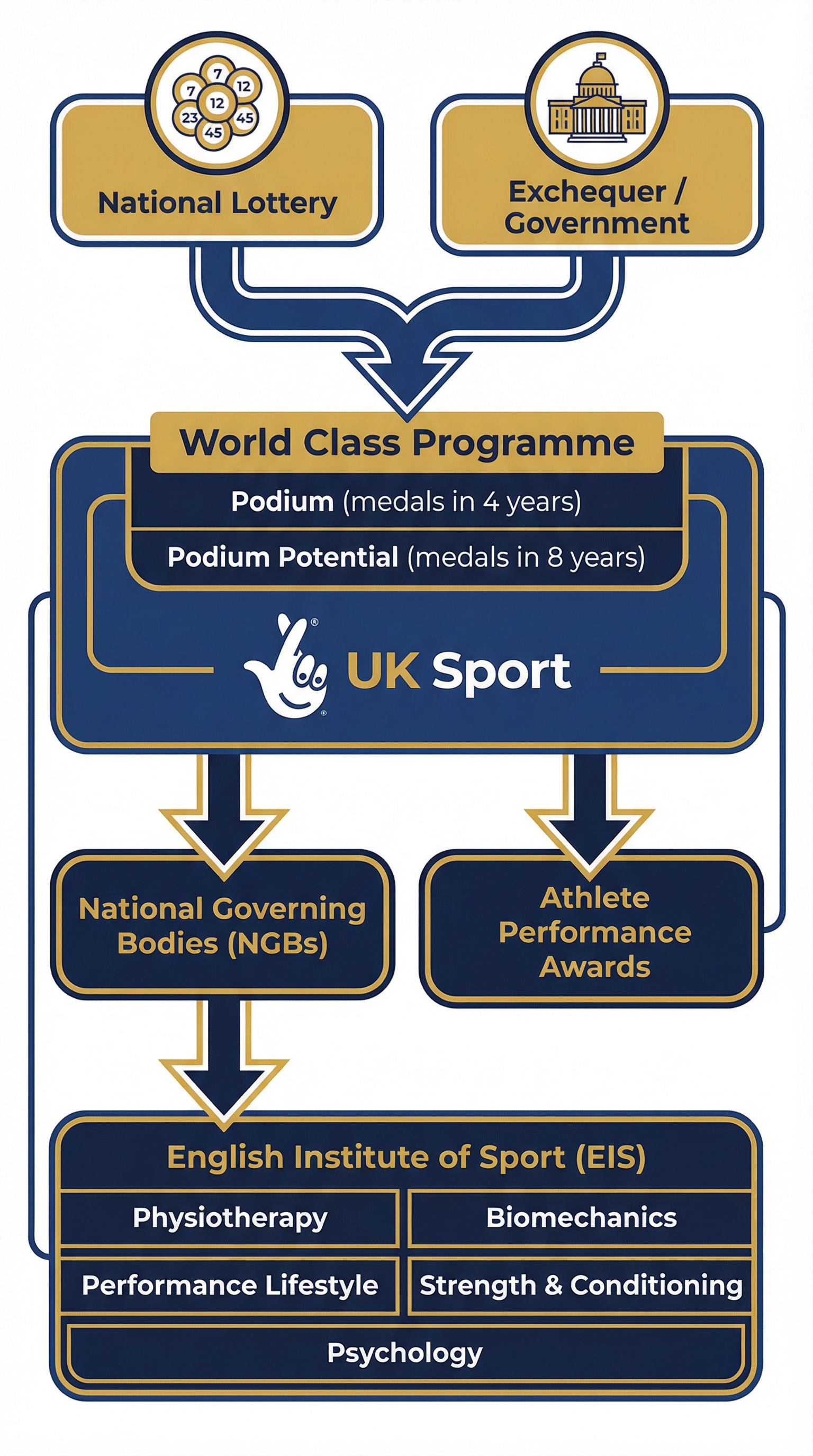
The UK's elite sport system is a hierarchical structure designed to maximise the return on investment, with that return being measured in Olympic and Paralympic medals. The key agencies and concepts you must understand are:
- UK Sport: The nation's high-performance sports agency. Its primary role is to strategically invest National Lottery and Exchequer (government) funding to maximise the performance of UK athletes in the Olympic and Paralympic Games. Crucially, its remit is elite sport, not grassroots participation (which is handled by Sport England).
- The World Class Programme (WCP): This is UK Sport's flagship funding mechanism. It is tiered to provide support to athletes at different stages of their development. Candidates must be able to differentiate between the two main tiers:
- Podium: Supporting athletes with a realistic chance of winning a medal at the next Olympic/Paralympic Games (i.e., within a 4-year cycle).
- Podium Potential: Supporting athletes whose performances suggest they have a realistic chance of winning a medal at the subsequent Games (i.e., an 8-year cycle).
- National Governing Bodies (NGBs): These are the organisations responsible for managing and developing a specific sport, for example, British Cycling or the Lawn Tennis Association. They bid for funding from UK Sport by submitting a 'Whole Sport Plan' that outlines their strategy for achieving medal success. They are the delivery partners for the WCP.
- English Institute of Sport (EIS): The EIS is the 'team behind the team'. It is not a funding body but a provider of world-class sport science and medical services to elite athletes. It works in partnership with NGBs to deliver support where it is needed most. Candidates must be able to name specific services provided by the EIS.
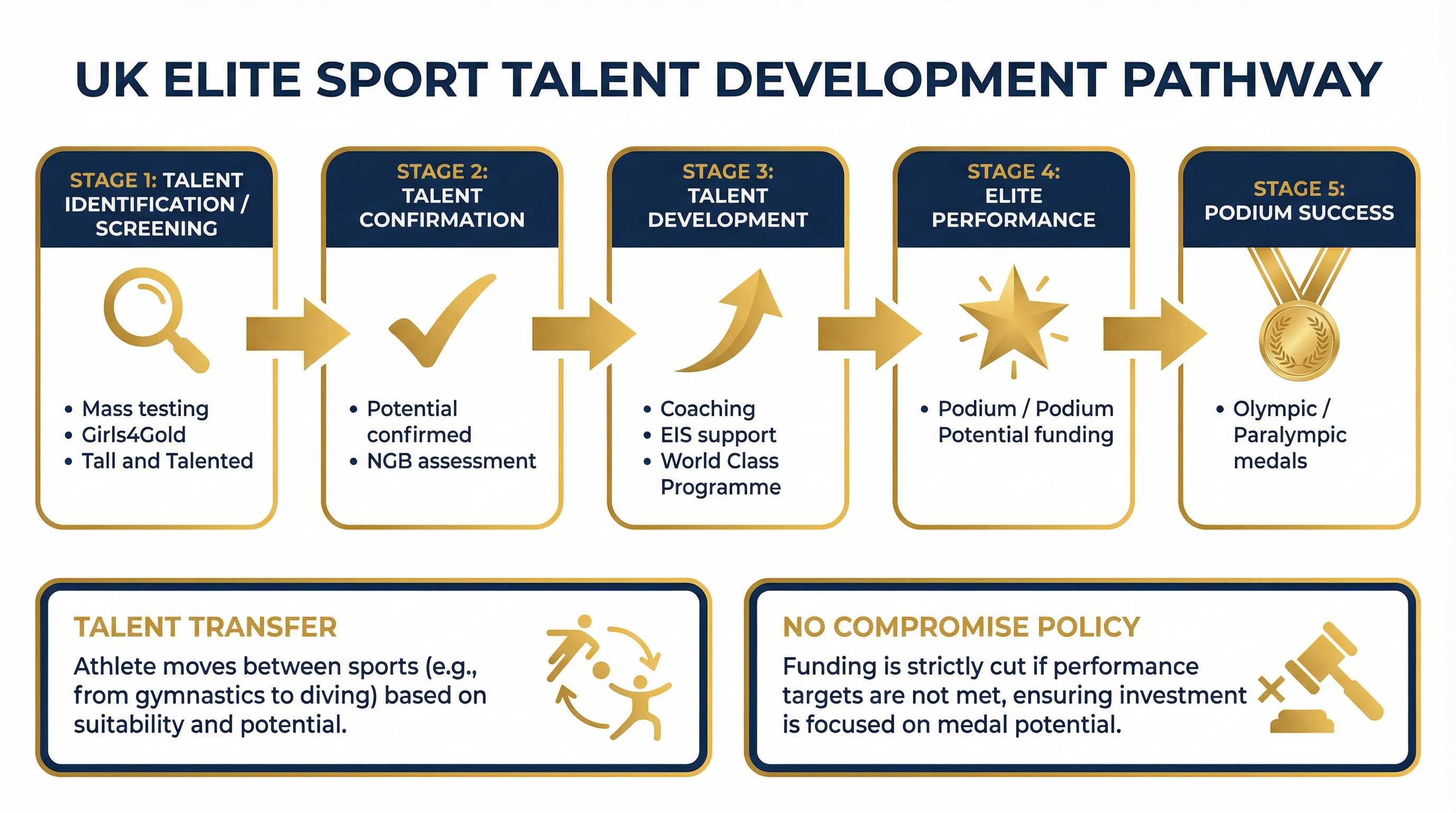
- The 'No Compromise' Approach: This is the foundational principle of UK Sport's funding strategy. It means that investment is directed only to sports and athletes with genuine medal potential. While highly effective in boosting medal counts, it is ethically contentious as it can lead to sports with high participation but low medal chances (like basketball) having their funding cut.
Key Practitioners/Artists/Composers
In the context of PE, 'practitioners' are the organisations and initiatives that shape the elite sport landscape.
| Name | Period/Style | Key Works | Relevance |
|---|---|---|---|
| UK Sport | 1997-Present | World Class Programme, 'No Compromise' Policy | The central agency for elite funding and strategy in the UK. |
| English Institute of Sport (EIS) | 2002-Present | Provision of Sport Science & Medicine | Delivers the practical support that transforms athletic potential into performance. |
| National Lottery | 1994-Present | Primary funding source for UK Sport | Transformed British sport from amateurism to professionalism. |
| Talent ID Programmes (e.g., Girls4Gold) | 2008-Present | Talent Identification & Transfer | Proactive initiatives to find athletes with the raw physical potential for elite sport. |
Technical Vocabulary
- Talent Identification: The process of screening large populations to find individuals with the potential to become elite athletes.
- Talent Development: The process of providing a suitable learning environment to accelerate an individual's progress towards elite status.
- Talent Transfer: A specific type of talent identification where an athlete is moved from one sport to another that may be better suited to their physical or psychological attributes (e.g., a powerful gymnast to diving).
- Athlete Performance Award (APA): A grant paid directly to an athlete from UK Sport to help with living and training costs, allowing them to be a 'full-time' athlete.
- Whole Sport Plan: A detailed strategy submitted by an NGB to UK Sport when bidding for funding, outlining their medal targets and development plans.
Practical Skills
Techniques & Processes
The 'practical skill' in this topic is the application of knowledge to exam questions. A key process is the D-E-E Method for extended answers:
- Define (AO1): Clearly and concisely define the key term or organisation in the question (e.g., "UK Sport is the UK's high-performance agency responsible for distributing National Lottery funding to elite athletes.").
- Explain (AO2): Apply your knowledge to the specific context of the question. Provide examples. (e.g., "UK Sport applies its 'No Compromise' policy by allocating funding from its World Class Programme to NGBs, such as British Rowing, based on their ability to win medals. This is split into Podium and Podium Potential tiers...").
- Evaluate (AO3): Make a judgement. Discuss the strengths, weaknesses, effectiveness, or ethical implications. (e.g., "Whilst this 'No Compromise' approach has been hugely successful in raising the UK's position in the medal table, it can be criticised for creating a two-tier system where non-Olympic sports or those with less medal potential, like basketball, lose out on vital funding, negatively impacting their development.").
Materials & Equipment
Your 'equipment' for this topic is a deep well of specific, concrete examples. Generic statements will not earn high marks. You must be able to cite:
- Specific EIS Services: Physiotherapy, Performance Lifestyle, Biomechanics, Strength & Conditioning, Sports Psychology.
- Specific Talent ID Programmes: Girls4Gold, Tall and Talented, Sporting Giants.
- Specific Sports that have had funding cut: Basketball, Handball.
- Specific Sports that receive high levels of funding: Cycling, Rowing, Athletics, Swimming.
Portfolio/Coursework Guidance
While PE has a practical component, this topic is purely theoretical and examined in the written paper. Your 'portfolio' is your revision folder, which should be built to evidence your understanding.
Assessment Criteria
Examiners are looking for your ability to demonstrate understanding across three Assessment Objectives (AOs):
- AO1 (30%): Knowledge and understanding of concepts, facts, and terminology.
- AO2 (30%): Application of knowledge to different sporting contexts and scenarios.
- AO3 (40%): Analysis and evaluation of concepts, theories, and policies.
Notice the heavy weighting on AO3. Pure description will not pass. You must analyse and evaluate.
Building a Strong Portfolio
- Case Studies: Create one-page summaries for sports like British Cycling (a success story) and Basketball (a funding casualty). For each, explain how the elite sport structure has impacted them.
- Debate Summaries: Write a for-and-against summary for the 'No Compromise' policy. This is perfect preparation for an evaluation question.
- Diagrams: Redraw the funding structure diagram from memory. This forces active recall and embeds the relationships between organisations in your mind.
Exam Component
Written Exam Knowledge
This entire topic is assessed in the written exam papers. It can appear as short-answer questions (1-4 marks) or as part of the longer 8 and 15-mark extended response questions. The concepts are fundamental to Paper 1 (Factors affecting participation in physical activity and sport) and Paper 2 (Factors affecting optimal performance in physical activity and sport).
Practical Exam Preparation
There is no direct practical exam for this topic. However, a deep understanding of the support systems available to elite athletes (like EIS services) provides excellent context for your own practical performance and coursework, allowing you to analyse performance in a more sophisticated way."