Study Notes
Overview
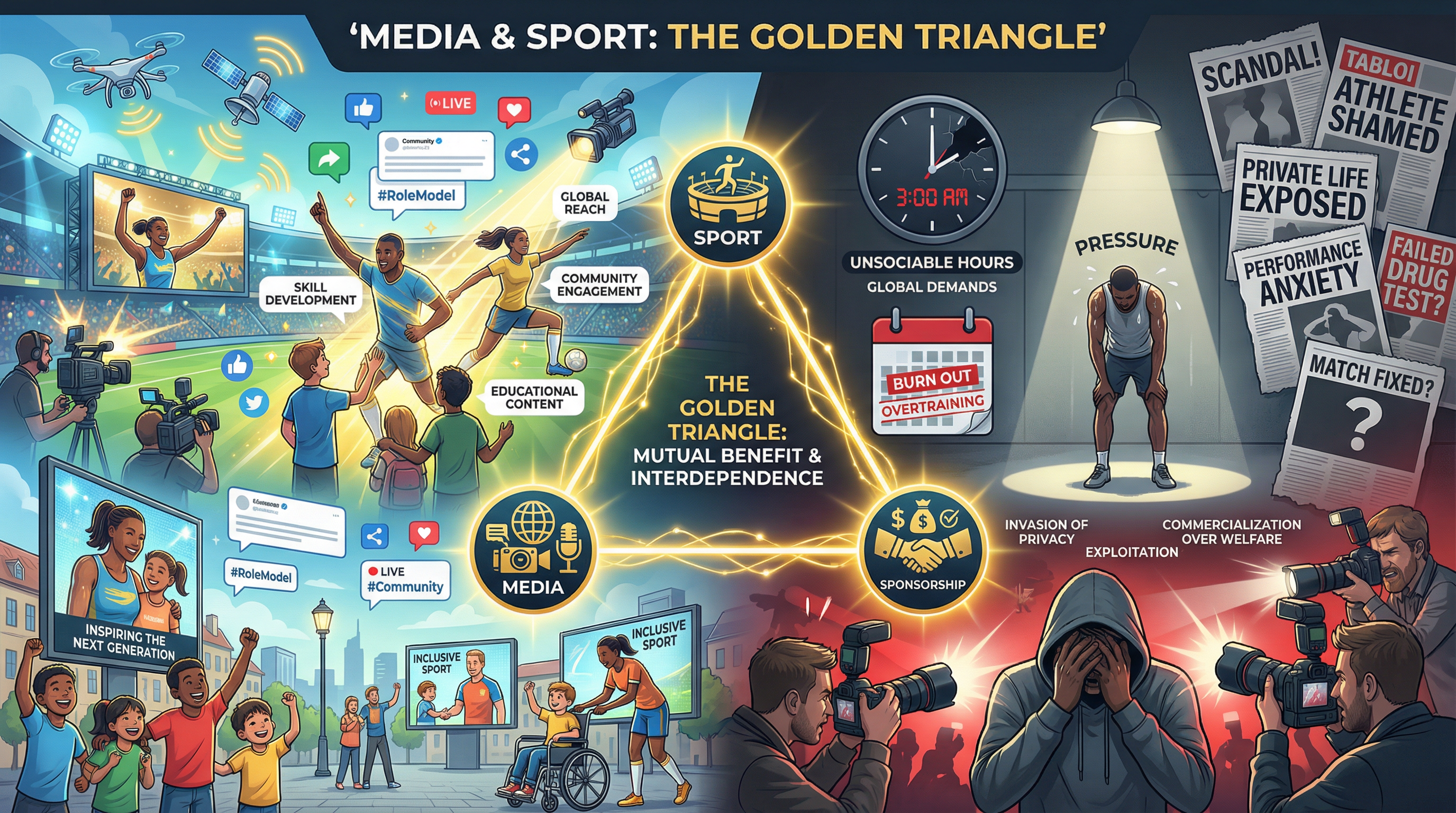
The relationship between media and sport is one of the most commercially significant and socially influential dynamics in modern society. Within the OCR GCSE Physical Education specification (Component 02, Section 6.2), candidates are required to analyse how various media sectors—terrestrial television, satellite and subscription services, radio, internet platforms, social media, and print press—shape the sporting landscape. This relationship is best understood through the concept of the Golden Triangle, a model that illustrates the mutual dependence between Sport, Media, and Sponsorship. Each entity relies on the others for survival and growth: Sport provides compelling content, Media broadcasts and amplifies this content to mass audiences, and Sponsorship injects capital in exchange for brand visibility. The examiner expects candidates to demonstrate a nuanced understanding of this interdependence, recognising that while media coverage can elevate sports to unprecedented heights, it can also impose significant pressures and distortions on performers, governing bodies, and the integrity of competition itself.
Key Knowledge & Theory
Core Concepts
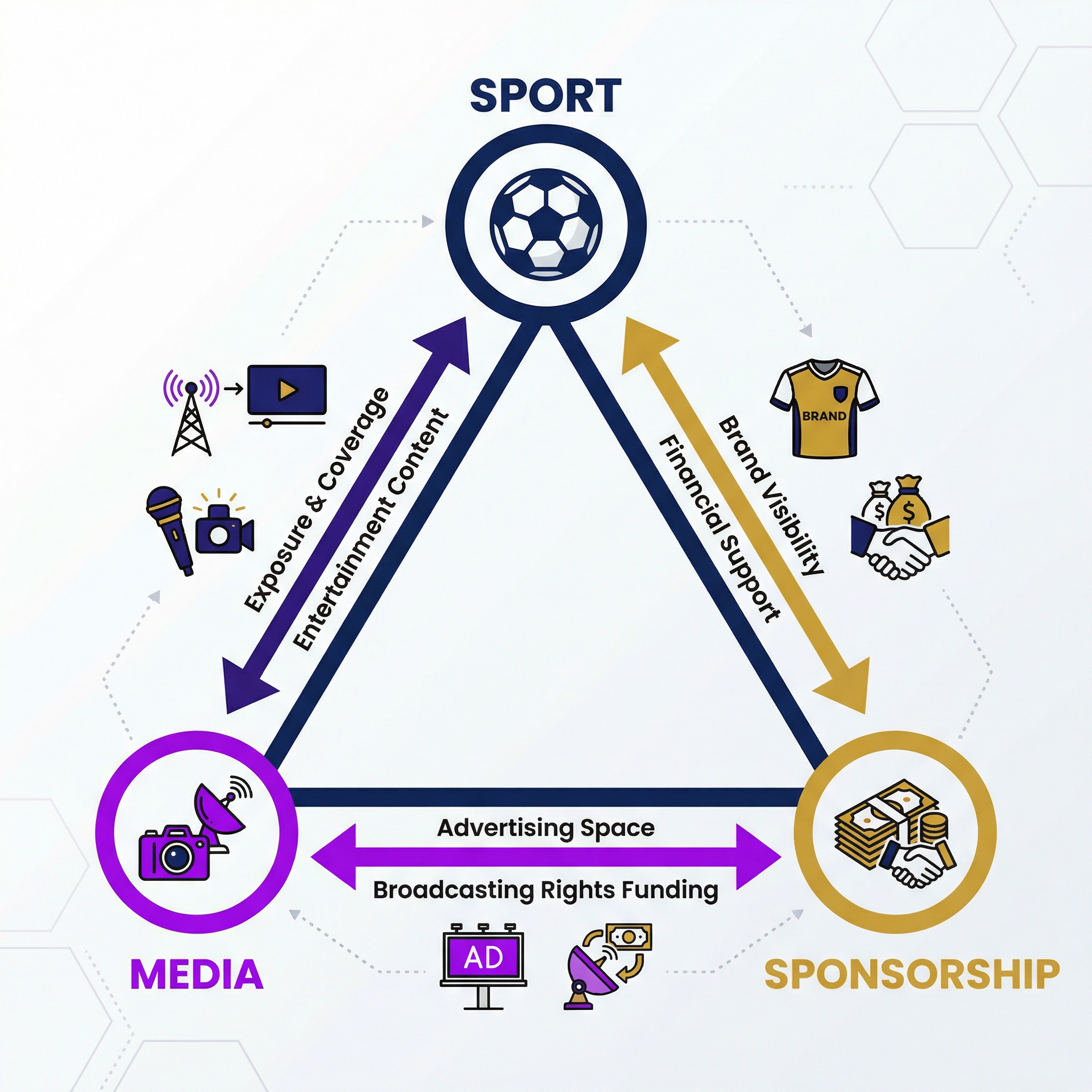
The Golden Triangle is the foundational model for understanding the commercialisation of sport. At its apex sits Sport, which generates the drama, skill, and emotional engagement that captivates audiences. On the two base corners are Media and Sponsorship. Media organisations purchase broadcasting rights from sports governing bodies and leagues, providing them with substantial revenue streams. In return, Media gains exclusive content that attracts viewers, listeners, and online users. Sponsorship completes the triangle by paying Media for advertising slots during broadcasts and by directly funding sports teams, events, and individual athletes in exchange for brand exposure. This creates a self-reinforcing cycle: increased media coverage raises the profile of a sport, which attracts more sponsors, which in turn provides more funding for the sport to grow and improve its product, making it even more attractive to broadcasters.
However, this symbiosis is not without tension. Media organisations wield considerable influence over the sports they cover, often dictating kick-off times to suit prime-time television schedules or international audiences in different time zones. Rule changes may be introduced to make sports more telegenic or fast-paced, as seen with the creation of Twenty20 cricket, the introduction of Video Assistant Referee (VAR) technology in football, and the adoption of tie-breaks in tennis. While these innovations can enhance the spectator experience, they may also alter the fundamental character of the sport and disadvantage local fans who must attend matches at unsociable hours.
Another critical concept is media bias and coverage inequality. Mainstream sports such as football, rugby, and cricket receive the lion's share of broadcasting time and financial investment, while minority sports, women's sports, and disability sports are often marginalised. This disparity perpetuates a cycle in which under-covered sports struggle to attract sponsorship, limiting their ability to develop grassroots programmes and elite pathways. The examiner awards credit to candidates who recognise this imbalance and can discuss its implications for participation and equity in sport.
Key Practitioners and Case Studies
| Name/Organisation | Role/Context | Key Contribution | Relevance to Exam |
|---|---|---|---|
| Sky Sports | Satellite broadcaster | Revolutionised football coverage in the UK through exclusive Premier League rights, driving commercialisation | Example of media's financial power and influence over scheduling |
| BBC Sport | Terrestrial broadcaster | Provides free-to-air coverage of major events (Wimbledon, Olympics), promoting mass participation | Demonstrates positive impact of accessible media on grassroots engagement |
| Marcus Rashford | Elite footballer and campaigner | Used media platform to advocate for child food poverty, becoming a role model beyond sport | Illustrates positive performer impact via media visibility |
| England Lionesses | Women's football team | Euro 2022 victory generated unprecedented media coverage, boosting participation in women's football | Case study for media's role in raising profile and inspiring participation |
| T20 Cricket (IPL) | Format innovation | Created to suit television audiences with shorter, faster matches and entertainment elements | Example of rule changes driven by media and commercial interests |
| Paralympic Games | Disability sport event | Increased media coverage (Channel 4) has improved public perception and participation in disability sports | Demonstrates how media can address inequality and challenge stereotypes |
Technical Vocabulary
Candidates must use precise terminology to demonstrate subject knowledge and earn Assessment Objective 1 (AO1) marks. Key terms include:
- Broadcasting Rights: The exclusive legal permission granted to a media organisation to transmit coverage of a sporting event, typically sold by National Governing Bodies (NGBs) or leagues for substantial fees.
- Commercialisation: The process by which sport becomes increasingly driven by profit motives, often through media deals, sponsorship, and merchandising.
- Golden Triangle: The interdependent relationship between Sport, Media, and Sponsorship, where each entity relies on the others for financial and promotional success.
- Media Intrusion: Unwanted and invasive coverage of a performer's private life by journalists, paparazzi, or social media, often leading to stress and loss of privacy.
- Role Model: An individual whose behaviour, achievements, and public profile inspire others, particularly young people, to participate in sport or adopt positive values.
- Deviant Behaviour: Actions that violate accepted norms or rules, which may be exacerbated by media pressure on performers to succeed at any cost (e.g., doping, aggression).
- Minority Sports: Sports that receive limited media coverage and funding compared to mainstream sports, including women's sports, disability sports, and less popular activities such as netball, volleyball, or badminton.
- Scheduling Conflicts: Situations where match or event timings are dictated by media requirements (e.g., global broadcast windows) rather than the convenience of local fans or player welfare.
Practical Skills
Techniques for Analysing Media Impact
While this topic is primarily theoretical, candidates must develop the analytical skill of evaluating multiple perspectives. When presented with a scenario or case study in the exam, candidates should systematically consider the impact on different stakeholders using the P.E.S.S. framework:
- Performer: How does media coverage affect the individual athlete's mental health, privacy, financial opportunities, and public profile?
- Event/Sport: How does media influence the rules, scheduling, funding, and global reach of the sport itself?
- Spectator: How does media coverage shape the fan experience, accessibility, and engagement with the sport?
- Sponsor: How does media exposure provide value to sponsors through brand visibility and audience reach?
This structured approach ensures that candidates address the full breadth of the question and avoid the common mistake of focusing exclusively on one stakeholder group.
Constructing Extended Responses
For 6-mark questions, candidates should adopt a balanced argument structure:
- Introduction: Briefly define the key concept (e.g., the Golden Triangle) and state the dual nature of media's impact.
- Positive Impacts: Provide two to three specific examples with explanation (e.g., increased participation due to role models, revenue from broadcasting rights funding grassroots facilities).
- Negative Impacts: Provide two to three specific examples with explanation (e.g., loss of privacy for performers, rule changes prioritising entertainment over tradition).
- Conclusion: Synthesise the argument, acknowledging that media's impact is context-dependent and varies across different sports and stakeholders.
Candidates should aim to write approximately one mark per minute, meaning a 6-mark question should take around 6-8 minutes and produce a response of 150-200 words.
Portfolio/Coursework Guidance
While this topic does not have a direct coursework component, candidates may be required to produce case study analyses or research tasks as part of their controlled assessment or homework. When building a portfolio of evidence on media's impact, candidates should:
Assessment Criteria
Examiners look for:
- Accurate identification of media sectors and their characteristics (AO1).
- Clear explanation of the mechanisms by which media influences sport, using the Golden Triangle model (AO1 and AO2).
- Critical evaluation of both positive and negative impacts, supported by specific, varied examples (AO2 and AO3).
- Application of knowledge to unfamiliar scenarios, such as emerging sports or new media platforms like streaming services and social media influencers (AO2).
Building a Strong Evidence Base
Candidates should:
- Collect contemporary examples from news articles, documentaries, and sports broadcasts to illustrate key concepts.
- Compare different sports to demonstrate breadth of understanding (e.g., contrast Premier League football with women's netball or wheelchair basketball).
- Analyse the role of social media as a newer form of media that allows performers to control their own narrative and build personal brands, bypassing traditional broadcasters.
- Reference specific data where possible, such as the value of broadcasting deals (e.g., Premier League TV rights worth £5 billion over three years) or participation statistics following major media events (e.g., increase in women's football registrations post-Euro 2022).
Exam Component
Written Exam Knowledge
This topic appears in OCR GCSE Physical Education Component 02: Socio-cultural Influences and Wellbeing in Physical Activity and Sport. The written paper is 1 hour long and worth 60 marks, with this topic typically assessed through a combination of short-answer questions (1-2 marks) and extended response questions (4-6 marks). The Assessment Objective weightings for this component are:
- AO1 (Knowledge and Understanding): 40% — Candidates must accurately recall and define key terms, identify media sectors, and describe the Golden Triangle.
- AO2 (Application): 40% — Candidates must apply their knowledge to specific examples, explaining how media impacts different stakeholders.
- AO3 (Analysis and Evaluation): 20% — Candidates must critically evaluate the balance of positive and negative impacts, making judgements about the overall effect of media on sport.
Typical question stems include:
- "Identify two types of media that cover sport." (2 marks, AO1)
- "Explain how media coverage can have a positive impact on a sport." (4 marks, AO1/AO2)
- "Evaluate the impact of media on elite performers." (6 marks, AO2/AO3)
Practical Exam Preparation
While there is no practical component for this topic, candidates should:
- Practise timed responses to build fluency and ensure they can produce detailed answers within the time constraints.
- Use flashcards to memorise key definitions and examples.
- Engage with real-world media by watching sports broadcasts, reading sports journalism, and following athletes on social media to deepen their understanding of how media operates in practice.
- Participate in class debates on controversial issues, such as whether media has done more harm than good to sport, to develop evaluative skills.
Podcast Script
Hello and welcome to the GCSE PE Pod, your go-to resource for acing your exams! I'm your host, and today we're diving into a massive topic: the impact of media on sport. It's section 6.2 of the OCR spec, and it's a goldmine for marks if you know what you're doing. We'll break down the good, the bad, and the ugly of how TV, social media, and the press shape the sports we love. Ready? Let's get started.
First up, let's talk about the 'Golden Triangle'. This is a key concept examiners love. Picture a triangle: at the top, you have 'Sport'. At the bottom two corners, you have 'Media' and 'Sponsorship'. They are all symbiotically linked – they depend on each other to thrive. Sport provides the content for the Media – the drama, the skill, the excitement. The Media then packages this and sells it to us, the audience. This huge audience attracts Sponsors, who want to advertise their products. The Sponsors pay the Media for advertising slots and also pay the Sport directly through deals and endorsements. That money, from both media rights and sponsorship, is the lifeblood of modern professional sport. It funds everything from grassroots facilities to multi-million-pound player contracts. So, Sport needs Media for exposure, Media needs Sport for content, and Sponsorship needs both to reach customers. It's a perfect, mutually beneficial relationship... or is it?
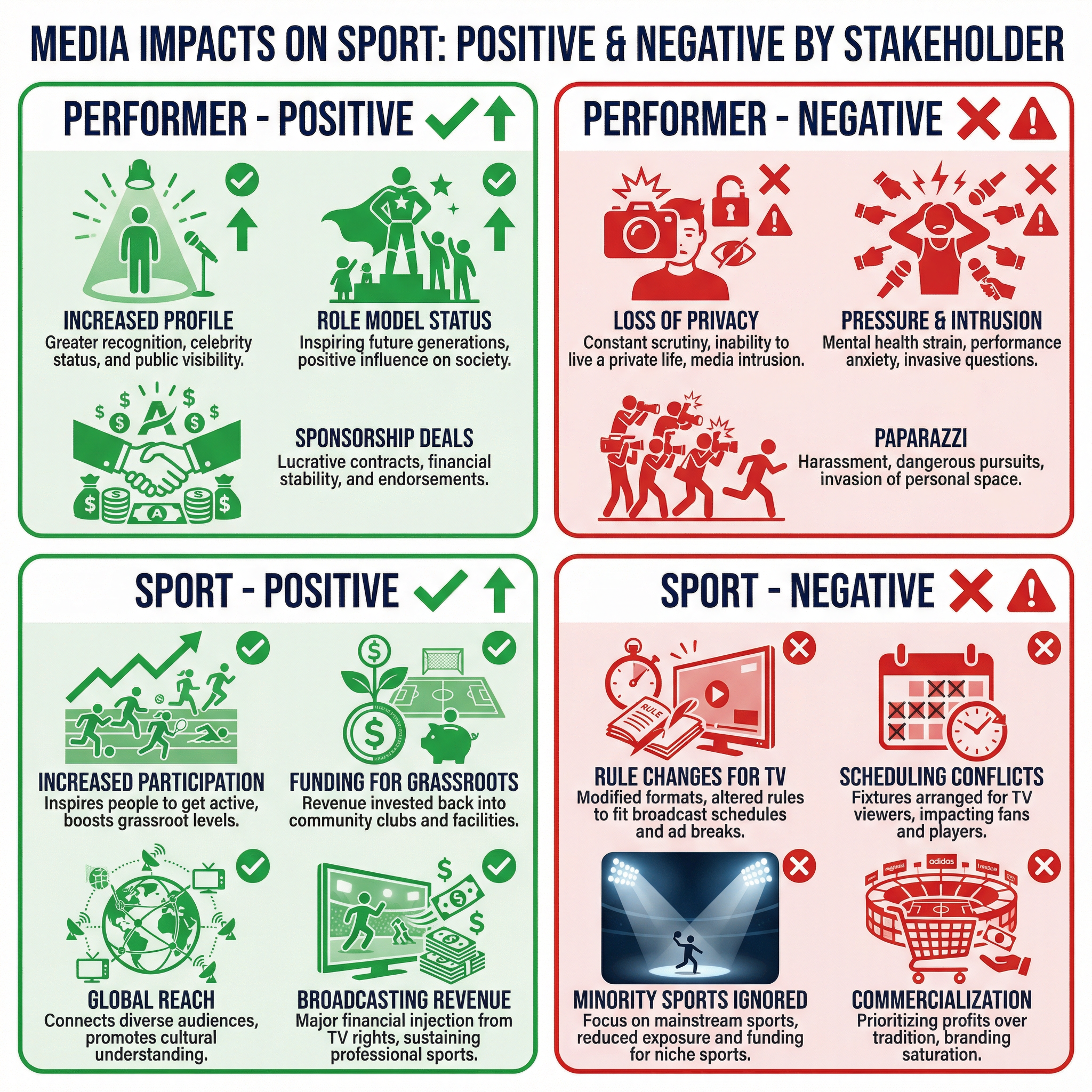
Let's look at the positives. For the sport itself, media coverage massively increases its profile. Think about the growth of women's football after the Lionesses' Euros win – it was all over the TV, and participation skyrocketed. It also brings in huge revenue from broadcasting rights. The Premier League's TV deal is worth billions! This money can be reinvested into better facilities and coaching. For performers, media turns them into role models, inspiring the next generation. Think Marcus Rashford and his incredible charity work, amplified by his media profile. It gives them a platform for good.
But there's a flip side. The media's influence isn't always positive. For the sport, it can lead to rule changes purely for entertainment. Think of T20 cricket with its faster pace, or the introduction of VAR in football – these are designed to make it a better TV product, but can sometimes disrupt the flow of the game. Kick-off times are often dictated by global TV audiences, meaning late nights for local fans. And the media tends to focus on mainstream sports like football, leaving minority sports like volleyball or disability sports fighting for airtime and funding.
For the performer, the negative impact can be immense. The media spotlight brings intense pressure to perform, week in, week out. And it can lead to a serious loss of privacy. Paparazzi, sensationalist headlines in the press... it can take a huge toll on a player's mental health. One mistake, on or off the pitch, can be blown out of all proportion.
So, when you're answering a question on this, you need to show the examiner you understand this two-sided coin. A great way to structure a 6-mark answer is to use the P.E.S.S. acronym: discuss the impact on the Performer, the Event (the sport itself), the Spectator, and the Sponsor. This ensures you cover all the angles.
Now for some common mistakes to avoid. First, don't confuse 'media' and 'sponsorship'. The media broadcasts the sport; sponsors pay to be associated with it. They are different points on the Golden Triangle. Second, be specific. Don't just say 'sport gets more money'. Say where the money comes from – broadcasting rights – and who it goes to, like National Governing Bodies. Finally, don't just use football as your example. Show your breadth of knowledge. Talk about the lack of coverage for wheelchair rugby, or how the media has boosted the profile of netball.
Okay, time for a quick-fire recall quiz! I'll ask a question, you pause and answer, then I'll give you the correct response. Ready?
One: What are the three points of the Golden Triangle?
(Pause) ... Sport, Media, and Sponsorship.
Two: Name two positive impacts of media on a sport.
(Pause) ... Increased profile, increased participation, more revenue from broadcasting rights.
Three: Name two negative impacts of media on a performer.
(Pause) ... Loss of privacy, increased pressure, media intrusion.
Four: Give an example of a sport's rules being changed to suit the media.
(Pause) ... T20 cricket, VAR in football, or rule changes in badminton.
Great job! Keep practicing those, and you'll have the core knowledge locked in.
So, to summarise: the media's relationship with sport is a classic double-edged sword. It brings money, profile, and role models, but at the cost of commercialisation, pressure, and a loss of privacy. The key to exam success is to understand this balance and to use specific, varied examples to back up your points. Remember the Golden Triangle and the P.E.S.S. structure for your answers.
That's all for today's episode of the GCSE PE Pod. Keep up the hard work, and I'll see you next time. (Outro music fades in and out).