Study Notes
Overview
Attribution Theory and Self-Efficacy are cornerstone concepts in sport and exercise psychology. They provide a framework for understanding the critical link between an athlete's thoughts, feelings, and performance. For A-Level PE candidates, mastering this topic is not just about memorising theories; it's about applying them to real-world sporting scenarios to analyse motivation, persistence, and behaviour. Examiners are looking for students who can dissect why an athlete might give up after a setback (Learned Helplessness) or why another might thrive under pressure. This guide will equip you with the theoretical knowledge and practical application skills to achieve this.
Key Knowledge & Theory
Core Concepts
**Weiner's Attribution Theory (1979)**Bernard Weiner's model proposes that individuals seek to explain the causes of events, particularly unexpected successes or failures. These explanations, or attributions, are categorised along two dimensions:
- Locus of Causality: Is the cause Internal (e.g., effort, ability) or External (e.g., luck, task difficulty) to the performer?
- Stability: Is the cause Stable (unchanging, e.g., ability, task difficulty) or Unstable (changeable, e.g., effort, luck)?
Combining these dimensions creates a 2x2 grid that is essential for analysis. Credit is awarded for correctly categorising attributions and, crucially, for explaining the motivational consequences of these attributions.
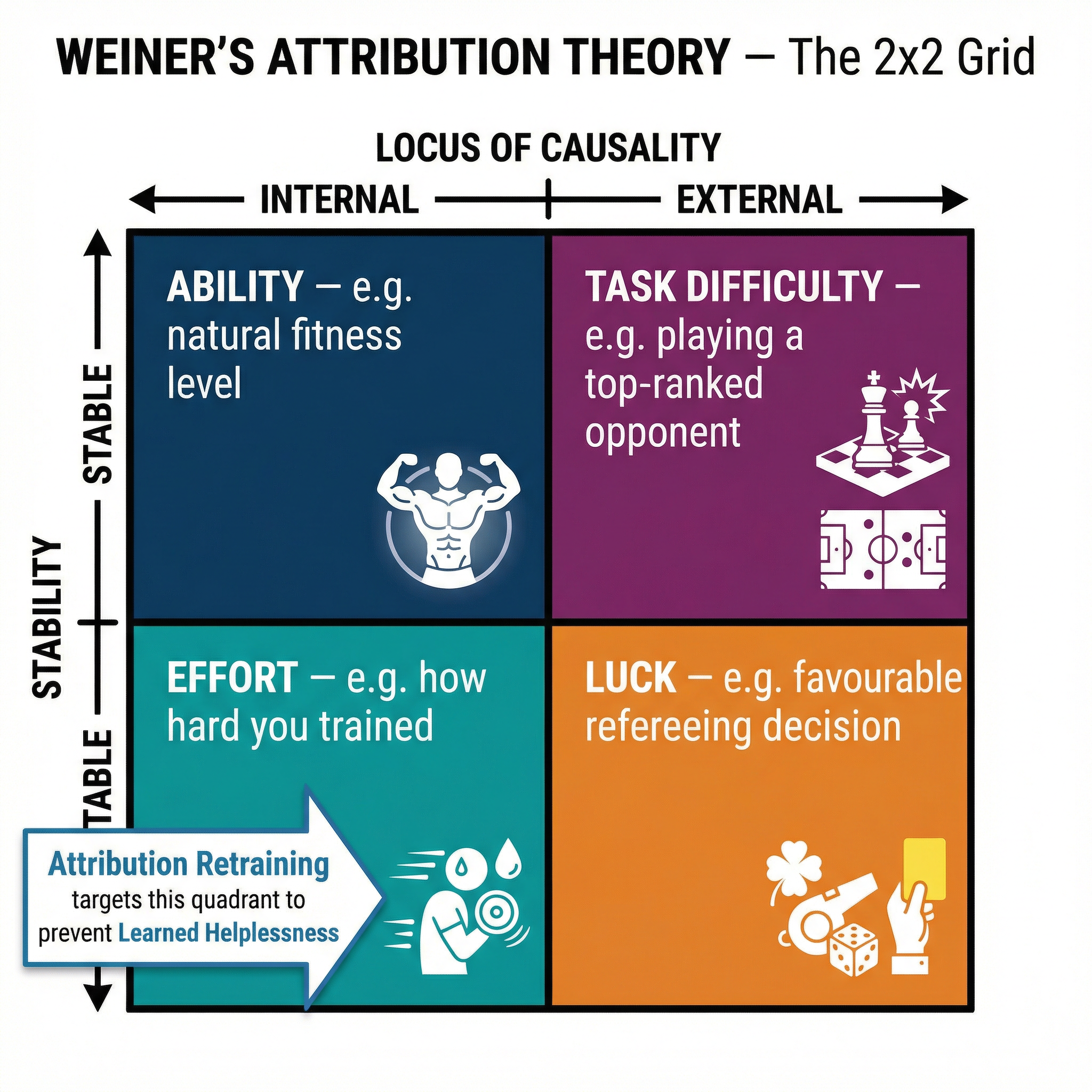
- Internal/Stable (Ability): Attributing outcomes to natural talent or lack thereof. Attributing failure to low ability is highly demotivating as it suggests the outcome is unchangeable.
- Internal/Unstable (Effort): Attributing outcomes to the level of work invested. This is the most adaptive attribution for failure, as it implies the performer can change the outcome in the future by trying harder. This is the target of Attribution Retraining.
- External/Stable (Task Difficulty): Attributing outcomes to the challenge level of the opposition or task. A valid reason for failure against a superior opponent.
- External/Unstable (Luck): Attributing outcomes to chance or random factors. While it can protect self-esteem in the short term, over-reliance on luck can be detrimental.
Learned HelplessnessA state that can arise from repeatedly attributing failure to stable, internal factors (i.e., lack of ability). The athlete comes to believe that failure is inevitable regardless of their actions. This leads to a cessation of effort and a significant drop in performance. It can be specific (in one sport) or global (across all sports).
Self-Serving BiasThis is a common psychological tendency to protect self-esteem. Athletes often attribute their successes to internal factors (e.g., "I won because I'm talented and worked hard") and their failures to external factors (e.g., "I lost because the referee was biased"). While it can maintain motivation, it can also prevent an athlete from taking responsibility for their mistakes.
**Bandura's Self-Efficacy Model (1977)**Self-efficacy is not general confidence; it is the task-specific belief in one's ability to succeed in a particular situation. Albert Bandura identified four key antecedents that influence an individual's level of self-efficacy. Candidates must be able to evaluate the relative importance of these sources.
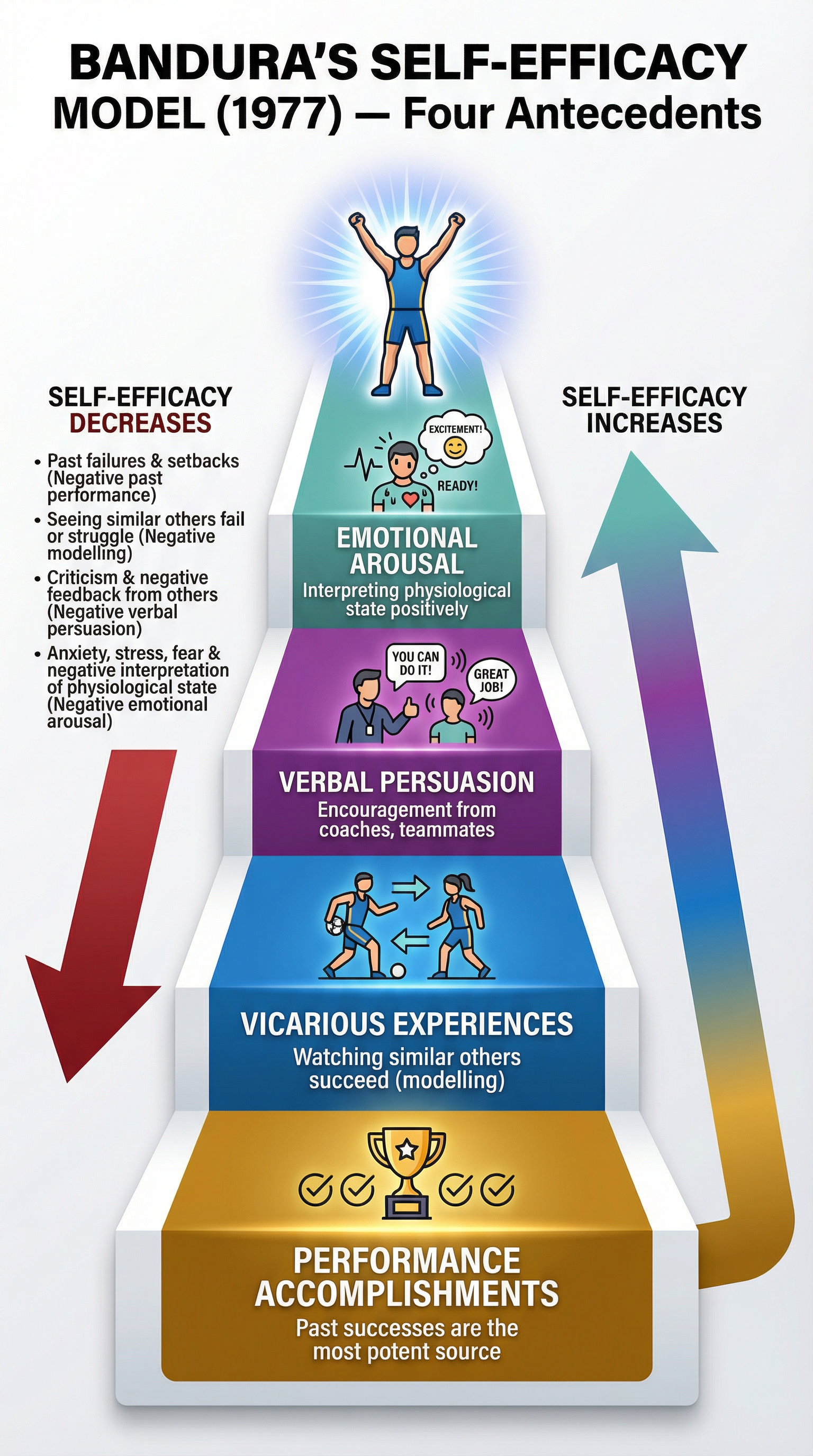
- Performance Accomplishments (Most Potent): Past experiences of success are the most powerful source of self-efficacy. A history of success builds a strong belief in one's capabilities, while a history of failure undermines it.
- Vicarious Experiences (Modelling): Watching others of a similar ability succeed can raise our own belief that we can also succeed. The more similar the model, the greater the influence.
- Verbal Persuasion: Encouragement from significant others (coaches, peers, parents). While helpful, its effects can be temporary if not supported by actual performance accomplishments.
- Emotional Arousal (Least Potent): The athlete's interpretation of their physiological state. A high heart rate can be interpreted as anxiety (lowering efficacy) or as readiness and excitement (raising efficacy). Cognitive techniques can help athletes reframe this arousal positively.
Key Practitioners/Artists/Composers
| Name | Period/Style | Key Works | Relevance |
|---|---|---|---|
| Bernard Weiner | 1970s-Present / Social Psychology | 'A theory of motivation for some classroom experiences' (1979) | Developed the foundational Attribution Theory model (Locus of Causality & Stability) used to analyse motivation in sport. |
| Albert Bandura | 1970s-2000s / Social Cognitive Theory | 'Self-efficacy: Toward a Unifying Theory of Behavioral Change' (1977) | Introduced the concept of Self-Efficacy and its four antecedents, providing a framework for understanding task-specific confidence. |
Technical Vocabulary
- Attribution: The perceived cause of an outcome.
- Locus of Causality: The dimension of attribution relating to whether a cause is internal or external.
- Stability: The dimension of attribution relating to whether a cause is stable or unstable.
- Learned Helplessness: The belief that failure is inevitable, stemming from attributions of failure to internal, stable causes.
- Attribution Retraining: A coaching process to encourage performers to attribute failure to unstable, controllable factors like effort.
- Self-Efficacy: The task-specific belief in one's ability to succeed.
- Antecedent: A factor that precedes and influences a psychological state (e.g., the four sources of self-efficacy).
Practical Skills
Techniques & Processes
Applying Attribution Retraining as a Coach:
- Monitor Attributions: Actively listen to the language your athletes use after a performance. Do they blame their ability? Or external factors?
- Reframe Failure: After a loss or mistake, immediately reframe the cause. Instead of letting an athlete say "I'm just not good enough," a coach should intervene: "That wasn't about ability. Your focus lapsed for a moment, and we can work on maintaining that focus under pressure. Let's try it again."
- Set Process Goals: Shift focus from outcome goals (winning) to process goals (e.g., executing a specific technique correctly). This makes success more attainable and links it directly to effort and strategy.
- Provide Video Feedback: Show an athlete a video of them successfully performing a skill in the past (Performance Accomplishment) to counter a recent failure.
Materials & Equipment
- Performance Diaries: Athletes can use diaries to log their performances and their immediate thoughts on the causes of success and failure. This provides tangible data for a coach to review and begin the attribution retraining process.
- Video Analysis Software: Tools like Hudl or Dartfish allow coaches to isolate specific moments in a performance. This can be used to provide evidence for verbal persuasion (e.g., "See, you can do it, here's the proof") or to highlight technical errors (effort-based attributions) rather than ability deficits.
Portfolio/Coursework Guidance
Assessment Criteria
While this topic is primarily theoretical, it can be applied in coursework (e.g., AEP - Analysis and Evaluation of Performance). Examiners look for:
- AO1 (Knowledge): Accurate definitions of Weiner's and Bandura's models.
- AO2 (Application): Applying the models to your own or an elite performer's performance, using specific examples.
- AO3 (Analysis/Evaluation): Evaluating the effectiveness of psychological strategies (like attribution retraining) on performance, and making synoptic links between attribution, efficacy, and motivation.
Building a Strong Portfolio
If analysing your own performance, you could structure a section as follows:
- Identify a Weakness: E.g., "My free-throw percentage drops significantly in the final two minutes of a close game."
- Analyse Attributions: "Initially, I attributed this to a lack of clutch ability (internal, stable). This lowered my self-efficacy in pressure situations."
- Implement a Strategy: "My coach implemented attribution retraining, focusing me on my breathing technique (effort, unstable) and used video of my successful free-throws in training (performance accomplishments). They also used verbal persuasion, reminding me of my high training percentage."
- Evaluate the Impact: "This shifted my attribution towards effort and raised my self-efficacy. My free-throw percentage in the last two minutes improved by 15% over the next five games."
Exam Component
Written Exam Knowledge
This is a major topic in the 'Sport Psychology' section of the written paper. Expect multiple-choice, short-answer, and extended 8- or 20-mark questions.
- AO1: You will be asked to define terms like 'Locus of Causality' or 'Vicarious Experiences'.
- AO2: You will be given a scenario (e.g., a hockey player misses a penalty) and asked to explain their potential attributions and the effect on their self-efficacy.
- AO3: You will be asked to analyse how a coach could use attribution retraining to prevent learned helplessness, or to evaluate the relative importance of Bandura's four antecedents for a novice vs. an elite performer.
Practical Exam Preparation
N/A for this specific topic, as it is theoretical. However, your practical performance is directly influenced by these concepts. High self-efficacy, fostered by healthy attributions, is a hallmark of elite performers.