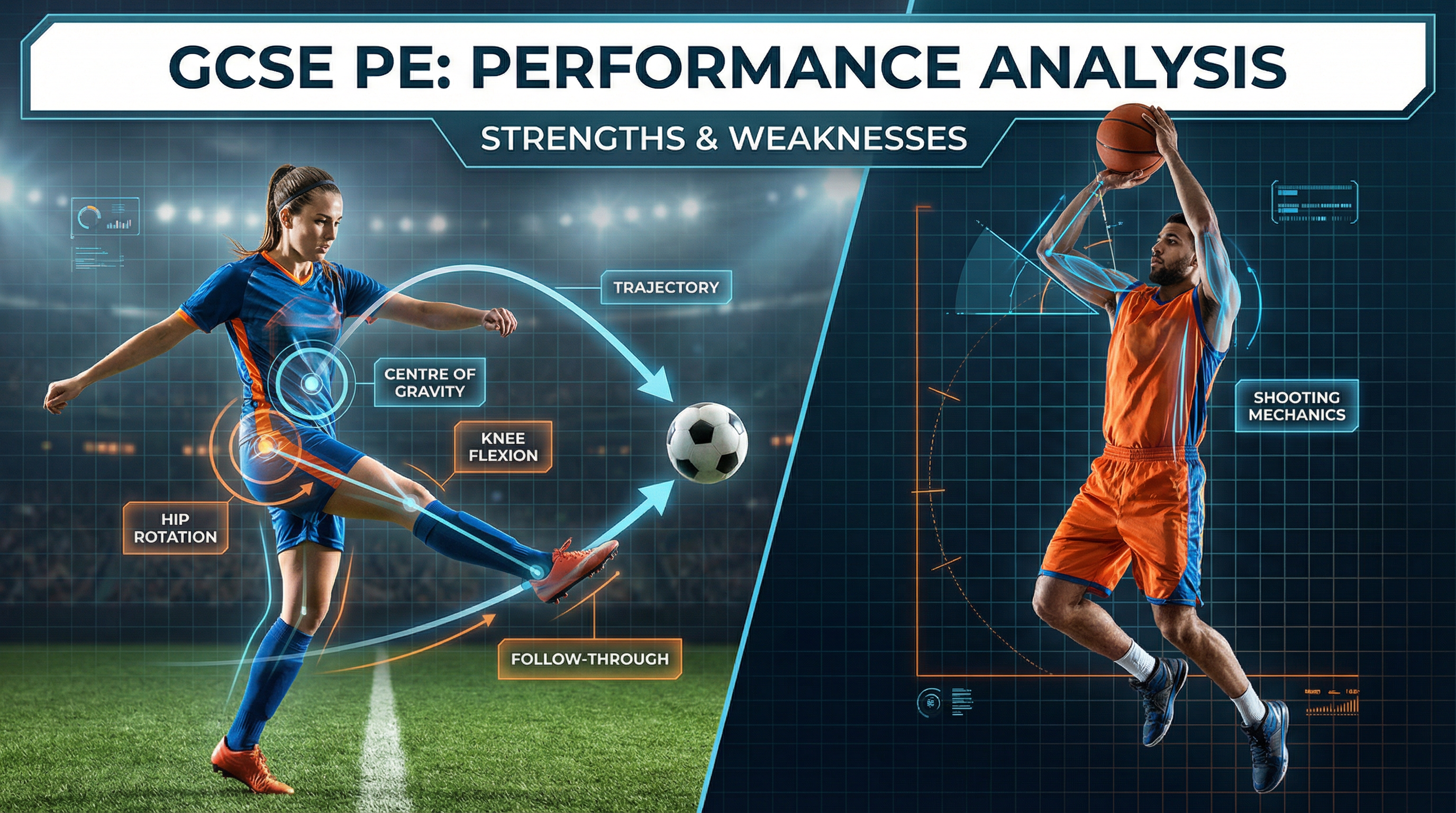
Performance Analysis (Strengths and Weaknesses)

    This guide breaks down the Performance Analysis (AEP) task for OCR GCSE PE, a critical component of the non-exam assessment. It provides the theoretical knowledge and practical skills needed to accurately identify strengths and weaknesses, justify them with evidence, and create a targeted action plan for improvement. Master this, and you'll be well on your way to securing top marks.

    6
    Min Read
    3
    Examples
    4
    Questions
    6
    Key Terms
    🎙 Podcast Episode
    Performance Analysis (Strengths and Weaknesses)
    4:30
    0:00-4:30

    Study Notes

    Header image for Performance Analysis (Strengths and Weaknesses).

    Overview

    The Analysing and Evaluating Performance (AEP) component is a cornerstone of your OCR GCSE PE qualification. It moves beyond simply playing a sport and challenges you to think like a coach or a sports scientist. You will be required to critically observe a live or recorded performance—either your own or a peer's—and dissect it to identify what works well (strengths) and what needs development (weaknesses). This isn't just about spotting mistakes; it's about understanding why they happen and creating a robust, evidence-based plan to improve them. This task directly assesses your ability to apply theoretical knowledge from across the specification to a real-world sporting context, making it a crucial test of your AO2 and AO3 skills.

    Key Knowledge & Theory

    Core Concepts

    To produce a high-level analysis, you must be confident in distinguishing between the three core areas of performance:

    1. Skills/Techniques: These are the specific, learned actions required to perform a sport. A key requirement is to break down any given skill into its constituent phases: Preparation, Execution, and Recovery. For example, a tennis serve involves the ball toss and backswing (Preparation), the strike and follow-through (Execution), and returning to a ready position (Recovery). Marks are awarded for identifying the exact phase where a strength or weakness occurs.

    2. Components of Fitness: These are the physical attributes that underpin your ability to perform skills effectively. It is vital that you do not confuse these with skills. For instance, "Speed" is a fitness component, whereas a "Fast Sprint" is the application of that fitness within a skill. Your analysis must correctly classify and justify why a specific fitness component is a strength or weakness, such as, 'My lack of cardiovascular endurance (fitness) was a weakness, evidenced by my slower recovery times between sprints in the final ten minutes of the match.'

    3. Tactics/Strategies: These are the plans and decisions made before and during a game to increase the chance of success. This could involve team formations, set-plays, or individual decision-making (e.g., choosing to pass instead of shoot). Analysis should focus on the effectiveness of a chosen tactic, referencing its impact on the game's outcome.

    Listen to our 10-minute podcast guide to mastering Performance Analysis.

    Technical Vocabulary

    Using precise terminology is non-negotiable for achieving high marks. Examiners are looking for candidates who can communicate their analysis with the clarity of a subject expert. You must integrate the following terms into your work:

    • Movement Analysis: Use biomechanical terms like flexion, extension, abduction, adduction, rotation, centre of gravity, levers, and planes of movement to describe why a technique is effective or flawed.
    • Fitness Components: Be specific. Instead of 'stamina', use cardiovascular endurance or muscular endurance. Use terms like agility, balance, coordination, power, reaction time, and flexibility correctly.
    • Principles of Training: When designing your action plan, you must apply the principles of SPOR (Specificity, Progressive Overload, Reversibility) and the FITT principles (Frequency, Intensity, Time, Type).

    Practical Skills

    Techniques & Processes

    The core practical skill is the analysis itself. A high-scoring approach is the Impact-Cause-Consequence Model:

    1. IMPACT (What?): State the observable strength or weakness. e.g., "My lay-up shot consistently missed the target."
    2. CAUSE (Why?): Explain the technical or physical reason for it. This is where you apply your theoretical knowledge. e.g., "Biomechanical analysis shows that during the execution phase, my centre of gravity was too far forward, causing me to be off-balance upon take-off."
    3. CONSEQUENCE (So what?): Describe the effect this had on the performance or game outcome. e.g., "This resulted in 5 lost scoring opportunities and allowed the opposition to regain possession."
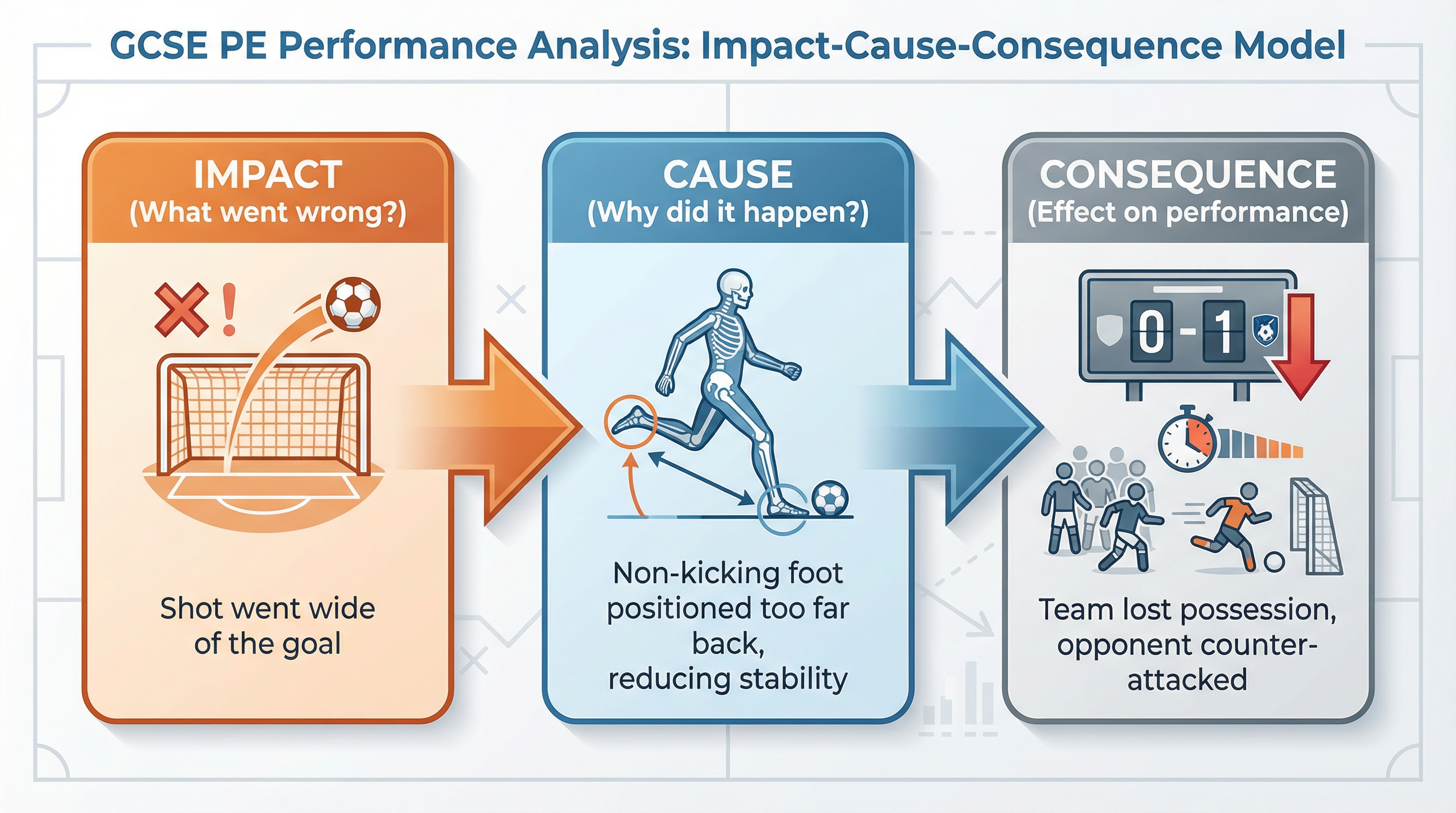
    Use the I-C-C model to structure your analysis of weaknesses for maximum marks.

    Portfolio/Coursework Guidance

    Assessment Criteria

    Your AEP is marked against the Assessment Objectives. Understanding this is key to knowing where to focus your effort.

    • AO1 (Knowledge): This is for using the correct terminology and showing you understand the concepts.
    • AO2 (Application): This is for applying your knowledge to the specific performance you are analysing.
    • AO3 (Analysis & Evaluation): This is the most heavily weighted. It's for making judgements about the quality of performance, explaining the causes of weaknesses, and creating a justified action plan. This is where the Impact-Cause-Consequence model is vital.
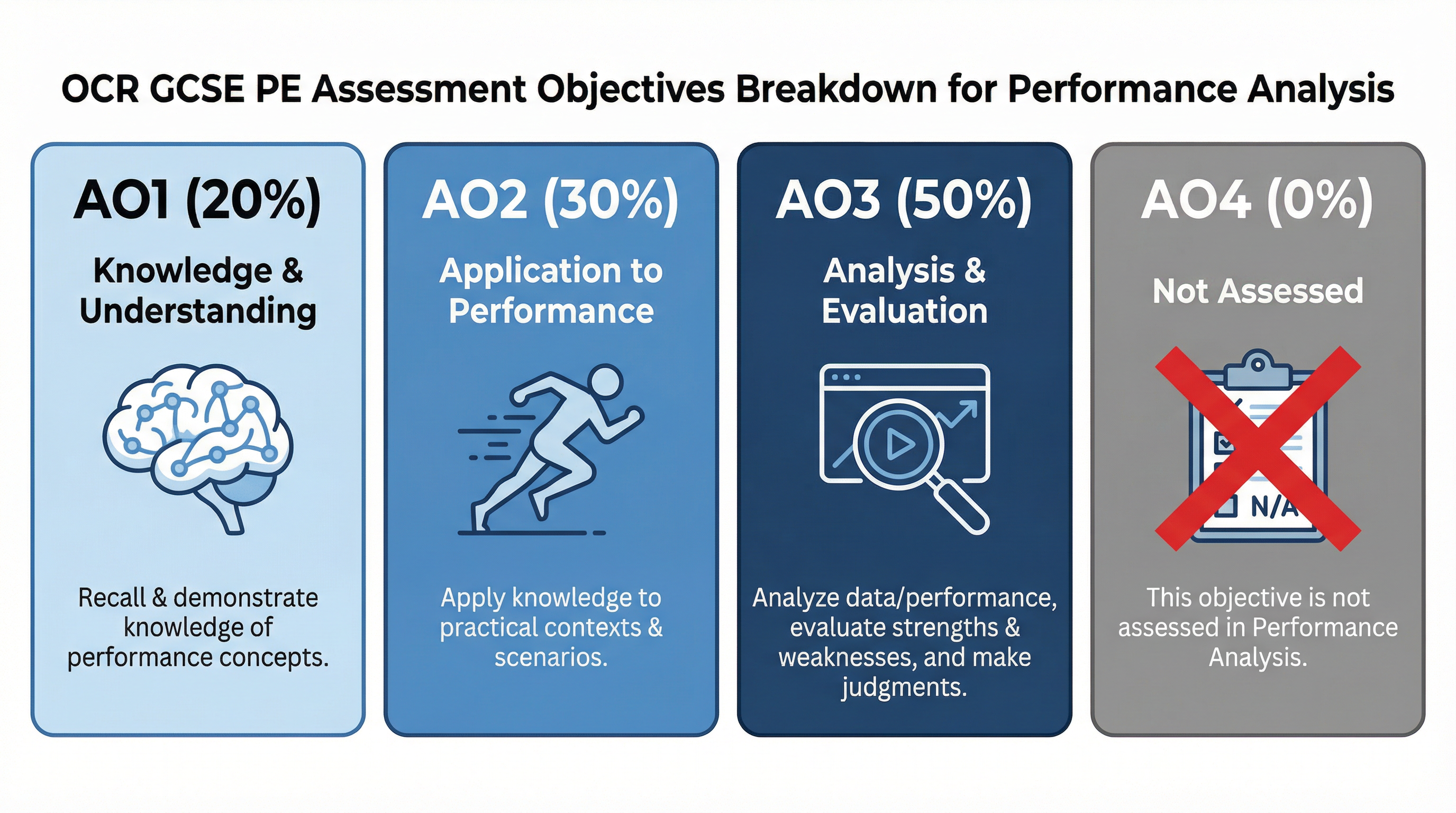
    Assessment Objectives (AO) weighting for the Performance Analysis task.

    Building a Strong Portfolio

    Your AEP is a written or verbal report. To make it strong:

    • Use Specific Examples: Do not make generic statements. Refer to exact moments in a competitive game. For example: "In the third quarter of the match against Saddleworth Netball Club on Saturday, my opponent intercepted my pass because I failed to use a shoulder pass (tactic) and instead opted for a chest pass which had a longer flight time."
    • Embed Evidence: If possible, use video clips or diagrams to support your analysis. You can annotate these to pinpoint the exact moment or technical flaw you are describing.
    • Justify Everything: Every point you make must be justified. Why is it a strength? How do you know? What was the effect? Why will your proposed action plan work? Link your plan directly to the weakness and explain how the chosen training methods will lead to improvement, referencing SPOR and FITT.

    Visual Resources

    2 diagrams and illustrations

    Assessment Objectives (AO) weighting for the Performance Analysis task.
    Assessment Objectives (AO) weighting for the Performance Analysis task.
    Use the I-C-C model to structure your analysis of weaknesses for maximum marks.
    Use the I-C-C model to structure your analysis of weaknesses for maximum marks.

    Interactive Diagrams

    1 interactive diagram to visualise key concepts

    Observe PerformanceIdentify Strength / WeaknessCategorise: Skill, Fitness, or TacticAnalyse using I-C-C ModelJustify with Game EvidenceDesign Action Plan for WeaknessApply SPOR & FITT PrinciplesTest & Re-Evaluate

    The Performance Analysis Process from Observation to Evaluation

    Worked Examples

    3 detailed examples with solutions and examiner commentary

    Practice Questions

    Test your understanding — click to reveal model answers

    Q1

    Identify one tactical strength you observed in a team performance.

    2 marks
    foundation

    Hint: Think about a team plan or strategy that worked well. Did it create chances or stop the opposition?

    Q2

    Describe a weakness in the execution phase of a skill you performed.

    4 marks
    standard

    Hint: Break the skill down into Preparation, Execution, and Recovery. What goes wrong in the middle part of the movement?

    Q3

    Explain how you would use the principle of progressive overload to improve your cardiovascular endurance.

    6 marks
    standard

    Hint: Think about the FITT principles. How can you make your training harder over time by changing Frequency, Intensity, or Time?

    Q4

    Evaluate the effectiveness of your action plan for improving a named weakness.

    8 marks
    challenging

    Hint: This requires you to make a judgement. Did your plan work? How do you know? What were its strengths and weaknesses? What would you do next?

    Key Terms

    Essential vocabulary to know

    More Physical Education Study Guides

    View all

    Media: Positive and Negative Impact on Sport

    OCR
    GCSE

    This topic examines the symbiotic relationship within the 'Golden Triangle' of Sport, Media, and Sponsorship. Candidates must critically evaluate both the positive impacts of media coverage—such as increased participation, funding, and role models—and the negative consequences, including loss of privacy, commercialisation, and scheduling conflicts. Understanding this dichotomy is essential for achieving high marks in OCR GCSE Physical Education Component 02.

    Engagement Patterns: Factors Influencing Participation in Sport

    OCR
    GCSE

    This topic requires candidates to analyse why participation in sport and physical activity varies significantly across different social groups, including gender, age, ethnicity, and disability. Understanding the structural, social, and economic barriers that limit engagement — and the strategies used to overcome them — is essential for both AO1 knowledge questions and AO3 data interpretation tasks. This is one of the highest-value theory areas on the OCR GCSE PE specification and appears in some form on every exam paper.

    Arousal: Inverted-U Theory

    OCR
    GCSE

    This guide provides a comprehensive overview of the Inverted-U Theory of arousal for OCR GCSE Physical Education. It explores how arousal levels impact athletic performance and how factors like task type, skill level, and personality shift the optimal zone for success, providing essential knowledge for the written exam.

    Lever Systems: Types and Application in Sport

    OCR
    GCSE

    This guide provides a comprehensive overview of Lever Systems for OCR GCSE Physical Education. It covers the three classes of levers, their application in sporting contexts, and the concepts of mechanical advantage and disadvantage, all tailored to help students excel in their exams.

    Cardiovascular System: Structure, Function, and Response to Exercise

    OCR
    GCSE

    This comprehensive study guide covers the Cardiovascular System (OCR GCSE PE 1.3), focusing on the structure of the heart, the double circulatory system, and the immediate and long-term responses to exercise. Mastering this topic is essential for understanding how the body delivers oxygen to working muscles and adapts to training.

    Methods of Training: Weight Training, Circuit Training, Interval Training, Continuous Training, Fartlek Training, Plyometrics

    OCR
    GCSE

    This guide provides a comprehensive breakdown of the six methods of training required for the OCR GCSE Physical Education specification (J587). Mastering these methods is crucial for success in both the theoretical exam paper and for informing practical performance.