Study Notes
Overview
Understanding the planes of movement is fundamental to the biomechanical analysis of sport. It allows us to deconstruct complex actions into simple, observable motions. For the OCR GCSE PE exam, candidates are expected to not only define the three planes and their axes but, more importantly, apply this knowledge to specific sporting contexts. This guide will equip you with the core knowledge, practical analysis skills, and exam techniques needed to master this topic.
Key Knowledge & Theory
Core Concepts
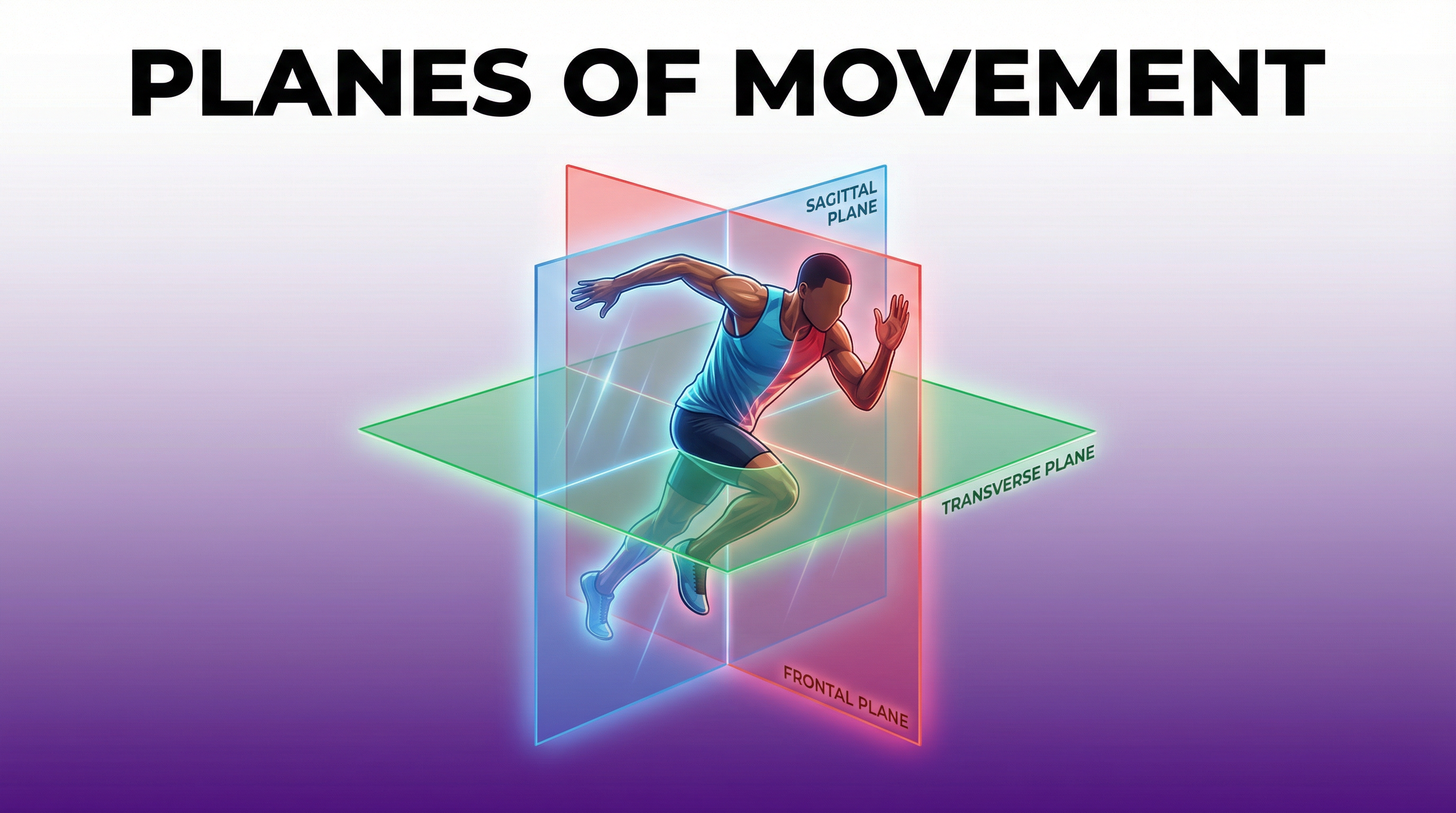
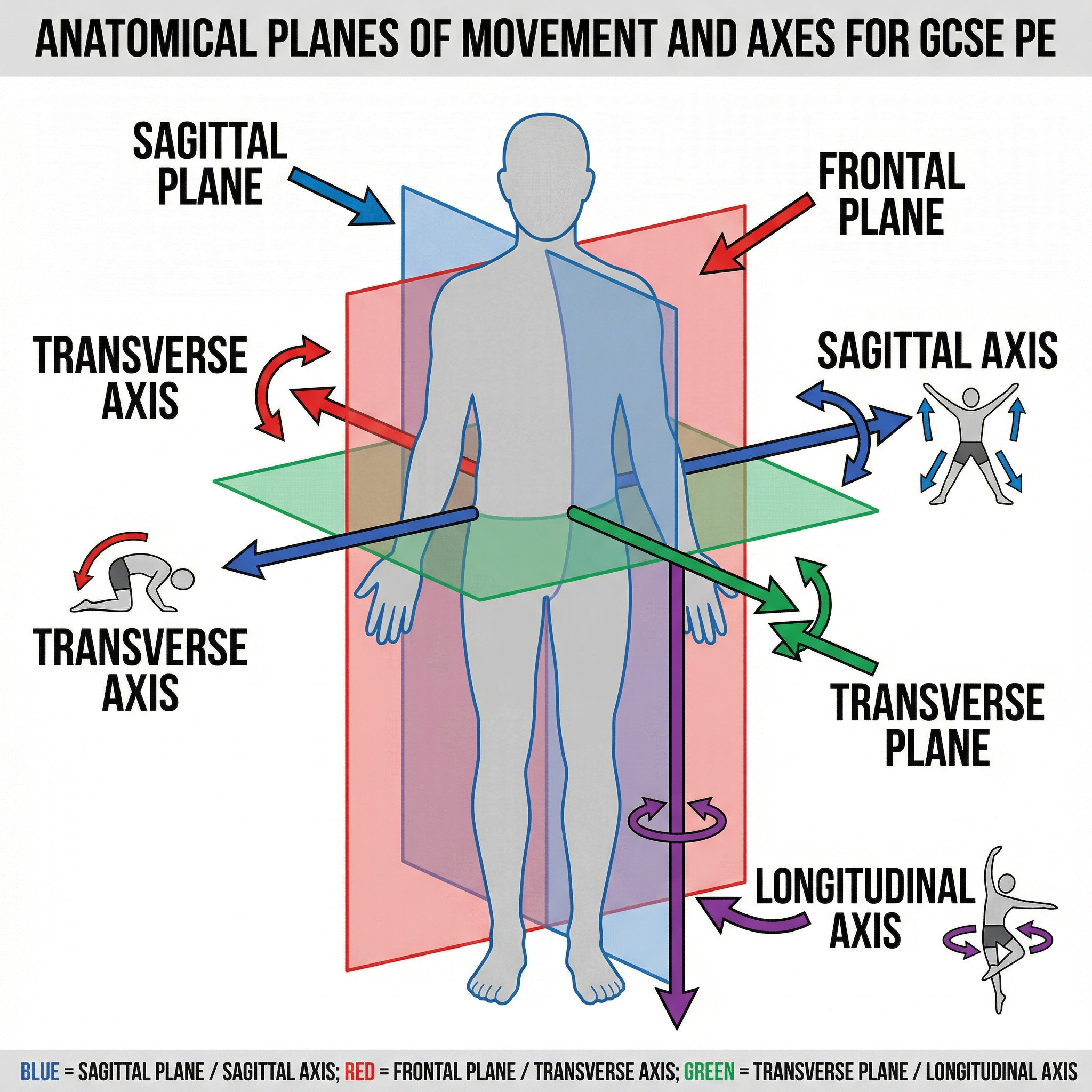
The human body moves in three dimensions. To analyse this movement, we use three imaginary flat surfaces, or planes, that pass through the body. Each plane is associated with a specific axis of rotation, which is a straight line around which an object rotates.
- Sagittal Plane: A vertical plane that divides the body into left and right halves. Movements in this plane are forwards and backwards.
- Associated Movements: Flexion (decreasing the angle of a joint) and Extension (increasing the angle of a joint).
- Axis of Rotation: Transverse Axis (runs horizontally from side to side).
- Frontal (or Coronal) Plane: A vertical plane that divides the body into front and back halves. Movements in this plane are sideways.
- Associated Movements: Abduction (moving a limb away from the midline of the body) and Adduction (moving a limb towards the midline of the body).
- Axis of Rotation: Sagittal Axis (runs horizontally from front to back).
- Transverse (or Horizontal) Plane: A horizontal plane that divides the body into top and bottom halves. Movements in this plane are rotational or twisting.
- Associated Movements: Rotation (e.g., internal/external rotation of the shoulder, pronation/supination of the forearm).
- Axis of Rotation: Longitudinal Axis (runs vertically from top to bottom).
Technical Vocabulary
Using precise terminology is critical for gaining marks. Examiners look for candidates who can communicate their understanding using the language of sports science.
| Term | Definition | Example of Use |
|---|---|---|
| Flexion | Decreasing the angle at a joint. | "The upward phase of a bicep curl involves flexion at the elbow joint." |
| Extension | Increasing the angle at a joint. | "Kicking a football involves extension at the knee joint." |
| Abduction | Movement of a limb away from the body's midline. | "During a star jump, the arms and legs perform abduction." |
| Adduction | Movement of a limb towards the body's midline. | "Bringing the arms back to the sides after a star jump is adduction." |
| Rotation | Movement of a bone around its own axis. | "A golf swing involves rotation of the trunk in the transverse plane." |
| Anatomical Position | The standard reference position: standing upright, feet together, arms at the side with palms facing forward. | "All analysis of movement begins from the anatomical position." |
Practical Skills
Techniques & Processes for Movement Analysis
To analyse a sporting action, follow this step-by-step process:
- Isolate the Action: Focus on a specific part of the skill (e.g., the kicking leg in a football pass, not the whole body).
- Identify the Joint: Name the primary joint where the movement is occurring (e.g., hip, knee, shoulder).
- Describe the Movement: Use the correct technical term (e.g., flexion, abduction, rotation).
- Determine the Plane: Visualize the "pane of glass" the movement is parallel to. Is it forward/backward (Sagittal), sideways (Frontal), or rotational (Transverse)?
- State the Axis: Recall the correct plane-axis pairing (ST, FS, TL).
Exam Component
Written Exam Knowledge
This topic is a favourite for short-answer (2-4 mark) and extended-answer (6-8 mark) questions. You will be asked to:
- Define the planes and axes.
- Identify the plane/axis for a given sporting action.
- Analyse a complex skill and break it down into its component movements, planes, and axes.
- Explain how different types of movement contribute to a successful performance.
Podcast Script
[INTRO - 1 MINUTE]
Hello and welcome to GCSE PE Essentials! I'm your host, and today we're diving into one of those topics that sounds complicated but is actually really logical once you get your head around it: the three planes of movement and their axes of rotation.
This is specification point 2.2 for OCR GCSE Physical Education, and it's absolutely crucial for your exam. Why? Because understanding planes and axes helps you analyze any sporting movement scientifically. Whether you're watching a gymnast perform a cartwheel or a footballer kicking a ball, you'll be able to break down exactly which plane that movement occurs in and which axis it rotates around.
Examiners love this topic because it tests both your knowledge and your ability to apply it to real sporting examples. So let's get started!
[CORE CONCEPTS - 5 MINUTES]
Right, let's build this from the ground up. Imagine the human body standing in anatomical position - that's standing upright, arms by your sides, palms facing forward. Now imagine three giant panes of glass cutting through that body. These are your three planes of movement.
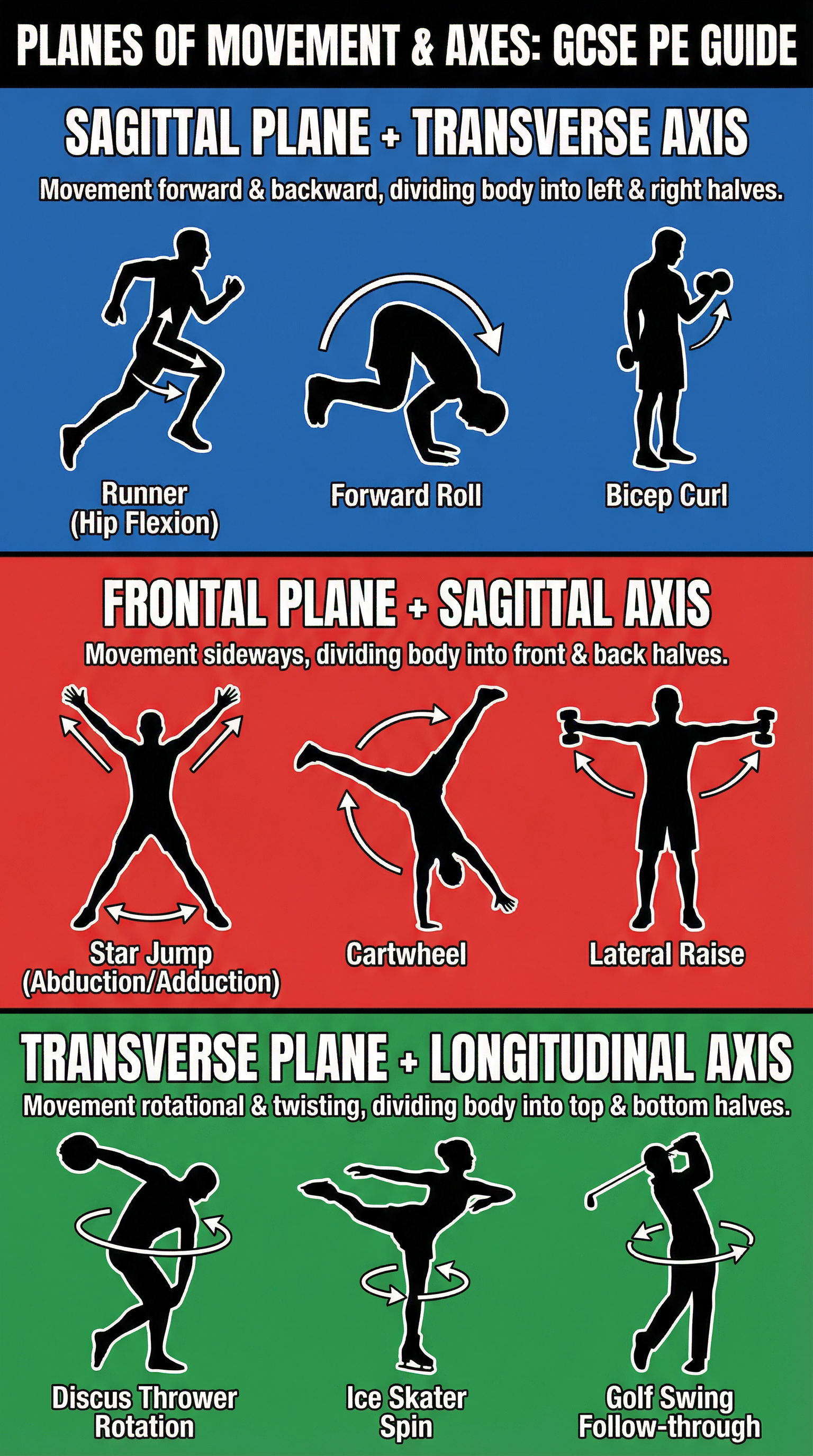
First up: the Sagittal Plane. This is a vertical plane that divides your body into left and right halves. Think of it like a sheet of glass running from the front of your body to the back, slicing you down the middle. Movements in the sagittal plane are forward and backward movements. So when a runner's leg swings forward during their stride, that's hip flexion in the sagittal plane. When a gymnast performs a forward roll, they're rotating in the sagittal plane. The key movements here are flexion - that's decreasing the angle at a joint - and extension, which is increasing that angle.
Now here's where it gets interesting. Every plane has a corresponding axis of rotation. The sagittal plane pairs with the transverse axis. This is a horizontal line running from side to side through your body, like a skewer going through your hips. When you rotate in the sagittal plane, you're rotating around this transverse axis. Picture a forward somersault - you're flipping forward and backward, moving in the sagittal plane, rotating around that side-to-side axis.
Next: the Frontal Plane, also called the coronal plane. This is another vertical plane, but this one divides your body into front and back halves. Imagine a pane of glass running from your left side to your right side, cutting you into a front half and a back half. Movements in the frontal plane are side-to-side movements. The classic example is a star jump - when you spread your arms and legs out to the sides, that's abduction in the frontal plane. When you bring them back in, that's adduction. A cartwheel is another perfect example - you're moving sideways through space in the frontal plane.
The frontal plane pairs with the sagittal axis. This is a horizontal line running from front to back through your body. So when you perform that cartwheel, you're rotating around an axis that runs from your belly button to your back.
Finally, we have the Transverse Plane, sometimes called the horizontal plane. This one's different - it's a horizontal plane that divides your body into top and bottom halves. Imagine lying on a glass table - that table represents the transverse plane cutting through your waist. Movements in the transverse plane are rotational movements. When a discus thrower spins before releasing the discus, that's rotation in the transverse plane. When an ice skater performs a pirouette, spinning on the spot, that's transverse plane movement. The key movement type here is rotation - twisting movements around the body.
The transverse plane pairs with the longitudinal axis, which is a vertical line running from the top of your head down through your body to your feet. When you spin around, you're rotating around this vertical axis.
Now, here's a critical point for your exam: you must be able to pair each plane with its correct axis. Examiners will test this explicitly. Let me give you the three pairings again: Sagittal plane with Transverse axis. Frontal plane with Sagittal axis. Transverse plane with Longitudinal axis.
[EXAM TIPS & COMMON MISTAKES - 2 MINUTES]
Let's talk about how to ace exam questions on this topic. First, timing: this is typically worth 4 to 6 marks in an exam question, so you should be spending about 5 to 7 minutes on it. That's roughly one minute per mark, plus a bit of thinking time.
When you see a question asking you to identify the plane of movement for a sporting action, follow this process. First, visualize the movement. Picture the athlete performing it. Second, ask yourself: is the movement forward-backward, side-to-side, or rotational? That immediately tells you which plane. Third, if the question asks for the axis as well, recall the pairing using those acronyms I'll give you in a moment.
Now, let's talk about the mistakes candidates make every single year. The biggest one? Confusing the frontal plane with the sagittal plane. Remember: frontal plane divides front and back, sagittal plane divides left and right. It sounds obvious, but under exam pressure, students mix these up constantly.
Second mistake: incorrectly pairing planes with axes. This is where my acronym trick comes in. Use ST, FS, and TL. Sagittal-Transverse. Frontal-Sagittal. Transverse-Longitudinal. Say it three times right now: ST, FS, TL. That's your golden ticket to marks.
Third mistake: being too vague with your examples. Don't just write "running" - that's not specific enough. Write "hip flexion during the drive phase of a sprint" or "elbow extension in a basketball chest pass." Examiners want to see that you understand which specific joint action occurs in which plane.
And here's a pro tip: use the "pane of glass" visualization technique. If you're analyzing a movement and you're not sure which plane it's in, imagine the athlete moving parallel to a pane of glass. If they'd smash through the glass, it's the wrong plane. If they move parallel to it without breaking it, you've found your plane.
[QUICK-FIRE RECALL QUIZ - 1 MINUTE]
Right, let's test your knowledge with a quick-fire quiz. I'll give you a sporting action, you shout out the plane. Ready?
One: A footballer performing a bicycle kick - which plane is the kicking leg moving in? That's the sagittal plane, with flexion and extension at the hip and knee.
Two: A tennis player performing a forehand drive with a side-to-side weight transfer - which plane? Frontal plane, with lateral flexion of the trunk.
Three: A gymnast performing a twist in the air during a vault - which plane? Transverse plane, rotation around the longitudinal axis.
Four: A swimmer's arm during the recovery phase of front crawl, moving forward over the water - which plane? Sagittal plane, shoulder flexion.
Five: A basketball player jumping for a rebound with arms reaching upward and outward - which plane for the arm abduction? Frontal plane, moving around the sagittal axis.
How did you do? If you got four or five right, you're in great shape. Three? You're getting there. Less than three? Go back and review those core concepts.
[SUMMARY & SIGN-OFF - 1 MINUTE]
Alright, let's wrap this up with your key takeaways. There are three planes of movement: sagittal for forward-backward, frontal for side-to-side, and transverse for rotational. Each plane has a paired axis: sagittal with transverse, frontal with sagittal, transverse with longitudinal. Remember ST, FS, TL.
In your exam, be specific with your sporting examples. Identify the exact joint action, not just the general movement. Use the pane of glass visualization to check your answer. And always, always pair the plane with the correct axis if the question asks for both.
This topic appears in both short-answer and extended-response questions, and it's often combined with questions about joint actions and muscle movements, so make sure you can link all these concepts together.
Thanks for listening to GCSE PE Essentials. Keep practicing, keep visualizing those planes, and you'll smash this topic in your exam. Good luck, and see you next time!