Study Notes

Overview
The Principles of Training are the bedrock of any effective fitness programme. For a GCSE PE student, they are not just theoretical concepts; they are the rules you must follow to explain how and why athletes improve. Understanding and applying these principles correctly is essential for achieving high marks in both written exams and practical assessments. This guide will break down each principle, provide clear sporting examples, and show you how to structure your answers to meet the specific demands of the OCR specification.
Key Knowledge & Theory
Core Concepts
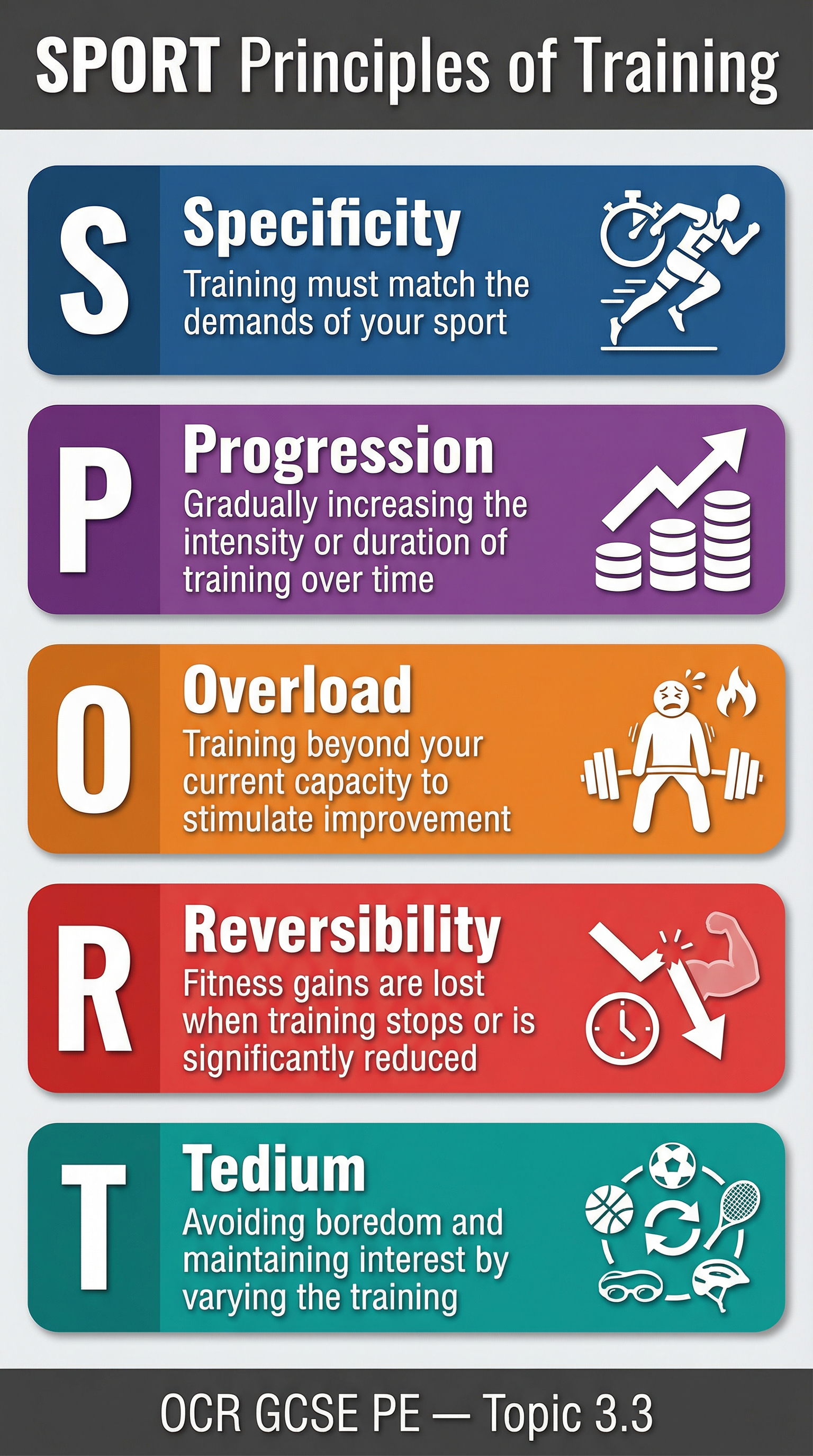
The five core principles can be remembered with the acronym SPORT:
- Specificity: Training must be tailored to the specific demands of the sport, the position played, and the components of fitness required. For example, a marathon runner's training must focus on developing aerobic endurance, whereas a 100m sprinter's training must focus on anaerobic power and speed.
- Progression: This is the gradual and systematic increase of training load over a period of time. As the body adapts to a certain level of stress, the training must become progressively harder to stimulate further improvement. This prevents a plateau in performance.
- Overload: To improve, an athlete must work their body harder than it is accustomed to. This stress stimulates physiological adaptations, such as muscle growth (hypertrophy) or an improved ability to use oxygen (VO2 max). Overload is applied using the FITT principle.
- Reversibility: Often phrased as "use it or lose it", this principle states that if an athlete stops training, the physiological adaptations they have gained will be lost. This can be due to injury, illness, or simply the end of a competitive season.
- Tedium: This refers to the boredom that can arise from a repetitive training schedule. To maintain motivation and ensure continued effort, training should be varied and engaging.
Key Practitioners/Artists/Composers
While PE doesn't have 'practitioners' in the same way as Art or Music, we can look at influential coaches and sports scientists whose work is built on these principles.
| Name | Period/Style | Key Works | Relevance |
|---|---|---|---|
| Sir Dave Brailsford | 2003-Present | Marginal Gains | Popularised the idea of making small, incremental improvements in many areas to achieve a significant overall performance gain. This is a direct application of Progression. |
| Tudor Bompa | 1960s-Present | Periodisation | Known as the father of modern periodisation, his work involves structuring training into phases (macrocycles, mesocycles, microcycles) to ensure peak performance at the right time, directly applying Progression and Specificity. |
| Dr. Gunnbjorn Fleck | 1980s-Present | FITT Principle Application | Co-authored seminal texts on strength and conditioning, providing a structured framework for applying Overload through Frequency, Intensity, Time, and Type. |
Technical Vocabulary
- Physiological Adaptation: The body's response to training stress, leading to long-term changes like increased muscle size or improved cardiovascular efficiency.
- Hypertrophy: The increase in the size of muscle cells as a result of strength training.
- Atrophy: The decrease in the size of muscle cells due to inactivity or reversibility.
- VO2 Max: The maximum rate at which an individual can take in and use oxygen during intense exercise. A key indicator of aerobic fitness.
- Anaerobic Threshold: The point during exercise at which lactate begins to accumulate in the blood faster than it can be removed.
- Periodisation: The organised division of a training year into specific blocks, each with a particular goal and focus.
Practical Skills
Techniques & Processes
Applying the principles is a practical skill. The most important process to master is the application of Overload through the FITT principle.
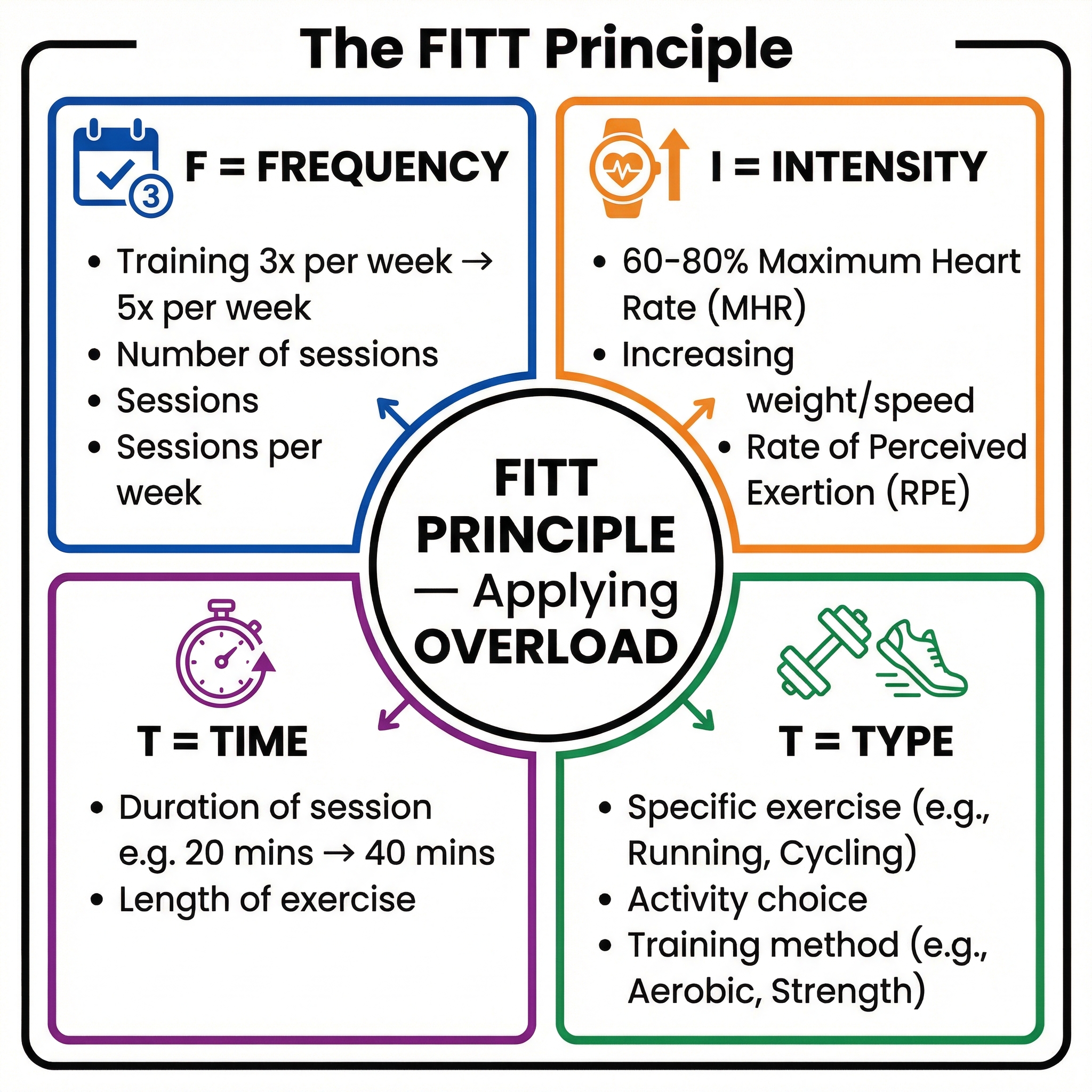
- Frequency: How often you train. To apply overload, you could increase the number of training sessions per week (e.g., from 3 to 4).
- Intensity: How hard you train. This can be increased by lifting heavier weights, running at a faster speed, or working at a higher percentage of your maximum heart rate (MHR).
- Time: How long you train for. You can overload by increasing the duration of a session (e.g., from 45 minutes to 60 minutes) or reducing rest periods.
- Type: The kind of training you do. To overload, you could introduce a new, more challenging training method (e.g., moving from steady-state cardio to High-Intensity Interval Training - HIIT).
Materials & Equipment
Understanding which equipment to use is key to Specificity.
- Cardiovascular Equipment: Treadmills, rowing machines, and exercise bikes are excellent for developing aerobic and anaerobic fitness. The choice depends on the specific muscle groups the athlete needs to target.
- Resistance Equipment: Free weights (dumbbells, barbells) are ideal for developing strength and power as they recruit stabiliser muscles. Resistance machines are safer for beginners and can isolate specific muscle groups.
- Monitoring Technology: Heart rate monitors and GPS watches are crucial for applying Overload with precision. They allow an athlete to train at the correct intensity (e.g., 60-80% of MHR for the aerobic zone) and track Progression over time.
Portfolio/Coursework Guidance
Assessment Criteria
In your practical performance, you are assessed on your ability to demonstrate effective performance in a chosen sport. While you don't submit a training diary for marking, your performance itself is evidence of your training. A well-trained athlete who has correctly applied the principles will show higher levels of skill, fitness, and decision-making. Examiners look for fluency, efficiency, and effectiveness of technique under pressure.
Building a Strong Performance Profile
To perform well, you must train smart. This means applying the principles to your own training:
- Be Specific: Choose training methods that directly improve the components of fitness most important for your sport.
- Track Progression: Keep a simple training log. Note your session frequency, the intensity (e.g., weights lifted, speed), and duration. This is your evidence of progression.
- Apply Overload Systematically: Don't just 'go hard' every session. Plan to increase one FITT component every 1-2 weeks.
- Vary Your Training: To avoid Tedium, mix up your drills. If you're a netballer, don't just do shooting practice; include footwork drills, plyometrics for jumping, and small-sided games.
Exam Component
Written Exam Knowledge
The Principles of Training are a major part of the Paper 1: Physical Factors Affecting Performance. You will be asked AO1 questions (define the principles), AO2 questions (apply them to a scenario), and AO3 questions (analyse and evaluate their use).
Practical Exam Preparation
There is no practical exam in the traditional sense, but your performance in your chosen sports is assessed. Your level of fitness, which is a direct result of your training, will impact your ability to perform skills under pressure and make effective decisions. A candidate who has neglected their fitness training will show fatigue, leading to a drop in skill level and a lower mark."