Study Notes
Overview
Tactical awareness and decision-making are what separate good performers from elite ones. This topic moves beyond just physical skill to explore the cognitive processes that underpin success in sport. For the OCR GCSE PE exam, candidates must understand the theoretical models that explain how we make choices under pressure and be able to apply them to practical sporting examples. Mastery of this topic is crucial for high marks in both the written paper and the practical NEA component, as it demonstrates a deep, analytical understanding of performance.
Key Knowledge & Theory
Core Concepts
Strategy vs. Tactic: This is the most fundamental distinction. A strategy is a long-term, pre-planned course of action for an entire game or event (e.g., a basketball team deciding to play a zone defence for the whole match). A tactic is a short-term, reactive adjustment made in response to a specific situation within the game (e.g., a player deciding to drive past a specific defender who looks slow).
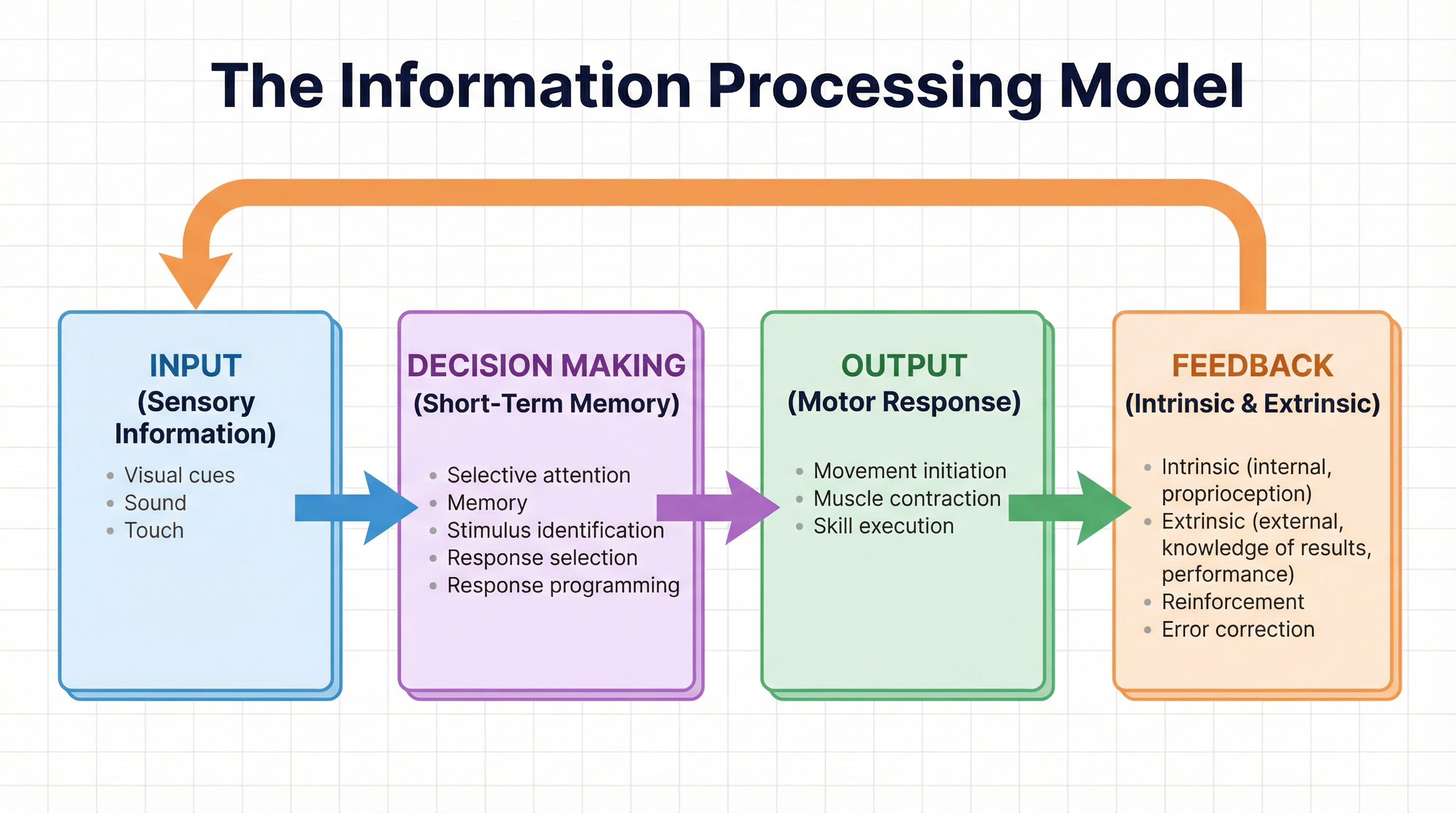
The Information Processing Model: This is the central theoretical framework. It explains the sequential process the brain goes through to produce a skilled response. Candidates must know the four stages:
- Input: The performer gathers data from the environment via their senses (sight, sound, touch). This is often called cue detection.
- Decision-Making: The brain processes this information. This involves three key sub-stages: stimulus identification (what is it?), response selection (what should I do?), and response programming (how do I do it?). This is where selective attention—the ability to filter out irrelevant information—is vital.
- Output: The decision is translated into a physical action. The nervous system sends signals to the muscles to execute the chosen motor programme (the skill).
- Feedback: The performer receives information about the outcome of the output. This can be intrinsic (from within, e.g., the feeling of a good tennis shot) or extrinsic (from outside, e.g., seeing the ball land in, or a coach’s comment). This feedback is then used to adapt future decisions, creating a continuous loop of improvement.
Selective Attention: This is the cognitive skill of focusing on relevant cues while ignoring irrelevant distractions. An expert performer has a highly developed 'filter' that allows them to pick out the most important information (e.g., the gap in a defensive line) from a noisy, high-pressure environment (e.g., a shouting crowd). Examiners award significant credit for linking selective attention to the decision-making stage.
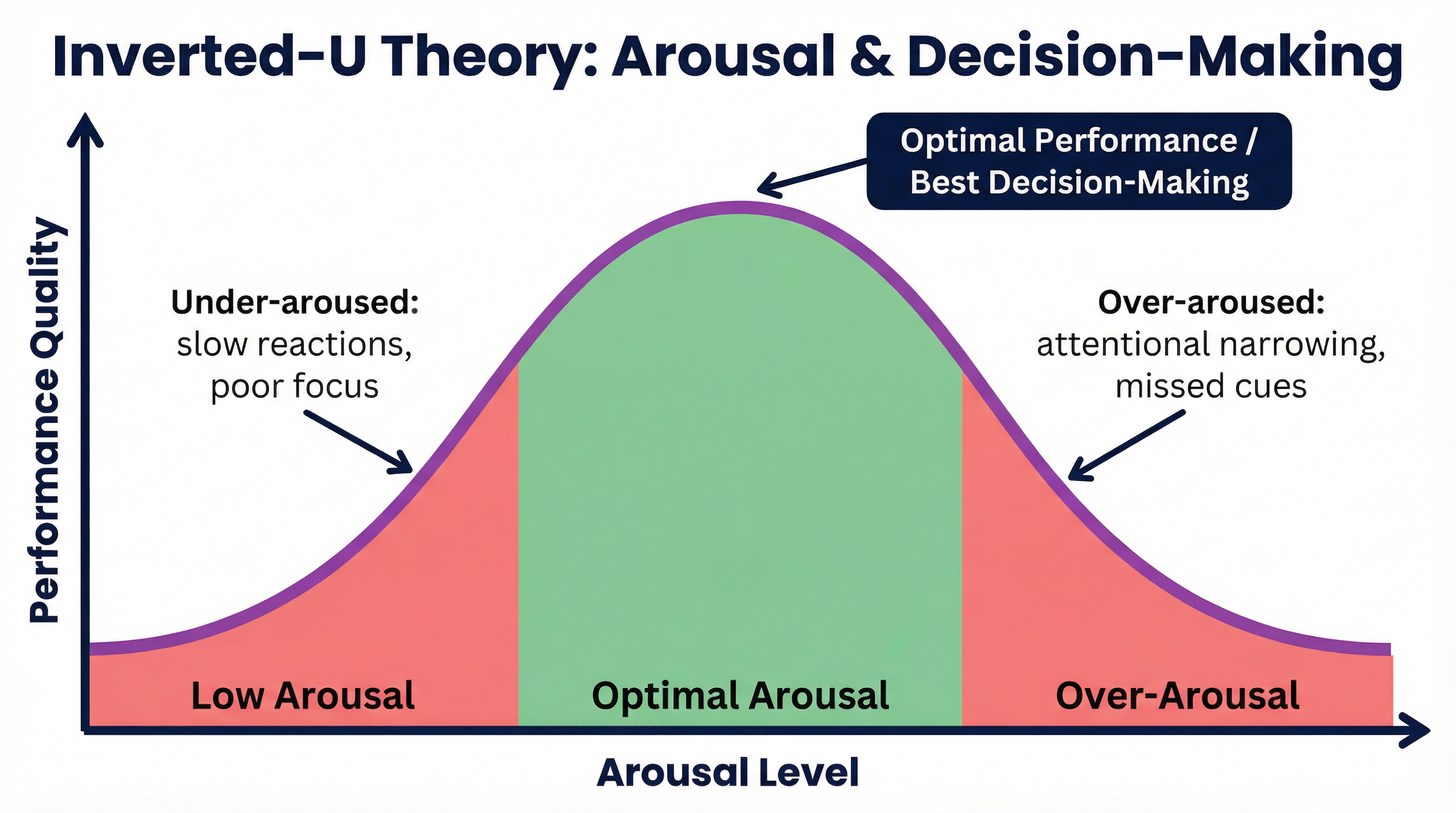
Arousal and the Inverted-U Theory: Arousal is a state of alertness and activation. The Inverted-U Theory (Yerkes-Dodson Law) proposes that performance quality increases with arousal, but only up to an optimal point. If a performer becomes over-aroused (too anxious or excited), their performance, particularly decision-making, deteriorates rapidly. This is often due to attentional narrowing, where the performer’s focus becomes too narrow, causing them to miss important peripheral cues.
Key Practitioners/Artists/Composers
| Name | Period/Style | Key Works | Relevance |
|---|---|---|---|
| Welford, A.T. | 1960s | Information Processing Model | Developed one of the first and most influential models of information processing, laying the groundwork for how we understand decision-making in sport. |
| Yerkes & Dodson | 1908 | Inverted-U Law | Their research on the relationship between arousal and performance in rats established the fundamental principle that optimal performance occurs at a moderate level of arousal. |
| Schmidt, R.A. | 1970s-2000s | Schema Theory | While not a core part of this topic, his work on motor learning explains how feedback helps performers build and refine motor programmes, which is the 'Output' of the decision-making process. |
Technical Vocabulary
Candidates must use this terminology accurately in their exam answers to access the higher mark bands. Key terms include: Strategy, Tactic, Input, Decision-Making, Output, Feedback, Selective Attention, Arousal, Inverted-U Theory, Attentional Narrowing, Intrinsic Feedback, Extrinsic Feedback, Cue Detection, Motor Programme.
Practical Skills
Techniques & Processes
Improving tactical awareness is a practical skill. Drills should be designed to challenge the Information Processing Model, not just the physical execution of a skill.
- Conditioned Games: Small-sided games with specific rules designed to encourage certain tactical decisions. For example, a 3-on-2 basketball drill forces the attackers to constantly assess the overload situation and make quick decisions.
- Variable Practice: Instead of repeating the same skill in the same way (blocked practice), variable practice involves performing the skill in a range of different situations. This forces the performer to constantly adapt their decisions, strengthening the link between decision-making and output.
- Video Analysis: Watching recordings of their own performance allows performers to analyse their decisions away from the pressure of the game. They can identify missed cues or better alternative options, which informs future performance.
Materials & Equipment
Equipment for improving decision-making often involves creating specific game scenarios. This includes standard sports equipment (balls, bibs, cones) but used in a way that manipulates the 'Input' stage. For example, using different coloured cones to signal different required actions can train a performer to process information and select a response more quickly.
Portfolio/Coursework Guidance
Assessment Criteria
In the OCR NEA (Non-Exam Assessment), candidates are assessed on their ability to analyse and evaluate performance. For tactical awareness, this means:
- AO2 (Application): Justifying the selection of specific tactics in a performance.
- AO3 (Analysis & Evaluation): Critically evaluating the effectiveness of their own and others' decision-making, using the Information Processing Model to explain why certain decisions were successful or unsuccessful.
Building a Strong Portfolio
Your logbook or analysis of performance must go beyond describing what happened. You need to explain why it happened. When analysing your decision-making, use the language of the Information Processing Model. For example: "In this situation, my decision-making was poor. Due to over-arousal, my attentional field narrowed (Inverted-U Theory), and I failed to process the visual cue of my teammate in space (Input). This led to a poor response selection, and I chose to shoot instead of pass (Decision-Making)."
Exam Component
Written Exam Knowledge
This topic is a mainstay of the Sports Psychology section of Paper 1. Expect multiple-choice questions on definitions (e.g., distinguishing strategy and tactic) and short-answer questions requiring application of the Information Processing Model. There is a high probability of a 6-mark extended response question asking you to evaluate the role of decision-making in sport.
Practical Exam Preparation
In your moderated practical performance, you are being observed on your ability to make effective decisions under pressure. A performer who demonstrates excellent physical skills but consistently makes poor tactical choices will not achieve high marks. Assessors are trained to look for evidence of 'game sense'—players who read the game, anticipate opponent actions, and select the appropriate response.