Study Notes
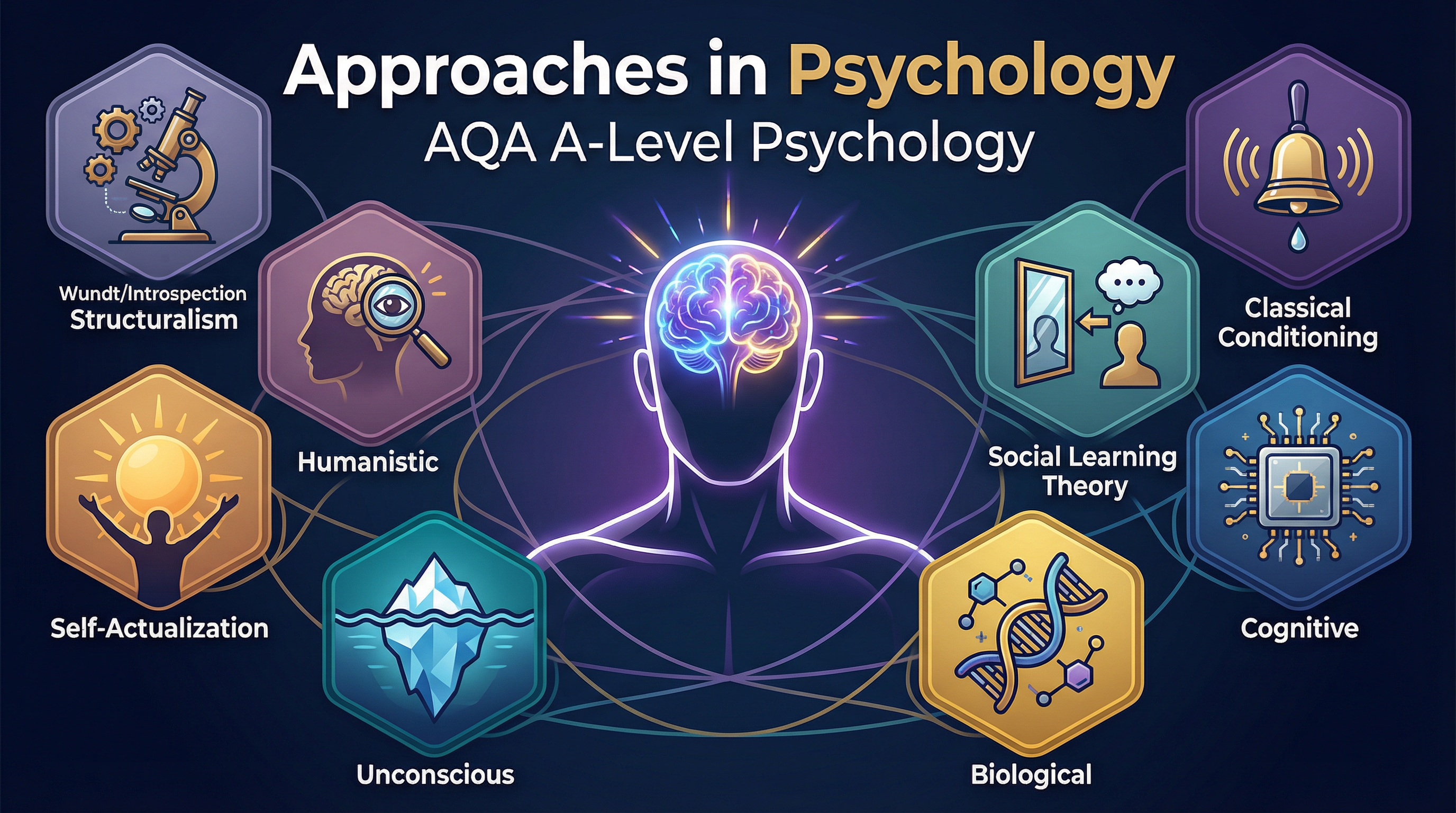
Overview
This topic traces the evolution of psychology from its philosophical roots to a modern science. Candidates are expected to understand, apply, and critically evaluate seven key approaches: the Origins of Psychology (Wundt), the Behaviourist Approach, Social Learning Theory, the Cognitive Approach, the Biological Approach, the Psychodynamic Approach, and the Humanistic Approach. A core skill is the ability to compare and contrast these approaches, particularly in relation to the major issues and debates such as determinism vs. free will, reductionism vs. holism, and the nature-nurture debate. Examiners look for precise use of terminology and the ability to apply theoretical concepts to novel scenarios (AO2), as well as providing well-developed evaluation points (AO3).
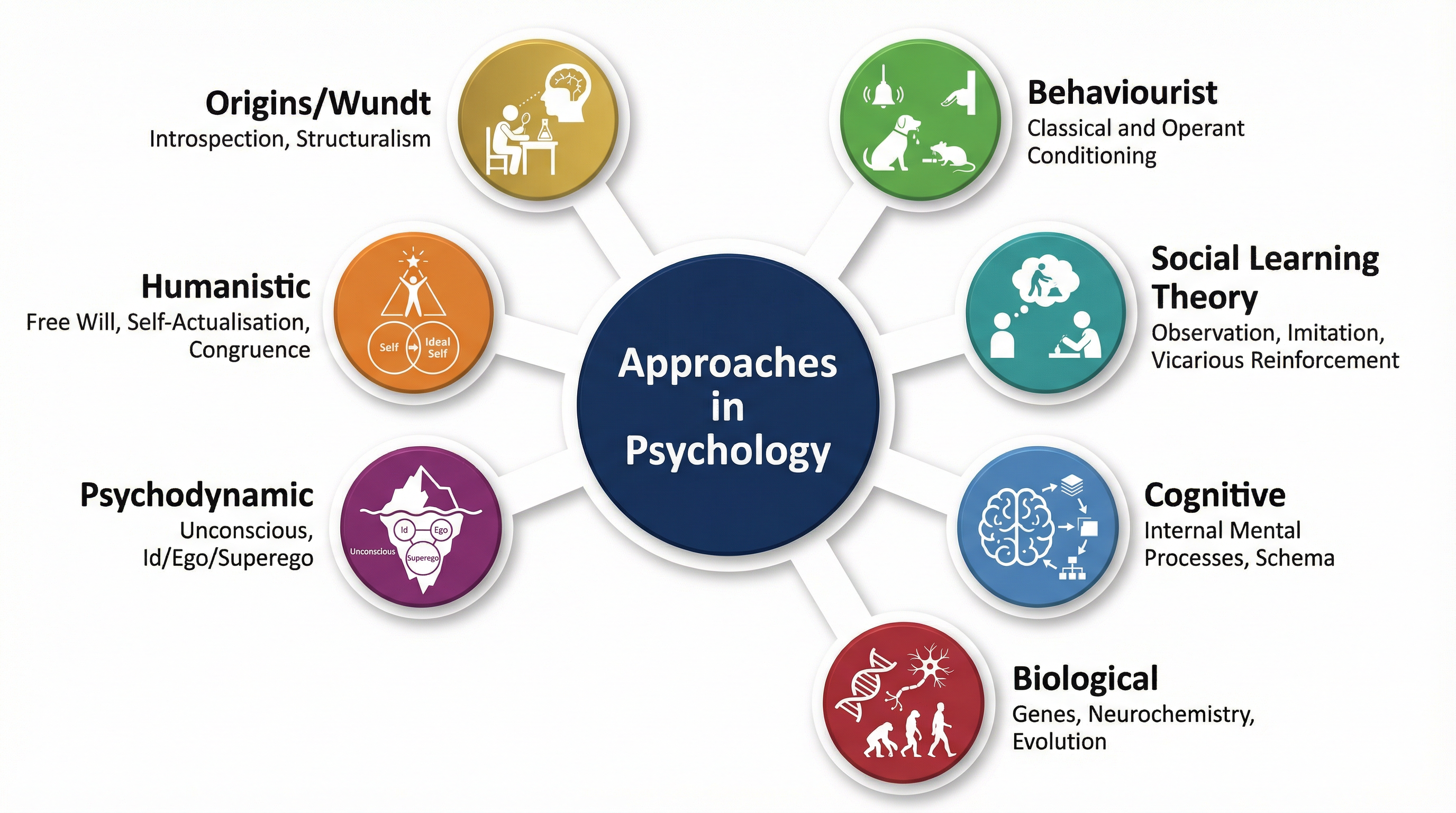
Key Approaches & Developments
The Behaviourist Approach
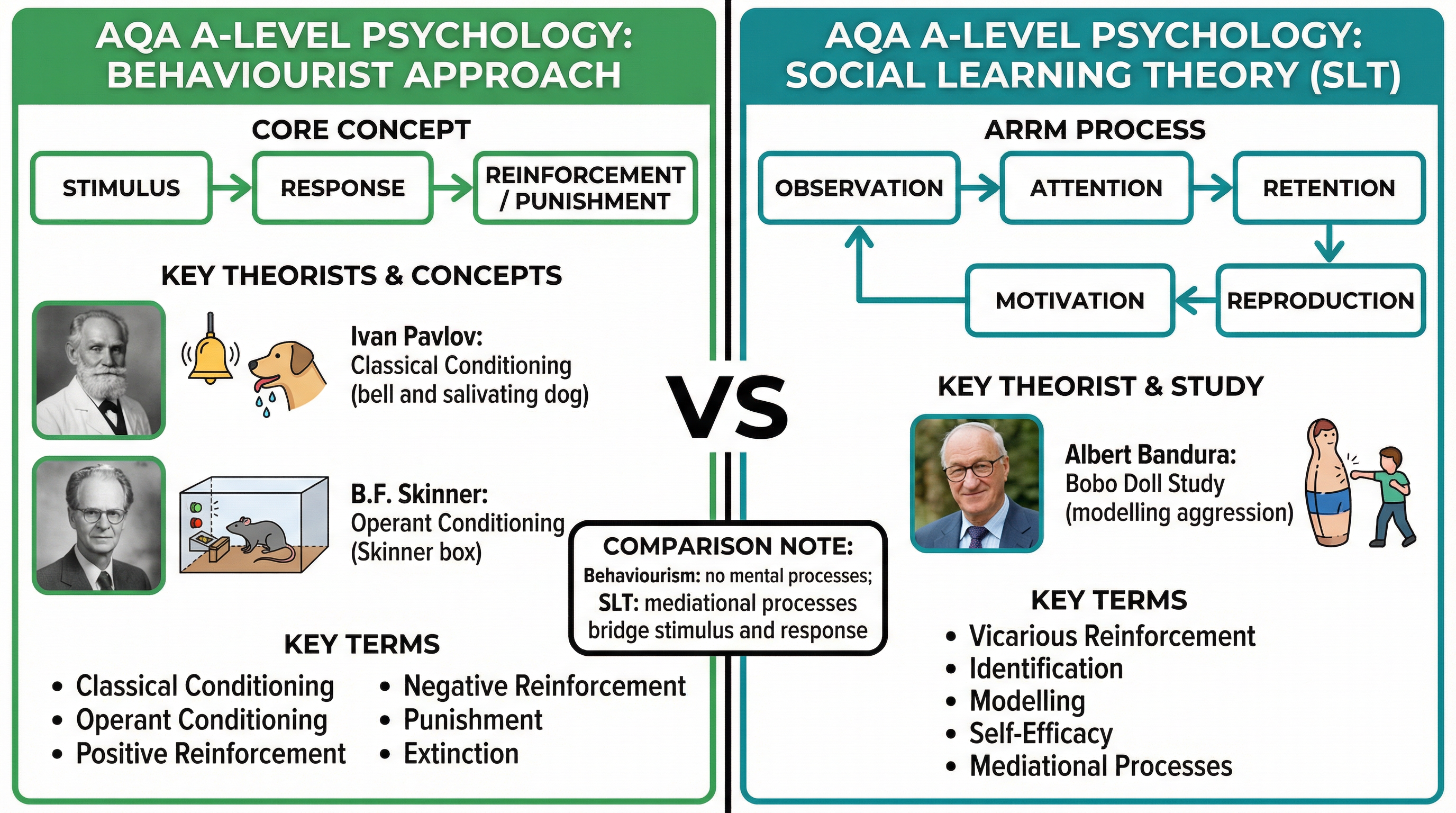
What happened: Pioneered by figures like Watson and Skinner, this approach rejected the subjective nature of introspection and argued that psychology should be the scientific study of observable behaviour. It proposes that all behaviour is learned from the environment.
Why it matters: It introduced scientific rigour and objective measurement to psychology. Key concepts like Classical Conditioning (learning by association) and Operant Conditioning (learning through consequences) provide powerful explanations for behaviour formation and are the basis for many therapies (e.g., token economies).
Specific Knowledge: Pavlov (Classical Conditioning), Skinner (Operant Conditioning), Positive Reinforcement, Negative Reinforcement, Punishment.
Social Learning Theory (SLT)
What happened: Albert Bandura proposed SLT as a bridge between Behaviourism and the Cognitive approach. He argued that learning also occurs indirectly, through observation and imitation of others within a social context.
Why it matters: SLT introduced the importance of cognitive 'mediational processes' (Attention, Retention, Reproduction, Motivation) that lie between stimulus and response. This acknowledged the role of thought in learning. The concept of 'vicarious reinforcement' is crucial.
Specific Knowledge: Bandura's Bobo Doll Study (1961), Vicarious Reinforcement, Identification, Modelling, Mediational Processes (ARRM).
The Cognitive Approach
What happened: With the advent of computers in the 1950s and 60s, psychologists began to use the 'computer analogy' to explain human mental processes. This approach focuses on the scientific study of internal mental processes such as perception, memory, and thinking.
Why it matters: It re-established the scientific study of the mind. The use of theoretical and computer models to explain and test cognitive processes has been highly influential. The concept of 'schema' is a key contribution, explaining how our expectations shape our interpretation of the world.
Specific Knowledge: Schema, Theoretical Models (e.g., Multi-Store Model of Memory), Computer Models, Cognitive Neuroscience.
The Biological Approach
What happened: This approach views humans as biological organisms and seeks to explain behaviour through genetics, neurochemistry, and the structure of the nervous system. It assumes that all thoughts, feelings, and behaviours have a physical basis.
Why it matters: It has led to significant real-world applications, particularly in the development of psychoactive drugs to treat mental illnesses like depression and schizophrenia. It also provides a strong scientific basis for understanding behaviour, using methods like brain scanning (fMRI) and twin studies.
Specific Knowledge: Genotype vs. Phenotype, Twin Studies, Evolution, Neurotransmitters (e.g., Serotonin, Dopamine), Nervous System.
The Psychodynamic Approach
What happened: Sigmund Freud developed this approach, emphasising the role of the unconscious mind in shaping behaviour. He proposed that our personality is composed of three parts (Id, Ego, Superego) and that we progress through psychosexual stages in childhood.
Why it matters: Freud's work represented a monumental shift, highlighting the importance of early childhood experiences and unconscious conflicts. It formed the basis of psychoanalysis, the first 'talking cure', and its concepts have had a lasting impact on Western culture.
Specific Knowledge: The Unconscious, Tripartite Personality (Id, Ego, Superego), Psychosexual Stages (Oral, Anal, Phallic, Latency, Genital), Defence Mechanisms (e.g., Repression, Denial).
The Humanistic Approach
What happened: Emerging in the 1950s, humanistic psychology was a reaction against the deterministic and negative views of the other approaches. Carl Rogers and Abraham Maslow championed a holistic view that emphasised free will and the innate human drive for 'self-actualisation'.
Why it matters: It offered a more positive and optimistic alternative, focusing on personal growth and fulfilment. Rogers' client-centred therapy has been hugely influential, and the approach's focus on subjective experience has brought the 'person' back into psychology.
Specific Knowledge: Free Will, Self-Actualisation, Maslow's Hierarchy of Needs, Congruence, Conditions of Worth, Client-Centred Therapy.
Podcast Episode
Listen to our 10-minute podcast episode for a full breakdown of the approaches, exam tips, and a quick-fire quiz.