Study Notes

Overview
Forensic Psychology is a critical component of the OCR GCSE Psychology specification (J203), focusing on the psychological explanations for criminal behaviour. Examiners expect candidates to demonstrate a robust understanding of two core theories: Eysenck’s Criminal Personality Theory and Bandura's Social Learning Theory. A detailed knowledge of the aims, procedure, results, and evaluation of the Cooper and Mackie (1986) core study is essential for achieving high marks. Furthermore, candidates must be able to apply these psychological concepts to novel scenarios and evaluate different methods of dealing with criminal behaviour, such as punishment and rehabilitation. This guide will equip you with the detailed knowledge, analytical skills, and exam strategies required to excel in this topic, ensuring you can confidently tackle everything from short-answer questions to the extended 13-mark essays.
Key Theories & Studies
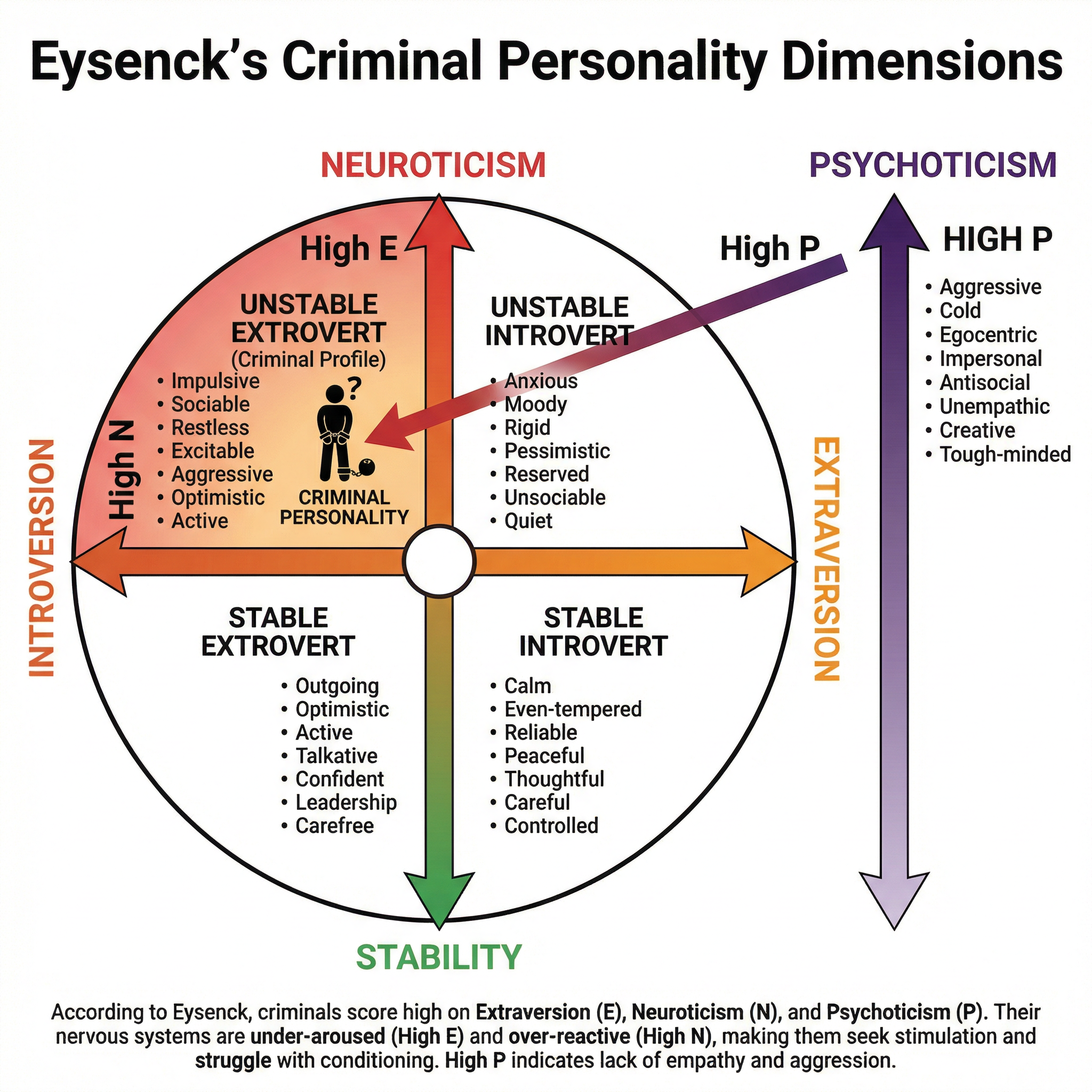
Eysenck’s Criminal Personality Theory
What it is: Hans Eysenck proposed that criminal behaviour is not learned but is a result of an individual's innate personality type. He argued that certain personality traits predispose a person to offending.
Why it matters: This is a biological explanation of criminality that you must be able to explain and evaluate. It provides a counter-argument to learning-based theories.
Specific Knowledge: Candidates must know the three key dimensions:
- Extraversion (E): High scorers are sociable, impulsive, and risk-taking. Eysenck linked this to an under-aroused nervous system, causing them to seek external stimulation.
- Neuroticism (N): High scorers are anxious, moody, and emotionally unstable. This is linked to an over-reactive nervous system, making them difficult to condition (i.e., learn from punishment).
- Psychoticism (P): High scorers are aggressive, cold, and lack empathy. This dimension was added later and is most associated with serious, repeat offending.
Social Learning Theory (SLT)
What it is: Developed by Albert Bandura, SLT suggests that behaviour, including criminal behaviour, is learned from the environment through the process of observation and imitation.
Why it matters: This is a key environmental explanation for crime. It is often used in scenario-based questions where you must apply its concepts to a fictional character.
Specific Knowledge: Candidates must understand the key processes:
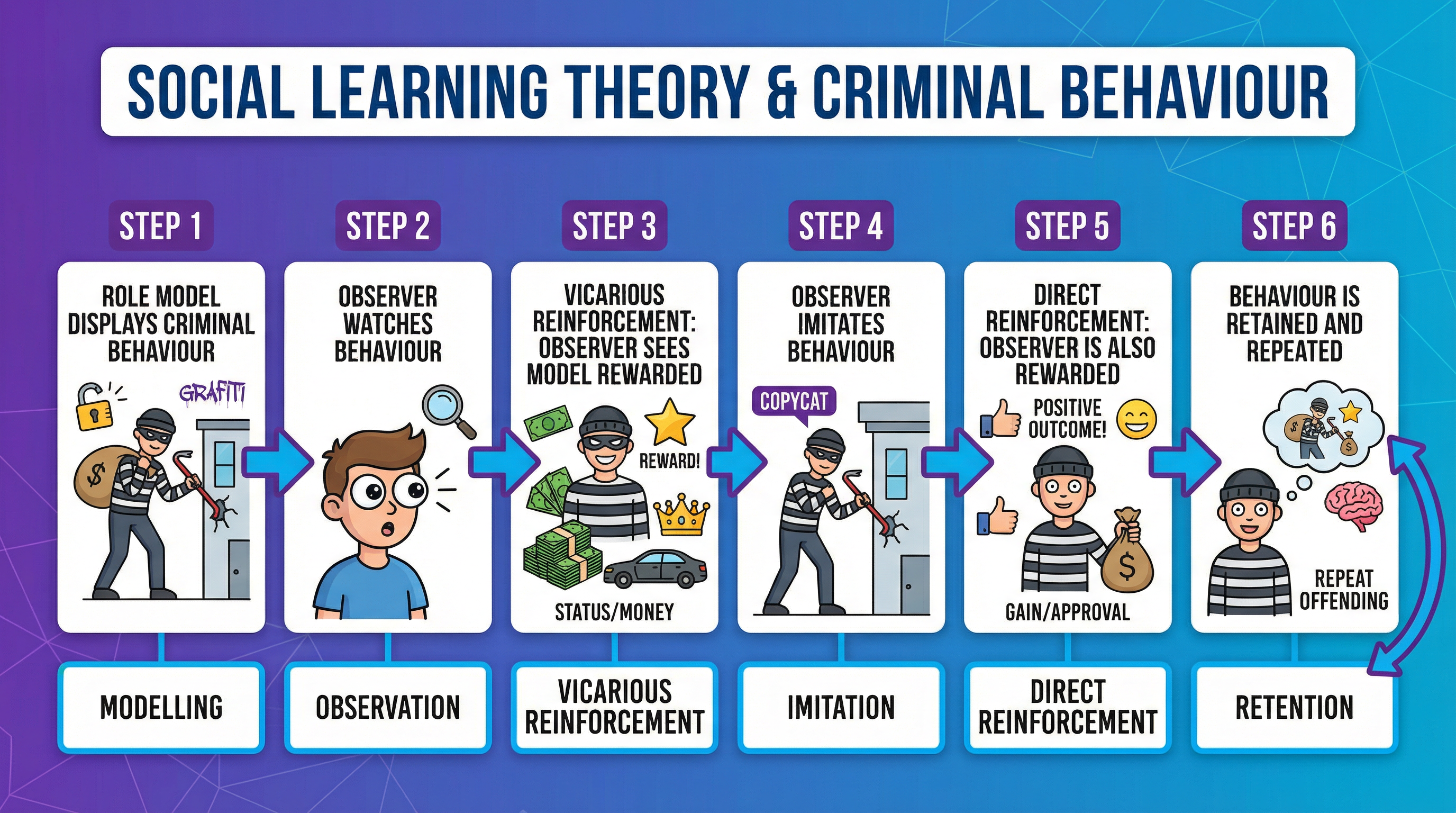
- Modelling: Learning occurs by observing a 'model' (e.g., a parent, peer, or media figure).
- Observation: The learner pays attention to the model's behaviour.
- Vicarious Reinforcement: The learner observes the model being rewarded for their behaviour (e.g., gaining status or money from crime), which makes imitation more likely.
- Imitation: The learner copies the observed behaviour.
- Direct Reinforcement: The learner is then directly rewarded for their own imitated criminal act, strengthening the behaviour.
Cooper and Mackie (1986) Core Study
What it is: A laboratory experiment designed to investigate the effect of playing violent video games on aggression in children.
Why it matters: This is your core study for this topic. You must know its aim, procedure, results, and be able to evaluate it in detail using the GRAVE acronym.
Specific Knowledge:
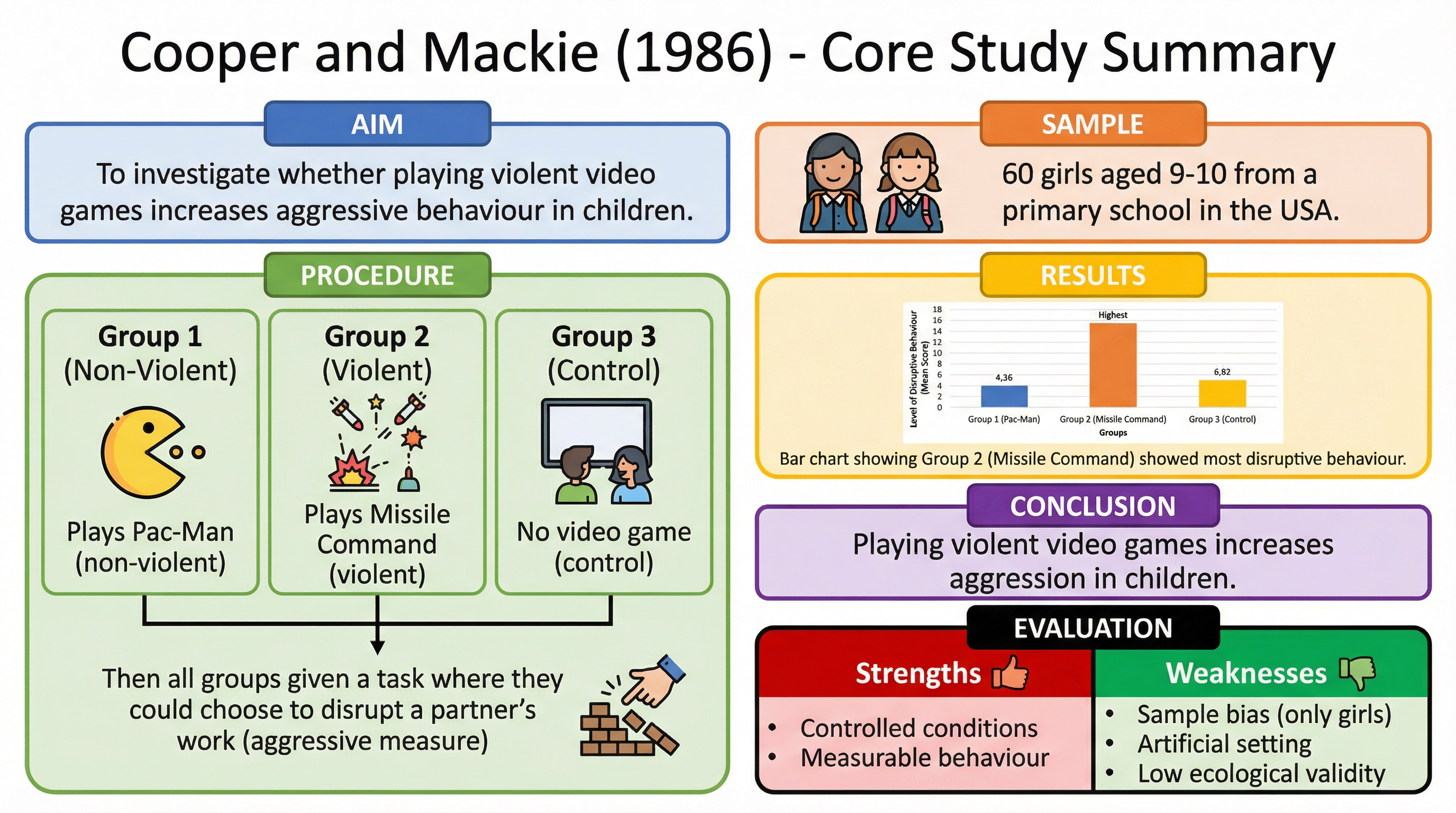
- Aim: To see if playing a violent video game (Missile Command) led to more aggression than playing a non-violent game (Pac-Man) or no game.
- Sample: 60 girls aged 9-10 from a US primary school.
- Procedure: Three conditions (violent game, non-violent game, control). Aggression was measured by how much the children chose to disrupt a partner's task afterwards.
- Results: The group that played the violent game showed the most disruptive behaviour.
- Conclusion: Playing violent video games can increase aggression in children, supporting Social Learning Theory.
Second-Order Concepts
Causation
- Biological Causes: Eysenck's theory points to inherited personality traits and nervous system differences as the root cause of criminality.
- Environmental Causes: Social Learning Theory argues that crime is caused by environmental factors, specifically the observation and imitation of criminal role models.
- Interactionist Approach: A more sophisticated analysis suggests that both factors likely interact; an individual might have a biological predisposition (like high extraversion) which is then triggered by environmental factors (like associating with a criminal peer group).
Application
- Punishment: Strategies like prison sentences are based on the idea of deterrence and retribution. They are linked to behaviourist principles of learning through consequences. However, high recidivism (reoffending) rates suggest punishment alone is often ineffective.
- Rehabilitation: Strategies like Cognitive Behavioural Therapy (CBT) for offenders, anger management courses, and restorative justice aim to change the underlying thoughts and behaviours of criminals. This is linked to cognitive and social learning approaches.
Change & Continuity
- Change: The focus in the justice system has slowly shifted from purely punitive measures towards incorporating more rehabilitative elements, based on psychological evidence about the causes of crime.
- Continuity: Despite the rise of psychological explanations, punishment (especially imprisonment) remains the primary method for dealing with serious crime, showing a continuity of traditional approaches to justice."