Study Notes
Overview
Data analysis is a cornerstone of the OCR GCSE Psychology (J203) specification, falling under the vital Research Methods component. It is the process by which psychologists make sense of the results they have collected in their studies. For candidates, this is not just about being ableto perform calculations; it is about understanding what the numbers mean and why one statistical test might be chosen over another. Examiners are looking for competence in both quantitative and qualitative data handling. This includes arithmetic skills, the ability to interpret graphical representations of data, and, crucially, the ability to justify methodological choices. A strong performance in this area is often what separates a good candidate from an excellent one, as it demonstrates a deeper understanding of the scientific process in psychology. This guide will equip you with the specific knowledge and techniques required to analyse data with confidence and precision, directly addressing the demands of AO2 (Application) and AO3 (Evaluation), which together constitute 70% of the marks.
Key Concepts in Data Analysis
Measures of Central Tendency
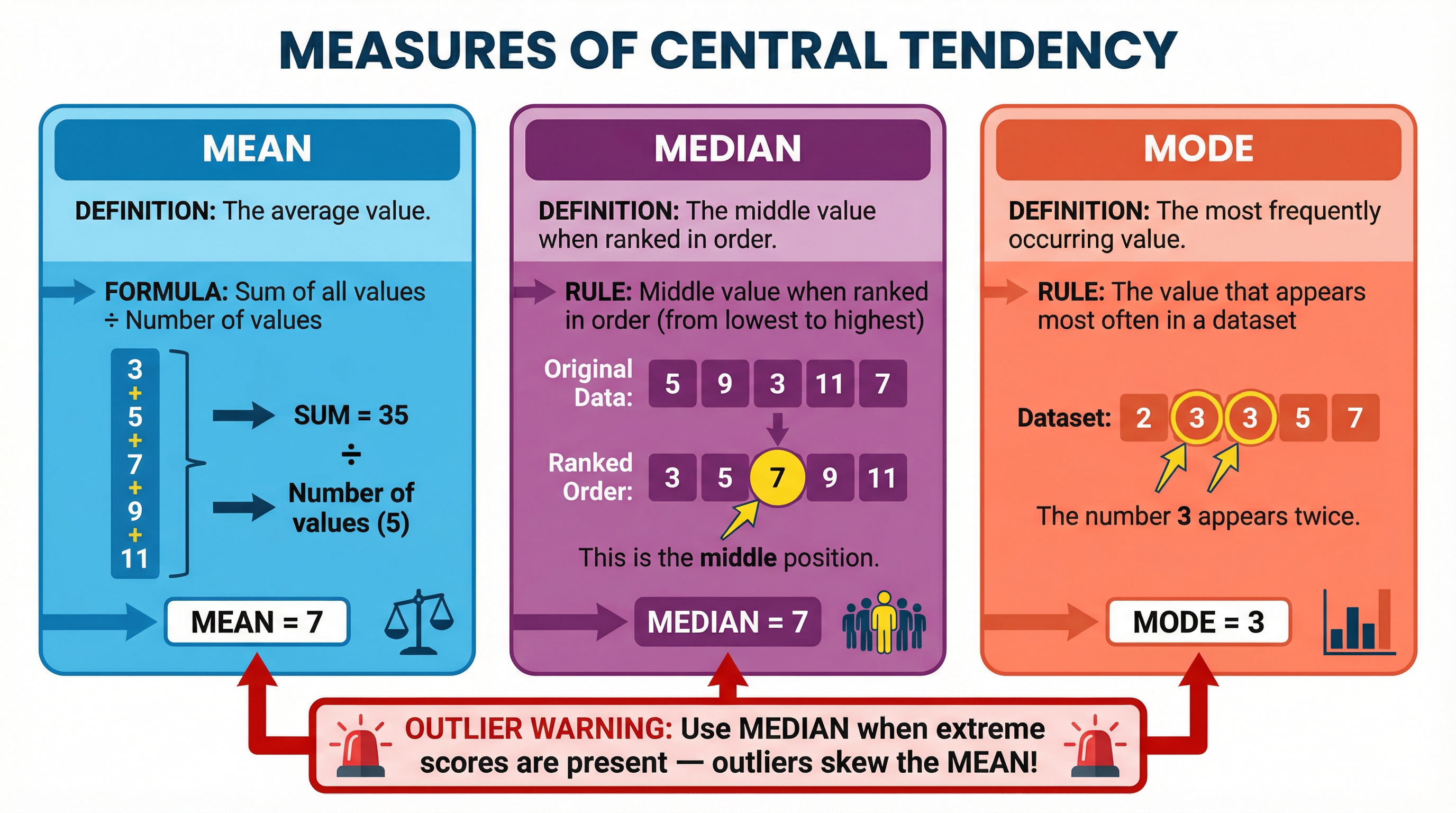
What it is: A single value that attempts to describe a set of data by identifying the central position within that set of data. The main measures are the mean, median, and mode.
Why it matters: Examiners will ask you to calculate these and, more importantly, to justify which is the most appropriate for a given dataset. This is a key AO3 skill.
Specific Knowledge: You must know the definitions and calculations for all three.
Measures of Dispersion
What it is: A measure of how spread out the scores are in a dataset. The main measure you need to know is the range.
Why it matters: The range provides context to the measures of central tendency. A small range indicates the data points are clustered closely together, while a large range indicates they are spread far apart.
Specific Knowledge: Calculation of the range (Highest score - Lowest score). Be aware that, like the mean, the range is affected by outliers.
Data Presentation
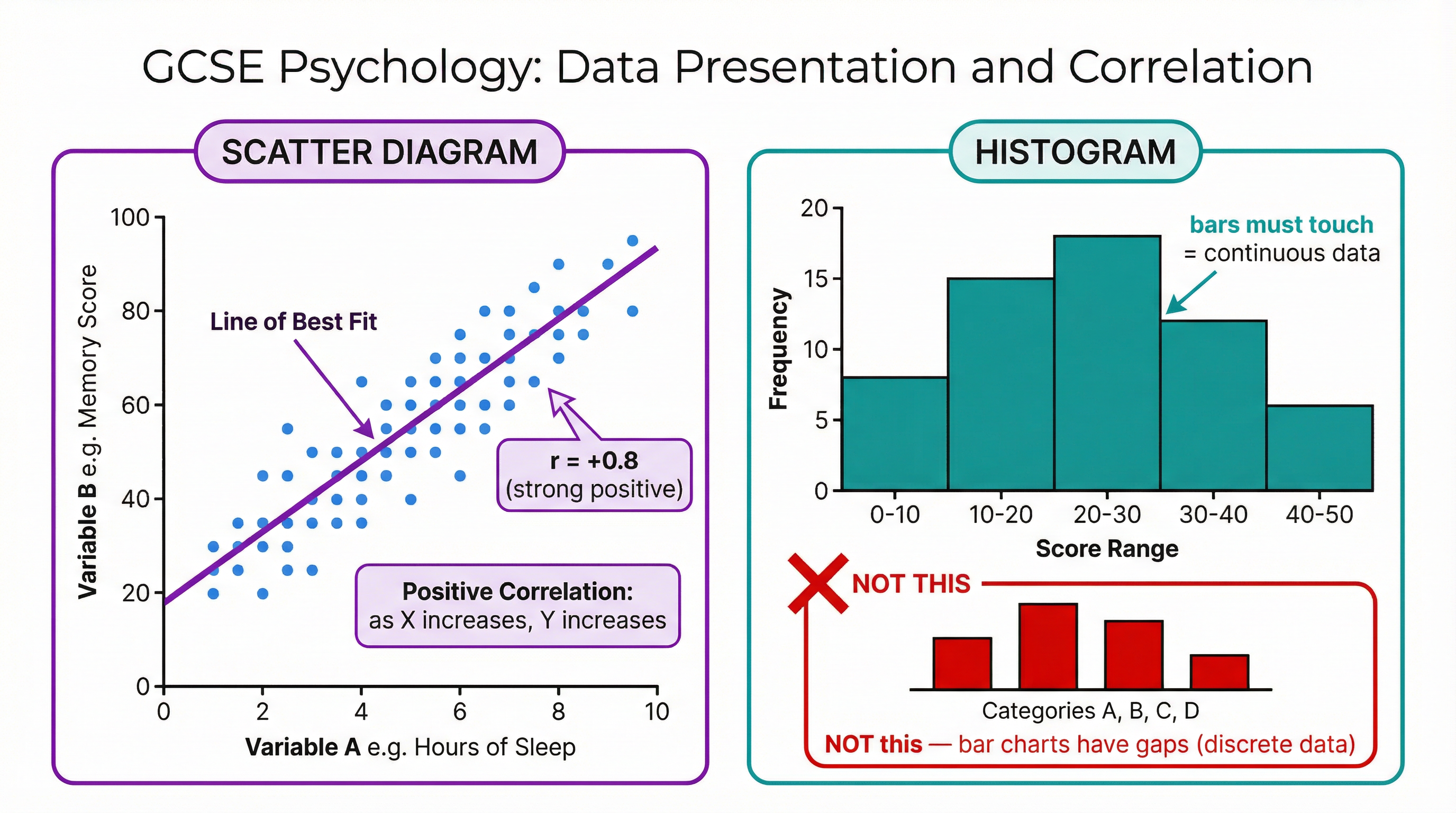
What it is: The various ways in which data can be visually represented. For OCR GCSE, you must be proficient with scatter diagrams and histograms.
Why it matters: These are common formats for presenting data in exam questions. You will be expected to interpret them, and potentially plot them. Marks are awarded for accuracy, correct labelling of axes, and a clear title.
Specific Knowledge: The difference between histograms (continuous data, bars touch) and bar charts (discrete data, bars have gaps). How to plot and interpret scatter diagrams to identify correlations.
Second-Order Concepts
Interpretation vs. Description
When presented with a graph or table, it is not enough to simply describe what you see (e.g., "the bar for Group A is higher than Group B"). You must interpret the data in the context of the study, explaining what the results suggest about the psychological phenomenon being investigated.
Justification of Choices
A common high-mark question involves justifying the use of a particular statistical test or descriptive statistic. For example, you must be able to explain why the median is a better measure than the mean when there are extreme scores (outliers) in a dataset, as the mean would be skewed.
Correlation and Causation
This is arguably the most important concept in data analysis. A correlation between two variables does not mean one causes the other. There could be a third, unmeasured variable influencing both. Examiners will penalise candidates who make causal claims based on correlational data. You must use phrases like "there is a relationship between..." or "as X increases, Y also increases", but not "X causes Y".