Study Notes
Overview
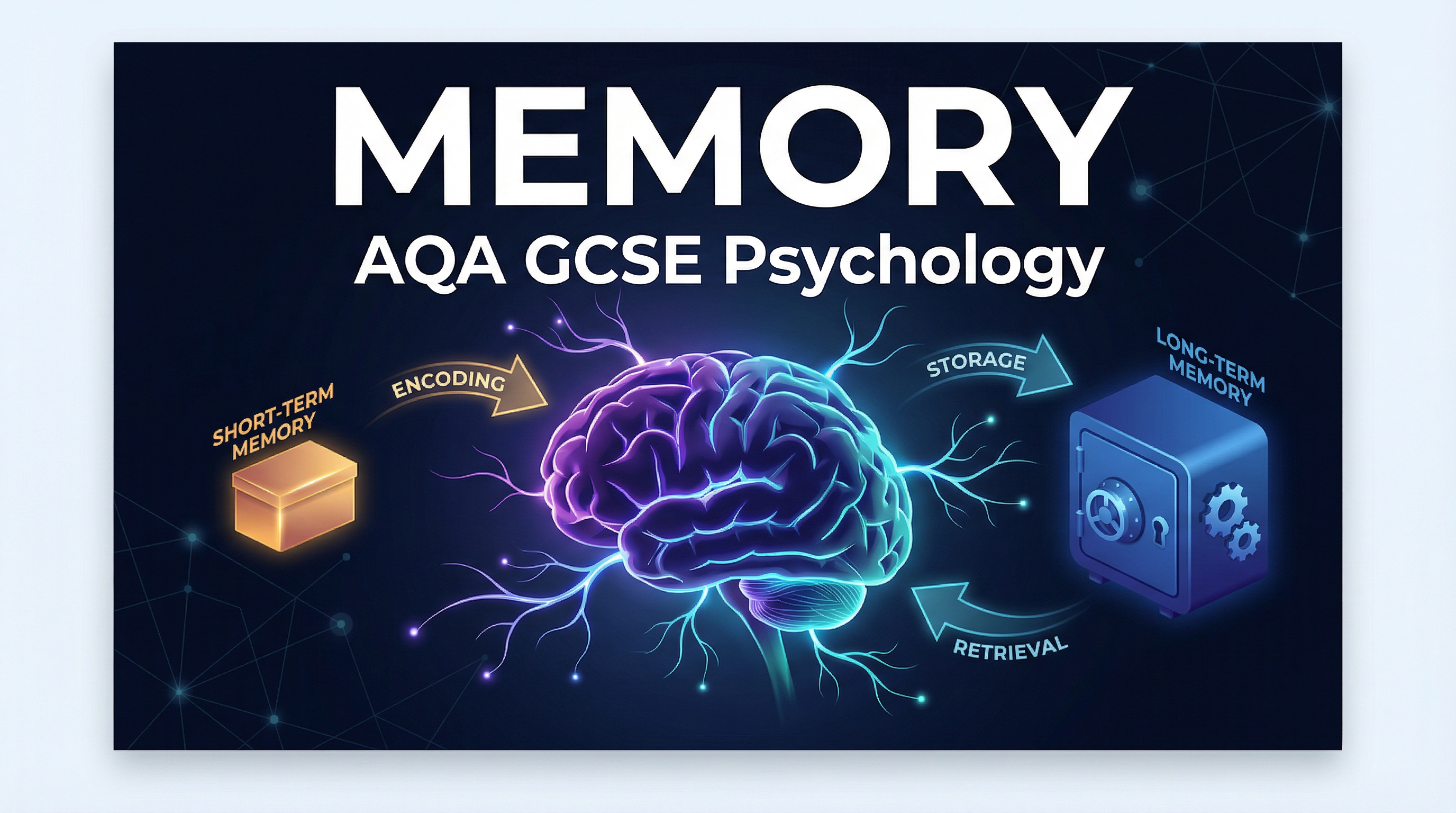
Memory is a foundational topic in psychology, exploring how we process, store, and recall information. For AQA GCSE candidates, this section demands a firm grasp of two key contrasting theories: the Multi-Store Model (MSM), which presents memory as a linear process through distinct stores, and Bartlett's Theory of Reconstructive Memory, which argues that memory is an active and often inaccurate reconstruction of past events. Examiners expect candidates to not only describe these theories but also to apply them to novel scenarios (AO2) and critically evaluate the supporting research (AO3). This guide will equip you with the precise knowledge, key terminology, and exam techniques required to confidently tackle questions on memory processes, structures, and the factors that affect its accuracy.
Key Theories & Concepts
The Multi-Store Model of Memory (Atkinson & Shiffrin, 1968)
What it is: A structural model that proposes memory consists of three separate, unitary stores through which information passes in a linear sequence.
Why it matters: This is the foundational theory for understanding memory as a system. It provides a simple framework for the different characteristics of short-term and long-term memory, which examiners frequently test. Credit is given for accurately describing the features of each store.
The Three Stores:
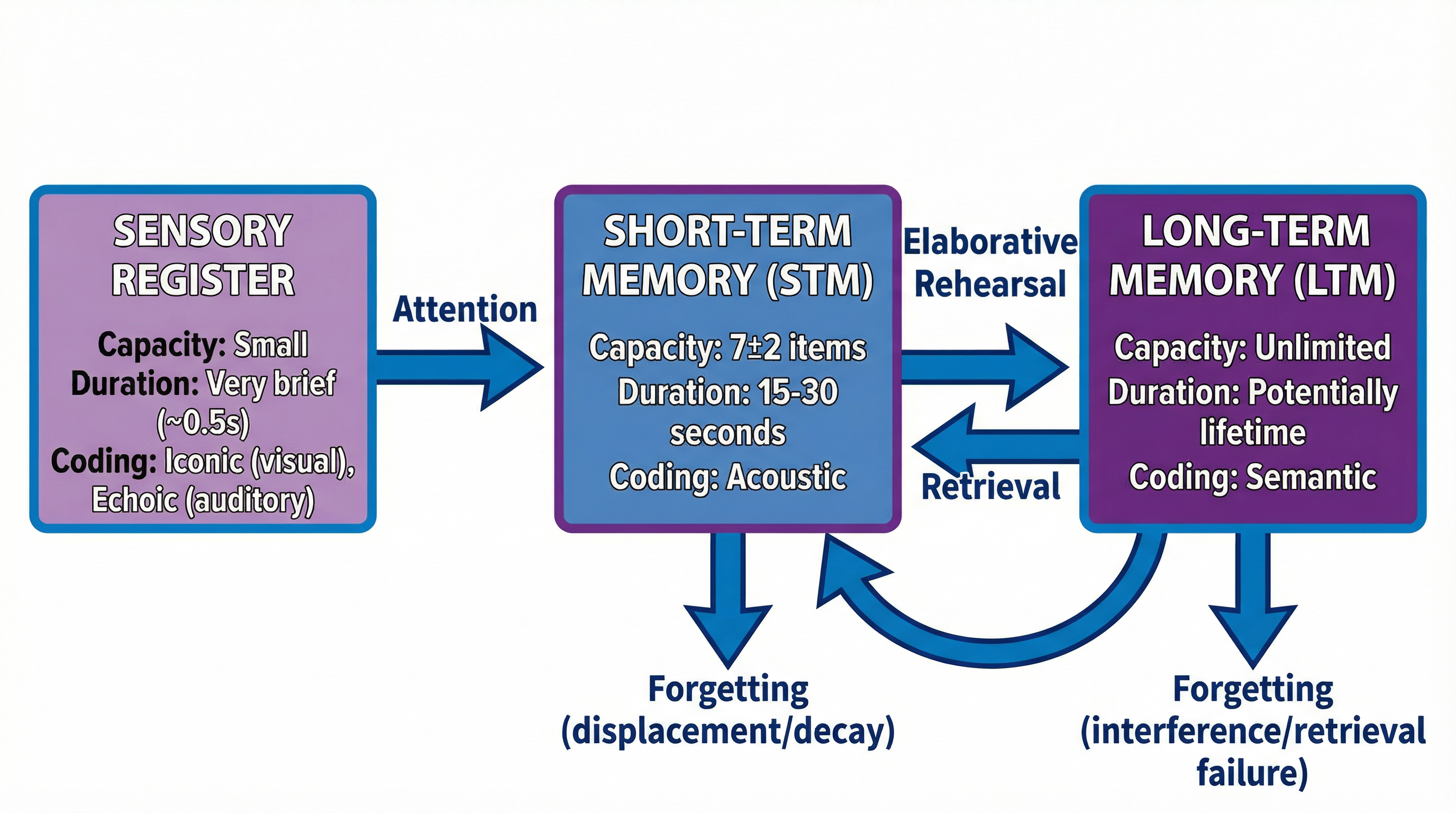
- Sensory Register: The first point of contact for sensory information. It has a very large capacity but a duration of less than a second. Information is coded depending on the sense (e.g., iconic for visual, echoic for auditory). Attention is required to pass information to the next store.
- Short-Term Memory (STM): A temporary store for information currently in conscious awareness. Its features are crucial for the exam:
- Capacity: 7 +/- 2 items (Miller, 1956).
- Duration: 15-30 seconds unless rehearsed.
- Coding: Primarily acoustic (sound-based).
- Long-Term Memory (LTM): The permanent store for information that has been rehearsed. It has a potentially unlimited capacity and duration, with coding being primarily semantic (based on meaning).
The Serial Position Effect (Murdock, 1962)
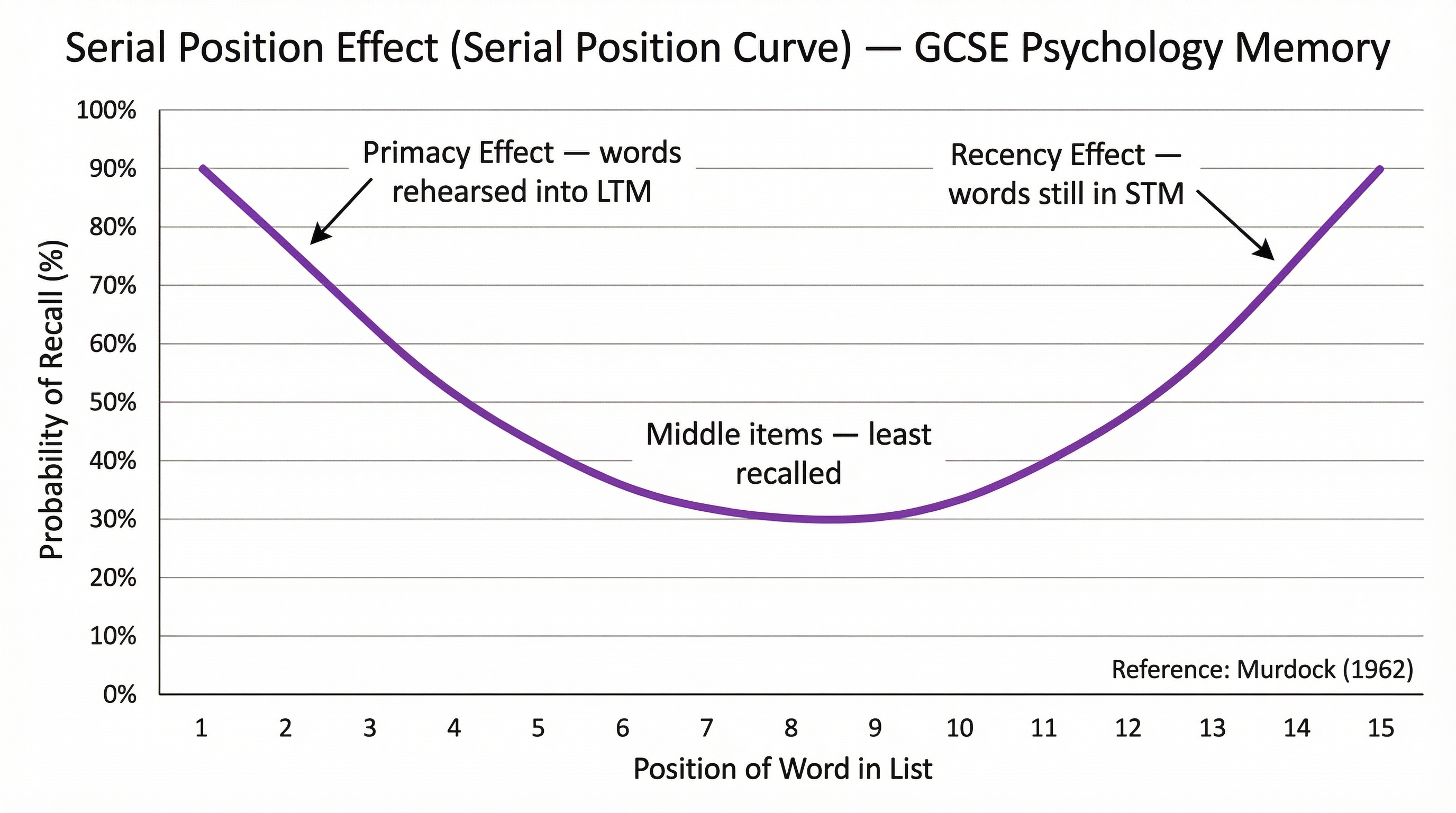
What it is: A key study providing evidence for the MSM. Murdock found that when recalling a list of words, participants remembered the first words (Primacy Effect) and the last words (Recency Effect) best.
Why it matters: This supports the idea of separate STM and LTM stores. The Primacy Effect occurs because the first words are rehearsed and transferred to LTM. The Recency Effect occurs because the last words are still in the STM. This is a go-to study for AO1 description and AO3 evaluation.
Bartlett's Theory of Reconstructive Memory (1932)
What it is: A theory suggesting that memory is not a perfect recording of events. Instead, we actively reconstruct our memories each time we recall them, often filling in gaps using our existing knowledge and expectations (schemas).
Why it matters: This theory challenges the MSM by proposing memory is a dynamic and often unreliable process. It's crucial for understanding eyewitness testimony and false memories. Marks are awarded for explaining how schemas lead to specific types of recall errors.
Key Concepts:
- Schema: A mental framework of beliefs and expectations developed from experience. Schemas help us process information quickly but can lead to distortions.
- Confabulation: When we fill in gaps in our memory with details that may not be accurate, often to make a memory more coherent or sensible.
- Distortions: Bartlett found three common patterns of distortion in his 'War of the Ghosts' study:
- Omissions: Leaving out unfamiliar or irrelevant details.
- Transformations: Changing details to make them more familiar and culturally sensible (e.g., 'canoe' becomes 'boat').
- Rationalisation: Adding details to the story to make it seem more logical.
Key Individuals
Atkinson & Shiffrin
Role: Psychologists who proposed the Multi-Store Model of Memory in 1968.
Key Actions: They conceptualised memory as a system of three distinct stores, defining the flow of information between them.
Impact: Their model dominated memory research for decades and remains the core theory for GCSE. It provides a clear, testable framework for memory processes.
Sir Frederic Bartlett
Role: A British psychologist who pioneered the concept of reconstructive memory.
Key Actions: Conducted the famous 'War of the Ghosts' study, demonstrating that memory is shaped by our personal schemas and cultural background.
Impact: Bartlett's work highlighted the fallibility of memory and laid the groundwork for later research into eyewitness testimony and cognitive biases. It provides the main counter-argument to the MSM.
Second-Order Concepts
Causation
- Forgetting in STM is primarily caused by displacement (new information pushing old information out due to limited capacity) and decay (information fading over time).
- Forgetting in LTM is often caused by interference (when memories clash) or retrieval failure (the information is there but cannot be accessed, perhaps due to a lack of cues).
Change & Continuity
- The MSM represents an early, influential model that has since been changed and refined. For example, the Working Memory Model (Baddeley & Hitch) proposed that STM is not a single store but a more complex system.
- However, the core distinction between a temporary short-term store and a more permanent long-term store has shown continuity and remains a central concept in cognitive psychology.
Significance
- Understanding the mechanisms of memory is highly significant for the real world. It has direct applications in the criminal justice system (improving eyewitness testimony), education (developing effective revision strategies), and clinical psychology (understanding memory loss in conditions like dementia)."