Study Notes
Overview
This topic explores the core theme of responses to people in authority, a cornerstone of the Social Area in psychology. Examiners expect candidates to draw detailed comparisons and contrasts between Milgram's classic study on destructive obedience and Bocchiaro's contemporary research into disobedience and whistleblowing. The focus is not just on what happened, but why, and how these studies reveal the power of situational factors to influence behaviour. A strong answer will demonstrate precise knowledge of procedures, quantitative findings, and a nuanced understanding of the complex ethical and methodological issues involved. Credit is awarded for moving beyond simple descriptions to a critical evaluation of the studies' validity, reliability, and contribution to the determinism-freewill debate.
Key Studies
Milgram (1963): Behavioural Study of Obedience
Date(s): 1963
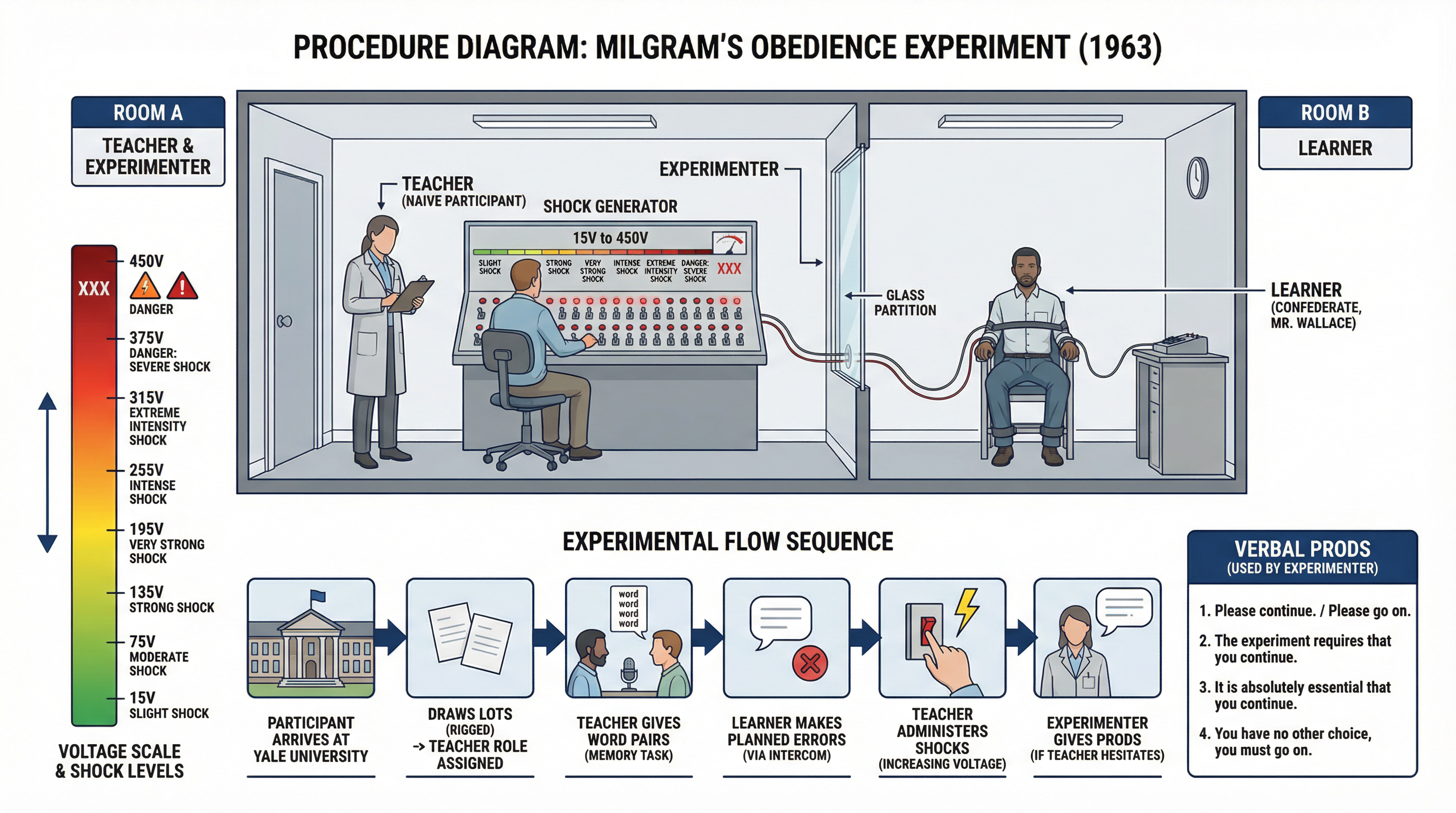
What happened: Milgram recruited 40 male participants for a supposed study on memory at Yale University. Through a rigged draw, the participant was always the 'Teacher' and a confederate was the 'Learner'. The Teacher was instructed by an authority figure (experimenter in a lab coat) to administer increasingly powerful electric shocks (from 15V to 450V) to the Learner for incorrect answers on a word-pair task. No real shocks were given.
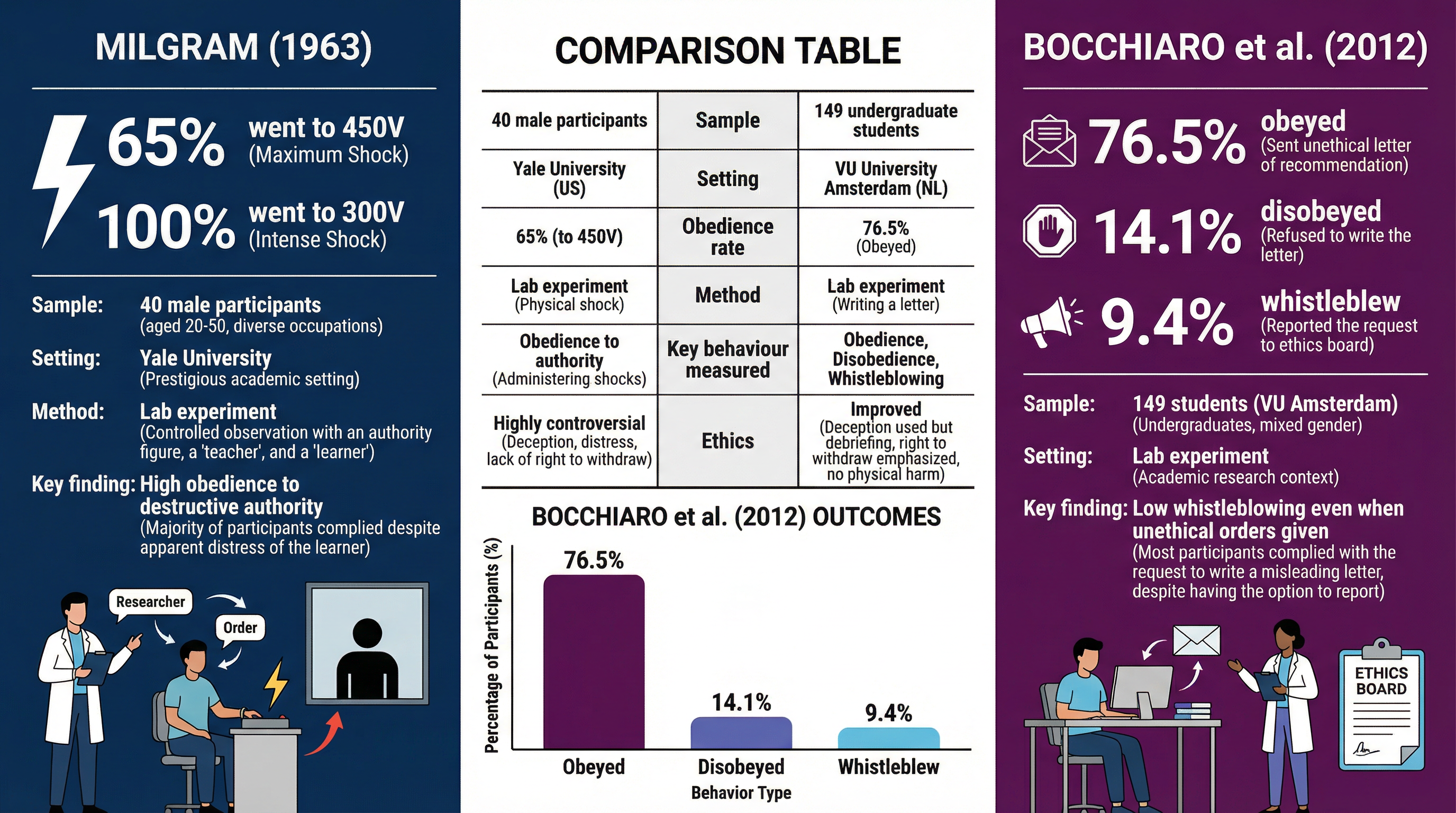
Why it matters: It provided startling evidence for the power of situational authority. A staggering 65% of participants obeyed orders to the point of administering the maximum 450V shock, despite the Learner's audible cries of pain and eventual silence. This demonstrated the 'agentic state', where individuals cede personal responsibility to an authority figure.
Specific Knowledge: 65% obeyed to 450V; 100% obeyed to 300V; Sample was 40 males aged 20-50 from New Haven; The four verbal prods were: 'Please continue', 'The experiment requires that you continue', 'It is absolutely essential that you continue', and 'You have no other choice, you must go on'.
Bocchiaro et al. (2012): From Disobedience to Whistleblowing
Date(s): 2012
What happened: Bocchiaro investigated obedience, disobedience, and whistleblowing at VU University Amsterdam. 149 undergraduate students were asked by an authority figure to write a letter encouraging other students to participate in a distressing sensory deprivation study. They were explicitly told the study was unethical. Participants could obey (write the letter), disobey (refuse), or whistleblow (report the study to an ethics committee).
Why it matters: It provided a more nuanced view of responses to authority, showing that while most people obey unethical instructions, very few are willing to take the active step of whistleblowing. It also highlighted our poor ability to predict our own behaviour, as a comparison group vastly overestimated their likelihood of disobeying or whistleblowing.
Specific Knowledge: 76.5% obeyed; 14.1% disobeyed; 9.4% whistleblew. Comparison group predictions: 3.6% thought they would obey, 64.5% thought they would whistleblow.
Second-Order Concepts
Social Area Assumptions
Both studies are key pillars of the Social Area. They powerfully demonstrate the core assumption that the social situation and the presence of others (like an authority figure) are a primary cause of our behaviour, often overriding our individual personality or moral beliefs. Milgram's participants did not have sadistic personalities; their behaviour was a product of the situation.
Determinism vs. Free Will
This topic is a classic battleground for the determinism vs. free will debate. The high obedience rates in both studies provide strong support for situational determinism – the idea that our actions are determined by external factors beyond our control. However, the fact that 35% of Milgram's participants and 23.5% of Bocchiaro's participants did resist (disobeying or whistleblowing) shows that free will still plays a role. Individuals can, and do, choose to defy authority.
Individual vs. Situational Explanations
While the primary explanation is situational, Bocchiaro did investigate individual factors. He found a weak link between religious faith and whistleblowing, suggesting that those with strong personal moral codes may be slightly more likely to resist. However, overall, the situation was a far stronger predictor of behaviour than any personality trait measured.
Evaluation Skills
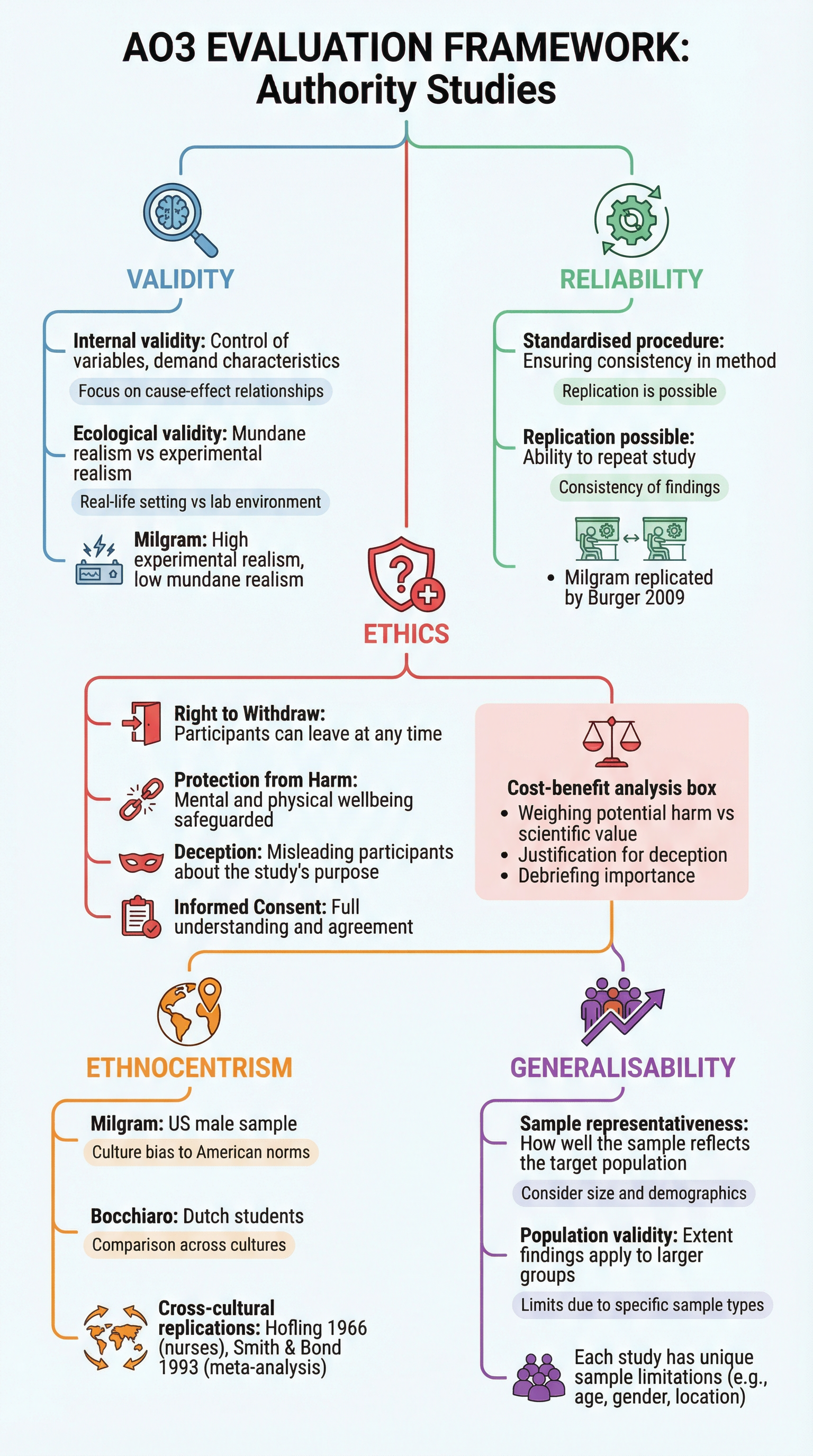
When evaluating these studies for AO3 marks, you must use the key methodological concepts. Use the framework provided in the diagram to structure your arguments. For example, when discussing ethics, don't just say a study was 'unethical'. Name the specific BPS guideline that was breached (e.g., Protection from Harm) and explain how it was breached (e.g., by causing visible psychological distress in participants). Then, provide a counter-argument by discussing the scientific value gained in a cost-benefit analysis."