Study Notes
Overview
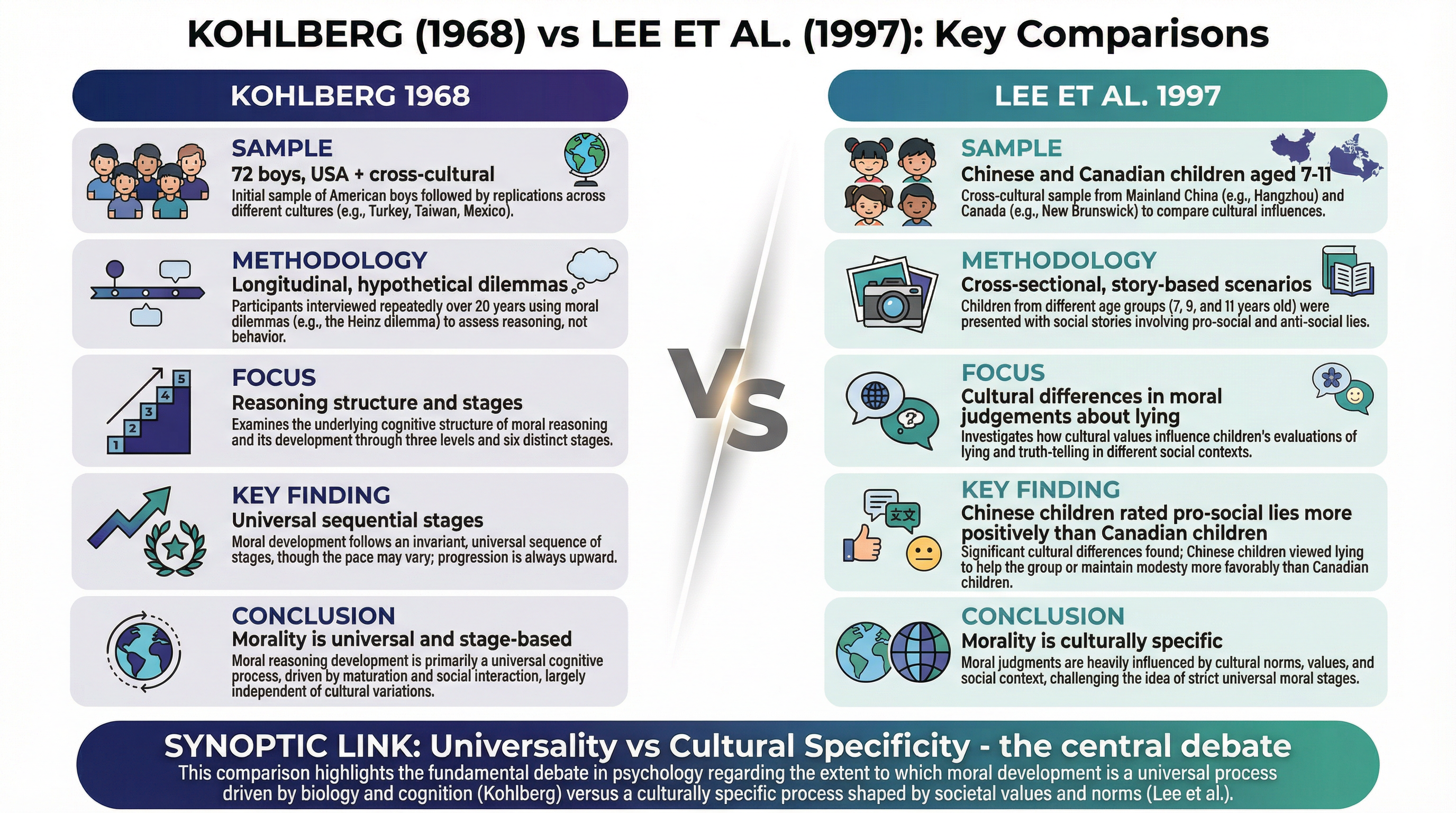
Kohlberg's (1968) study, 'The child as a moral philosopher', is a cornerstone of the Developmental Area in OCR A-Level Psychology. It presents a stage theory of moral reasoning, arguing that our thinking about right and wrong evolves through a universal, invariant sequence. For examiners, this isn't just about memorising the stages; it's about understanding the constructivist nature of the theory, the nuances of the longitudinal methodology, and the critical evaluation points that challenge its conclusions. This study is significant because it shifted the focus from moral behaviour to the cognitive processes behind it. Mastery requires candidates to not only describe the theory but to apply it to novel scenarios, critique its methodology (especially its use of hypothetical dilemmas and its all-male sample), and compare it effectively with the contemporary study by Lee et al. (1997), focusing on the debate between universalism and cultural relativism.
Key Concepts: The Three Levels and Six Stages
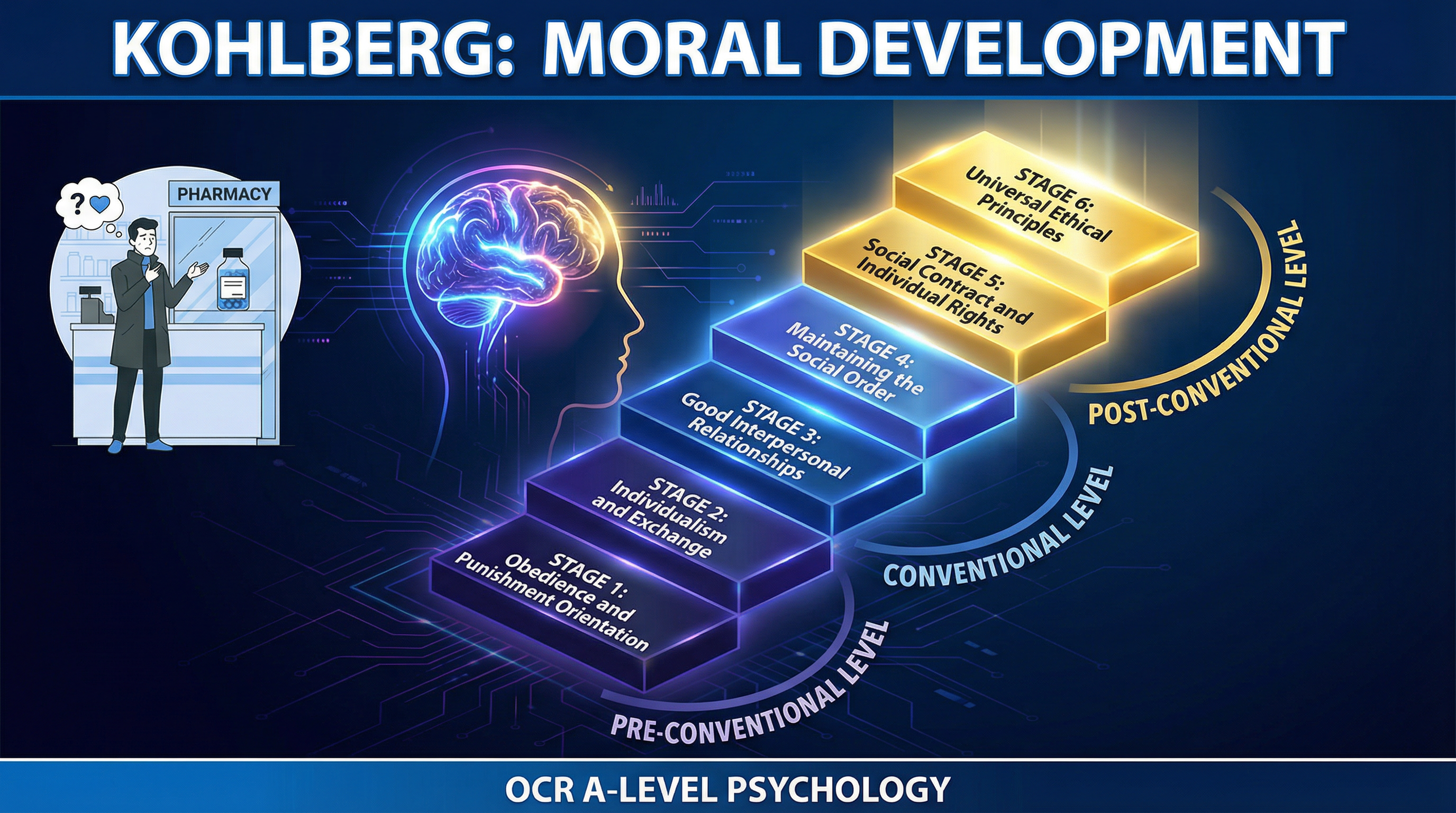
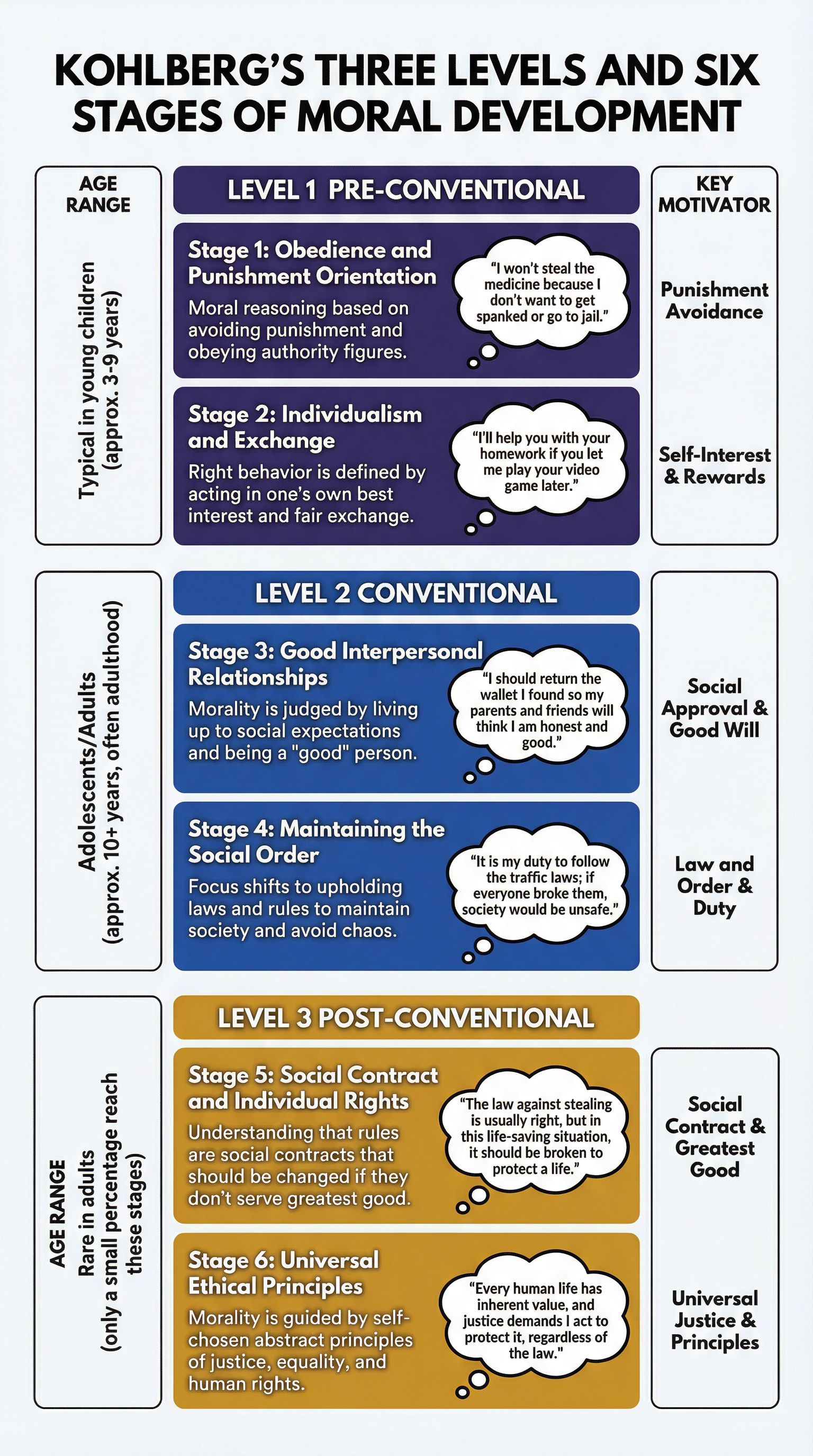
Kohlberg's theory is structured into three levels of moral reasoning, with two stages at each level. It is critical that candidates do not confuse levels and stages. Progression through the stages is sequential and invariant – no stage can be skipped. The development is not about age, but about the structure of a person's reasoning.
Level 1: Pre-conventional Morality
Focus: Self-interest. Rules are seen as external and are obeyed to avoid punishment or gain personal rewards.
- Stage 1: Obedience and Punishment Orientation: Reasoning is based on avoiding punishment from a powerful authority. Example: 'Heinz shouldn't steal the drug because he will be put in prison.'
- Stage 2: Individualism and Exchange: Right behaviour is defined by what serves one's own needs. There is an awareness that others have needs too, leading to a transactional 'you scratch my back, I'll scratch yours' mentality. Example: 'Heinz should steal the drug because his wife needs it and he wants her to live.'
Level 2: Conventional Morality
Focus: Social conformity. Morality is based on conforming to social roles, rules, and expectations to maintain social order.
- Stage 3: Good Interpersonal Relationships: The 'good boy/good girl' stage. Reasoning is based on living up to the expectations of others and maintaining good relationships. Example: 'Heinz should steal the drug because a good husband is expected to do anything to save his wife.'
- Stage 4: Maintaining the Social Order: The focus shifts to obeying laws and upholding social order for the good of society as a whole. Example: 'Heinz shouldn't steal the drug because it's against the law. If everyone broke the law, society would descend into chaos.'
Level 3: Post-conventional Morality
Focus: Abstract principles. Morality is defined in terms of abstract principles and values that apply to all situations and societies.
- Stage 5: Social Contract and Individual Rights: The individual understands that laws are social contracts that should be upheld, but can be challenged or changed if they compromise fundamental human rights. Example: 'Heinz should steal the drug because the right to life is more fundamental than the right to property.'
- Stage 6: Universal Ethical Principles: Reasoning is based on self-chosen, abstract ethical principles of justice, equality, and human dignity. These principles are seen as universal and take precedence over any law. Example: 'Heinz must steal the drug because the principle of preserving human life is a universal obligation that transcends any specific law or social agreement.'
The Core Study: Methodology & Procedure
Understanding the methodology is crucial for AO3 evaluation marks. Kohlberg's study was a longitudinal investigation that tracked the moral development of his participants over a significant period.
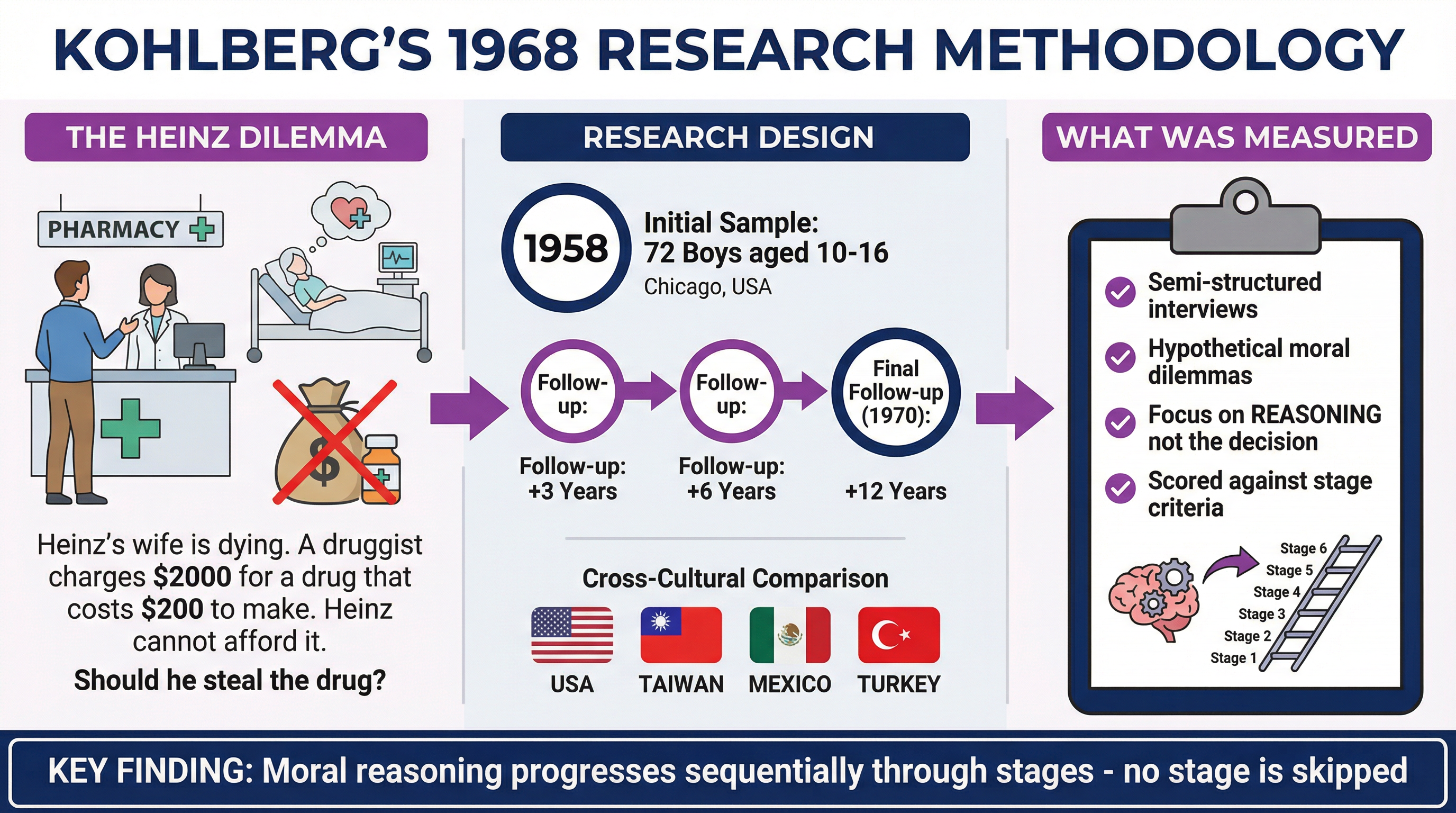
- Sample: The original sample consisted of 72 boys from Chicago, aged 10, 13, and 16 at the start of the study in 1958.
- Procedure: The boys were followed for 12 years, with interviews conducted every 3 years. In these semi-structured interviews, they were presented with a series of hypothetical moral dilemmas (e.g., the Heinz dilemma).
- Data Collection: The focus was not on the content of the decision (e.g., 'steal' vs. 'don't steal'), but on the structure of the reasoning given to justify the decision. This reasoning was then matched to one of the six stages.
- Cross-Cultural Research: A key detail often missed by candidates is that Kohlberg extended his research to other cultures, including boys from Taiwan, Mexico, and Turkey, to test the universality of his stage theory.
Second-Order Concepts: Evaluation (AO3)
Validity
- Ecological Validity: A major criticism is the use of artificial, hypothetical dilemmas. The way individuals reason about a fictional character may be very different from how they would reason and behave in a real-life moral crisis. This limits the extent to which the findings can be generalised to real-world moral behaviour.
- Construct Validity: Does the test accurately measure the construct of 'moral reasoning'? Critics like Gilligan argue it measures an 'ethic of justice' but ignores an 'ethic of care', making it an incomplete measure.
Reliability
- Inter-Rater Reliability: The scoring of the interview responses is subjective. While Kohlberg developed a detailed scoring manual, there is still potential for inconsistency between researchers when classifying a participant's reasoning into a specific stage.
Sampling Bias
- Androcentrism (Gender Bias): The original sample was exclusively male. Carol Gilligan (1982) famously criticised the theory, arguing that it was biased towards a male perspective that prioritises justice and rights (Stage 4/5), while downplaying a female perspective that often prioritises care and relationships (Stage 3). This is an example of beta bias, where gender differences are minimised.
- Ethnocentrism (Cultural Bias): Although Kohlberg claimed universality, his stages were developed based on a Western, individualistic culture. The emphasis on individual rights (Stage 5) and abstract principles (Stage 6) may not be the pinnacle of moral development in collectivist cultures that prioritise community and social harmony. This is a key point for comparison with Lee et al. (1997).