Study Notes
Overview
Criminal Psychology sits within Component 2 of the OCR J203 GCSE Psychology specification and addresses one of psychology's most enduring debates: are criminals born or made? This topic requires candidates to engage with two fundamentally different explanations of criminal behaviour. Eysenck's Theory of Criminal Personality proposes a biological basis — that inherited personality traits predispose certain individuals to offending. Social Learning Theory, associated with Albert Bandura, argues instead that criminal behaviour is acquired through observation and imitation of role models in the social environment.
Examiners expect candidates to demonstrate three distinct skills across this topic. AO1 (30% of marks) requires accurate description of theories, studies, and key terms. AO2 (35%) demands application of psychological concepts to novel scenarios — a skill that separates top-band candidates from the rest. AO3 (35%) calls for evaluation of research methodology using the GRAVE framework (Generalisability, Reliability, Application, Validity, Ethics), with every evaluative point contextualised to the specific study under discussion.
The two mandatory studies — Cooper and Mackie (1986) and Heaven (1996) — provide empirical evidence for each theoretical position and are frequently the focus of evaluation questions. Mastery of this topic requires not just knowledge, but the ability to deploy that knowledge precisely in response to the command word used.
Key Theories
Eysenck's Theory of Criminal Personality (1964)
Theoretical Basis: Biological determinism — personality is inherited through the nervous system.
Core Argument: Hans Eysenck proposed that criminal behaviour is not a free choice but a product of inherited personality traits that make certain individuals resistant to socialisation. Socialisation is the process by which society teaches individuals to conform to norms and laws through conditioning — reward and punishment. Eysenck argued that people with particular nervous system characteristics are simply harder to condition, meaning the normal social controls that prevent most people from offending are less effective on them.
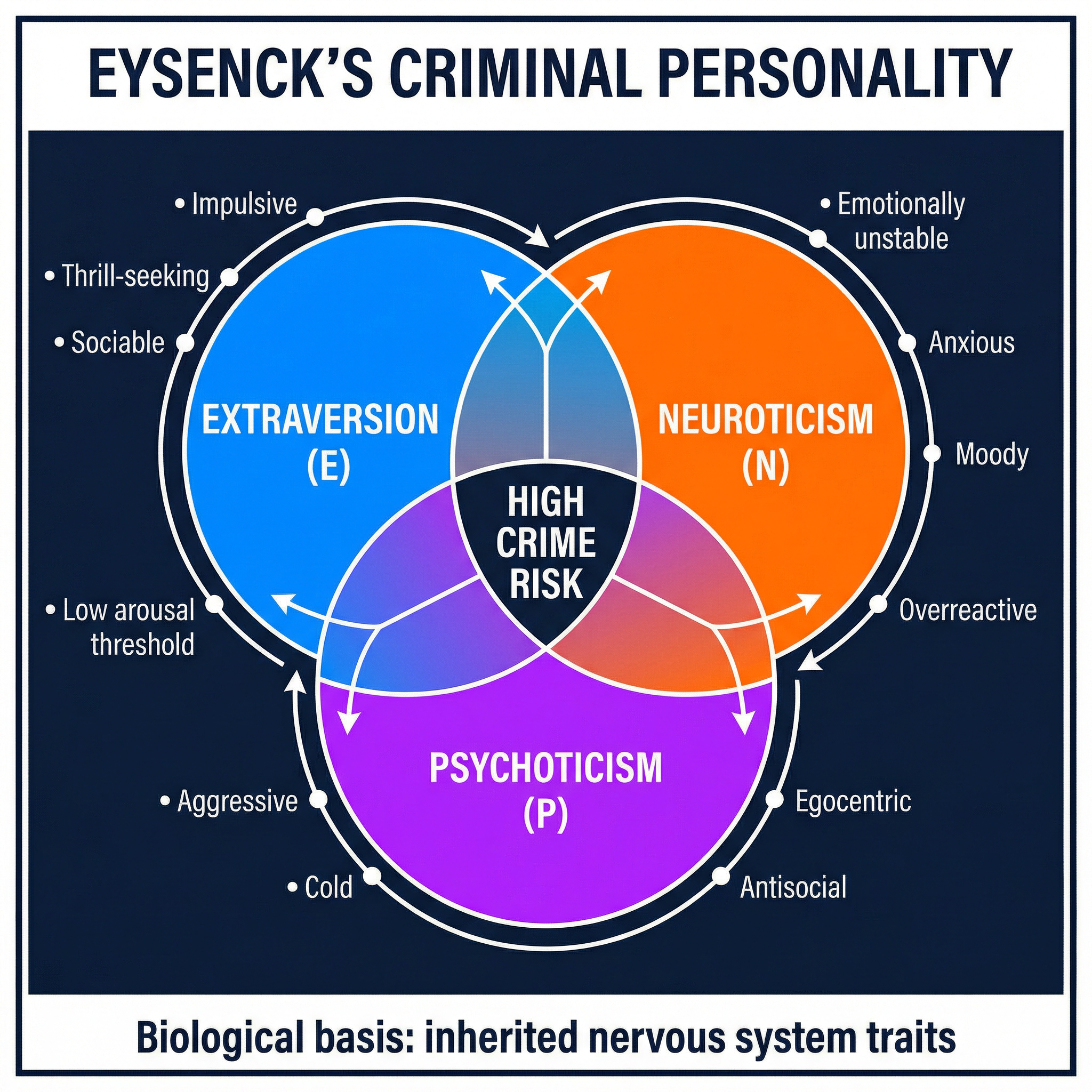
The Three Dimensions of Criminal Personality:
Eysenck identified three personality dimensions, each with a biological underpinning:
| Dimension | Abbreviation | Key Traits | Biological Basis |
|---|---|---|---|
| Extraversion | E | Impulsive, thrill-seeking, sociable, risk-taking | Under-aroused nervous system; seeks stimulation |
| Neuroticism | N | Emotionally unstable, anxious, moody, overreactive | Overactive autonomic nervous system |
| Psychoticism | P | Aggressive, cold, egocentric, antisocial, lacks empathy | Linked to testosterone and dopamine levels |
Individuals who score high on all three dimensions (high E, high N, high P) present the greatest risk of criminal behaviour. Their under-aroused nervous systems mean they constantly seek stimulation (leading to risk-taking and impulsive crime), their emotional instability makes them volatile and reactive, and their psychoticism means they lack the empathy and social conscience that inhibit most people from harming others.
Why It Matters for the Exam: Eysenck's theory is a classic example of biological determinism. When evaluating it, candidates must consider whether it is reductionist (reducing complex behaviour to biology alone), whether it ignores free will, and whether it is supported by empirical evidence such as Heaven (1996).
Social Learning Theory (SLT) Applied to Crime
Theoretical Basis: Environmental determinism — criminal behaviour is learned through observation.
Core Argument: Albert Bandura's Social Learning Theory proposes that behaviour — including criminal behaviour — is acquired by observing role models and imitating their actions, particularly when those actions are seen to be rewarded. Unlike classical conditioning, SLT does not require direct experience; learning can occur vicariously (by watching others).
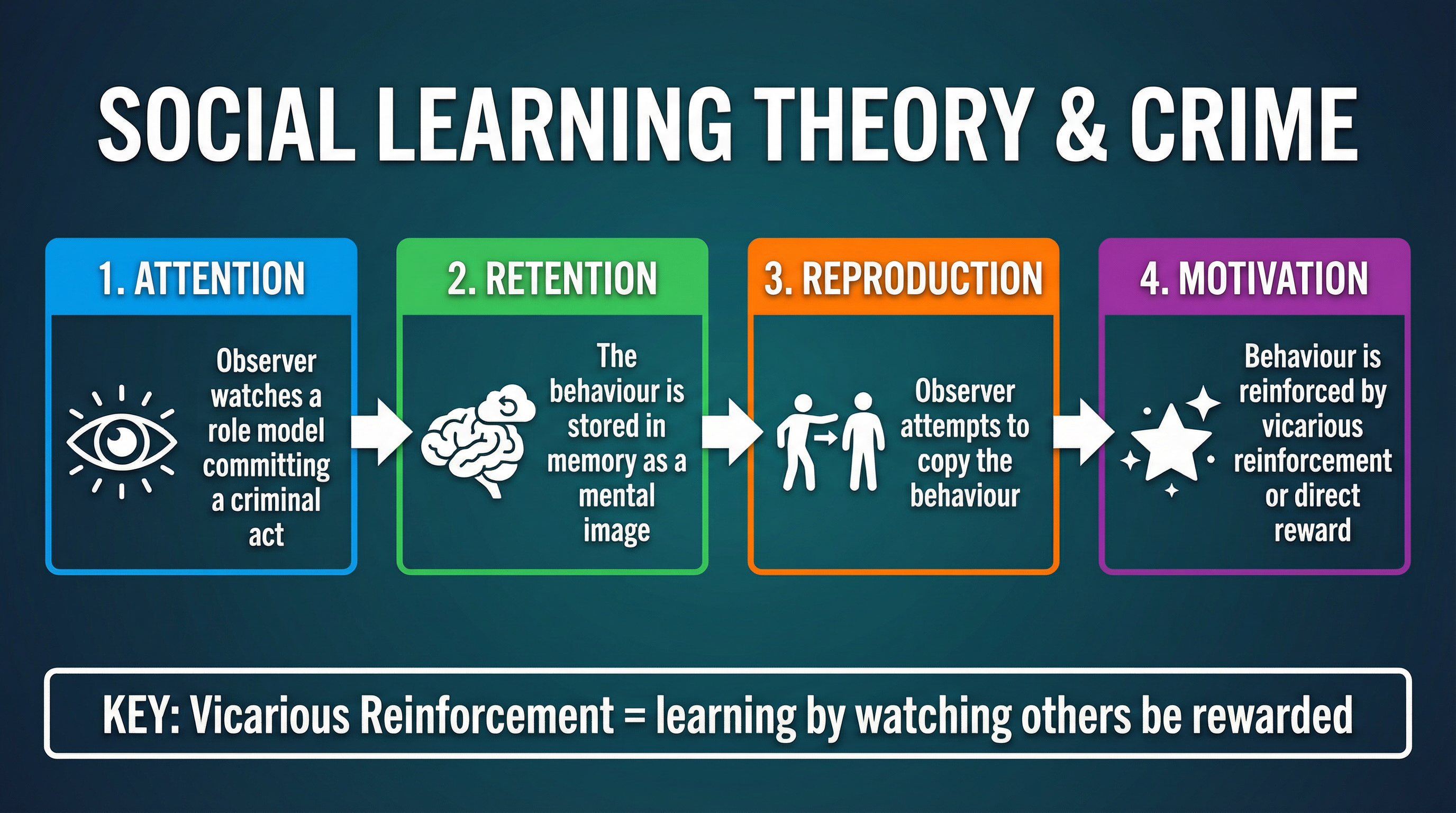
The Four Stages of SLT (ARRM):
| Stage | What Happens | Criminal Example |
|---|---|---|
| Attention | Observer notices the role model's behaviour | A teenager watches an older gang member steal |
| Retention | Behaviour is stored as a mental image or verbal code | The teenager mentally rehearses the theft |
| Reproduction | Observer attempts to copy the behaviour | The teenager attempts shoplifting |
| Motivation | Behaviour is reinforced vicariously or directly | The teenager sees the gang member gain status/money |
Vicarious Reinforcement is the key mechanism: the observer does not need to be personally rewarded. Seeing a role model rewarded is sufficient motivation to reproduce the behaviour. This explains why media portrayals of crime — in video games, films, or social media — may increase criminal behaviour if the criminal is shown to benefit.
Identification: SLT also emphasises that observers are more likely to imitate role models they identify with — those who are similar in age, gender, or status, or who are perceived as powerful and admirable.
Key Studies
Cooper and Mackie (1986)
Aim: To investigate whether playing violent video games increases aggression in children.
Method: Laboratory experiment. Participants were 60 children aged approximately 9–11 years, recruited from a primary school in the USA. They were randomly allocated to one of three conditions: (1) playing the violent video game Missile Command, (2) playing a non-violent video game (Pac-Man), or (3) playing with a toy. After the activity, aggression was measured through a structured free-play observation in which trained observers recorded the frequency and intensity of aggressive play with available toys, including a Bobo doll.
Results: Girls who had played Missile Command displayed significantly more aggressive play behaviour than girls in the other two conditions. This difference was not found for boys.
Conclusion: Exposure to violent video games can increase aggressive behaviour, particularly in girls. This supports Social Learning Theory: the girls attended to the aggressive content, retained it, and reproduced it in their subsequent play behaviour, motivated by the in-game rewards for aggression.
GRAVE Evaluation Summary:
- Generalisability: Limited — sample was American children; findings may not generalise to UK children or adults.
- Reliability: High — standardised laboratory procedure allows replication; structured observation with trained observers improves inter-rater reliability.
- Application: Supports calls for age ratings and parental controls on violent video games.
- Validity: Low ecological validity — the laboratory is artificial; Bobo doll aggression may not reflect real-world aggression.
- Ethics: Potential breach of BPS protection from harm guideline — exposing children to violent content may cause psychological distress.
Heaven (1996)
Aim: To investigate the relationship between Eysenck's personality dimensions and self-reported delinquency in adolescents.
Method: Correlational study. A self-report questionnaire was administered to a sample of Australian adolescents. The questionnaire measured Eysenck's three personality dimensions (E, N, P) using the Eysenck Personality Questionnaire (EPQ), self-esteem, and self-reported delinquent behaviour (e.g., theft, vandalism, drug use).
Results: High scores on Psychoticism were positively correlated with self-reported delinquency. Self-esteem was not significantly correlated with delinquency.
Conclusion: Psychoticism, as Eysenck predicted, is associated with delinquent behaviour. The lack of a significant relationship between self-esteem and delinquency suggests that low self-esteem is not a reliable predictor of criminal behaviour.
Examiner's Alert: The most common error candidates make with Heaven (1996) is reversing the findings — stating that self-esteem was correlated with delinquency. It was not. Only Psychoticism showed a significant correlation. This distinction is worth marks.
GRAVE Evaluation Summary:
- Generalisability: Limited — Australian adolescent sample; may not generalise to adult offenders or other cultures.
- Reliability: Self-report data is susceptible to social desirability bias; participants may under-report delinquency.
- Application: Supports use of personality screening in identifying at-risk youth for early intervention.
- Validity: Correlational design cannot establish causation — high P may not cause delinquency; a third variable may explain both.
- Ethics: Self-report of criminal behaviour raises confidentiality concerns; participants must be assured of anonymity.
The GRAVE Evaluation Framework

Every study evaluation question in OCR Psychology should be structured using GRAVE. The framework ensures candidates cover all relevant methodological dimensions. Crucially, each point must be contextualised — generic statements earn minimal credit.
| GRAVE Letter | What to Address | Contextualised Example |
|---|---|---|
| G — Generalisability | Can findings apply to wider populations? | Heaven's Australian adolescent sample limits application to adult UK offenders |
| R — Reliability | Can the study be replicated consistently? | Cooper and Mackie's standardised lab procedure supports replication |
| A — Application | What real-world use do the findings have? | Cooper and Mackie supports age ratings on violent video games |
| V — Validity | Did the study measure what it claimed to? | Cooper and Mackie's Bobo doll measure lacks ecological validity |
| E — Ethics | Were BPS guidelines followed? | Heaven's self-report of crime raises confidentiality concerns under BPS guidelines |
Second-Order Concepts
Causation
A central debate in Criminal Psychology is whether criminal behaviour is caused by biology (Eysenck) or by environmental exposure (SLT). Eysenck's biological determinism implies that personality traits are the root cause of offending, operating through the mechanism of poor conditionability. SLT identifies social environment as the causal agent — specifically, the presence of criminal role models who are seen to be rewarded. Neither theory fully accounts for the complexity of criminal causation; most contemporary psychologists favour an interactionist position that acknowledges both biological predispositions and environmental triggers.
Consequence
The theoretical position adopted has significant consequences for criminal justice policy. If Eysenck is correct, rehabilitation through conditioning (e.g., cognitive-behavioural therapy) may be limited in effectiveness for high-P individuals. If SLT is correct, interventions that reduce exposure to criminal role models — such as media regulation, mentoring programmes, and community-based support — should be prioritised. Heaven's (1996) finding that Psychoticism correlates with delinquency has implications for early identification and intervention with at-risk youth.
Change and Continuity
The debate between biological and social explanations of crime has persisted throughout the history of psychology. What has changed is the sophistication of the evidence base — from Eysenck's early personality questionnaire studies to neuroimaging research linking brain structure to antisocial behaviour. What remains constant is the fundamental tension between determinism (whether biological or social) and the legal and moral assumption of free will that underpins the criminal justice system.
Significance
Criminal Psychology is significant because it has direct implications for how society responds to crime. If criminal behaviour is biologically determined, punitive approaches may be unjust. If it is socially learned, prevention through environmental change becomes the ethical priority. The OCR specification uses this topic to develop candidates' ability to think critically about the relationship between psychological theory and social policy.