Eyewitness Testimony

    OCR
    GCSE
    Psychology

    Eyewitness Testimony is a cornerstone of the justice system, yet psychological research reveals it to be surprisingly fallible. This guide explores how memory is not a perfect recording but an active reconstruction, a concept crucial for understanding why well-meaning witnesses can make mistakes, and a key area where examiners award marks for nuanced understanding.

    4
    Min Read
    2
    Examples
    2
    Questions
    6
    Key Terms
    πŸŽ™ Podcast Episode
    Eyewitness Testimony
    0:00-0:00

    Study Notes

    Header image for Eyewitness Testimony

    Overview

    Eyewitness Testimony (EWT) is a critical area within cognitive psychology that examines the accuracy of memory for witnessed events, particularly in legal contexts. For the OCR GCSE, the focus is not on memory as a passive video recording, but on Reconstructive Memory, a theory pioneered by Sir Frederic Bartlett. Examiners expect candidates to understand that memory is an active process, shaped and distorted by our pre-existing mental frameworks, or schemas. This guide will cover the core theory of Reconstructive Memory, the key studies by Bartlett (1932) and Braun et al. (2002) that you must know, and the specific exam techniques required to achieve top marks. Understanding this topic is not just about learning facts; it's about appreciating the profound implications of memory's unreliability for justice and society.

    Podcast: OCR GCSE Eyewitness Testimony Revision

    The Theory: Bartlett's Reconstructive Memory

    Schemas: The Brain's Filing Cabinets

    What they are: Schemas are mental shortcuts or frameworks of knowledge and expectation, built up from all our past experiences. For example, you have a 'classroom' schema that tells you what to expect and how to behave in that environment (desks, a teacher, a whiteboard).

    Why they matter for EWT: When we witness an event, we don't have time to process every single detail. Our schemas help us make sense of the situation quickly. However, when we later recall the event, our schemas can lead to errors by 'filling in the gaps' with what we expected to see, rather than what was actually there. This is not lying; it's an unconscious process of reconstruction.

    The Three Processes of Distortion

    Bartlett identified three key ways schemas distort memory. You MUST use these terms in your exam answers.

    1. Omission: Details that are unfamiliar or do not fit with our schema are left out. The brain discards information it deems irrelevant or confusing.
    2. Rationalisation: Unfamiliar or strange details are altered to make them more logical and consistent with our schemas. The memory is 'tidied up' to make more sense.
    3. Transformation: Details are changed or reordered to fit our expectations. This can include exaggerating certain aspects or adding new information entirely.
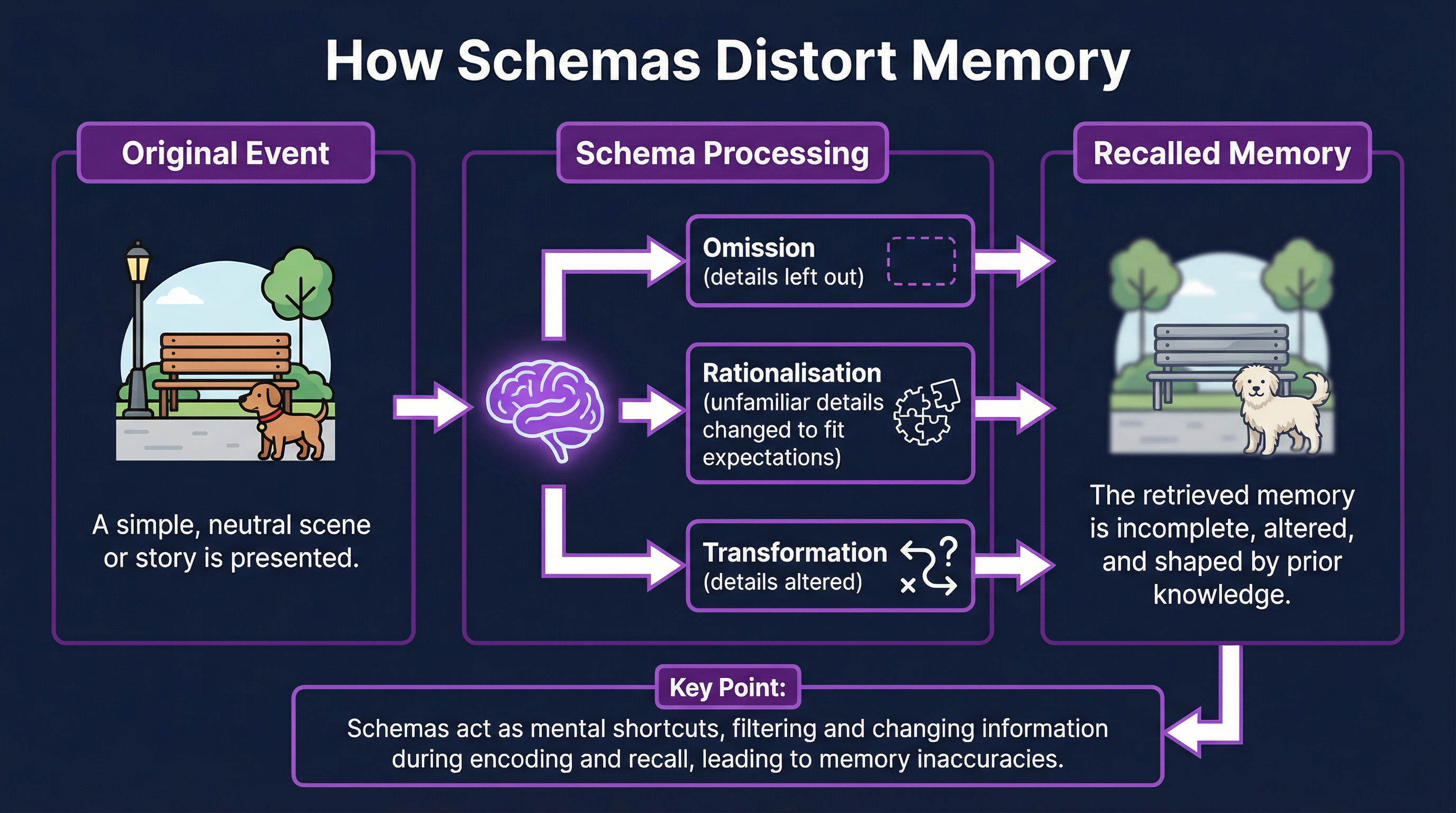
    How Schemas Distort Memory

    Key Studies for OCR GCSE

    Bartlett (1932) - 'War of the Ghosts'

    What happened: Bartlett showed British participants a Native American folk story called 'War of the Ghosts', which was culturally unfamiliar to them. He then used serial reproduction (like a game of 'Chinese Whispers') where participants retold the story to each other from memory.

    What he found: The story changed significantly with each retelling. It became shorter (omission), strange details were changed to be more conventional (e.g., 'canoes' became 'boats' - rationalisation), and the order of events was altered to fit a more standard story structure (transformation).

    Why it matters: This was the first major study to provide evidence for Reconstructive Memory. It showed that memory is not a passive replay but an active reconstruction shaped by our cultural schemas.

    Braun et al. (2002) - False Autobiographical Memories

    What happened: Researchers showed participants misleading print advertisements for Disneyland which featured the Warner Bros. character Bugs Bunny (who would never be at a Disney park).

    What they found: After viewing the ads, 16% of participants claimed they remembered meeting and shaking hands with Bugs Bunny on a past trip to Disneyland. They had created a vivid, but entirely false, autobiographical memory.

    Why it matters: This study demonstrates the power of suggestion and how easily false memories can be implanted. It shows that our personal memories are malleable and can be influenced by external information, such as post-event discussions or media reports, which has huge implications for the reliability of EWT.
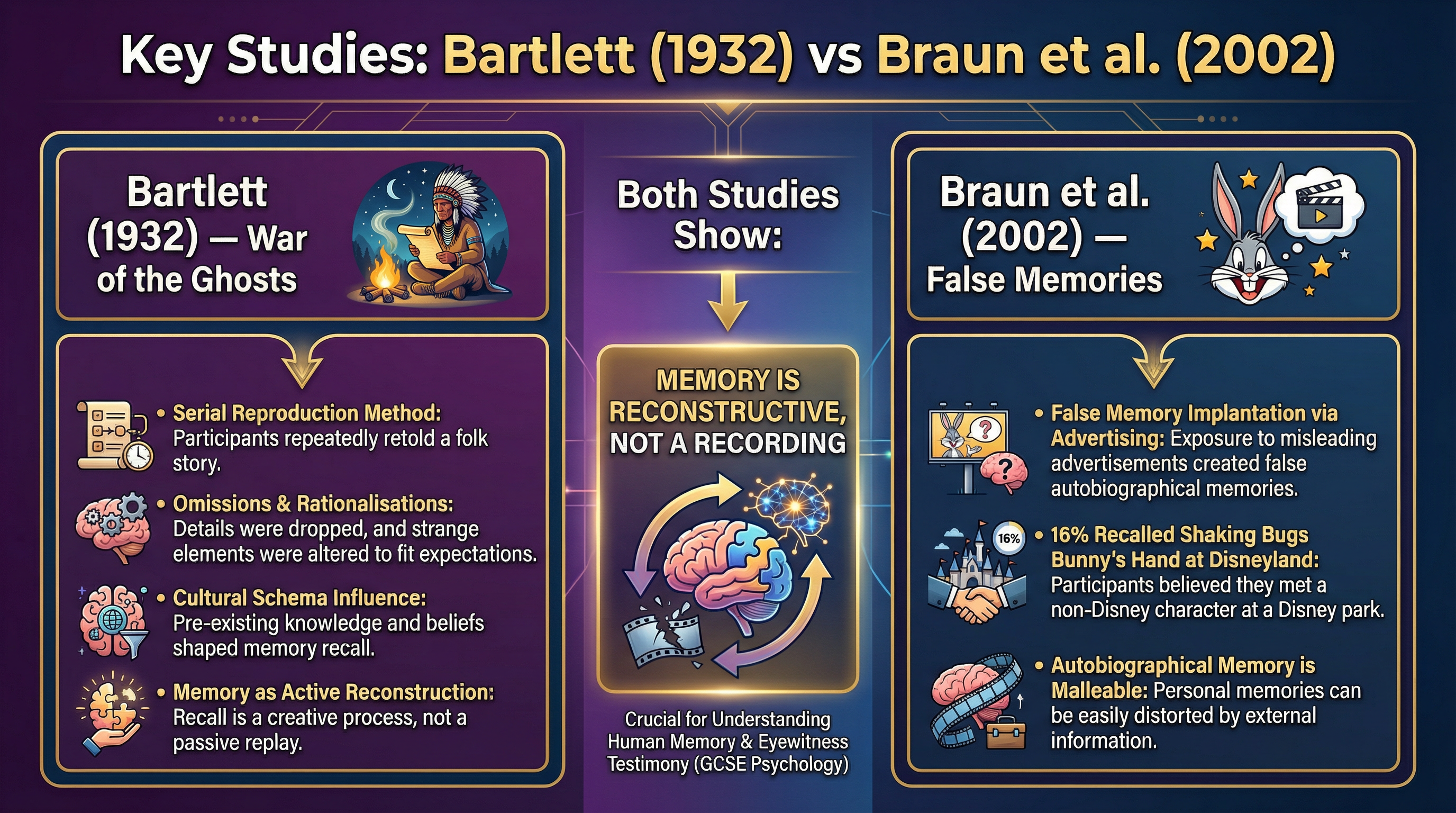
    Key Studies: Bartlett vs. Braun

    Visual Resources

    2 diagrams and illustrations

    How Schemas Distort Memory
    How Schemas Distort Memory
    Key Studies: Bartlett vs. Braun
    Key Studies: Bartlett vs. Braun

    Worked Examples

    2 detailed examples with solutions and examiner commentary

    Practice Questions

    Test your understanding β€” click to reveal model answers

    Q1

    Describe what Bartlett's (1932) study of 'The War of the Ghosts' tells us about memory. (4 marks)

    4 marks
    standard

    Hint: Focus on the conclusions Bartlett drew. What was his big idea? Mention schemas and the active nature of memory.

    Q2

    Outline one strength and one weakness of Braun et al.'s (2002) study into false memories. (4 marks)

    4 marks
    standard

    Hint: For the strength, think about control. For the weakness, think about ecological validity.

    Explore this topic further

    View Topic PageAll Psychology Topics

    Key Terms

    Essential vocabulary to know

    More Psychology Study Guides

    View all

    Bystander Behaviour

    OCR
    GCSE

    This study guide explores the fascinating psychology of bystander behaviour, focusing on the pivotal Piliavin et al. (1969) subway study. It's a deep dive into why people doβ€”or don'tβ€”help in emergencies, providing you with the critical knowledge and exam skills needed to excel in your OCR GCSE Psychology exam.

    Key Concepts in Development

    OCR
    GCSE

    This study guide explores the core principles of cognitive and biological development in OCR GCSE Psychology. It unpacks the essential theories of Piaget, Dweck, and Willingham, providing a clear pathway to understanding how our minds grow and learn. Master these concepts to excel in your exam and gain a profound insight into the foundations of human psychology.

    The Role of Education

    OCR
    GCSE

    Unlock top marks in OCR GCSE Psychology by mastering the theories of Dweck and Willingham. This guide breaks down how mindset and cognitive science shape learning, providing examiner insights and multi-modal tools to turn complex theory into exam success."

    Forensic Psychology

    OCR
    GCSE

    This guide provides a comprehensive, exam-focused breakdown of Forensic Psychology for OCR GCSE. It dissects key theories like Eysenck's Criminal Personality and Social Learning Theory, evaluates the core Cooper and Mackie (1986) study, and provides essential exam techniques to help candidates secure top marks."

    Forgetting

    OCR
    GCSE

    This study guide delves into the psychology of forgetting, a core topic for OCR GCSE Psychology (J203). It explores why we fail to recall information, focusing on Interference Theory and Context-Dependent Forgetting, and unpacks the crucial Godden and Baddeley (1975) study that examiners love to test."

    Theories of Development

    OCR
    GCSE

    This guide provides a comprehensive, exam-focused breakdown of key developmental theories for OCR GCSE Psychology. It covers Piaget's stages, Dweck's mindset theory, and Willingham's learning principles, complete with critical analysis of core studies like Piaget (1952) and Gunderson et al. (2013)."