Study Notes
Overview
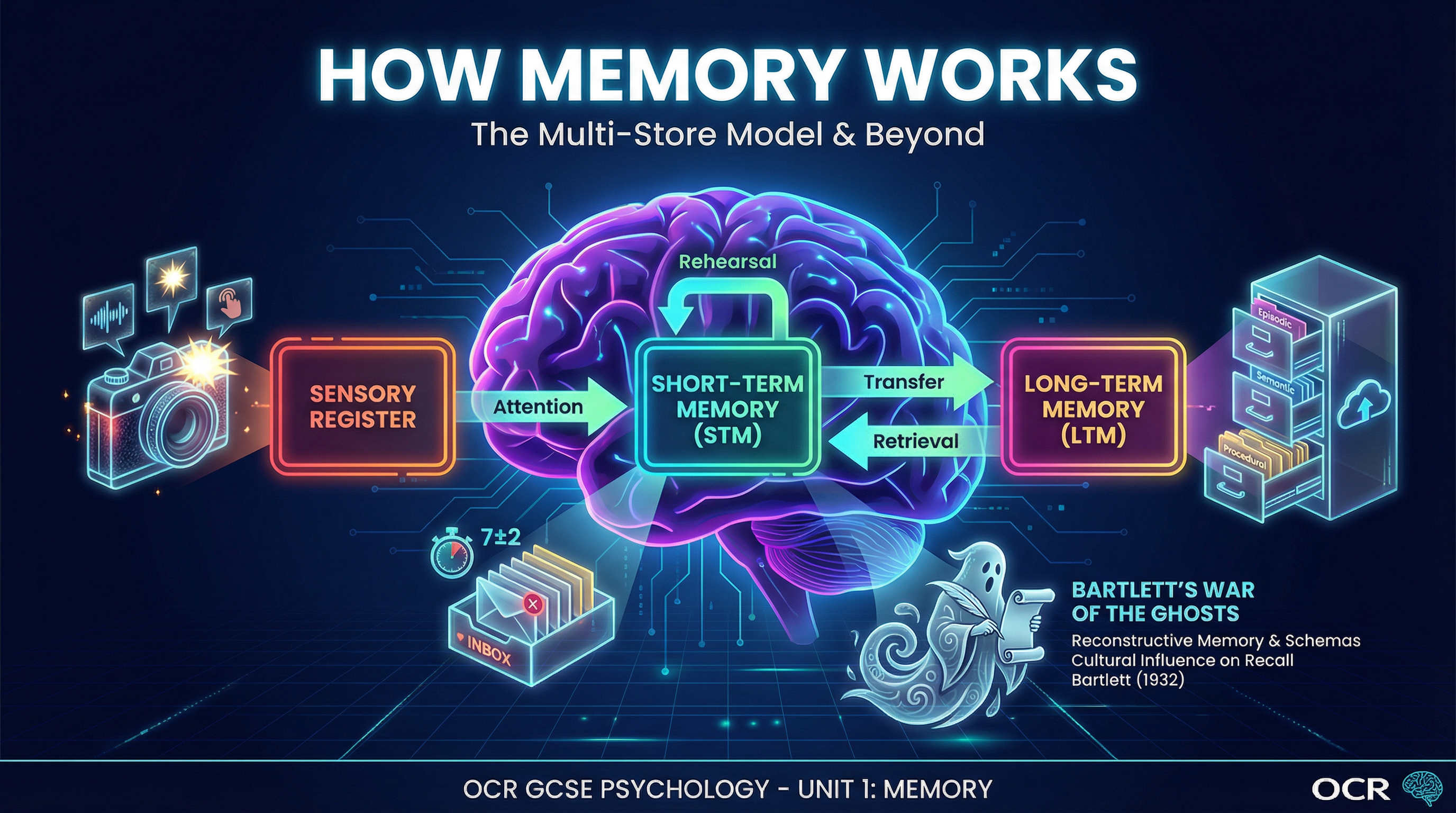
This topic explores the fundamental cognitive process of memory, a cornerstone of the OCR J203 Psychology specification. Examiners expect candidates to demonstrate a precise understanding of two contrasting theoretical frameworks: the structural Multi-Store Model (MSM) and the process-oriented Reconstructive Memory theory. Mastery involves not just describing these models (AO1), but critically applying them to novel scenarios (AO2) and evaluating their methodological and theoretical underpinnings (AO3). This guide will equip you with the specific terminology, study details, and analytical techniques required to explain how information is encoded, stored, and retrieved, and why our memories are not always a perfect record of the past. Credit is consistently awarded for moving beyond generic descriptions to a nuanced analysis of the core studies by Murdock (1962) and Bartlett (1932).
Key Theories & Studies
The Multi-Store Model (Atkinson & Shiffrin, 1968)
What it is: A structural model proposing that memory consists of three separate, unitary stores through which information passes in a linear sequence.
Why it matters: This is the foundational model for understanding memory as a system. It provides a clear framework for the processes of attention, rehearsal, and retrieval. Marks are awarded for accurately describing the characteristics of each store.
Specific Knowledge: Candidates must know the capacity, duration, and primary encoding format for each store.
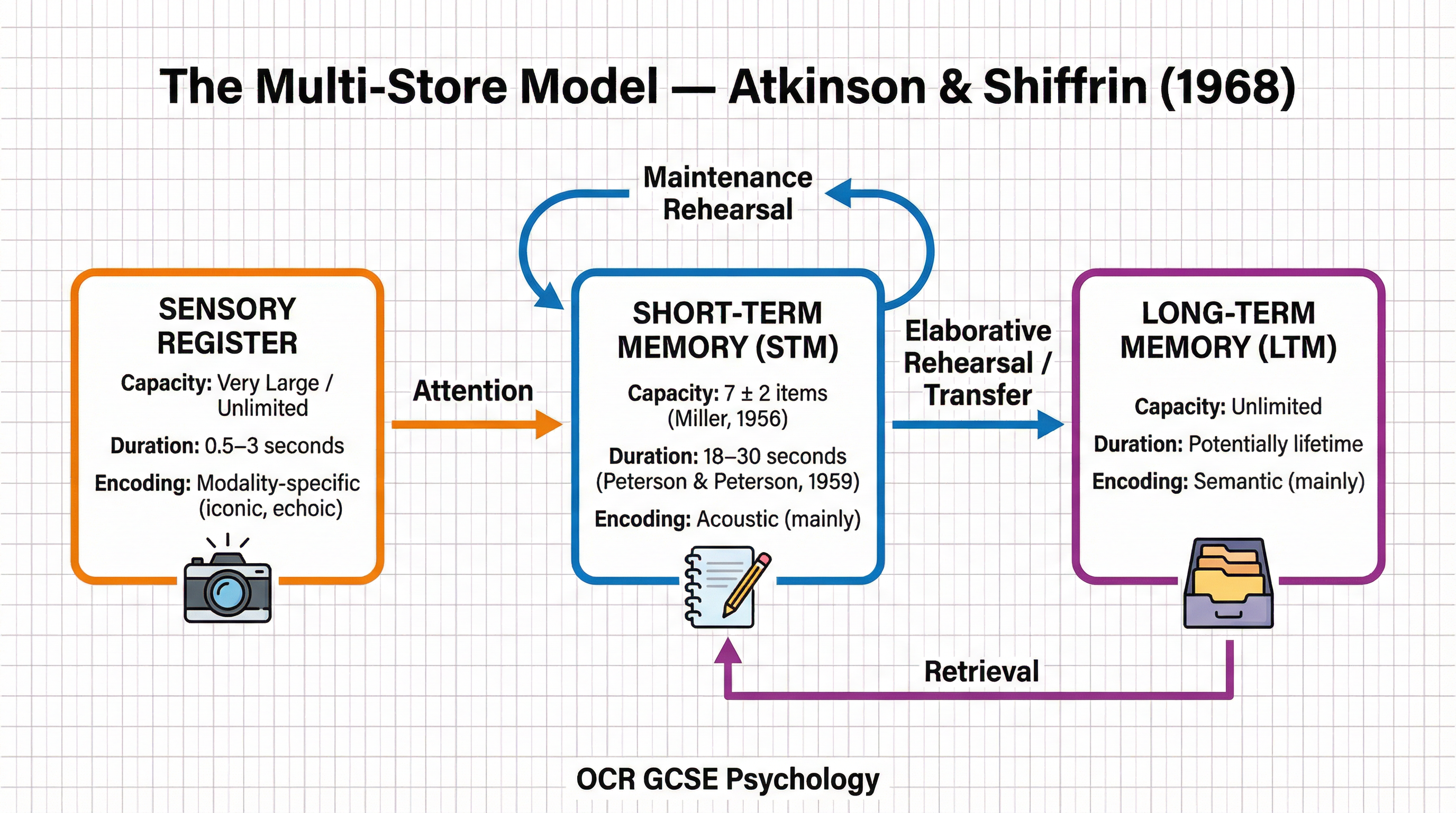
- Sensory Register: The initial store for incoming sensory information. Its capacity is very large, but its duration is extremely brief (approx. 0.5-3 seconds). Encoding is modality-specific (e.g., iconic for visual, echoic for auditory).
- Short-Term Memory (STM): Information from the Sensory Register that is attended to moves here. Capacity is limited to 7 +/- 2 items (Miller, 1956). Duration is 18-30 seconds without rehearsal (Peterson & Peterson, 1959). Encoding is mainly acoustic.
- Long-Term Memory (LTM): Information that is elaborately rehearsed is transferred here for permanent storage. Capacity and duration are considered potentially unlimited. Encoding is mainly semantic (based on meaning).
Reconstructive Memory (Bartlett, 1932)
What it is: A theory suggesting that memory is not a passive recording device, but an active process of reconstruction. When we recall a memory, we rebuild it based on our pre-existing mental frameworks, or schemas.
Why it matters: This theory challenges the MSM by highlighting the fallibility and subjectivity of memory. It explains why memories can be distorted and provides a more realistic model for everyday memory. Examiners credit explanations of how schemas influence recall.
Specific Knowledge: Candidates must understand the concept of 'effort after meaning' and be able to describe Bartlett's key findings from his 'War of the Ghosts' study.
- Schemas: Packets of knowledge about an event, person, or place that influence how we interpret and remember information.
- Effort After Meaning: The process of trying to make sense of new information by fitting it into our existing schemas.
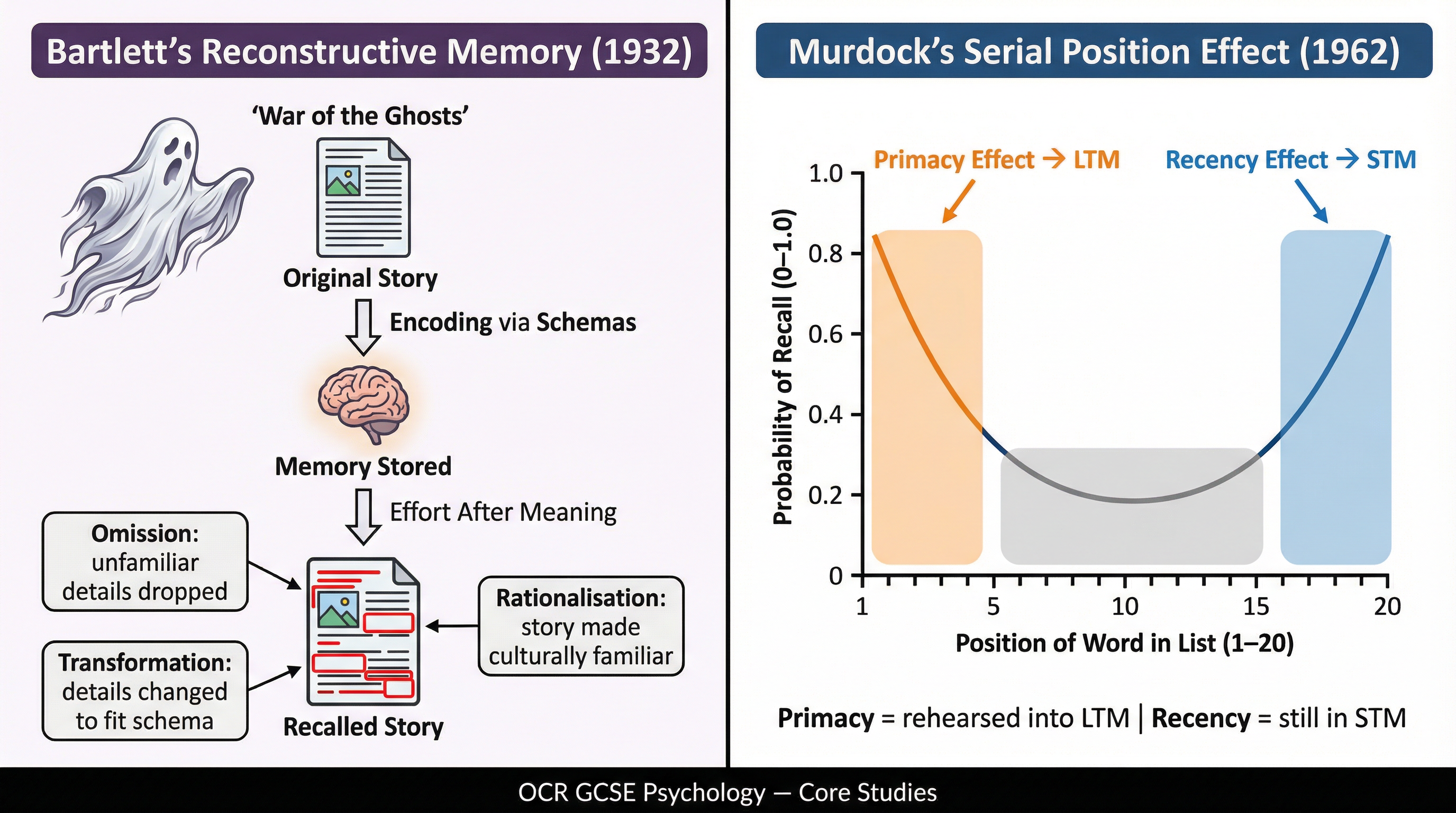
- Distortions: Bartlett identified three key ways schemas distort memory:
- Omission: Unfamiliar or irrelevant details are left out.
- Rationalisation: Details are altered to make them more logical and consistent with one's own cultural norms.
- Transformation: The order of events may be changed, or details transformed to be more familiar.
Core Studies
Murdock (1962) - The Serial Position Effect
Role: Provides key evidence for the existence of separate STM and LTM stores, supporting the MSM.
Key Actions: Presented participants with lists of 10-40 words, one at a time, and then asked for free recall. The position of each word in the list was the independent variable, and the probability of recall was the dependent variable.
Impact: The findings produced the now-famous Serial Position Curve. This U-shaped curve showed that words from the beginning of the list (primacy effect) and the end of the list (recency effect) were recalled best. This supports the MSM by suggesting the primacy effect occurs because words are rehearsed into LTM, while the recency effect occurs because words are still in the STM store.
Bartlett (1932) - War of the Ghosts
Role: Provides the foundational evidence for Reconstructive Memory theory.
Key Actions: Showed British participants a Native American ghost story, 'War of the Ghosts', which had unfamiliar concepts and a different narrative structure. He then used serial reproduction (one person reads and tells the story to another, and so on) and repeated reproduction (the same person recalls the story over time) to see how the story changed.
Impact: The recalled stories were not accurate reproductions. They showed clear evidence of omission, rationalisation, and transformation, as participants' schemas shaped their recall to be more conventional and culturally familiar. This demonstrated that memory is an active reconstruction, not a passive recording.