Study Notes
Overview
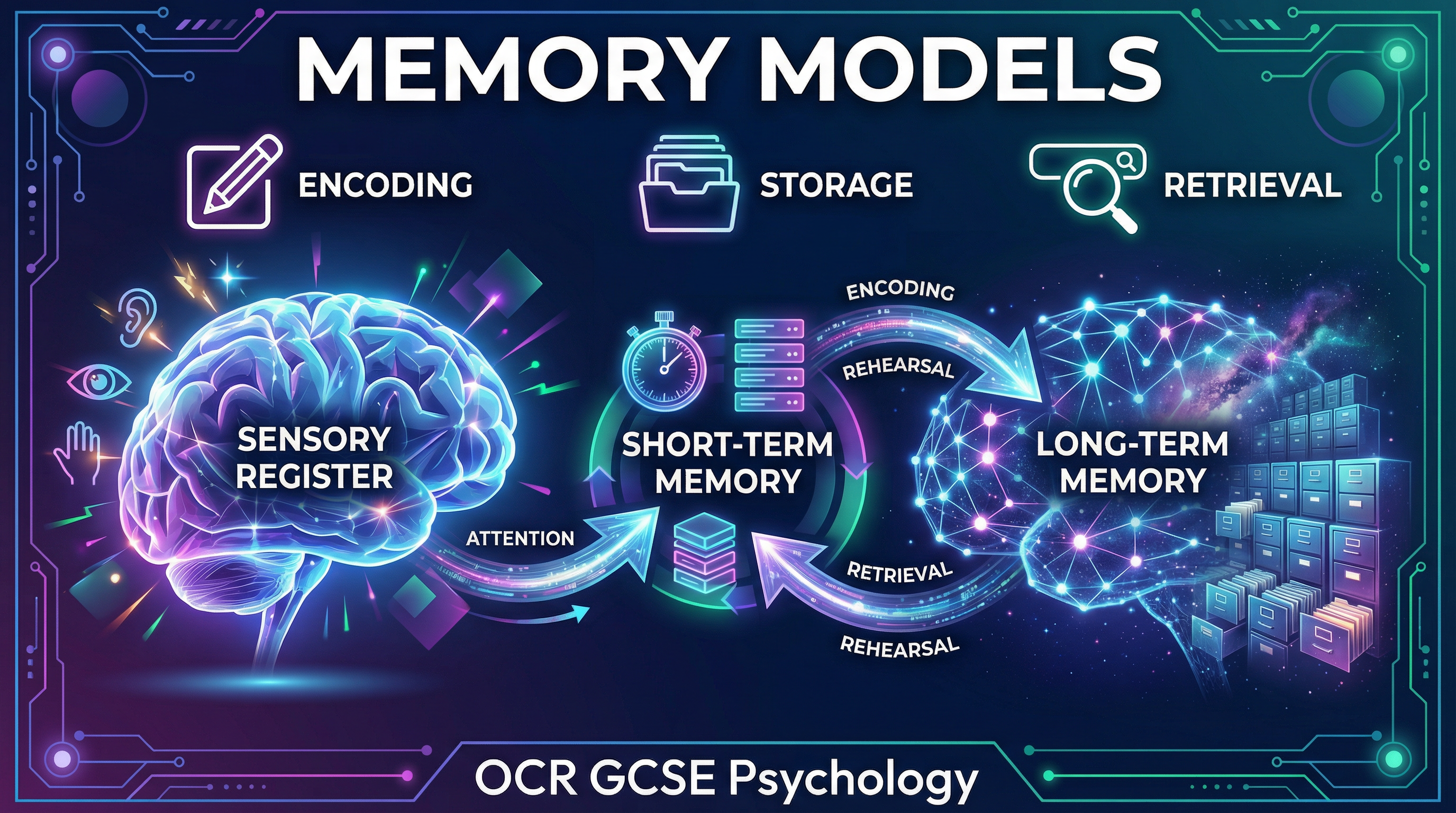
This guide explores two contrasting but equally important psychological models of memory: the Multi-Store Model (MSM) and the Theory of Reconstructive Memory. The MSM, proposed by Atkinson and Shiffrin, presents memory as a structured, linear process involving three distinct stores. In contrast, Bartlett's theory views memory as an active, reconstructive process heavily influenced by our personal experiences and cultural background. For the OCR GCSE Psychology exam, candidates must not only describe these models accurately but also apply them to novel scenarios (AO2) and critically evaluate their strengths and weaknesses using evidence from core studies (AO3). A strong understanding of the specific features of each memory store (encoding, capacity, duration) and the concept of schemas is essential for earning high marks.
Key Individuals
Richard Atkinson & Richard Shiffrin
Role: American cognitive psychologists who developed the Multi-Store Model of memory.
Key Actions: In 1968, they proposed a structural model that conceptualised memory as a system of three separate, sequential stores: the Sensory Register, Short-Term Memory (STM), and Long-Term Memory (LTM).
Impact: Their model was highly influential, stimulating a vast amount of research into the characteristics of each memory store. It provides a simple, clear framework for understanding memory processes, which remains a cornerstone of introductory psychology, although it is now considered overly simplistic.
Sir Frederic Bartlett
Role: British psychologist and a pioneer of cognitive psychology.
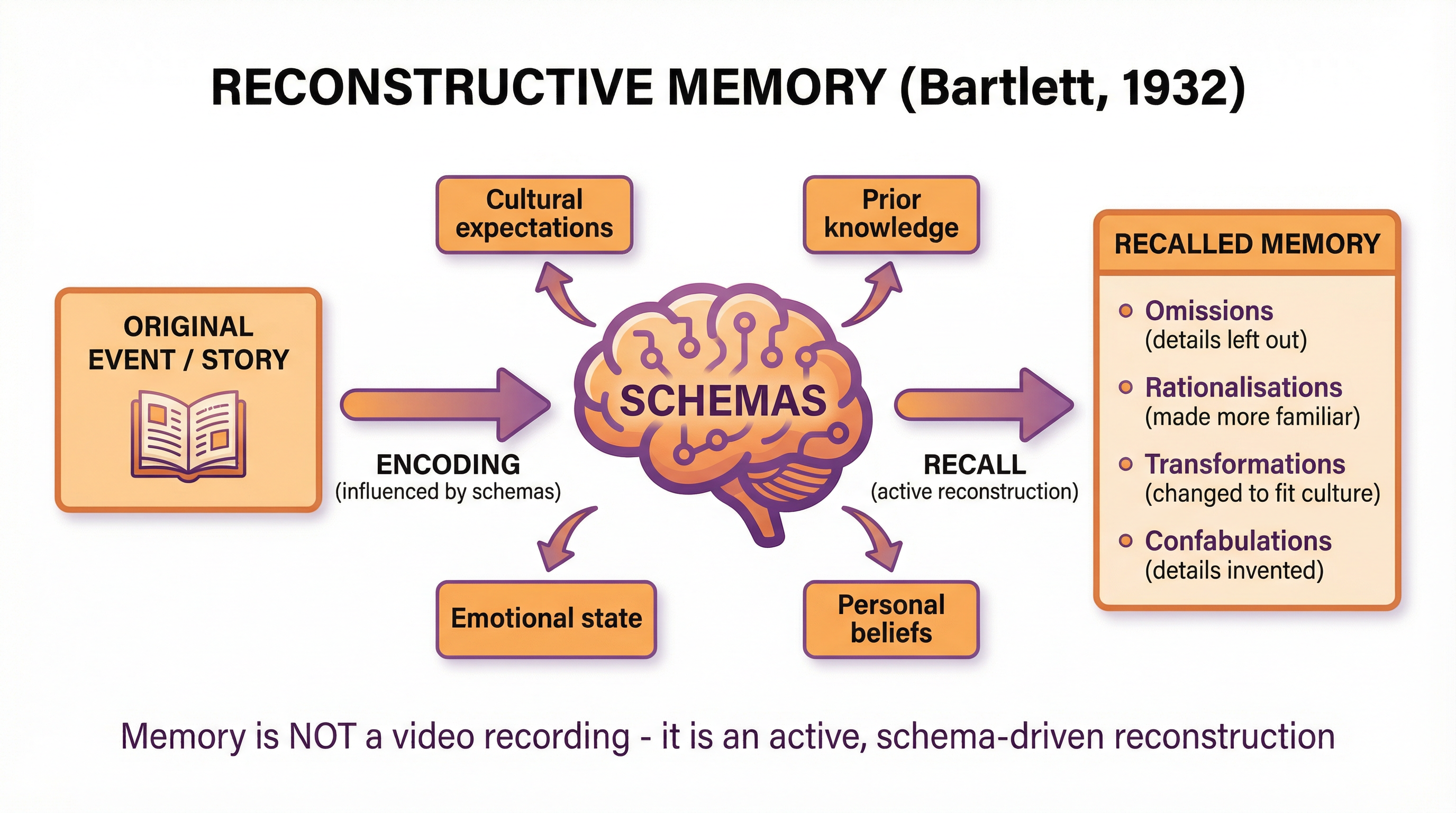
Key Actions: In his 1932 book "Remembering", Bartlett introduced the Theory of Reconstructive Memory. Through his famous "War of the Ghosts" study, he demonstrated that memory is not a passive recording but an active reconstruction influenced by an individual's pre-existing mental frameworks, which he termed 'schemas'.
Impact: Bartlett's work was groundbreaking because it shifted the focus from memory structure to memory process. His theory highlights the fallibility of memory and has had a profound impact on our understanding of eyewitness testimony and the nature of personal recollection.
Bennet Murdock
Role: American psychologist known for his research on human memory.
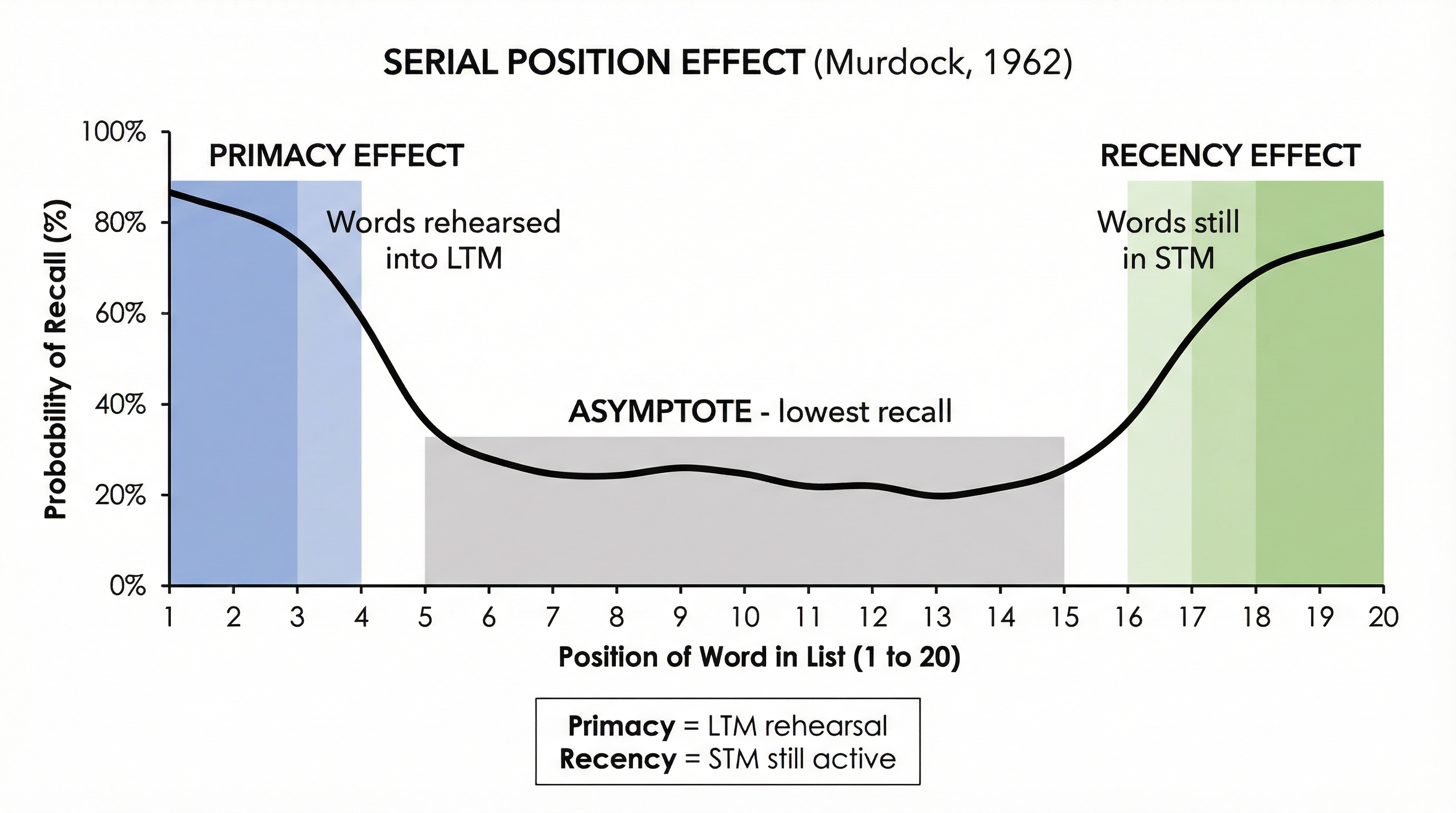
Key Actions: Conducted a key study in 1962 that provided strong evidence for the Multi-Store Model. He presented participants with lists of words and found that recall was best for words at the beginning (primacy effect) and end (recency effect) of the list.
Impact: The Serial Position Effect, as demonstrated by Murdock, supports the distinction between STM and LTM. The primacy effect is attributed to rehearsal into LTM, while the recency effect is attributed to words remaining in STM. This study is a critical piece of evidence for AO3 evaluation marks.
Key Developments & Concepts
The Multi-Store Model (MSM)
Date(s): 1968
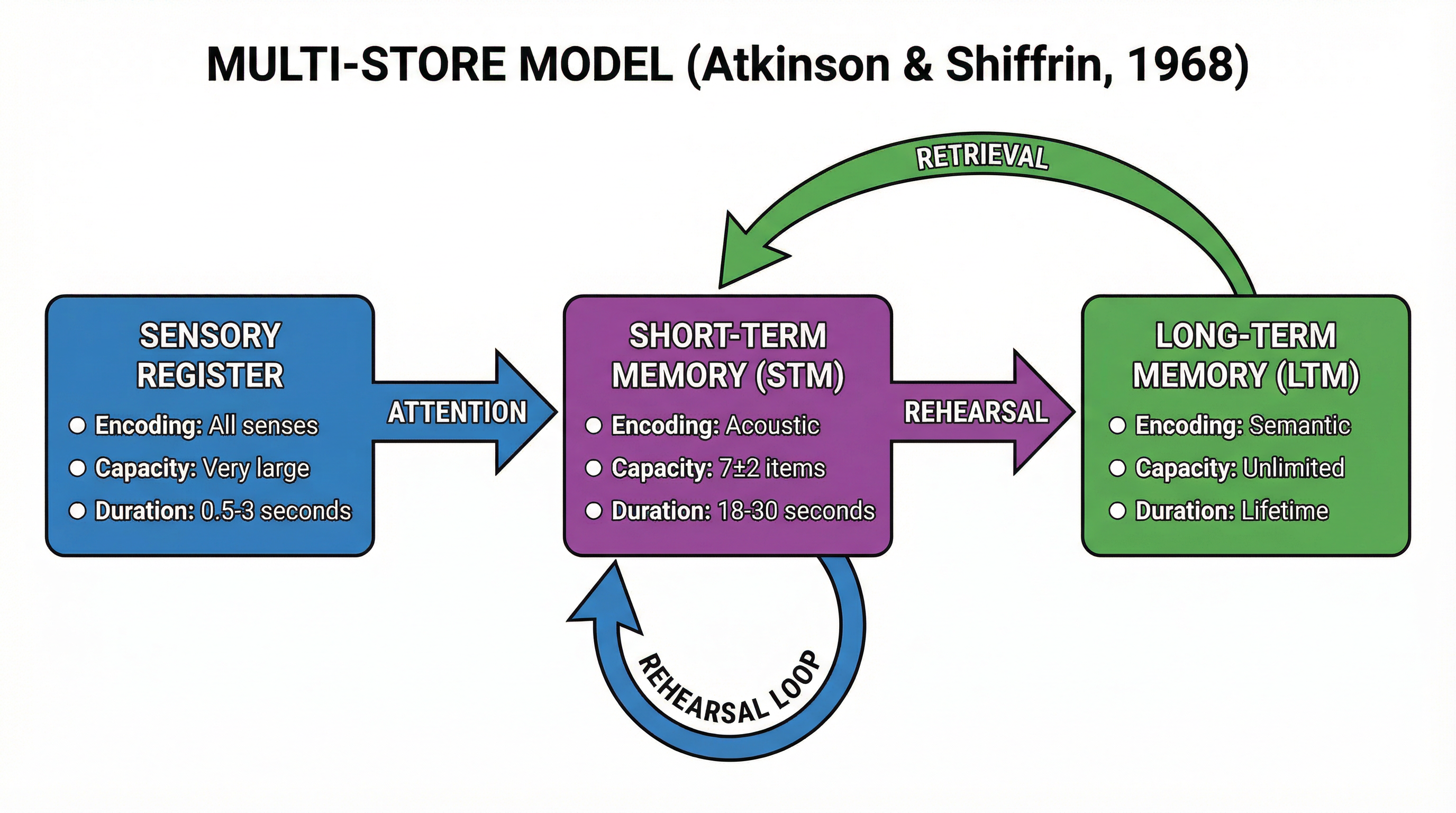
What happened: Atkinson and Shiffrin proposed that information flows from the environment, through the Sensory Register, into STM, and then into LTM. Transfer between stores is controlled by processes like attention and rehearsal.
Why it matters: This model provides a clear, testable framework for memory. For the exam, you must know the specific features of each store.
Specific Knowledge:
- Sensory Register: Encoding (all senses), Capacity (very large), Duration (0.5-3s). Attention is required to pass info to STM.
- Short-Term Memory (STM): Encoding (acoustic), Capacity (7+/-2 items), Duration (18-30s). Maintenance rehearsal keeps info in STM.
- Long-Term Memory (LTM): Encoding (semantic), Capacity (unlimited), Duration (lifetime, but retrieval can fail).
The Serial Position Effect
Date(s): Murdock (1962)
What happened: A U-shaped curve is observed when participants recall a list of words. Recall is high for the first few words (primacy) and the last few words (recency), but low for the middle words.
Why it matters: This provides strong evidence for separate STM and LTM stores. The primacy effect occurs because the first words are rehearsed into LTM. The recency effect occurs because the last words are still in STM.
Specific Knowledge: Candidates must be able to explain why the effects occur, not just describe the graph. Primacy = LTM; Recency = STM.
The Theory of Reconstructive Memory
Date(s): Bartlett (1932)
What happened: Bartlett argued that memory is an active reconstruction, not a passive recording. When we recall an event, we use our schemas (mental frameworks of belief and expectation) to fill in gaps and make sense of the information.
Why it matters: This theory explains why memories are often distorted and inaccurate. It is crucial for understanding the limitations of eyewitness testimony.
Specific Knowledge:
- Schemas: Packages of knowledge and expectation built from experience.
- Distortions: Recall is affected by:
- Omissions: Leaving out unfamiliar or irrelevant details.
- Rationalisations: Making the memory more logical and consistent with our own culture.
- Transformations: Changing details to make them more familiar.
- Confabulation: Inventing details to fill in gaps.