Study Notes
Overview
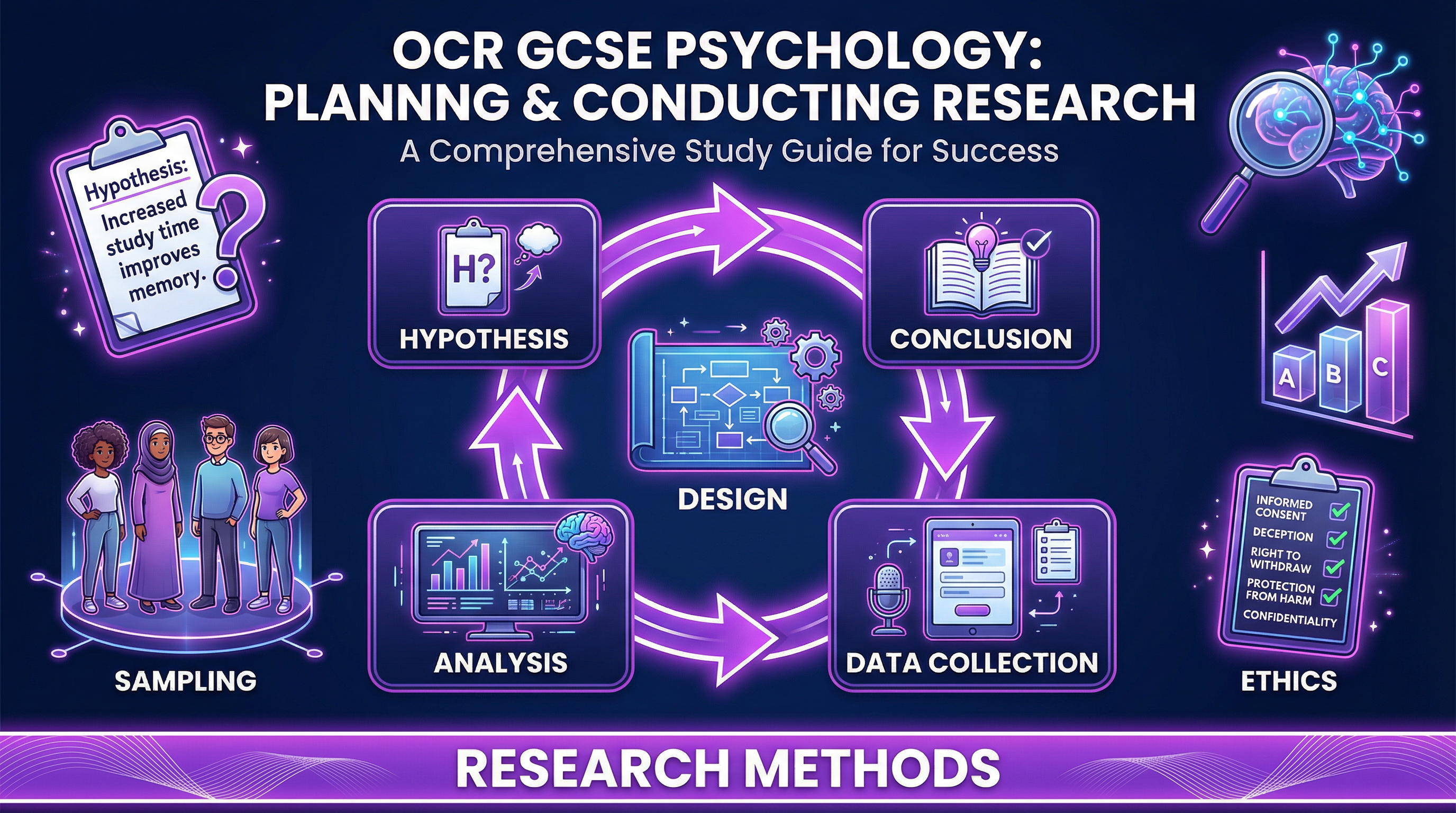
Planning and conducting research is the backbone of psychology as a scientific discipline. For the OCR J203 specification, this isn't just about memorising definitions; it's about application. Examiners want to see that you can act like a real psychologist, taking a novel scenario and applying the principles of scientific methodology with precision. This involves formulating a clear, testable hypothesis, selecting and justifying an appropriate experimental design, choosing a suitable sampling technique, and, crucially, navigating the complex ethical landscape of psychological research. This guide will equip you with the language, structure, and specific knowledge required to demonstrate competence and confidence, moving you beyond simple descriptions to the high-level evaluation that is credited with the most marks.
Key Concepts in Research
Aims and Hypotheses
What it is: An aim is a general statement about what the researcher intends to investigate. A hypothesis is a specific, testable prediction about the outcome of the study. It must be operationalised.
Why it matters: Marks are awarded for writing clear, falsifiable hypotheses. You must distinguish between a directional (one-tailed) hypothesis, which predicts the direction of the results (e.g., 'Group A will be faster than Group B'), and a non-directional (two-tailed) hypothesis, which simply predicts a difference (e.g., 'There will be a difference in speed between Group A and Group B').
Specific Knowledge: Always operationalise your Independent Variable (IV) and Dependent Variable (DV). For example, instead of saying 'revising improves memory', you must say 'participants who create a mind-map for 1 hour will recall significantly more words from a list of 20 than participants who read a chapter for 1 hour'.
Research Methods & Designs
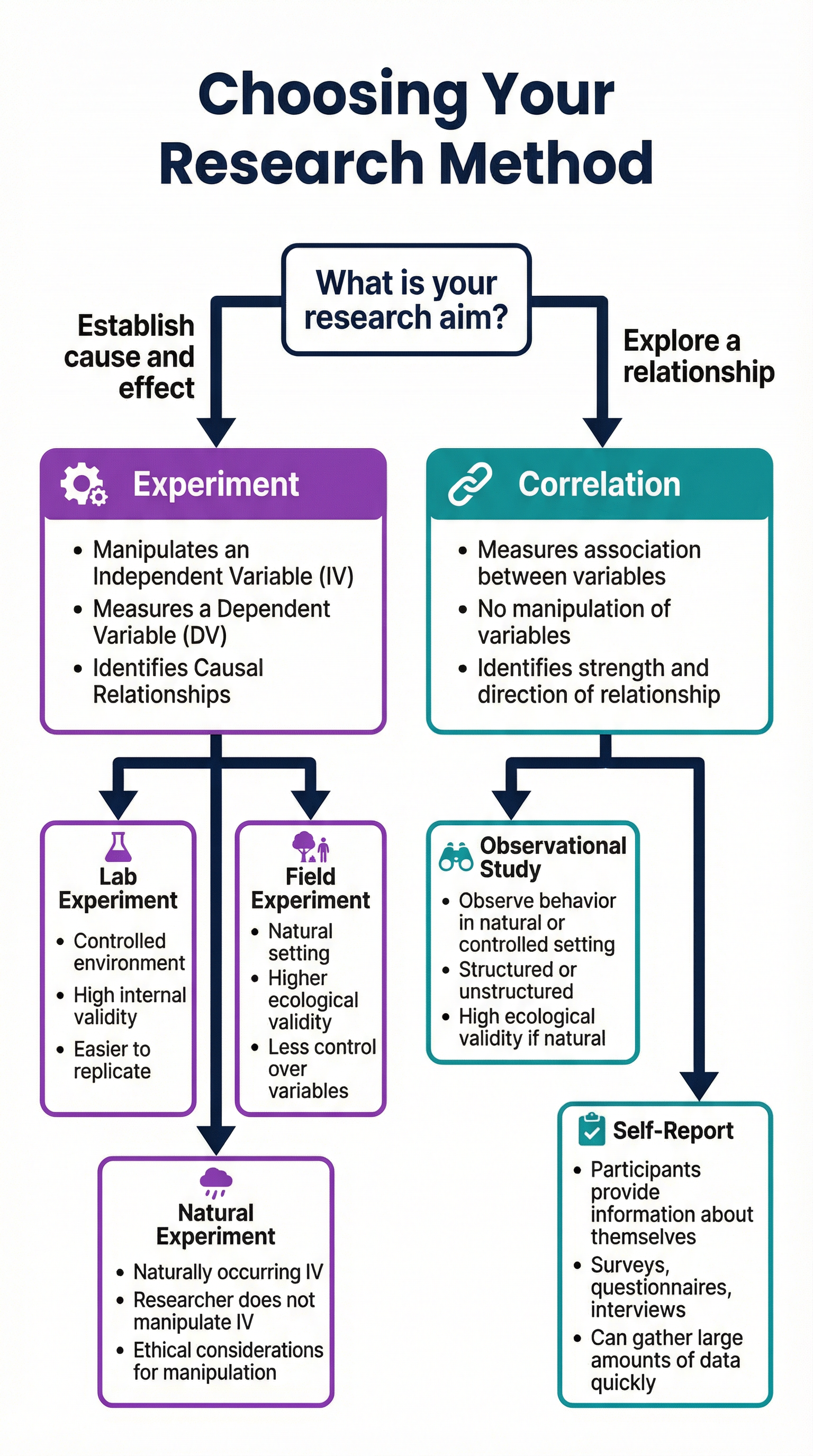
What it is: The overall method (e.g., Experiment, Correlation) and the specific design used to structure the investigation (e.g., Independent Groups, Repeated Measures, Matched Pairs).
Why it matters: Your choice of method and design has direct implications for the validity and reliability of your findings. You must be able to justify your choices. For example, a lab experiment offers high control over extraneous variables (high internal validity) but may lack real-world applicability (low ecological validity). A field experiment has the opposite profile.
Specific Knowledge: Be prepared to justify your choice of experimental design. For instance, state that you would use a Repeated Measures design to control for the effect of participant variables, but acknowledge you would need to use counterbalancing to mitigate order effects.
Sampling
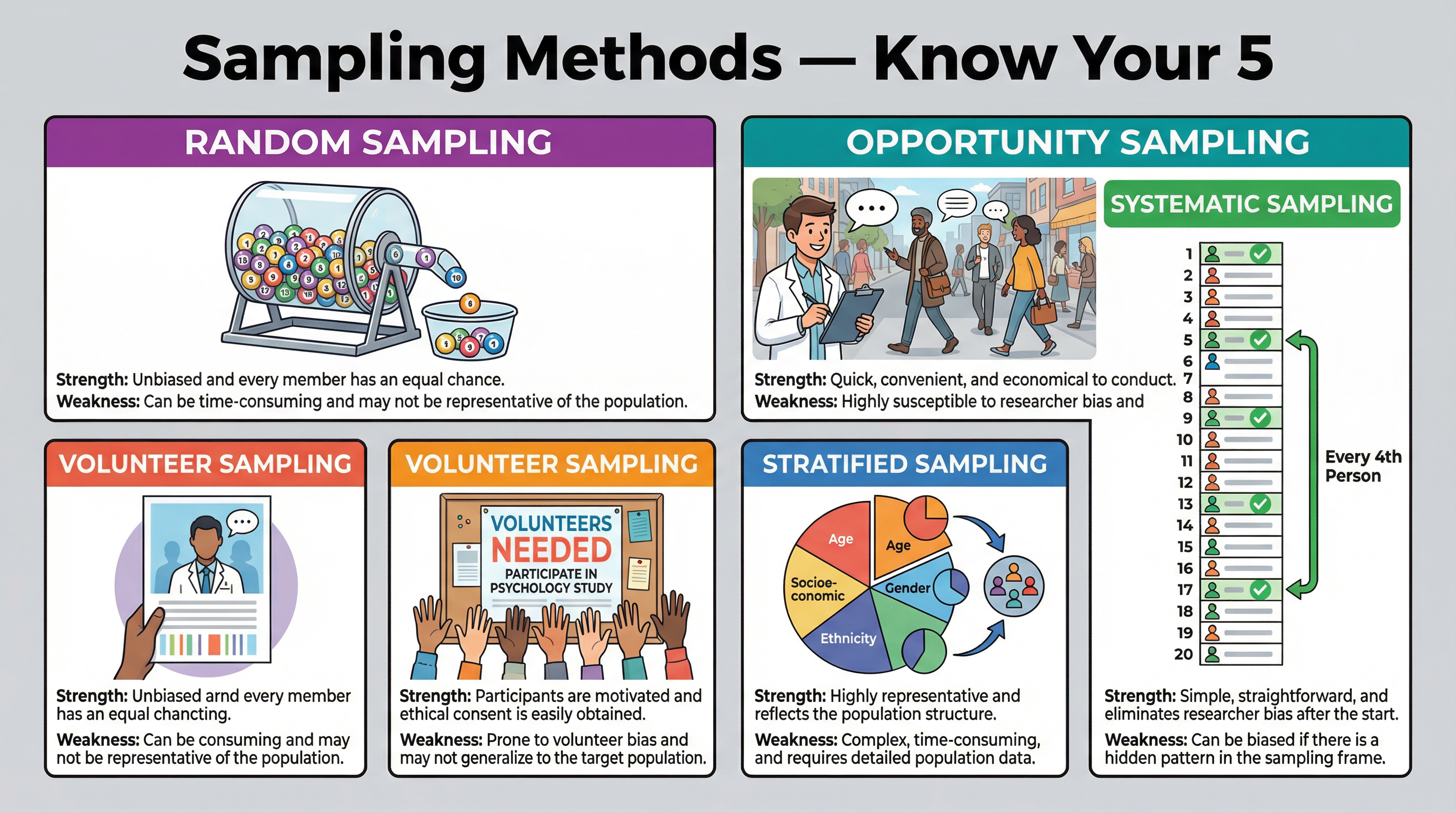
What it is: The process of selecting participants to represent a wider target population. Key methods include Random, Opportunity, Volunteer, Stratified, and Systematic sampling.
Why it matters: The sampling method determines how generalisable the results are. A small, biased sample (e.g., from an opportunity sample of only your friends) cannot be generalised to the whole population. Examiners look for a clear link between the chosen method and the specific target population in the question.
Specific Knowledge: Do not confuse random sampling (how you get your participants) with random allocation (how you assign your participants to conditions in an experiment). This is a very common mistake that costs candidates marks.
Ethics
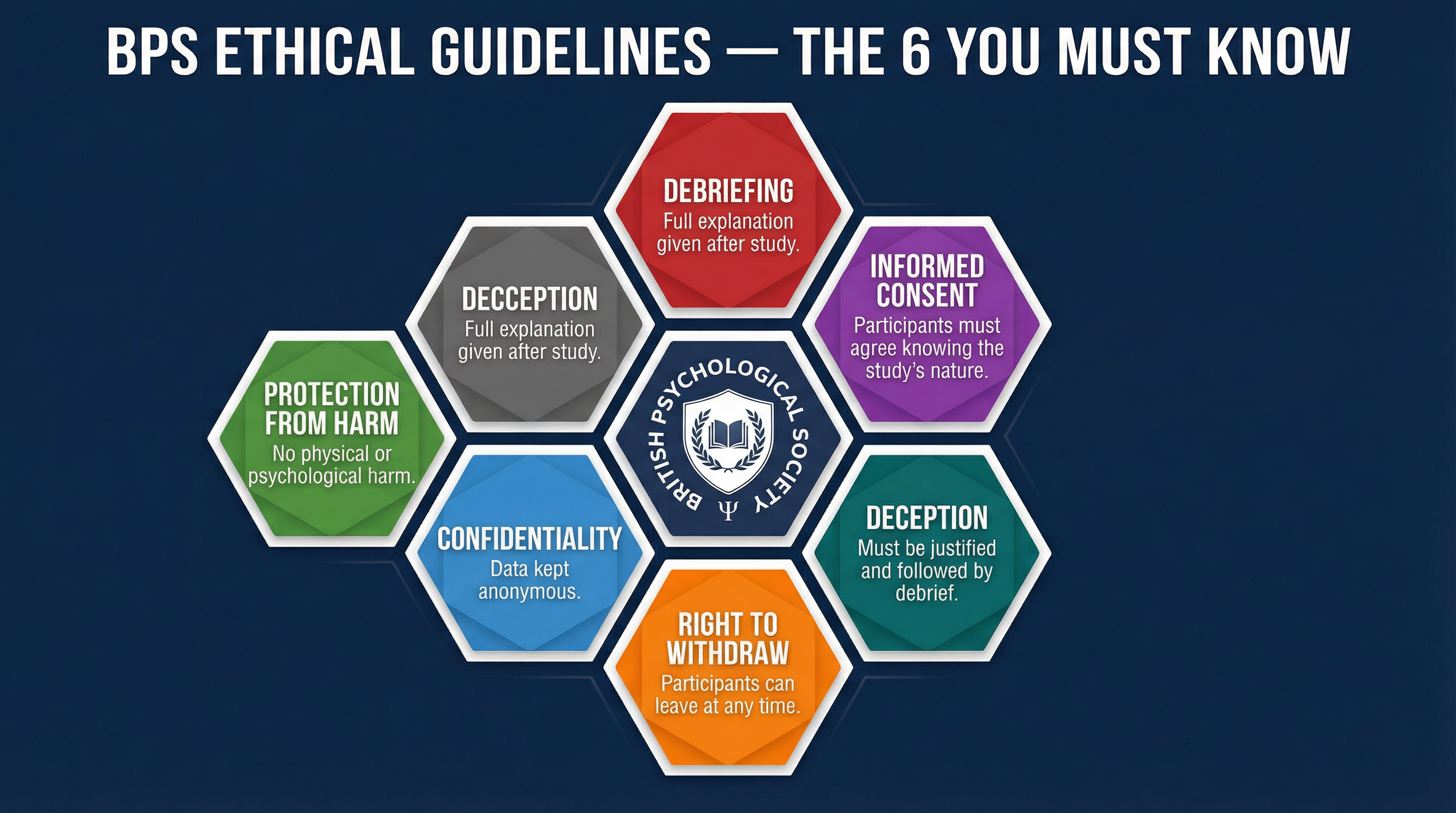
What it is: The moral principles and rules of conduct that guide psychological research, set out by the British Psychological Society (BPS).
Why it matters: This is a core component of any 'Design a study' question. You must go beyond listing the guidelines and explain how you would implement them in the context of the scenario provided.
Specific Knowledge: The six key guidelines are: Informed Consent, Deception, Right to Withdraw, Confidentiality, Protection from Harm, and Debriefing. For a study on phobias, you might ensure 'protection from harm' by stopping the procedure if a participant shows excessive anxiety and having a trained therapist on hand.