Study Notes
Overview
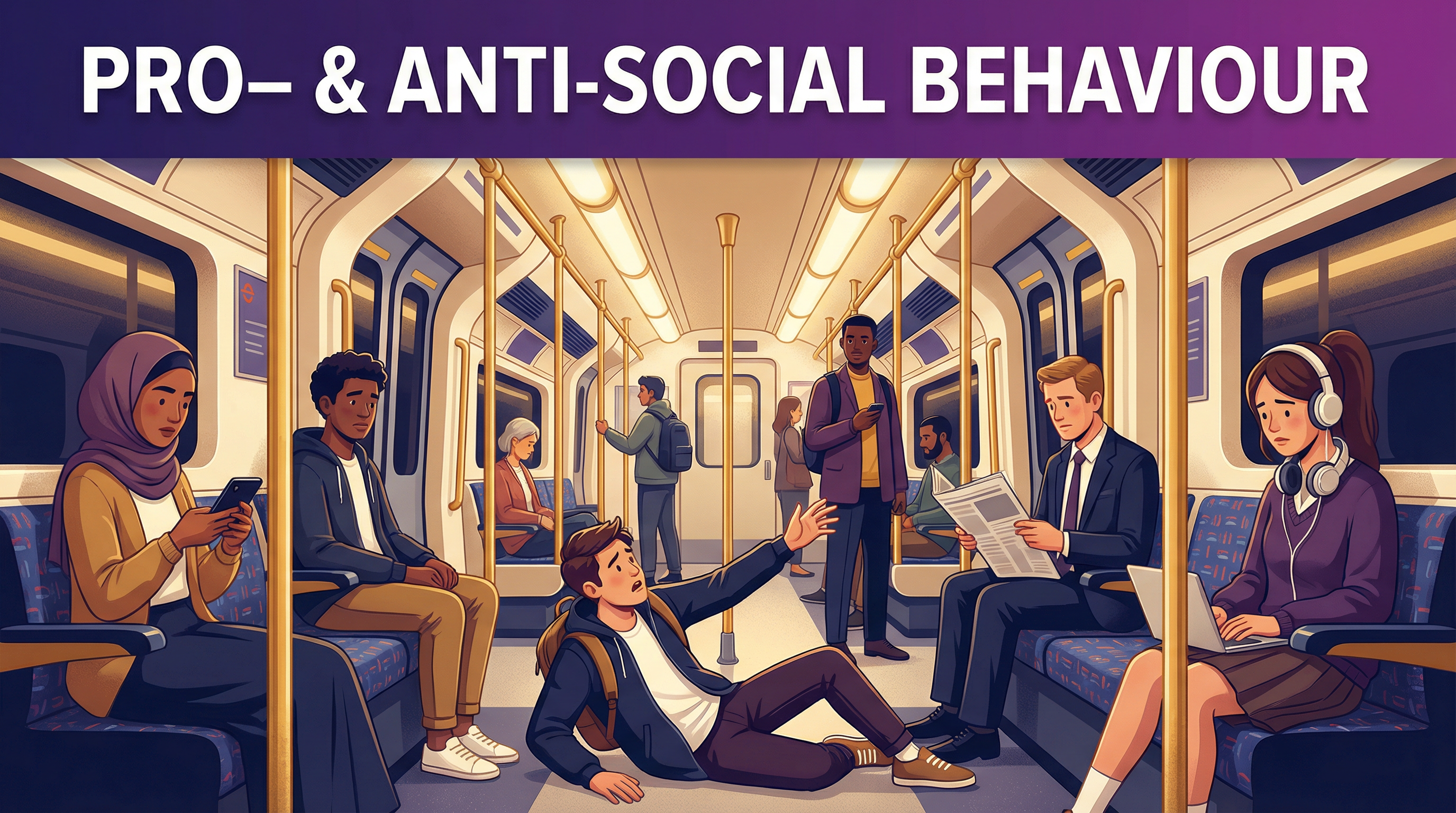
This guide covers the OCR GCSE Psychology topic of Pro- and Anti-Social Behaviour, a key part of the Social Influence component. Examiners expect candidates to move beyond simple descriptions and analyse why people help or fail to help in social situations. The focus is firmly on situational factors over dispositional traits. Mastery of this topic requires a detailed understanding of concepts like the Bystander Effect, Diffusion of Responsibility, and Pluralistic Ignorance, all grounded in the pivotal field experiment by Piliavin et al. (1969). This study is not just a historical curiosity; it represents a crucial shift in psychology towards understanding behaviour in realistic settings. Credit is awarded for precise definitions, accurate application of theory to novel scenarios, and a nuanced evaluation of the key study's strengths and weaknesses. This guide will equip you with the specific knowledge and exam techniques needed to secure top marks.
Key Concepts & Theories
The Bystander Effect
What it is: The Bystander Effect, or bystander apathy, is a social psychological phenomenon where individuals are less likely to offer help to a victim when other people are present. The greater the number of bystanders, the less likely it is that any one of them will help. This counter-intuitive finding was famously investigated by Bibb Latané and John Darley.
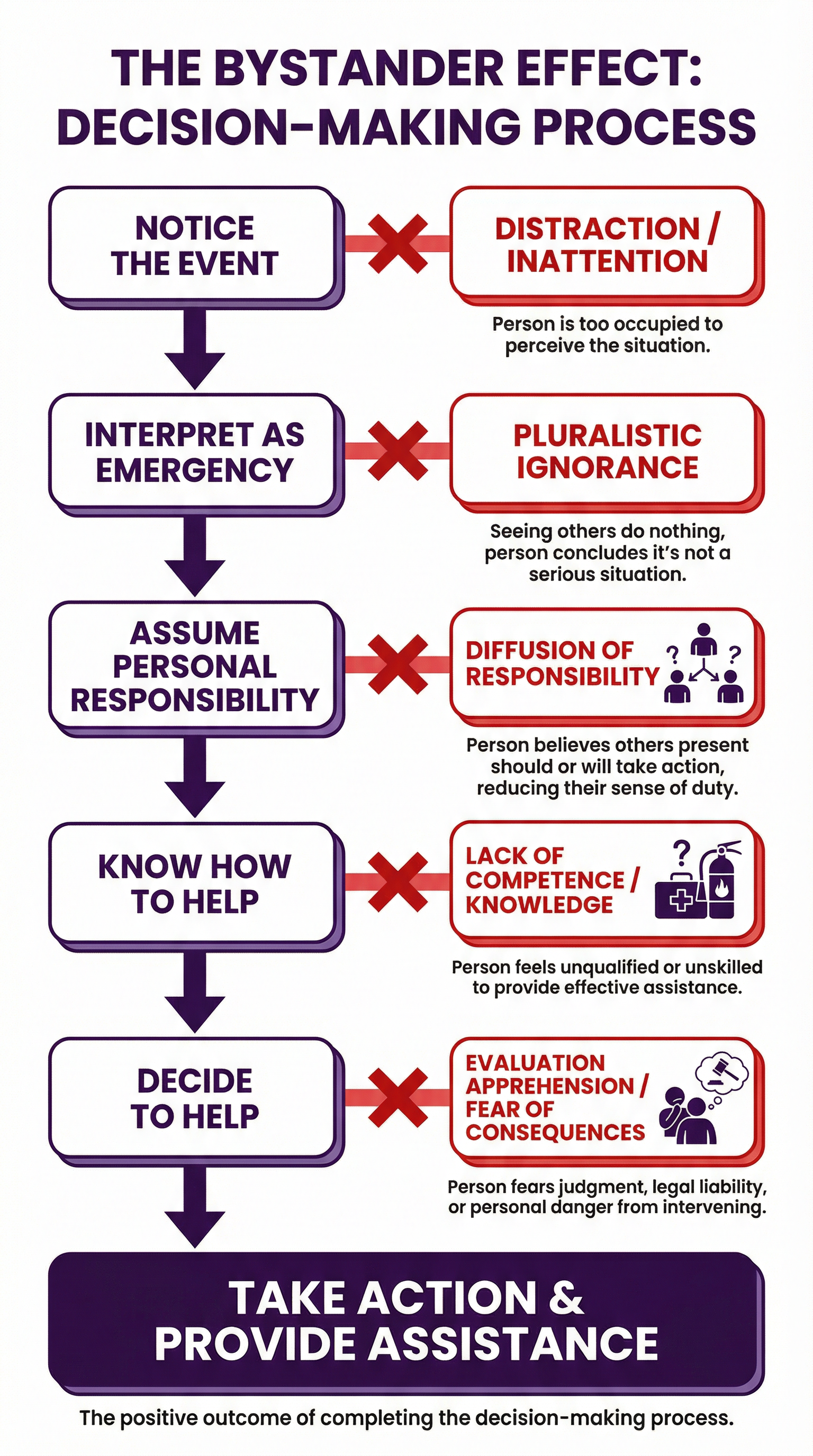
Why it matters: This is a cornerstone concept for explaining inaction. Examiners will expect you to explain the psychological mechanisms behind it, not just define the term. Two key processes are at play:
- Diffusion of Responsibility: When multiple people are present, the personal responsibility to intervene is divided among them. Each individual feels less accountable, assuming someone else will take action. For full marks, you must state that this is a reduction in personal obligation due to the presence of others.
- Pluralistic Ignorance: This is a more subtle process of social comparison. In an ambiguous situation, individuals look to others for cues on how to react. If no one else is acting concerned, each person concludes that the situation must not be an emergency. This leads to collective inaction, even if individuals privately feel worried.
Specific Knowledge: You must be able to distinguish these two concepts clearly. Diffusion of Responsibility = 'It's not my job to help'. Pluralistic Ignorance = 'It must not be an emergency because no one else is reacting'.
Deindividuation
What it is: Deindividuation is a state of reduced self-awareness and personal identity that can occur when a person is part of a large group or is anonymous (e.g., wearing a uniform or mask). This loss of individuality can weaken normal inhibitions and lead to behaviour that is inconsistent with personal values, including anti-social acts.
Why it matters: It provides a situational explanation for mob behaviour and aggression. Key factors that promote deindividuation are anonymity, group size, and arousal. Philip Zimbardo's (1969) study is a classic example, where anonymous participants delivered longer electric shocks.
Specific Knowledge: Know that deindividuation doesn't automatically lead to negative behaviour. It can also enhance pro-social behaviour if the group's norms are positive (e.g., a crowd at a charity event). The key is that it amplifies the prevailing social norms.
Social Loafing
What it is: Social Loafing is the tendency for individuals to exert less effort on a task when they are working in a group compared to when they are working alone. It is a form of anti-social behaviour as it involves a reduction in contribution to a collective goal.
Why it matters: It explains why group productivity is sometimes less than the sum of individual efforts. It is often seen in tasks where individual contributions are not easily identifiable.
Specific Knowledge: Do NOT confuse this with Social Facilitation (improved performance on simple tasks in the presence of others). This is a common mistake that costs candidates marks. Ringelmann's (1913) rope-pulling study is the classic example.
Key Study: Piliavin et al. (1969) Subway Samaritan
Aim
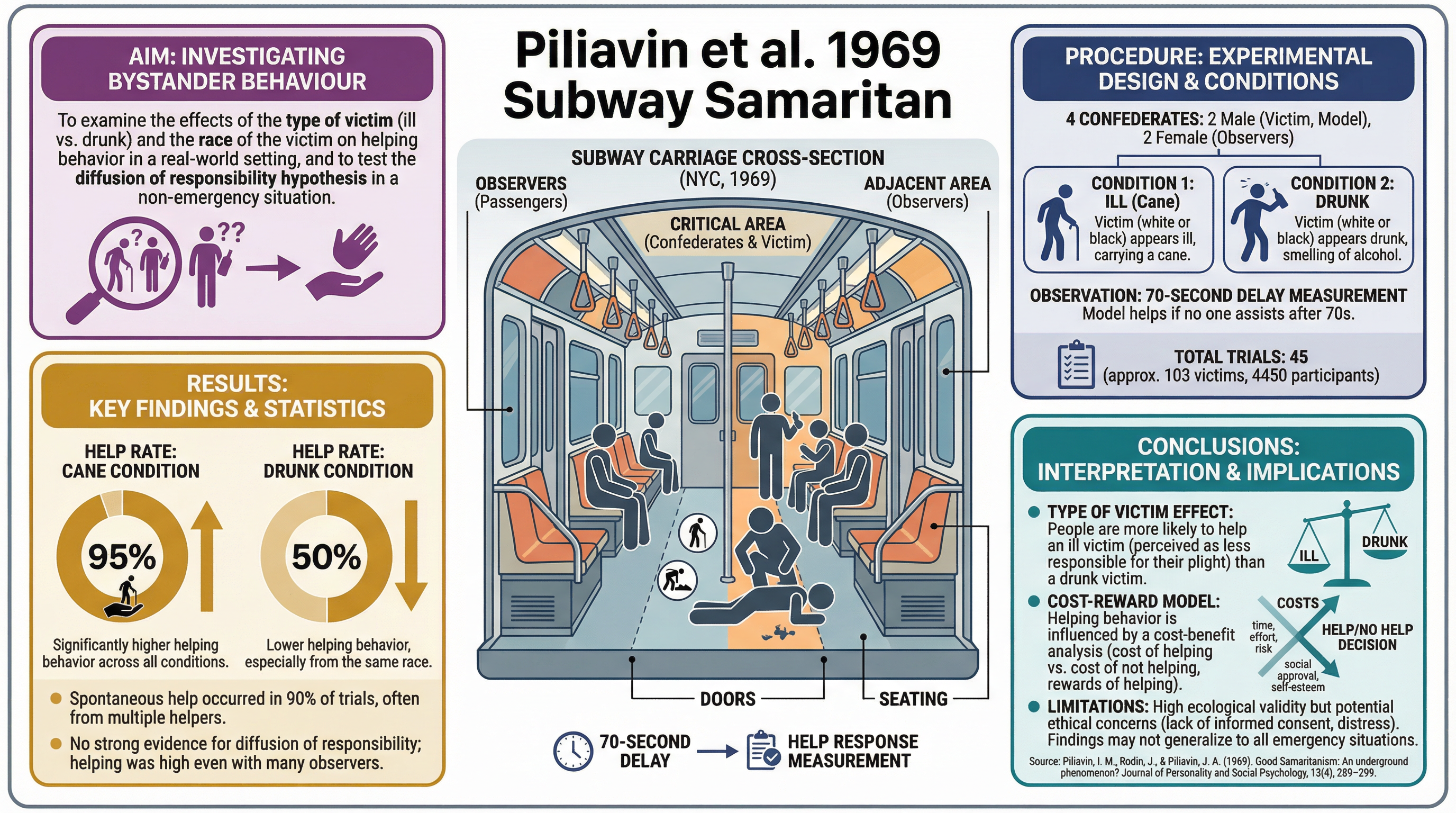
To investigate bystander behaviour in a naturalistic setting and to examine the effect of the type of victim (ill vs. drunk) and the race of the victim on the speed and frequency of helping behaviour. They also aimed to test the diffusion of responsibility hypothesis in a real-world context.
Procedure
- Design: A field experiment on the New York City subway. It had an independent groups design.
- Participants: An estimated 4,450 men and women who were passengers on the subway trains. They were 'unsolicited participants'.
- Confederates: A team of four confederates (two male, two female) boarded the train for each trial. The male victim (either white or black) would collapse after about 70 seconds. The female confederates acted as observers.
- Independent Variables (IVs):
- Victim's condition: Ill (carrying a cane) or Drunk (smelling of alcohol).
- Victim's race: White or Black.
- Model's behaviour: A 'model' confederate would step in to help after 70 or 150 seconds if no one else had.
- Dependent Variables (DVs): The frequency of help, the speed of help, the race of the helper, and the sex of the helper.
Results
- Cane vs. Drunk: The 'cane' victim received spontaneous help in 95% of trials, compared to only 50% for the 'drunk' victim.
- Speed of Help: Help was significantly faster for the cane victim. The median delay was 5 seconds for the cane victim and 109 seconds for the drunk victim.
- Diffusion of Responsibility: There was little evidence for diffusion of responsibility. The speed of helping was not significantly affected by the number of bystanders present. In fact, in 21 of the 103 trials, two or more helpers came forward.
- Race: There was some evidence of same-race helping, particularly when the victim was drunk.
Conclusions
Piliavin et al. proposed a Cost-Reward Model to explain their findings. Bystanders weigh the potential costs and rewards of helping versus not helping.
- Costs of helping: Effort, potential harm, embarrassment.
- Rewards of helping: Social approval, feeling good about oneself.
- Costs of not helping: Guilt, social disapproval, anxiety.
- Rewards of not helping: Continuing with one's own business.
In the cane condition, the costs of helping were low and the costs of not helping were high (e.g., guilt), leading to high rates of helping. In the drunk condition, the costs of helping were higher (e.g., potential disgust or danger), leading to less helping.
Second-Order Concepts
Causation
The primary cause of bystander inaction, as explored in this topic, is the situation itself, rather than the personality of the individuals. Factors like the number of other people present (diffusion of responsibility), the ambiguity of the situation (pluralistic ignorance), and the perceived costs of helping (cost-reward model) are the key causal factors.
Consequence
The consequence of these social processes is often a failure to provide help to someone in need, which can have tragic outcomes. However, understanding these factors also has positive consequences, as it allows us to develop strategies to increase pro-social behaviour (e.g., by making individuals feel personally responsible or by reducing the ambiguity of a situation).
Change & Continuity
Early theories focused on dispositional explanations for behaviour (i.e., people are either helpful or they are not). The research in this topic represents a significant change, shifting the focus to situational factors. However, there is a continuity in the debate, as modern psychology still acknowledges that both dispositional and situational factors interact to influence behaviour.
Significance
The research by Latané, Darley, and Piliavin was highly significant because it challenged common-sense assumptions about helping behaviour and demonstrated the power of the situation in a scientifically rigorous way. Piliavin's study, in particular, was significant for its high ecological validity, taking psychology out of the lab and into the real world.
Source Skills
In psychology, 'sources' are often data tables or summaries of results. When presented with a table from a study like Piliavin et al.:
- Read the Title and Labels: Understand exactly what the table is showing. What were the conditions? What was measured?
- Look for the Main Pattern: Identify the biggest differences. For example, the 95% vs. 50% help rate in Piliavin is the most striking result.
- Use the Data: When asked to 'Calculate', show your working. For example, calculating a percentage difference. Quote specific figures in your answer to support your points.
- Draw Conclusions: Explain what the data means in the context of the psychological theory being tested. A good answer links the numbers back to the concept (e.g., 'The lower level of helping in the drunk condition (50%) supports the Cost-Reward model, as the perceived costs of helping were higher.')."