Study Notes
Overview
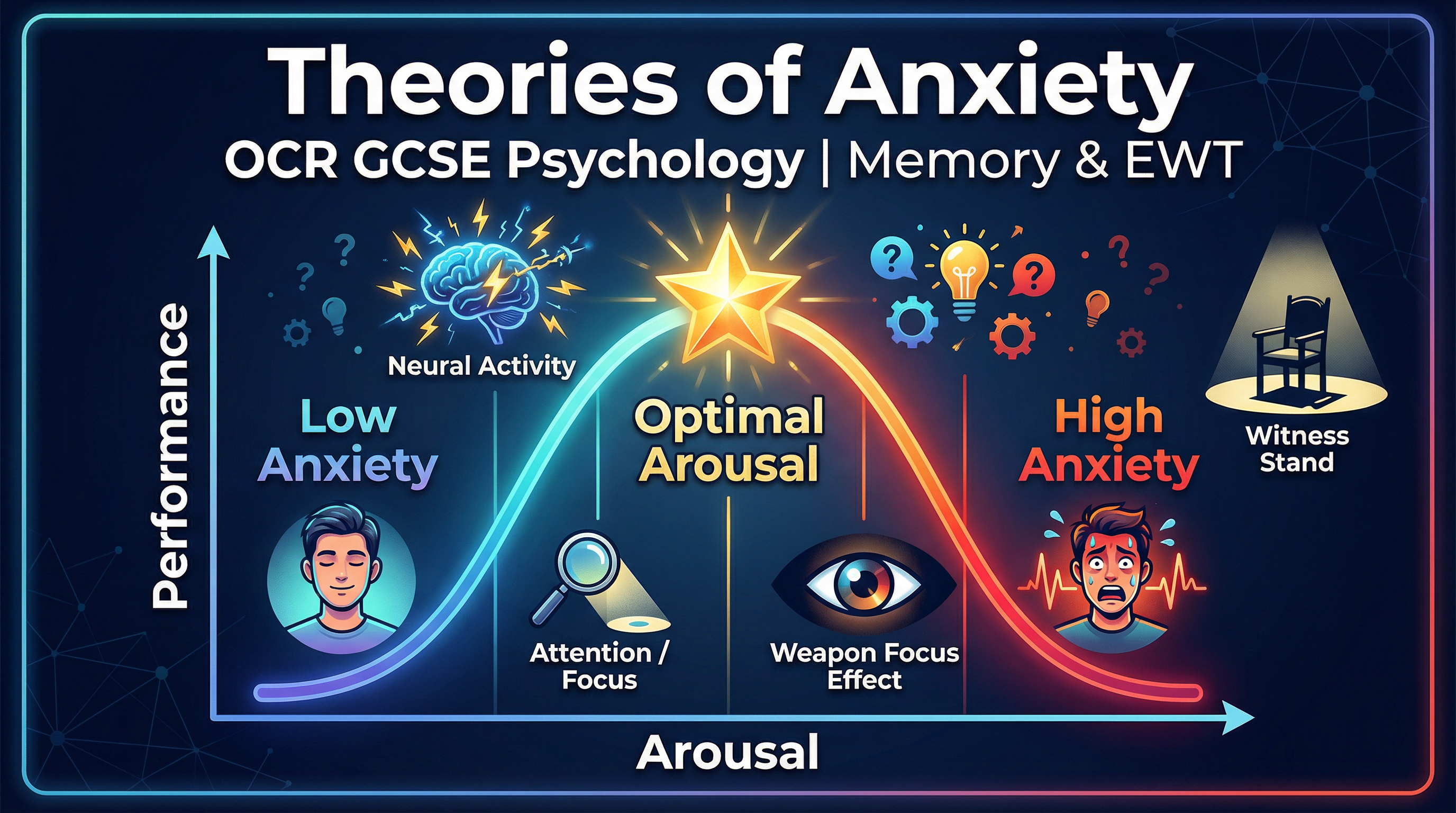
Welcome to a deep dive into one of psychology's most influential concepts: the theory of anxiety and its effect on performance. This guide focuses on the Inverted-U Hypothesis, also known as the Yerkes-Dodson Law, a pivotal theory for any student tackling the OCR GCSE Psychology specification, particularly within the Memory module. Examiners expect candidates to not just define this theory, but to apply it to the context of Eyewitness Testimony (EWT) and critically evaluate it using key research. This non-linear model, which posits that performance peaks at a moderate level of arousal before declining, is fundamental to explaining real-world phenomena from exam nerves to the accuracy of witness recall in criminal investigations. Understanding this topic is not just about memorising a graph; it’s about appreciating the complex, dynamic interplay between our physiological state and our cognitive abilities, a skill essential for achieving top marks.
Key Concepts & Developments
The Inverted-U Hypothesis (Yerkes-Dodson Law, 1908)
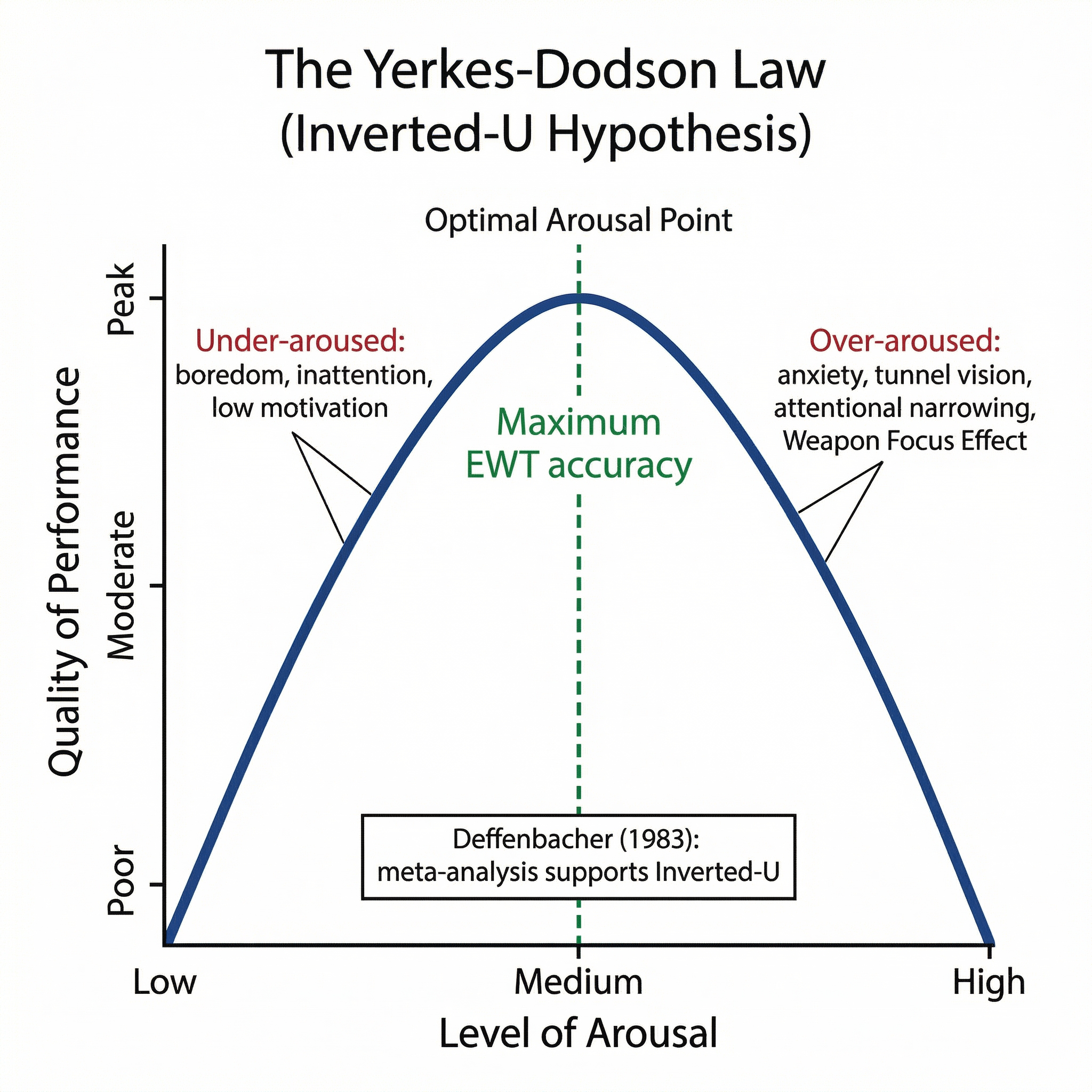
What it is: The Inverted-U Hypothesis describes the relationship between physiological or mental arousal and performance. It proposes that performance increases with arousal, but only up to a certain point (the 'optimal point'). Once arousal levels become too high, performance decreases. The name comes from the shape of the curve on a graph plotting Performance vs. Arousal.
Why it matters: This is the core theoretical framework (AO1). Candidates must be able to describe this curvilinear relationship accurately. Marks are awarded for explaining that both very low and very high levels of arousal lead to poor performance, while a moderate level leads to peak performance. It is the go-to explanation for why anxiety can sometimes help and sometimes hinder memory.
Specific Knowledge: Candidates must know the labels for the axes (Arousal/Anxiety on the x-axis, Performance/Recall Accuracy on the y-axis) and be able to identify the 'optimal point of arousal'.
The Weapon Focus Effect
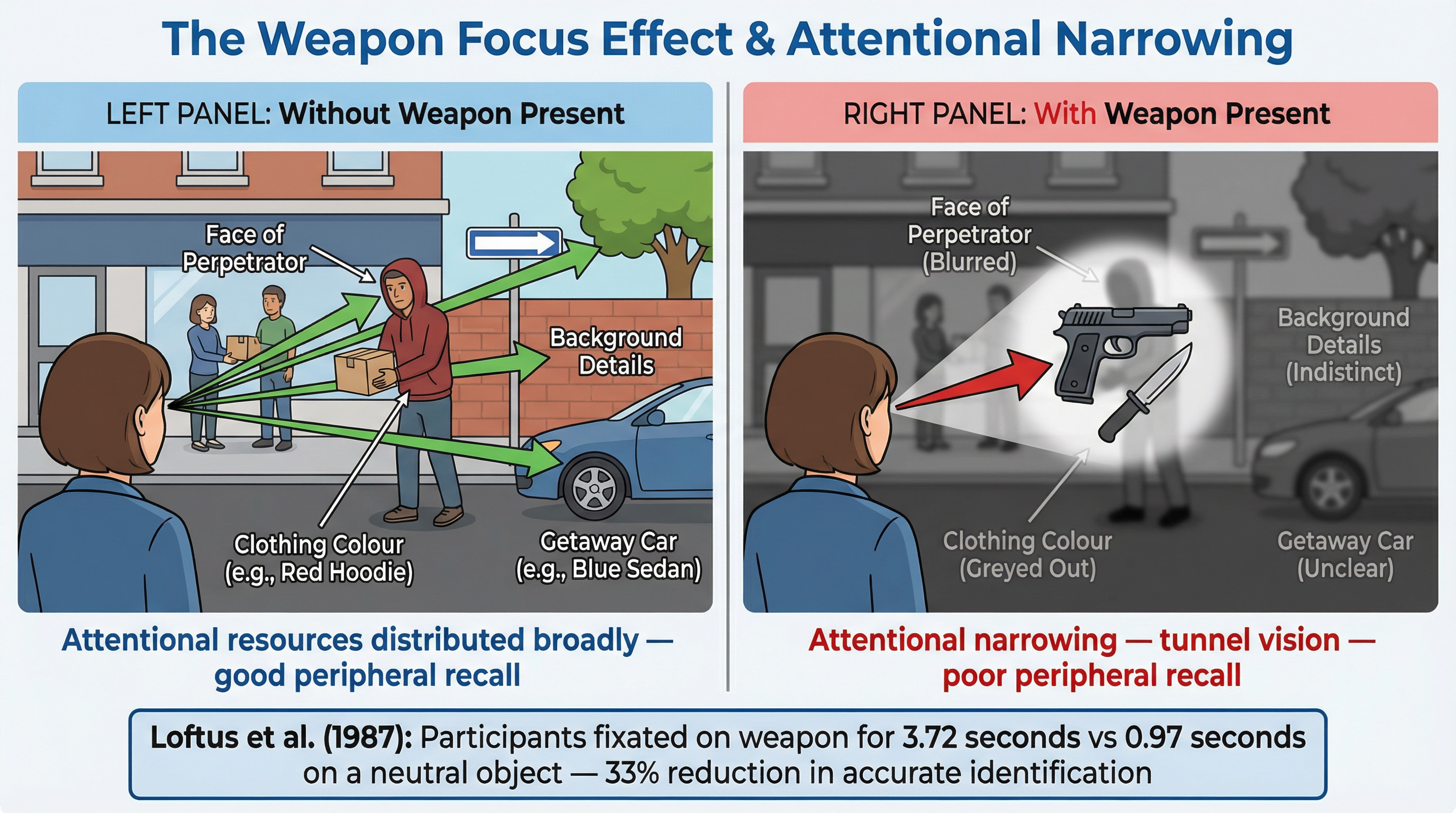
What it is: This is a key real-world application of the Inverted-U hypothesis (AO2). It's the finding that an eyewitness's memory for details of a crime is significantly poorer when a weapon is involved. The high anxiety and threat caused by the weapon push the witness past their optimal arousal point.
Why it matters: This provides a practical mechanism for the 'downward' slope of the Inverted-U. Examiners will credit candidates who explain that the witness's attention narrows onto the source of the threat (the weapon) at the expense of other details, such as the perpetrator's face or clothing. This is often referred to as 'attentional narrowing' or 'tunnel vision'.
Specific Knowledge: Loftus et al. (1987) conducted a key study where participants watched one of two sequences: a person pointing a gun at a cashier or a person handing a cheque to a cashier. Those who saw the gun (the high-anxiety condition) had significantly poorer recall of other details. This is a powerful piece of evidence to cite.
Evaluation: Lab vs. Real-World Evidence
What it is: A critical part of this topic is evaluating the theory (AO3). This involves contrasting the findings from controlled laboratory studies with those from real-life case studies.
Why it matters: This demonstrates higher-level thinking. While lab studies like Loftus's support the Weapon Focus Effect, they are often criticised for lacking ecological validity – the anxiety created in a lab is not the same as the genuine terror of a real crime. Real-world studies sometimes show the opposite effect.
Specific Knowledge: Deffenbacher (1983) conducted a meta-analysis of 21 lab studies, finding support for the Inverted-U. In contrast, Yuille & Cutshall (1986) studied a real-life shooting in Vancouver and found that the witnesses who reported the highest levels of stress were actually the most accurate in their recall months later. Using these two studies to create a debate is a classic strategy for a top-band evaluation.

Key Individuals
Yerkes & Dodson (1908)
Role: Psychologists who first proposed the relationship between arousal and performance.
Key Actions: Conducted studies on mice, finding they could learn a maze more quickly at moderate levels of electrical stimulation than at low or high levels.
Impact: Their work established the foundational concept of an 'optimal' level of arousal, which has been applied to countless areas of human performance, including memory and sport psychology.
Elizabeth Loftus
Role: A leading cognitive psychologist in the field of memory.
Key Actions: Conducted extensive research on the malleability of human memory, including the Weapon Focus Effect and the misinformation effect. Her work demonstrated how easily eyewitness accounts can be distorted.
Impact: Loftus's research has had a profound impact on the legal system, raising awareness of the potential unreliability of eyewitness testimony and influencing police procedures.
Second-Order Concepts
Causation
- Cause of improved performance: Moderate arousal leads to increased alertness, attention, and physiological readiness, causing cognitive functions to operate more efficiently.
- Cause of impaired performance: High arousal (anxiety) triggers the 'fight or flight' response. This leads to physiological changes and a cognitive phenomenon called 'attentional narrowing' (the Weapon Focus Effect), where attentional resources are monopolised by the perceived threat, causing a decline in ability to process other information.
Consequence
- Consequence of the theory: The Inverted-U hypothesis has had significant consequences for the criminal justice system, leading to greater caution in the weight given to eyewitness testimony, especially from those who have experienced traumatic events.
- Consequence of high anxiety: The primary consequence for EWT is a reduction in the accuracy of recall for peripheral details, which can lead to misidentification and wrongful convictions.
Change & Continuity
- Continuity: The basic idea that stress affects performance has been around for centuries.
- Change: The scientific understanding changed from a simple linear model (more stress = worse performance) to the more nuanced, non-linear Inverted-U model. More recently, studies like Yuille & Cutshall's have challenged the universal applicability of the Inverted-U, suggesting the relationship may be even more complex in real-world settings.
Significance
- The theory is highly significant as it provides a testable scientific model for the widely-held belief that stress impacts memory. It is a cornerstone of forensic psychology and is crucial for evaluating the evidence presented in criminal trials."