Study Notes
Overview
This guide covers the core psychological explanations for criminal behaviour as required by the OCR GCSE Psychology specification (J203). Examiners expect candidates to demonstrate a clear understanding of two key approaches: biological and social. The biological approach focuses on internal factors, specifically the role of the amygdala and Eysenck's theory of the criminal personality. The social approach examines how behaviour is learned from the environment, focusing on Bandura's Social Learning Theory. For full marks, candidates must not only describe these theories (AO1) but also apply them to scenarios (AO2) and critically evaluate their strengths and weaknesses (AO3), often with reference to the core studies of Heaven (1996) and Cooper and Mackie (1986). This topic requires a balanced understanding, recognising that behaviour is complex and rarely down to a single cause. A successful candidate will be able to compare and contrast these theories, using precise terminology and evidence to support their arguments.
Biological Explanations of Criminal Behaviour
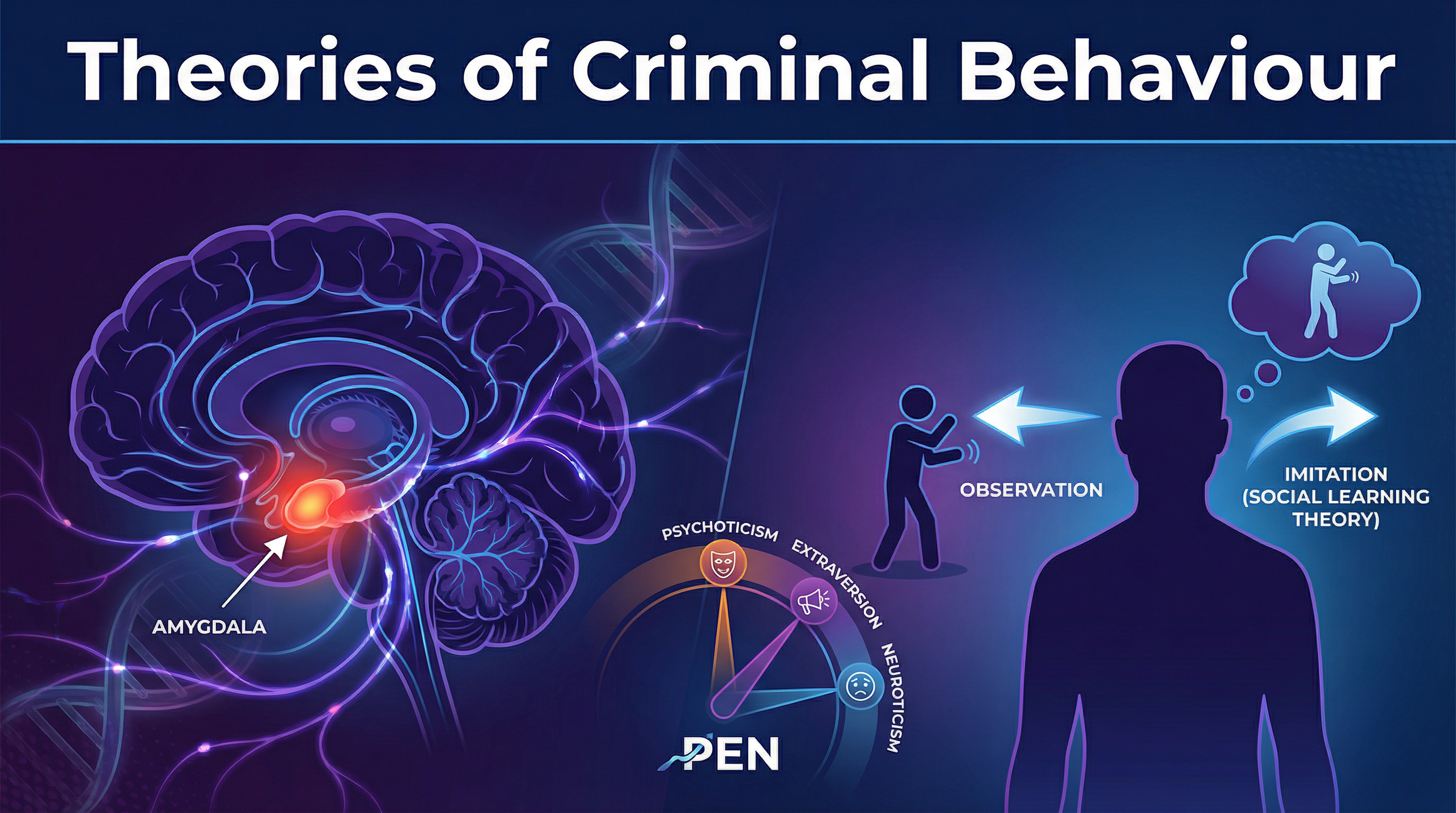
The Amygdala
What it is: The amygdala is an almond-shaped collection of nuclei located deep within the temporal lobes of the brain. It is a key component of the limbic system, which is central to processing emotions.
Role in Aggression: The amygdala is particularly associated with processing fear, threat, and aggression. Research suggests that dysfunction in the amygdala can lead to inappropriate levels of aggression. An overactive amygdala might perceive non-threatening situations as threatening, triggering an aggressive response. Conversely, a damaged or underactive amygdala could lead to a reduced fear response, which may result in greater risk-taking and a failure to learn from punishments for aggressive acts.
Why it matters: For the exam, candidates must be able to link the amygdala's function directly to criminal and aggressive behaviour. Credit is given for explaining how its role in emotion processing can lead to behaviours like assault. It provides a clear biological basis for aggression that can be supported by evidence from brain imaging studies (e.g., fMRI scans showing increased activity in aggressive individuals).
Eysenck's Theory of the Criminal Personality
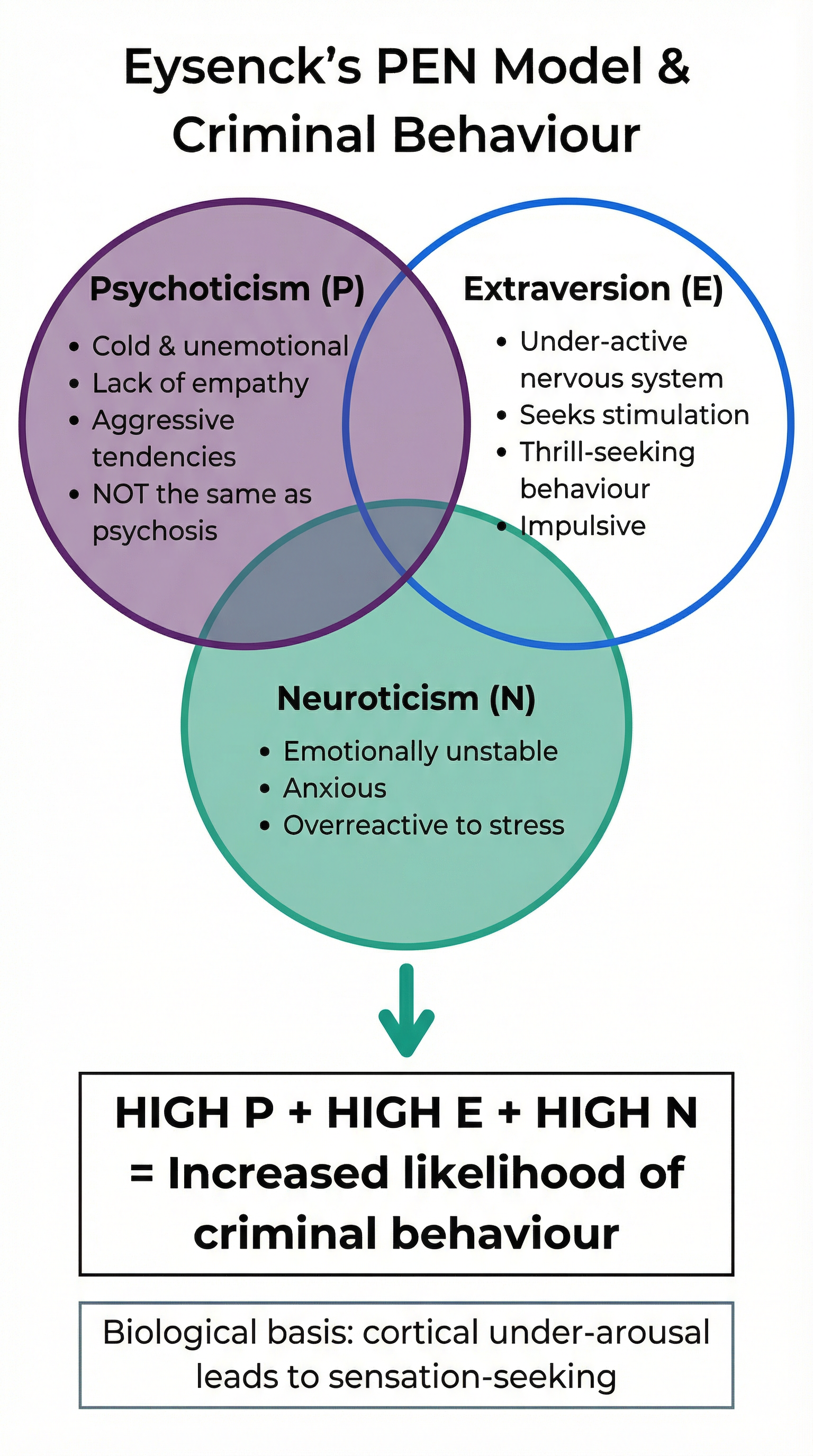
What it is: Hans Eysenck proposed that certain personality types are more prone to criminal behaviour. He identified three key dimensions of personality, which can be remembered with the mnemonic PEN.
The PEN Model:
- P - Psychoticism: This refers to a personality trait characterised by being cold, unemotional, lacking in empathy, and prone to aggression. It is crucial that candidates do not confuse this with clinical psychosis.
- E - Extraversion: Eysenck argued this has a biological basis. Extraverts have an under-active nervous system (low cortical arousal), meaning they seek external stimulation to raise their biological arousal levels. This can lead to thrill-seeking, impulsivity, and risk-taking.
- N - Neuroticism: This refers to emotional instability. Individuals high in neuroticism are anxious, moody, and tend to over-react to stressful situations.
The Criminal Personality: Eysenck's theory posits that a person who scores high on all three PEN dimensions is more likely to engage in criminal behaviour. Their impulsivity (E), aggression (P), and strong emotional reactions (N) create a volatile combination.
Social Explanations of Criminal Behaviour
Social Learning Theory (SLT)
What it is: Developed by Albert Bandura, SLT argues that behaviour is learned through the observation and imitation of others, known as 'role models'. This applies to criminal behaviour just as it does to any other behaviour.
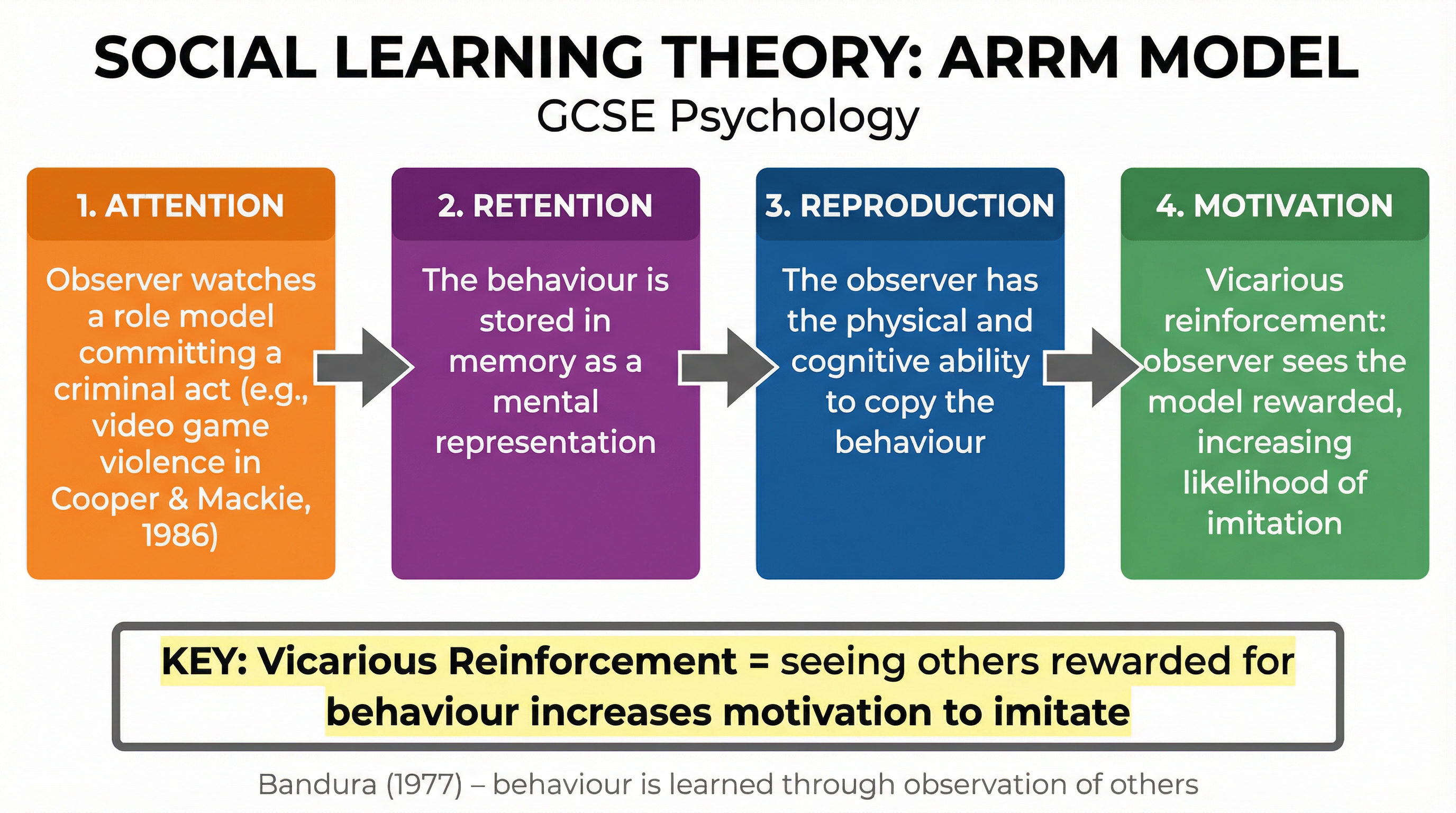
The ARRM Process: SLT can be broken down into four stages, remembered with the mnemonic ARRM.
- A - Attention: An individual must pay attention to the role model's behaviour.
- R - Retention: The behaviour must be stored in memory (a mental representation).
- R - Reproduction: The individual must have the physical and cognitive ability to replicate the behaviour.
- M - Motivation: The individual must be motivated to imitate the behaviour. This is often driven by vicarious reinforcement, where the role model is seen to be rewarded (e.g., with money, status, or respect) for their criminal actions.
Why it matters: SLT provides a powerful explanation for how criminal behaviour can be transmitted within families and peer groups. For the exam, candidates must be able to apply the ARRM stages to a novel scenario and, crucially, explain the role of vicarious reinforcement. Simply stating that crime is 'copied' is not sufficient for high marks.
Core Studies
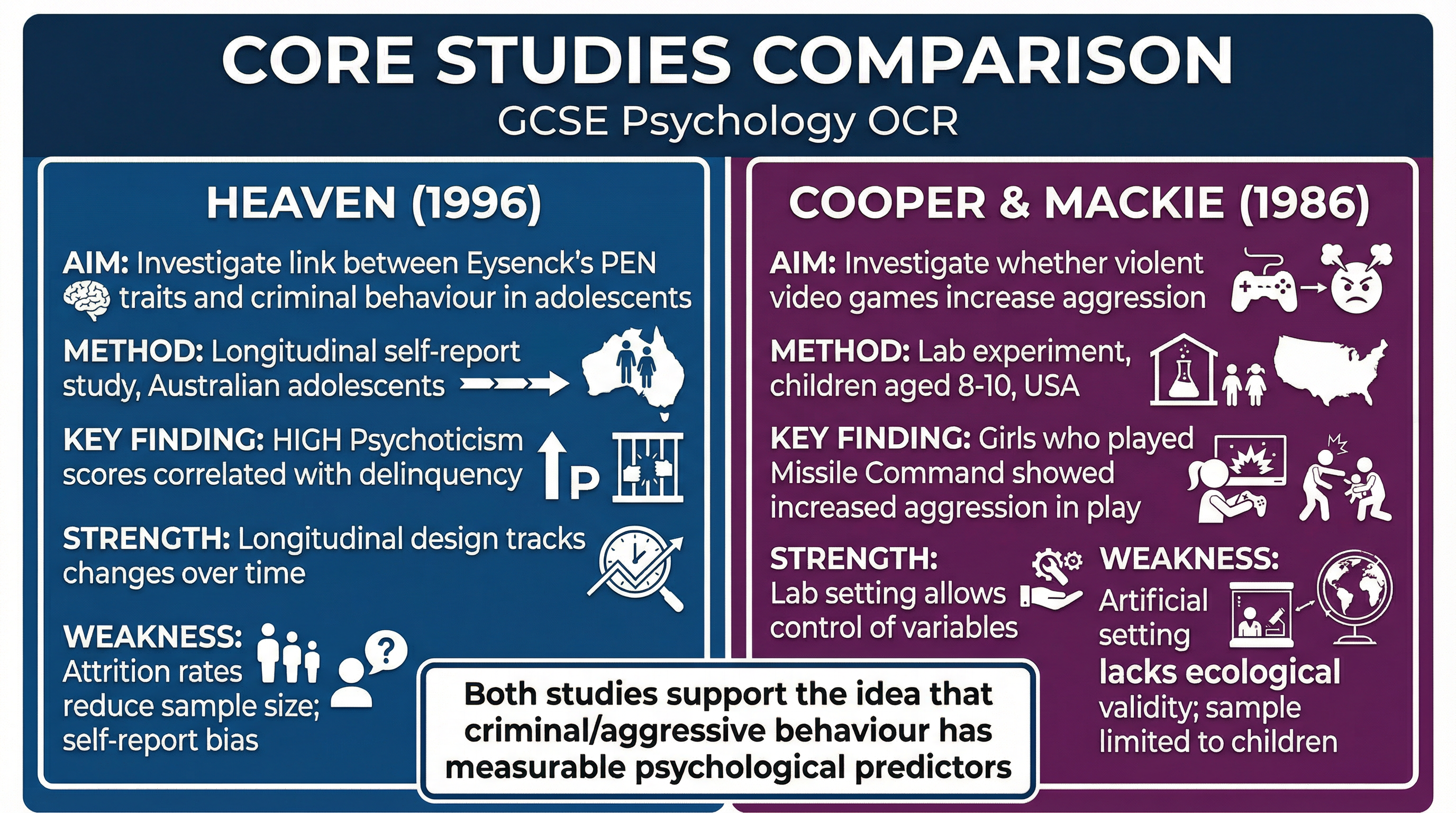
Heaven (1996) - Eysenck's Theory
Aim: To investigate the relationship between Eysenck's PEN personality traits and self-reported delinquency in adolescents.
Method: A longitudinal study conducted over two years with 282 adolescents from two Catholic schools in Australia. Participants completed self-report questionnaires to measure both their personality traits (P, E, N) and their involvement in delinquent acts.
Key Finding: Psychoticism was found to be the strongest predictor of delinquency at both the start and end of the study. Extraversion showed a small correlation, but Neuroticism did not.
Significance: This study provides some support for Eysenck's theory, specifically the link between the Psychoticism trait and criminal behaviour. However, its reliance on self-report data is a key limitation.
Cooper and Mackie (1986) - Social Learning Theory
Aim: To investigate whether playing a violent video game would lead to an increase in aggression in children, compared to a non-violent game or a no-game control.
Method: A laboratory experiment involving 84 children (aged 9-11) from schools in New Jersey, USA. They were randomly allocated to one of three conditions: playing a violent game (Missile Command), a non-violent game (Pac-Man), or observing others play. Aggression was then measured by observing their subsequent free play in a toy room.
Key Finding: Girls who played the violent video game showed significantly more aggression in their subsequent play (e.g., playing with aggressive toys) than girls in the other two conditions. The effect was not as clear for boys.
Significance: This study provides some support for SLT, suggesting that observing and engaging with mediated violence can increase aggression. However, the artificiality of the lab setting and the limited sample raise questions about its ecological validity and generalisability.