Study Notes
Overview
The Behaviourist Approach, a pivotal movement in early 20th-century psychology, posits that psychology should be a science of observable behaviour, rejecting the study of internal mental states. For WJEC A-Level candidates, this topic, part of Unit 1 (Past to Present), is fundamental. It requires a firm grasp of the core assumptions: that we are born as a 'tabula rasa' (blank slate), that our actions are shaped by environmental determinism, and that only measurable behaviours are valid data. Examiners expect candidates to precisely define and apply the mechanisms of Classical and Operant Conditioning, explain their application in therapies like Systematic Desensitisation, and critically evaluate the approach using key debates such as reductionism, determinism, and the scientific status of psychology. Mastery of this topic involves not just knowing the theories of Pavlov and Skinner, but being able to analyse their strengths, weaknesses, and enduring impact on the field.
Key Assumptions of the Behaviourist Approach
1. Tabula Rasa (The Blank Slate)
What it means: Behaviourists propose that the human mind is a 'blank slate' at birth, containing no innate ideas or knowledge. All behaviour, knowledge, and personality traits are acquired through interaction with the environment.
Why it matters: This assumption forms the basis of the 'nurture' side of the nature-nurture debate. For an exam essay, this is a critical point for AO3 evaluation. It directly opposes the views of the Biological Approach, which emphasizes the role of genetics and innate biological mechanisms.
2. Environmental Determinism
What it means: As a direct consequence of the blank slate concept, all our behaviour is seen as determined by our past experiences and conditioning. Free will is considered an illusion; our choices are merely the sum of our reinforcement history.
Why it matters: This is a major point of contention and a rich area for AO3 marks. While it allows for a scientific, cause-and-effect analysis of behaviour, it has significant implications for concepts of personal responsibility and morality. Candidates should be prepared to contrast this with the Humanistic Approach, which champions free will.
3. Focus on Observable Behaviour
What it means: Behaviourists argue that for psychology to be a credible science, it must focus on phenomena that can be objectively measured and observed. Internal mental processes like thoughts, emotions, and intentions are rejected as being too subjective and unscientific.
Why it matters: This focus on objectivity and control allowed psychology to establish itself as a scientific discipline. Evaluation should focus on the benefits of this (e.g., replicable lab experiments) and the drawbacks (e.g., ignoring the role of cognitive processes, which the Cognitive Approach later addressed).
Mechanisms of Learning
Classical Conditioning (Pavlov, 1927)
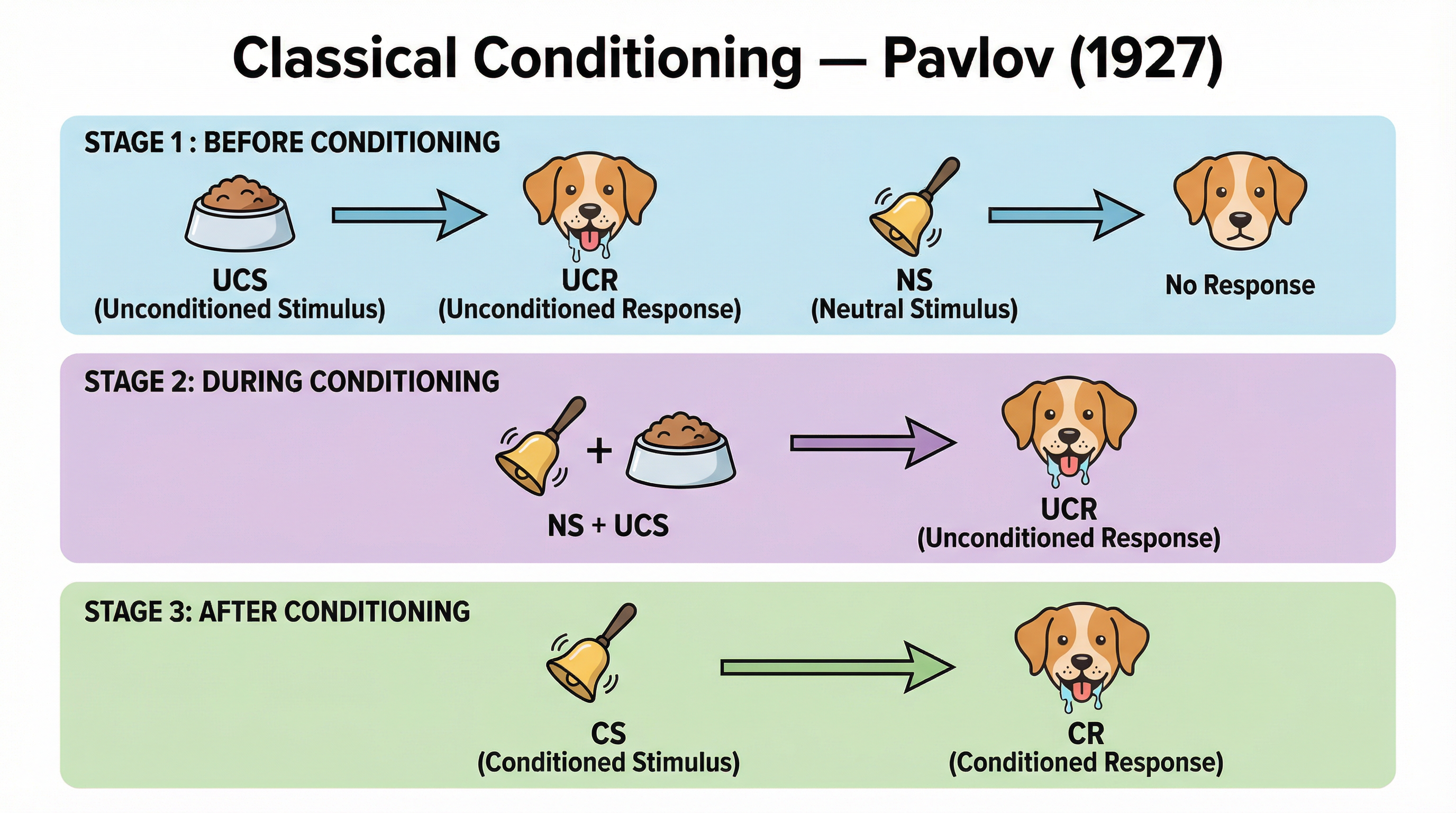
What happened: Ivan Pavlov, a Russian physiologist, discovered that dogs could be conditioned to salivate at the sound of a bell if the bell was repeatedly presented at the same time as food. He identified the key components of this learning process.
Why it matters: This demonstrated that a neutral stimulus could come to elicit a learned response through association. It provided the first systematic, scientific account of learning by association and is used to explain the acquisition of phobias.
Specific Knowledge: Candidates MUST know the five key terms: Unconditioned Stimulus (UCS), Unconditioned Response (UCR), Neutral Stimulus (NS), Conditioned Stimulus (CS), and Conditioned Response (CR).
Operant Conditioning (Skinner, 1938)
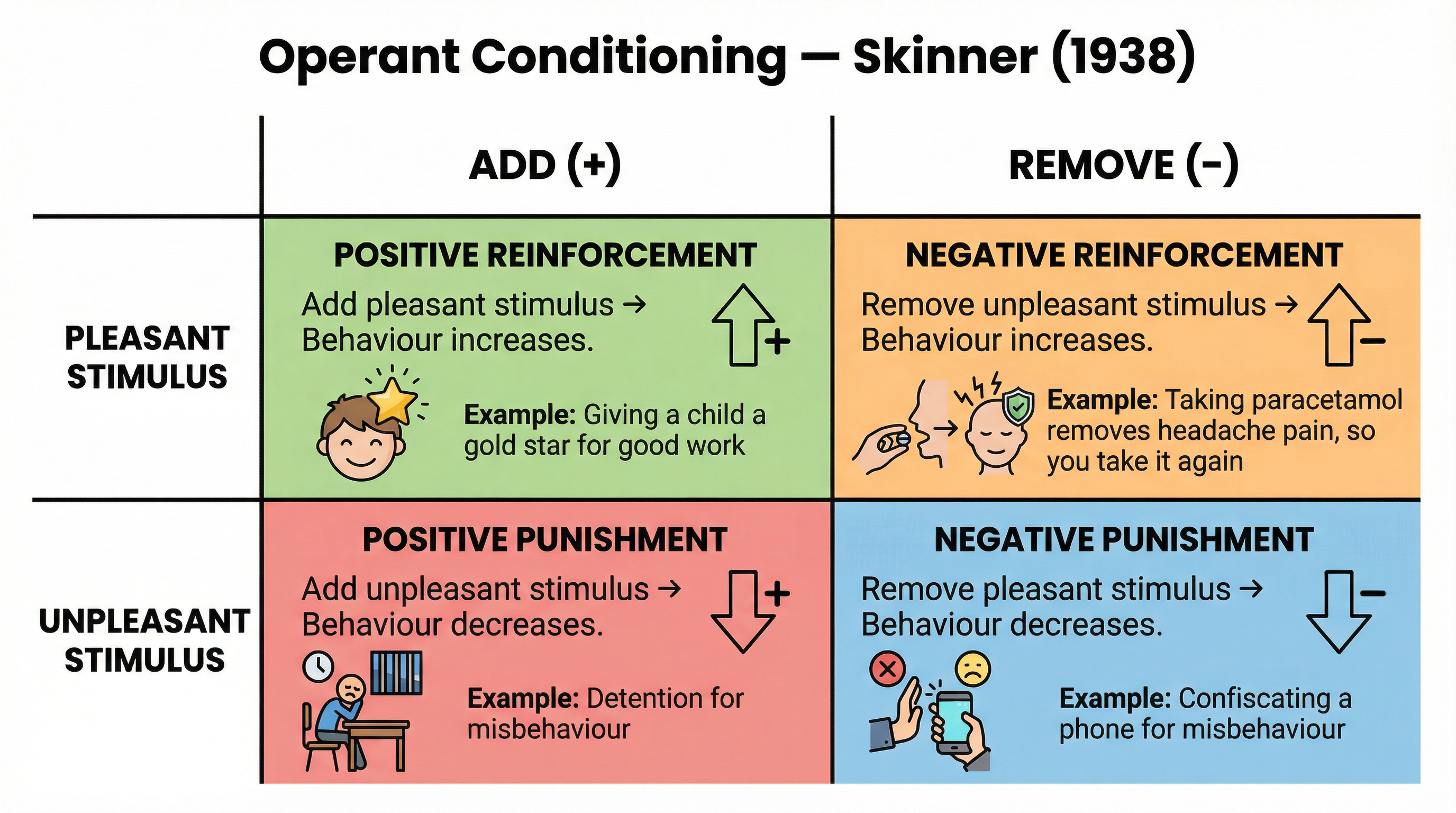
What happened: B.F. Skinner developed a theory of learning based on consequences. Using his 'Skinner Box', he showed that the likelihood of a behaviour being repeated is influenced by reinforcement (which increases behaviour) and punishment (which decreases behaviour).
Why it matters: Operant conditioning explains a vast range of voluntary human and animal behaviours, from a child learning to say 'please' to receive a treat, to the mechanisms underlying addiction. It forms the basis of many behaviour modification techniques.
Specific Knowledge: Candidates must be able to distinguish clearly between Positive Reinforcement, Negative Reinforcement, and Punishment.
Application: Behaviour Therapy
Systematic Desensitisation (Wolpe, 1958)
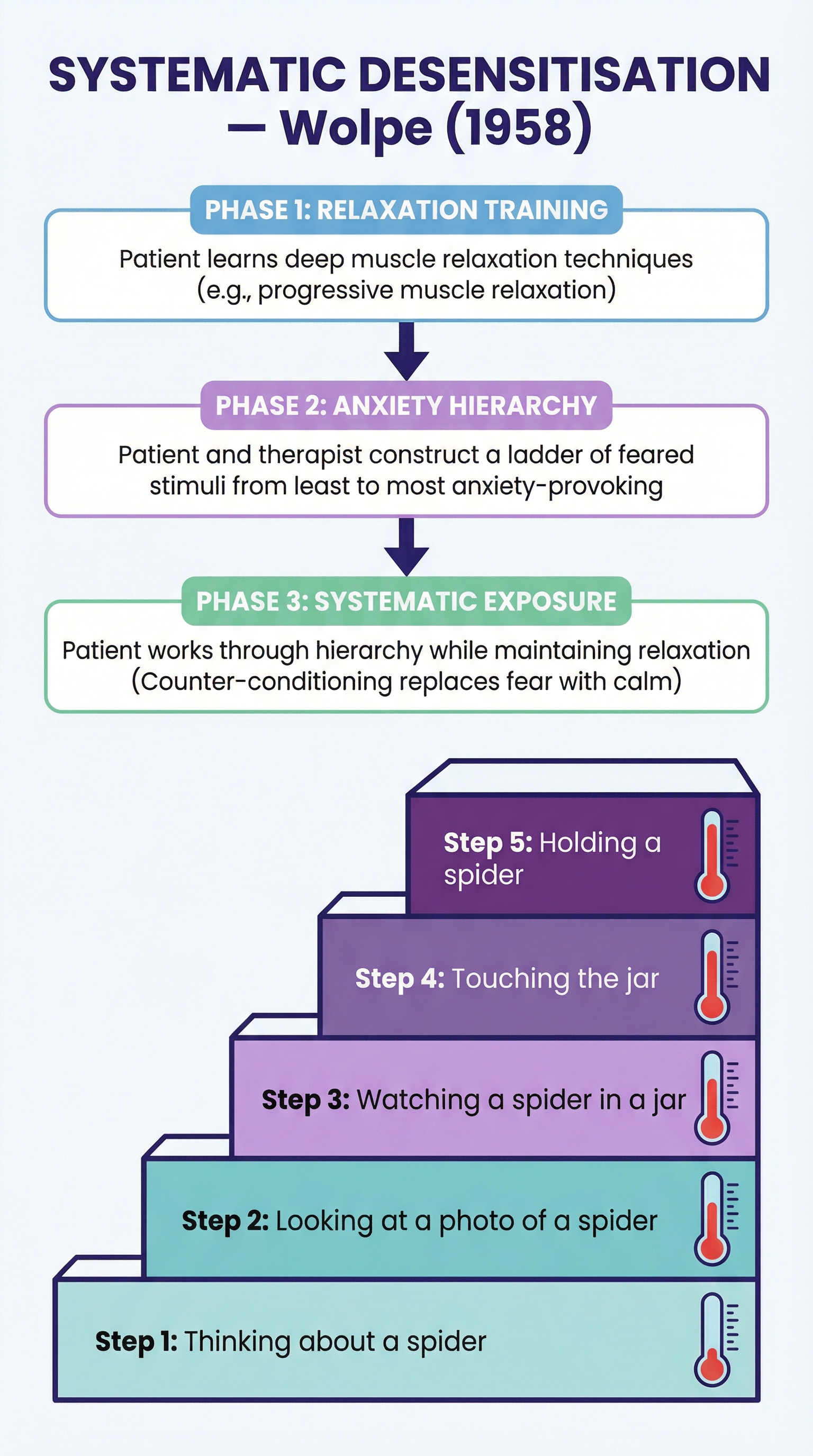
What it is: A behavioural therapy designed to treat phobias and anxiety disorders. It is based on the principle of counter-conditioning, replacing a maladaptive fear response with a new, adaptive relaxation response.
Why it matters: This is a prime example of how behaviourist principles can be applied to create effective treatments for psychological disorders. It provides strong evidence for the practical utility of the approach. Research by McGrath et al. (1990) found it was effective for 75% of patients with phobias.
Specific Knowledge: Candidates must know the three phases: 1) Relaxation Training, 2) Creation of an Anxiety Hierarchy, and 3) Gradual Exposure.