Study Notes
Overview
The Cognitive Approach, which emerged in the mid-20th century, marked a significant shift in psychology, moving away from the purely observable behaviours studied by behaviourists to focus on the internal mental processes that drive them. For WJEC A-Level candidates, this topic is a cornerstone of Component 1, requiring a robust understanding of its core assumptions, key terminology, and practical applications. Examiners expect candidates to be able to describe the computer analogy and schema theory, apply these concepts to therapies like CBT, and critically evaluate the approach's strengths and weaknesses. This guide will equip you with the specific knowledge and analytical skills needed to deconstruct exam questions, from the precise speed estimates in Loftus & Palmer's (1974) study to the nuanced argument of mechanistic reductionism. Mastering this content is not just about memorising facts, but about understanding how the mind is conceptualised as an information processor and critically assessing the validity of that model.
Key Concepts & Developments
The Computer Analogy
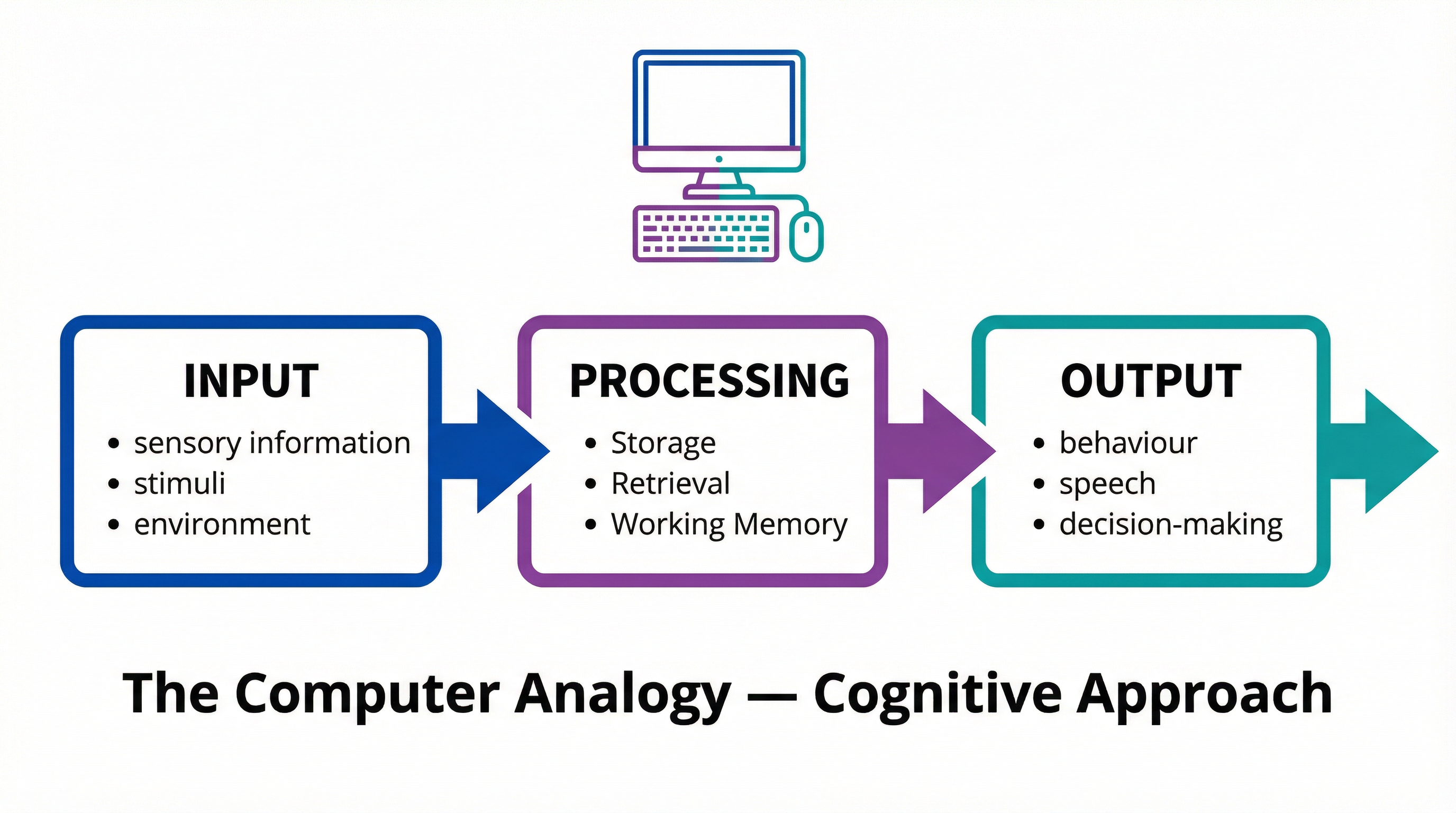
What it is: A core assumption of the cognitive approach, this is a model used to explain how humans process information. It compares the human mind to a computer, with distinct stages of processing.
Why it matters: This analogy provides a structured framework for studying mental processes. Examiners award credit for using the specific terms: Input (sensory information from the environment), Processing (the cognitive operations performed on the input, such as storage, retrieval, and decision-making), and Output (the resulting behaviour). It forms the basis of the information-processing paradigm.
Specific Knowledge: Candidates must be able to clearly define and distinguish between the three stages. For example, seeing a car braking suddenly is the 'input', thinking about past experiences and deciding to brake is the 'processing', and the physical act of pressing the brake pedal is the 'output'.
Schema Theory
What it is: Schemas are mental frameworks or packets of information developed through experience. They help us organise and interpret incoming information, acting as mental shortcuts.
Why it matters: Schemas allow for efficient processing of the vast amount of information we encounter daily. However, they can also lead to cognitive biases and stereotypes, as we may distort or ignore information that does not fit our existing schemas. This concept is crucial for understanding cognitive errors and disorders like depression.
Specific Knowledge: Be able to provide an example, such as having a 'classroom schema' which tells you what to expect and how to behave in a classroom setting. Link this to how faulty schemas (e.g., "I am worthless") can contribute to depression.
Cognitive Neuroscience
What it is: A more recent development that seeks to bridge the gap between the cognitive approach and the biological approach. It involves using brain imaging techniques (like fMRI and PET scans) to study the neurological basis of mental processes.
Why it matters: It provides objective, scientific evidence for the cognitive processes that were previously only inferred. It allows psychologists to map specific mental functions to specific brain regions, adding scientific credibility to the cognitive approach.
Specific Knowledge: Mentioning techniques like fMRI and how they have helped identify the brain areas involved in different types of memory (e.g., the hippocampus in long-term memory) is a good way to demonstrate detailed knowledge.
Key Individuals
Aaron Beck
Role: A key figure in the development of Cognitive Therapy for depression.
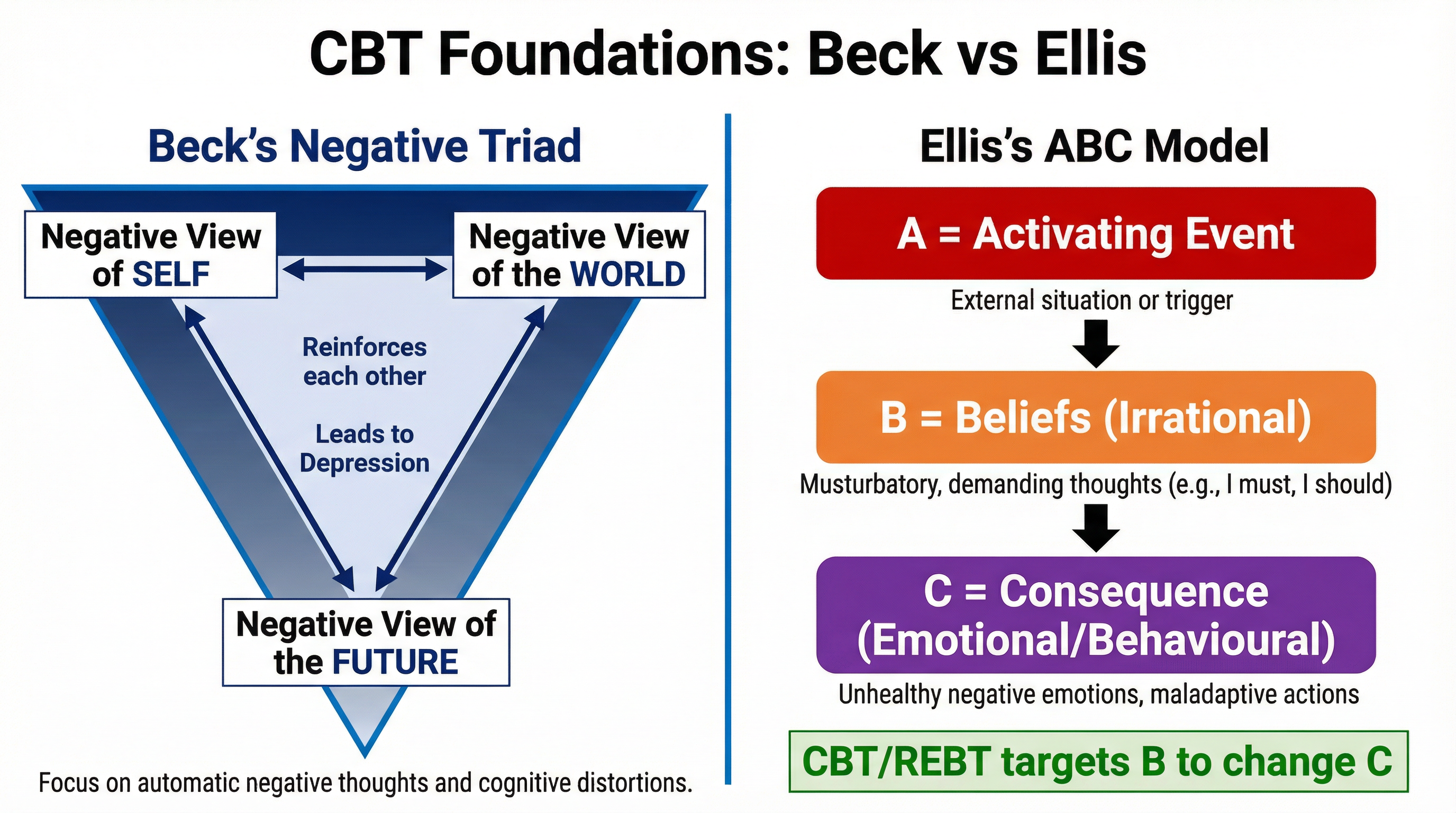
Key Actions: Proposed the Negative Triad, a model suggesting that depression is maintained by negative thoughts about the self, the world, and the future.
Impact: Beck's work was foundational in creating CBT, one of the most effective and widely used treatments for depression and other anxiety disorders. His focus on challenging automatic negative thoughts is a cornerstone of modern therapy.
Albert Ellis
Role: Another pioneer of cognitive therapies, developing Rational Emotive Behaviour Therapy (REBT).
Key Actions: Created the ABC Model to explain how irrational beliefs lead to negative emotional and behavioural consequences. A stands for Activating Event, B for Beliefs (about the event), and C for Consequences.
Impact: Ellis emphasised that it is not the event itself that causes distress, but the irrational belief about it. REBT focuses on disputing these irrational beliefs to foster more rational responses, heavily influencing the development of CBT.
Elizabeth Loftus
Role: A leading researcher in the field of human memory, particularly its fallibility.
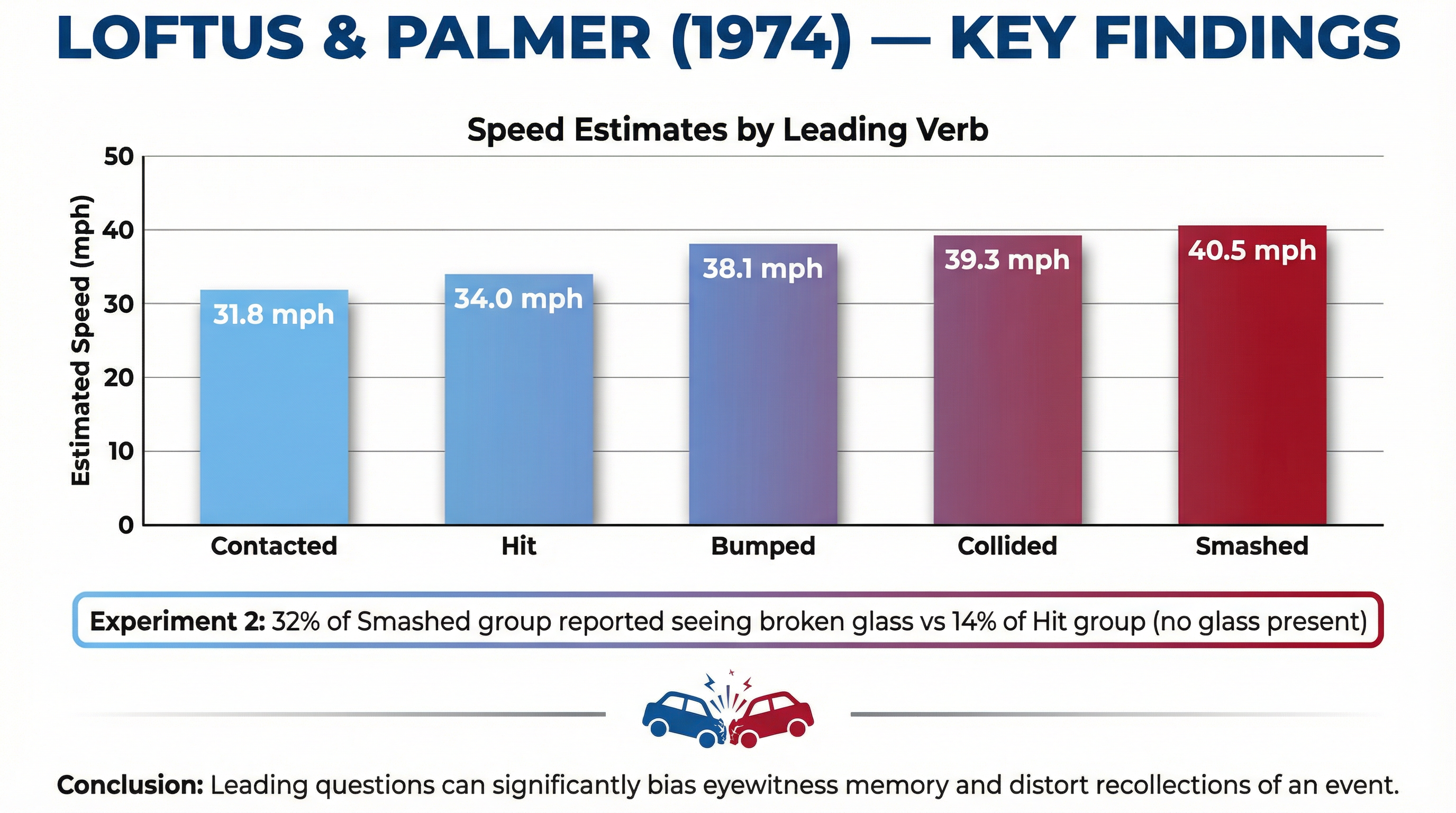
Key Actions: Conducted the classic 1974 study with John Palmer on the effect of leading questions on eyewitness testimony. Her work demonstrated that memory is not a perfect recording but is reconstructive and can be distorted by post-event information.
Impact: Loftus's research has had a profound impact on the legal system, raising awareness of the unreliability of eyewitness testimony and leading to changes in police interviewing techniques. It provides powerful evidence for the concept of reconstructive memory.
Second-Order Concepts (Evaluation)
Strengths of the Cognitive Approach
- Scientific Methods: The approach uses highly controlled and rigorous methods of study, such as laboratory experiments, which allow for reliable and objective data to be produced. This has given cognitive psychology a high degree of scientific credibility.
- Practical Applications: It has been successfully applied in numerous areas, most notably in the development of effective therapies like CBT. This has had a significant positive impact on the lives of people suffering from mental health disorders.
- Soft Determinism: It offers a more reasonable middle-ground in the free will vs. determinism debate. It suggests that while our cognitive system has limits, we are free to think and make decisions within those limits, which is a more flexible and realistic view of human behaviour than hard determinism.
Weaknesses of the Cognitive Approach
- Mechanistic Reductionism: This is a key criticism. The computer analogy is accused of being overly simplistic and machine-like, ignoring the influence of human emotion, motivation, and social factors on cognition. Humans are not simply information processors; our feelings and goals fundamentally shape our thoughts.
- Lack of Ecological Validity: Many studies, due to their laboratory setting, use artificial tasks that are different from everyday experiences (e.g., memorising word lists). This means the findings may not accurately reflect how our mental processes work in real-life situations.
- Inference vs. Direct Observation: Mental processes are unobservable and must be inferred from behaviour. This can lead to less objective conclusions compared to approaches like the biological approach, which can directly observe brain activity.",
"podcast_script": "# WJEC A-Level Psychology: Mastering the Cognitive Approach
(Intro - Upbeat, engaging music fades in and out)
Host: Hello and welcome to the study guide podcast for WJEC A-Level Psychology! I’m your host, and today we’re diving deep into one of the most influential perspectives in modern psychology: the Cognitive Approach. This is a cornerstone of your Component 1 paper, ‘Past to Present’, and understanding it well is your ticket to top-band marks. We’ll break down the core assumptions, link them directly to therapies like CBT, and give you the examiner’s-eye-view on how to evaluate it effectively. By the end of these 10 minutes, you’ll have the clarity and confidence to tackle any question the exam throws at you. Let’s get started!
(Core Concepts - Clear, slightly faster pace)
Host: So, what is the cognitive approach all about? At its heart, it’s the scientific study of our internal mental processes. Think of it as the psychology of the mind’s software. While behaviourists were only interested in observable actions, cognitive psychologists in the 1950s and 60s said, “Hang on, the stuff happening inside our heads is crucial!” They argued that to understand behaviour, we must understand thinking, perception, memory, and attention.
First, let’s lock down the core assumptions. Assumption one: The primacy of internal mental processes. Examiners want you to be clear that cognitive psychologists believe these processes are the key drivers of our behaviour. Processes like memory, perception, and language are central. For example, your decision to revise today is not just a response to a stimulus; it’s based on your memory of past exam results, your perception of the exam’s difficulty, and your thought processes about your future goals.
Assumption two is the Computer Analogy, and this is a big one. Candidates who use this term explicitly will be given credit. The analogy views the human mind as a processor of information, much like a computer. It involves three stages. First, Input, which is the information we receive from our senses. Second, Processing, where we manipulate this information – we store it, retrieve it, and make decisions. Finally, Output, which is the resulting behaviour, like speaking or solving a problem. The brain is seen as the ‘hardware’ and our cognitive processes are the ‘software’. It’s a powerful model for understanding how we handle information.
Assumption three is the concept of Schemas. Schemas are mental frameworks of beliefs and expectations that we develop from experience. They act as mental shortcuts, helping us to process a vast amount of information quickly without being overwhelmed. For instance, you have a schema for ‘a dog’ – it probably includes features like four legs, fur, and a tail. When you see a new animal that fits this schema, you can quickly identify it as a dog. However, schemas can also lead to stereotypes and biases, causing us to distort information to fit our existing beliefs.
Now, how do these assumptions apply to therapy? This is a huge application question area. The cognitive approach is the foundation for Cognitive Behavioural Therapy, or CBT. The core idea is that mental disorders like depression are caused by faulty or irrational thinking. CBT aims to identify and challenge these negative thought patterns. For example, Aaron Beck proposed the Negative Triad for depression: a negative view of the self, the world, and the future. Albert Ellis developed his ABC Model: an Activating event leads to a Belief about that event, which in turn leads to a Consequence, the emotional or behavioural response. CBT and its variant, REBT, directly target the ‘B’ – the irrational belief – to change the ‘C’.
(Exam Tips & Common Mistakes - Authoritative, direct tone)
Host: Right, let’s talk exam technique. To get into the top bands for evaluation, you need to be critical. A key evaluation point for the cognitive approach is mechanistic reductionism. This is a criticism of the computer analogy. It argues that comparing a human mind to a machine is overly simplistic because it ignores the profound influence of human emotion and motivation on our thinking. Computers don’t have feelings or get tired; we do. Using this term shows the examiner you are thinking critically.
Another key evaluation point is the approach’s use of soft determinism. This is often misunderstood. It doesn’t mean we have no free will. It means our free will operates within the limits of what we know and our cognitive system. We are free to think before we respond to a stimulus, but we can only think about things we have knowledge of or can imagine. Make sure you define that accurately.
Now for a classic study: Loftus and Palmer’s 1974 research on eyewitness testimony. A common mistake candidates make is confusing the procedure with the findings. When a question asks for ‘findings’, you must provide the data. For full marks, you need to state that the group given the verb ‘smashed’ estimated the car’s speed at 40.5 miles per hour, while the ‘contacted’ group estimated it at just 31.8 miles per hour. Quoting these specific numbers demonstrates precise knowledge and will be rewarded.
(Quick-Fire Recall Quiz - Upbeat, quiz-show style)
Host: Okay, time for a quick-fire recall round to get those retrieval muscles working! No looking at your notes. Ready?
Question 1: What are the three components of Beck's Negative Triad?
(Pause for 3 seconds)
Host: That’s the self, the world, and the future.
Question 2: In the computer analogy, what does the term 'processing' refer to?
(Pause for 3 seconds)
Host: It refers to cognitive operations like storage, retrieval, and decision-making.
Question 3: What was the mean speed estimate for the verb 'smashed' in Loftus and Palmer's study?
(Pause for 3 seconds)
Host: It was 40.5 miles per hour. Well done if you got all three!
(Summary & Sign-off - Warm, encouraging tone)
Host: So, to summarise: the cognitive approach focuses on internal mental processes, using the computer analogy and schema theory to explain how we think and behave. It has given us highly effective therapies like CBT by showing us how to challenge faulty thinking. When evaluating, remember to discuss its strengths, like its scientific methods, but also its limitations, such as mechanistic reductionism. For the exam, be precise, use the key terminology, and always back up your points with evidence, especially from classic studies like Loftus and Palmer.
That’s all for this episode. Keep practicing, keep retrieving, and you’ll be in a great position for your exams. Thanks for listening!
(Upbeat music fades in and ends)"