Study Notes
Overview
Welcome to the WJEC GCSE Psychology topic of Development. This area of study is fundamental to understanding the human condition, exploring how we change and grow from birth. Examiners expect candidates to have a firm grasp of three core areas: the biological development of the brain, the cognitive development of thinking as proposed by Jean Piaget, and the application of learning theories to education from Carol Dweck and Daniel Willingham. This guide will provide the detailed knowledge required for AO1 marks, demonstrate how to apply this knowledge to scenarios for AO2, and equip you with the critical evaluation skills needed for AO3. Mastery of this topic requires not just memorisation, but a genuine understanding of how these theories explain real-world behaviour, particularly in an educational context. You will need to know the procedures and findings of two named studies—Piaget & Inhelder (1956) and Gunderson et al. (2013)—and be prepared to critique them methodologically.
Key Theories & Concepts
Early Brain Development
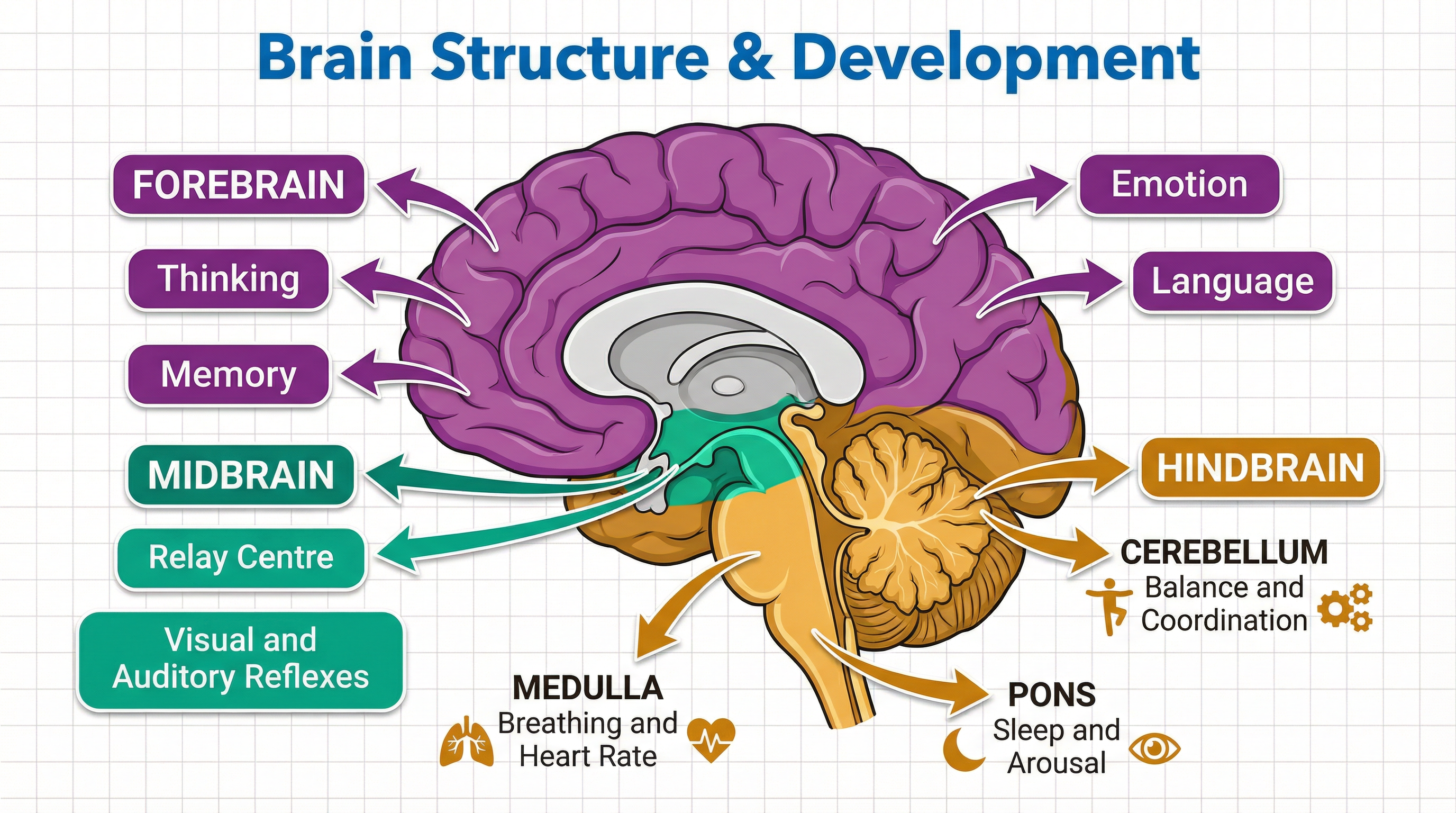
What it is: The brain is not a single entity but is comprised of distinct regions that develop and mature at different rates. For your exam, you must know the three main divisions.
- Forebrain: The largest and most complex part, responsible for higher-order thinking, memory, language, and emotions. It's what makes us consciously human.
- Midbrain: Acts as a crucial relay station, connecting the forebrain and hindbrain. It helps process sensory information, particularly for visual and auditory reflexes.
- Hindbrain: The 'primitive' part of the brain, controlling vital life-sustaining functions. It includes key structures you must memorise.
Specific Knowledge: Candidates must be able to identify the location and function of the Cerebellum (coordination and balance) and the Medulla (breathing and heart rate). A common error is confusing these two; remember Cerebellum for Coordination and Medulla for Maintenance of life.
Piaget's Theory of Cognitive Development
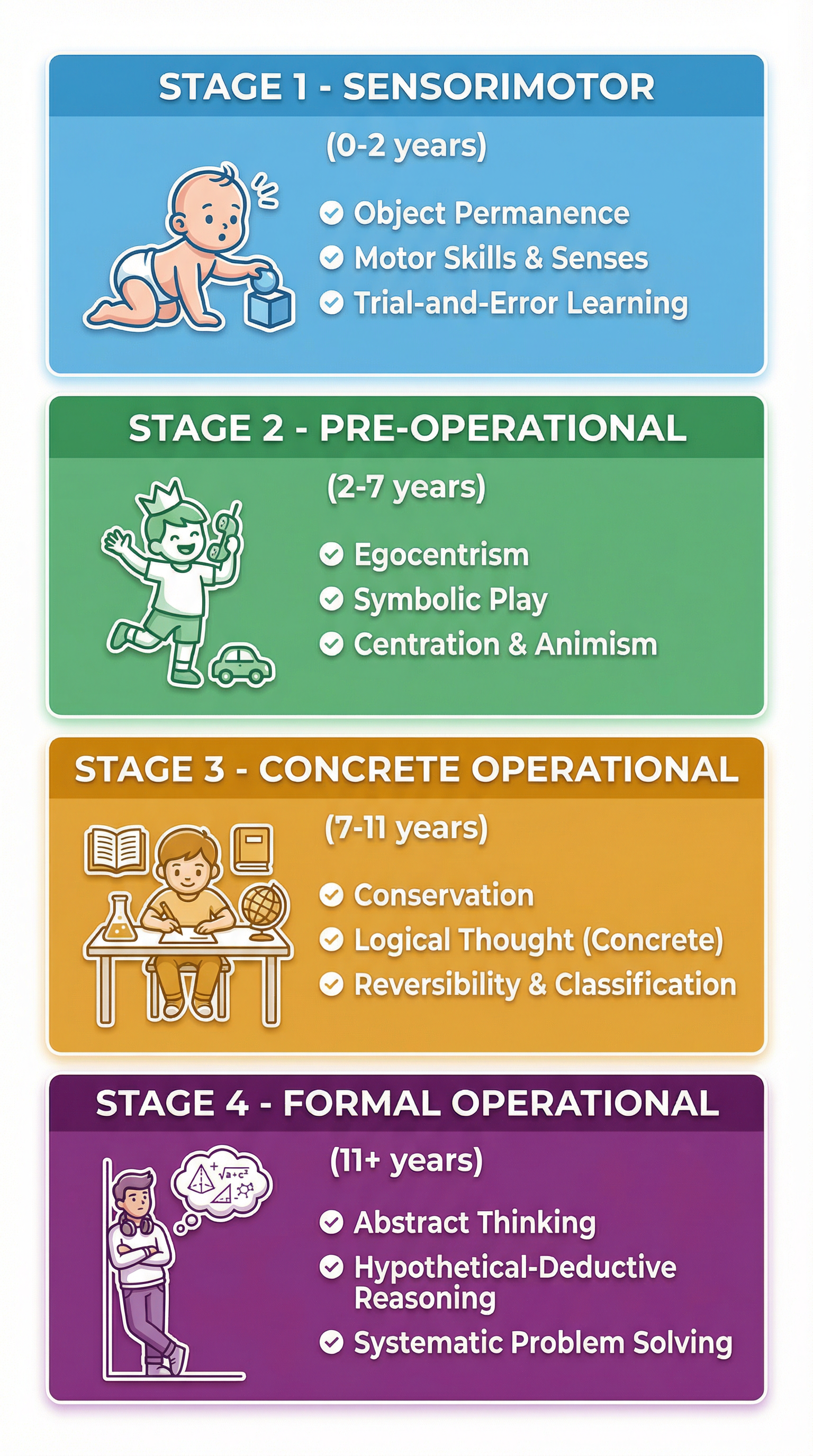
What it is: Jean Piaget proposed that children are active learners who construct their understanding of the world through a series of four universal stages. He believed thinking develops in a qualitatively different way at each stage.
Key Concepts:
- Schema: A mental framework for understanding a concept (e.g., a schema for 'dog').
- Assimilation: Fitting new information into an existing schema (e.g., calling a cat a 'dog').
- Accommodation: Changing an existing schema or creating a new one to fit new information (e.g., learning the difference between cats and dogs).
The Four Stages: Memorise the names and age ranges. Marks are often lost for incorrect ages.
Dweck's Mindset Theory
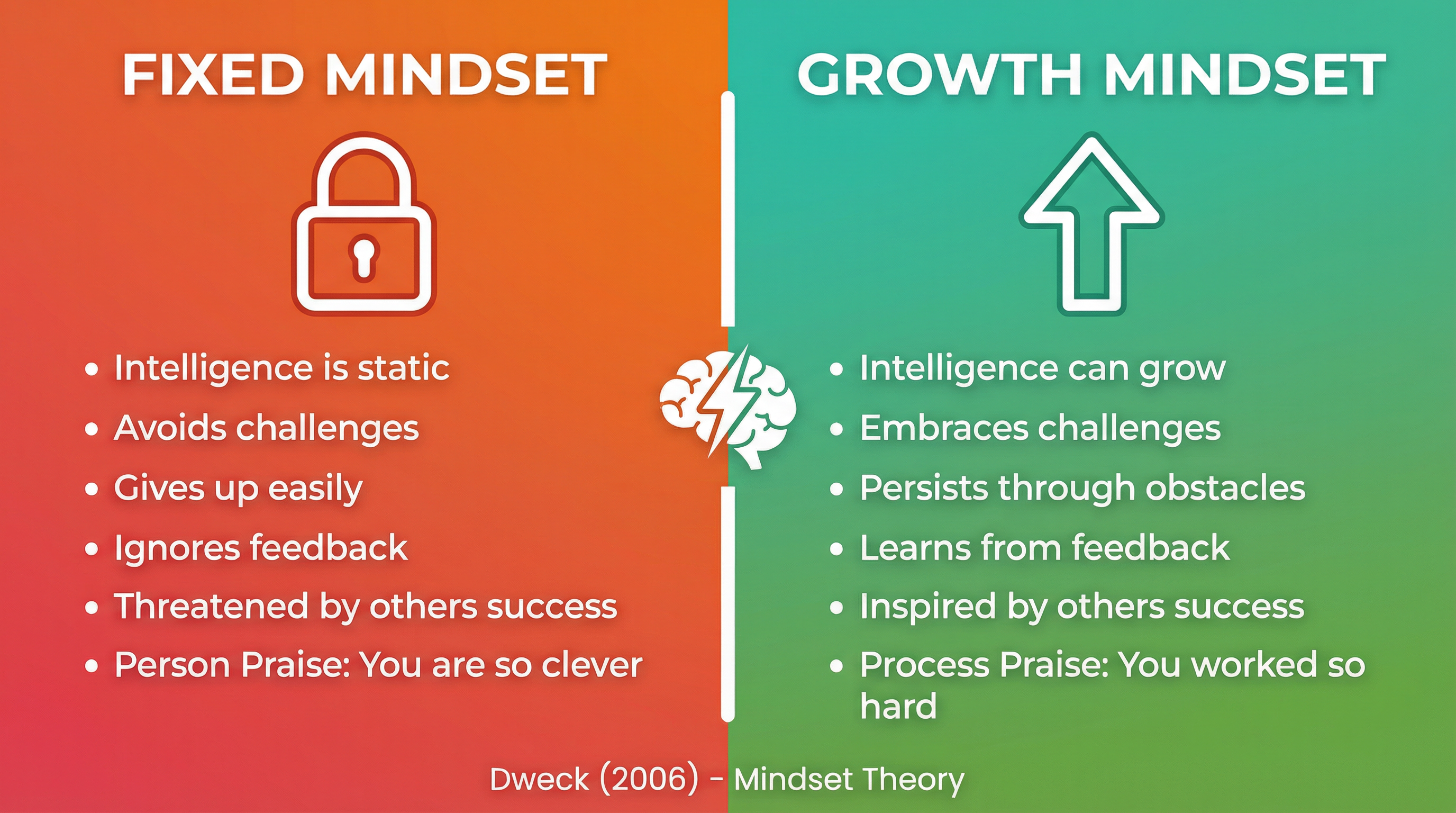
What it is: Carol Dweck proposes that our beliefs about our own intelligence profoundly impact our achievement. She identifies two core mindsets.
- Fixed Mindset: The belief that intelligence is a static, unchangeable trait. This leads to avoiding challenges and giving up easily.
- Growth Mindset: The belief that intelligence can be developed through effort and persistence. This leads to embracing challenges and learning from failure.
Specific Knowledge: You must be able to distinguish between Person Praise ("You're so clever") which fosters a fixed mindset, and Process Praise ("You worked so hard") which fosters a growth mindset. This is central to the Gunderson et al. (2013) named study.
Willingham's Learning Theory
What it is: Daniel Willingham, a cognitive scientist, argues against the idea of teaching generic 'skills' like critical thinking in isolation. His core principle is that factual knowledge precedes skill. To think critically about a topic, you must first have a deep well of knowledge about it. For the exam, this means applying his theory to educational scenarios by arguing that building a student's factual knowledge base is the essential first step to developing higher-order thinking.
Named Studies
Piaget & Inhelder (1956) - The Three Mountains Task
- Aim: To investigate egocentrism in pre-operational children.
- Procedure: Children were shown a 3D model of three mountains and asked to identify what a doll, placed at a different viewpoint, could see.
- Findings: Children under 7 consistently chose the picture showing their own view, demonstrating egocentrism.
- Conclusion: Supports Piaget's theory that children in the pre-operational stage are unable to see the world from another's perspective.
- Evaluation: The task was criticised for being too abstract. Studies like Hughes' 'Policeman Doll Study' (1975) used more familiar scenarios and found that younger children could take another's perspective, challenging the validity of Piaget's findings.
Gunderson et al. (2013) - Praise and Mindset
- Aim: To investigate the long-term effects of different types of parental praise on a child's later mindset.
- Procedure: A longitudinal study where researchers observed parent-child interactions at home, coding the type of praise used (person vs. process). Years later, they assessed the children's mindset.
- Findings: A positive correlation was found between the amount of process praise received in early childhood and the likelihood of having a growth mindset five years later.
- Conclusion: The type of praise a child receives is a key factor in the development of their mindset.
- Evaluation: A key strength is its high ecological validity, as observations were conducted in a naturalistic home environment. However, as it is a correlational study, it cannot establish a direct cause-and-effect link between praise and mindset; other factors could be involved."