Development

    WJEC
    GCSE
    Psychology

    This study guide for WJEC GCSE Psychology explores the fascinating journey of human development, from the wiring of the infant brain to the powerful theories of Piaget and Dweck. It's a crucial topic that explains how we become who we are, and mastering it is key to unlocking top marks in your exam.

    5
    Min Read
    3
    Examples
    3
    Questions
    6
    Key Terms
    πŸŽ™ Podcast Episode
    Development
    0:00-0:00

    Study Notes

    Header image for WJEC GCSE Psychology: Development

    Overview

    The WJEC GCSE Psychology unit on Development is a foundational topic that explores how individuals change and grow cognitively from infancy through to adolescence. It examines the biological underpinnings of early brain development before delving into Jean Piaget's seminal theory of cognitive stages. This is contrasted with contemporary learning theories from Carol Dweck (Mindset) and Daniel Willingham, which provide a more modern perspective on how we learn and think. Examiners expect candidates to have a detailed and critical understanding of these theories, supported by specific knowledge of two key studies: Piaget & Inhelder (1956) and Gunderson et al. (2013). Success in this topic requires not just memorisation, but the ability to apply, evaluate, and compare these psychological concepts in the context of exam questions.

    Key Theories & Concepts

    Early Brain Development

    What happens: From birth, the brain undergoes rapid development. An infant's brain is packed with around 100 billion neurons, but the crucial connections (synapses) between them are still forming. Through a process of synaptic pruning, frequently used connections are strengthened while unused ones are eliminated. This makes early childhood a critical period for learning and development, as the brain is at its most 'plastic' or adaptable.

    Why it matters: This biological process provides the 'why' behind the importance of a stimulating environment for young children. For the exam, candidates can be awarded marks for explaining how early experiences physically shape the brain's structure and function, impacting later cognitive abilities.

    Specific Knowledge: Synaptic pruning, brain plasticity, neurons, synapses.

    Piaget's Theory of Cognitive Development

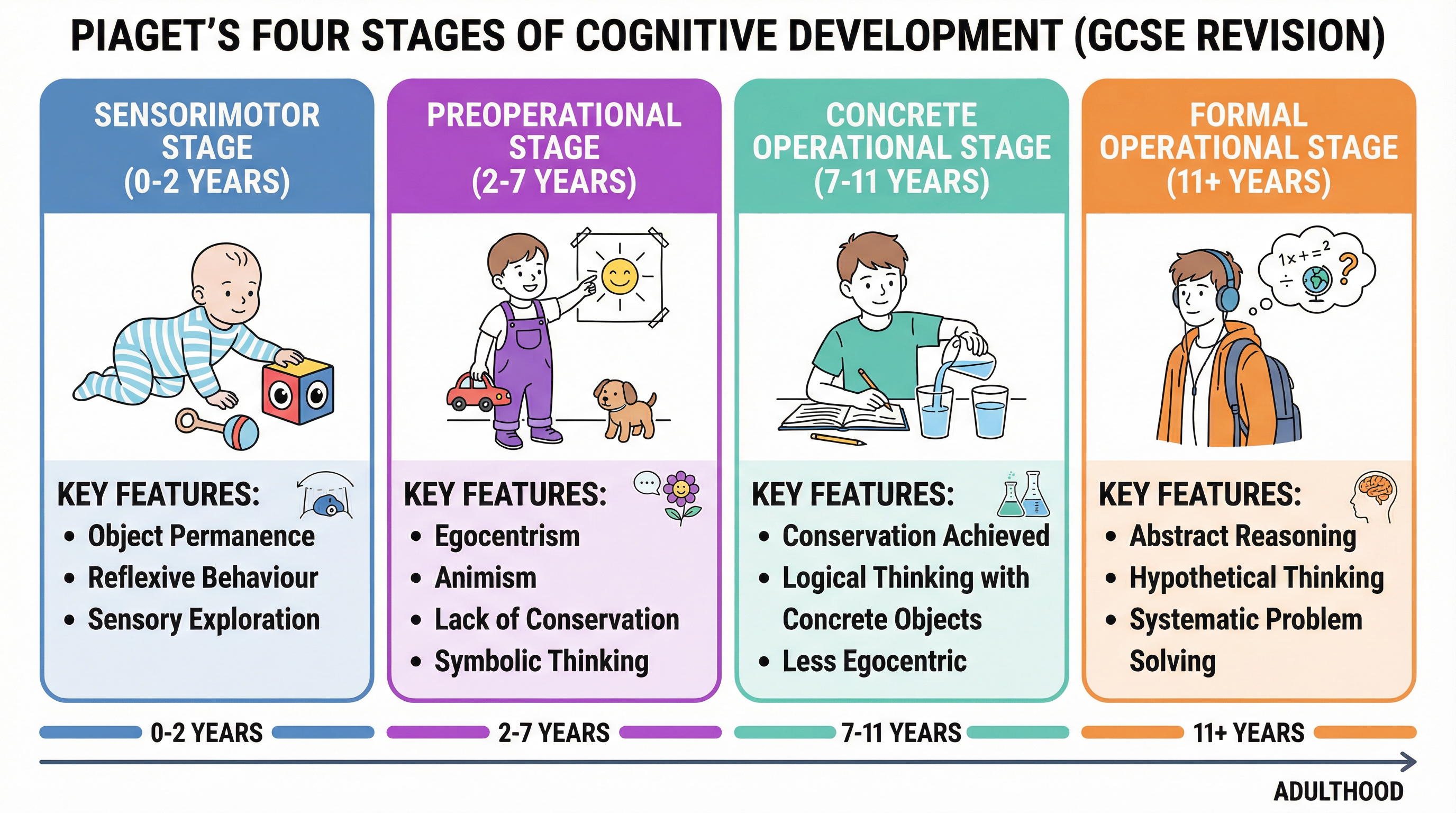
    What it is: Jean Piaget proposed that children are active learners who construct their understanding of the world through a series of four distinct, universal stages. He believed children's thinking is qualitatively different from adults'.

    Why it matters: Piaget's theory was revolutionary and provides a framework for understanding childhood cognition. Examiners will test your knowledge of the stages and the key concepts of schema, assimilation, and accommodation.

    Specific Knowledge: The four stages (Sensorimotor, Preoperational, Concrete Operational, Formal Operational), their age ranges, and key characteristics. Piaget's Four Stages of Cognitive Development
    Dweck's Mindset Theory

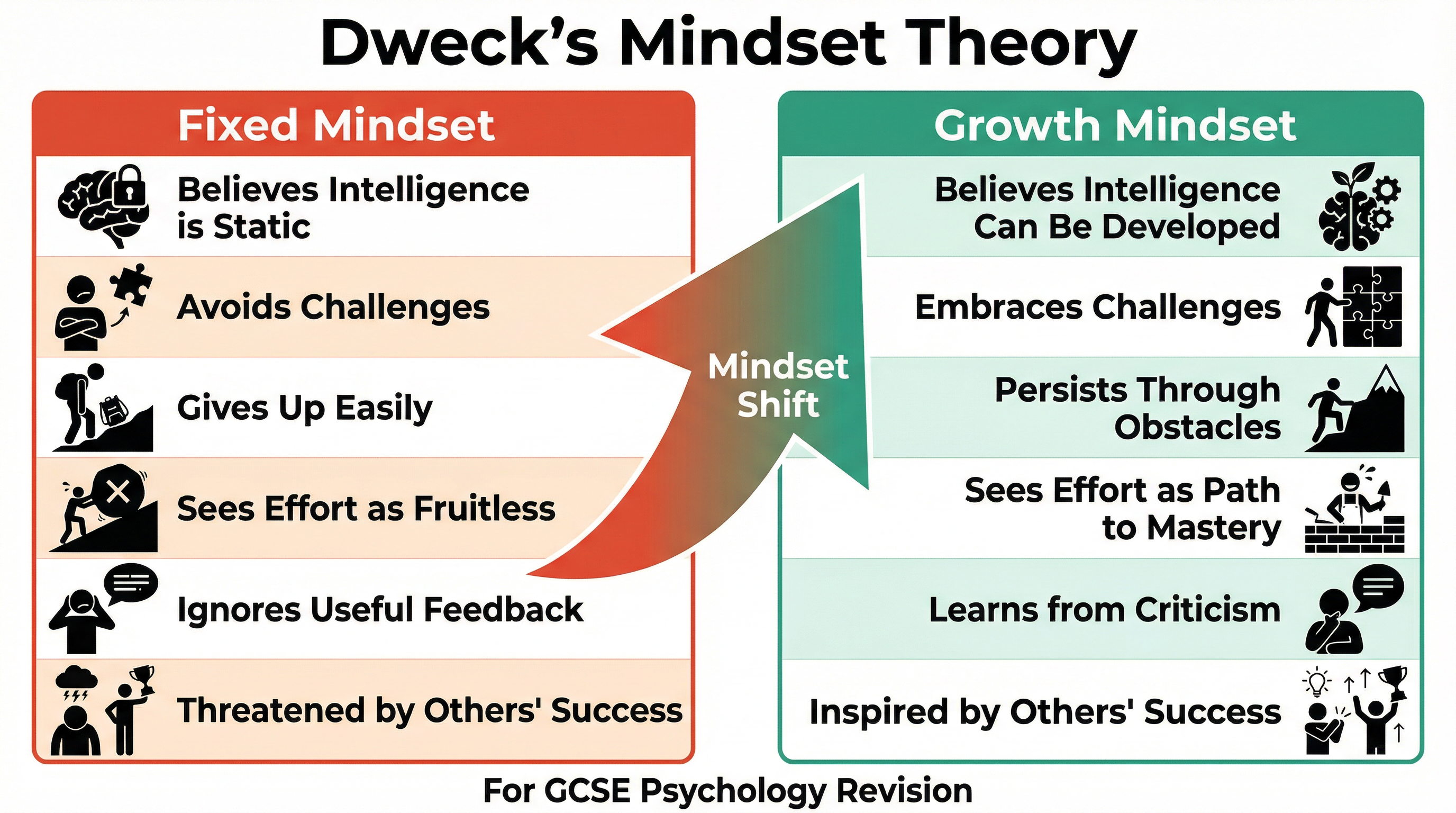
    What it is: Carol Dweck's theory focuses on our beliefs about intelligence. A 'Fixed Mindset' is the belief that intelligence is static, leading to an avoidance of challenges. A 'Growth Mindset' is the belief that intelligence can be developed through effort, leading to a desire to learn and embrace challenges.

    Why it matters: This theory has huge applications in education. It suggests that praising effort (process praise) rather than ability (person praise) can foster a growth mindset and improve student resilience and achievement. The Gunderson et al. (2013) study provides key evidence for this.

    Specific Knowledge: Fixed Mindset, Growth Mindset, Process Praise, Person Praise. Dweck's Mindset Theory: Fixed vs. Growth
    Key Individuals

    Jean Piaget

    Role: A Swiss psychologist considered the father of developmental psychology.

    Key Actions: Developed a stage theory of cognitive development based on observational studies of children. Introduced concepts like egocentrism, conservation, and object permanence.

    Impact: His work fundamentally changed how we view child development, although some of his methods and findings have been challenged for underestimating children's abilities.

    Carol Dweck

    Role: A leading American psychologist and researcher in the fields of motivation and mindset.

    Key Actions: Developed the theory of Fixed and Growth Mindsets based on extensive research with students.

    Impact: Her work has had a significant influence on educational practices worldwide, promoting the idea that fostering a growth mindset can lead to greater academic success and personal development.

    Podcast Episode

    GCSE Psychology: Development Revision Podcast

    Visual Resources

    2 diagrams and illustrations

    Piaget's Four Stages of Cognitive Development
    Piaget's Four Stages of Cognitive Development
    Dweck's Mindset Theory: Fixed vs. Growth
    Dweck's Mindset Theory: Fixed vs. Growth

    Worked Examples

    3 detailed examples with solutions and examiner commentary

    Practice Questions

    Test your understanding β€” click to reveal model answers

    Q1

    Describe what psychologists have discovered about early brain development. (4 marks)

    4 marks
    standard

    Hint: Think about the key biological processes that happen in the brain during infancy.

    Q2

    Using your knowledge of Piaget's research, explain why a four-year-old might fail a conservation task. (3 marks)

    3 marks
    standard

    Hint: Which of Piaget's stages is a four-year-old in? What are the key limitations of this stage?

    Q3

    Discuss Dweck's Mindset theory. (9 marks)

    9 marks
    challenging

    Hint: Start by describing the two mindsets (AO1), then evaluate the theory with strengths and weaknesses, using evidence (AO3).

    Explore this topic further

    View Topic PageAll Psychology Topics

    Key Terms

    Essential vocabulary to know

    More Psychology Study Guides

    View all

    Bystander Behaviour

    OCR
    GCSE

    This study guide explores the fascinating psychology of bystander behaviour, focusing on the pivotal Piliavin et al. (1969) subway study. It's a deep dive into why people doβ€”or don'tβ€”help in emergencies, providing you with the critical knowledge and exam skills needed to excel in your OCR GCSE Psychology exam.

    Key Concepts in Development

    OCR
    GCSE

    This study guide explores the core principles of cognitive and biological development in OCR GCSE Psychology. It unpacks the essential theories of Piaget, Dweck, and Willingham, providing a clear pathway to understanding how our minds grow and learn. Master these concepts to excel in your exam and gain a profound insight into the foundations of human psychology.

    The Role of Education

    OCR
    GCSE

    Unlock top marks in OCR GCSE Psychology by mastering the theories of Dweck and Willingham. This guide breaks down how mindset and cognitive science shape learning, providing examiner insights and multi-modal tools to turn complex theory into exam success."

    Forensic Psychology

    OCR
    GCSE

    This guide provides a comprehensive, exam-focused breakdown of Forensic Psychology for OCR GCSE. It dissects key theories like Eysenck's Criminal Personality and Social Learning Theory, evaluates the core Cooper and Mackie (1986) study, and provides essential exam techniques to help candidates secure top marks."

    Forgetting

    OCR
    GCSE

    This study guide delves into the psychology of forgetting, a core topic for OCR GCSE Psychology (J203). It explores why we fail to recall information, focusing on Interference Theory and Context-Dependent Forgetting, and unpacks the crucial Godden and Baddeley (1975) study that examiners love to test."

    Theories of Development

    OCR
    GCSE

    This guide provides a comprehensive, exam-focused breakdown of key developmental theories for OCR GCSE Psychology. It covers Piaget's stages, Dweck's mindset theory, and Willingham's learning principles, complete with critical analysis of core studies like Piaget (1952) and Gunderson et al. (2013)."