Study Notes

Overview
Welcome to the backbone of Psychology – Research Methods. For WJEC, this isn't just a topic; it's the toolkit you'll use to understand and critique every other part of the course. A strong grasp of the scientific process is non-negotiable, as examiners prioritise your ability to apply methodological knowledge to new scenarios. This means you must be fluent in experimental, observational, and correlational designs, be able to navigate the strict BPS ethical guidelines, and have the confidence to handle quantitative data. This guide will equip you with the specific language, techniques, and examples needed to demonstrate mastery. Candidates who excel here are those who can think like a psychologist – questioning, evaluating, and designing research with rigour and precision. This section carries a significant weighting (AO2 is 40%), so investing time here will pay dividends across your entire exam paper.
Key Concepts & Methodologies
The Scientific Process
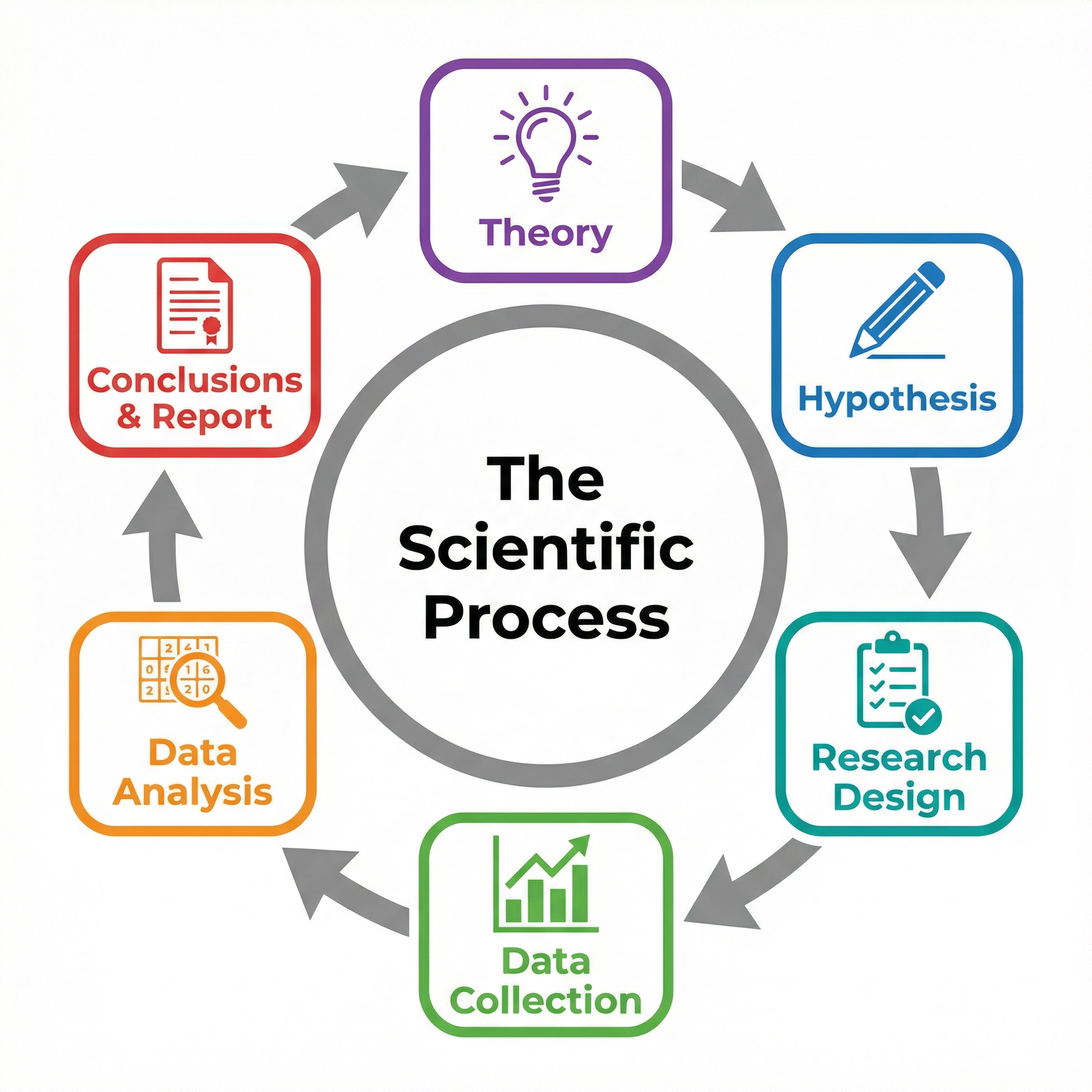
Psychology is a science because it follows an empirical, systematic process to gather knowledge. This isn't a random collection of ideas; it's a structured cycle of investigation.
The Research Cycle: A continuous loop of theory, prediction, testing, and refinement.
- Theory: A general principle or explanation for behaviour (e.g., 'Rehearsal improves memory').
- Hypothesis: A specific, testable prediction derived from a theory (e.g., 'Students who use flashcards will recall more words than those who don’t').
- Research Design: Choosing a method to test the hypothesis (e.g., a lab experiment).
- Data Collection: Gathering the results (e.g., recording test scores).
- Data Analysis: Interpreting the data using descriptive and inferential statistics.
- Conclusions & Report: Summarising the findings and linking them back to the original theory.
Variables: IV, DV, and Extraneous
Examiners award significant marks for correctly identifying and operationalising variables. Get this wrong, and you risk losing the entire question.
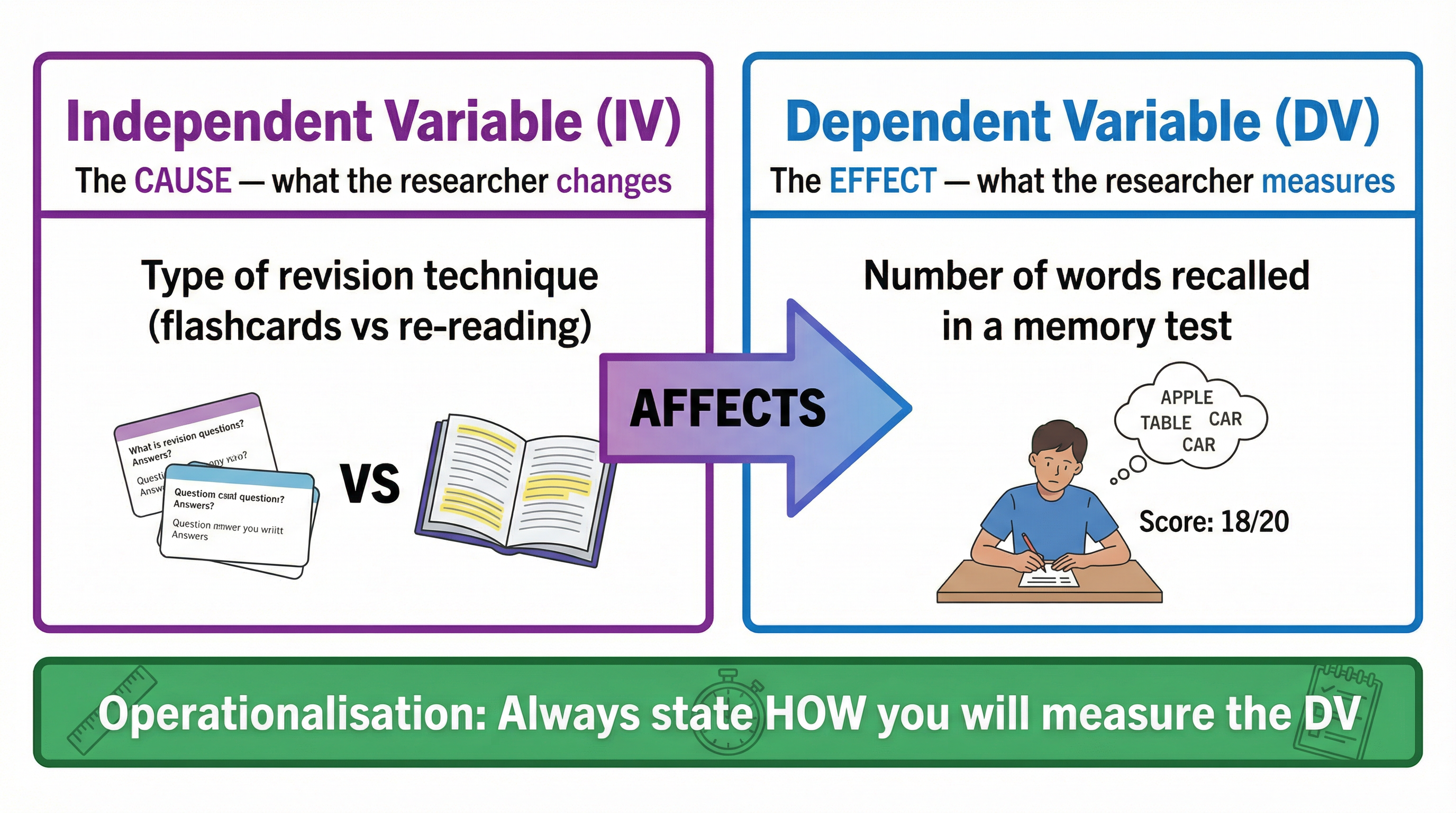
- Independent Variable (IV): The variable the researcher deliberately manipulates or changes. It is the presumed cause.
- Dependent Variable (DV): The variable the researcher measures to see the effect of the IV. It is the presumed effect.
- Extraneous Variables: Any other variables that could potentially affect the DV. These must be controlled to ensure the IV is the only thing influencing the DV.
Operationalisation is Key: You MUST state exactly how the IV will be changed and how the DV will be measured. For example, don't just say 'memory'; say 'the number of words correctly recalled from a list of 20'.
Research Methods
| Method | Description | Strengths | Weaknesses |
|---|---|---|---|
| Experiment | The researcher manipulates an IV to measure its effect on a DV. | Can establish cause and effect; high control over extraneous variables (in labs). | Low ecological validity (in labs); ethical issues with manipulation. |
| Observation | Behaviour is watched and recorded without manipulating variables. | High ecological validity (if naturalistic); can study behaviour that can't be manipulated. | Cannot establish cause and effect; observer bias can be an issue. |
| Correlation | Measures the relationship between two co-variables. | Can study variables that can't be manipulated ethically or practically; can identify trends. | Correlation does not equal causation; intervening variables may be responsible. |
Sampling Methods
How a researcher gets their participants. The method used affects the generalisability of the findings.
- Opportunity Sampling: Using whoever is available and willing. (e.g., asking students in the common room). Quick and easy, but often biased and not representative.
- Random Sampling: Every member of the target population has an equal chance of being selected. (e.g., putting all names from a school register into a hat). Highly representative, but can be time-consuming and difficult.
- Volunteer Sampling: Participants self-select by responding to an advert. Easy to get willing participants, but can lead to a biased sample (e.g., only attracting people with a specific interest in the topic).
Ethics in Research
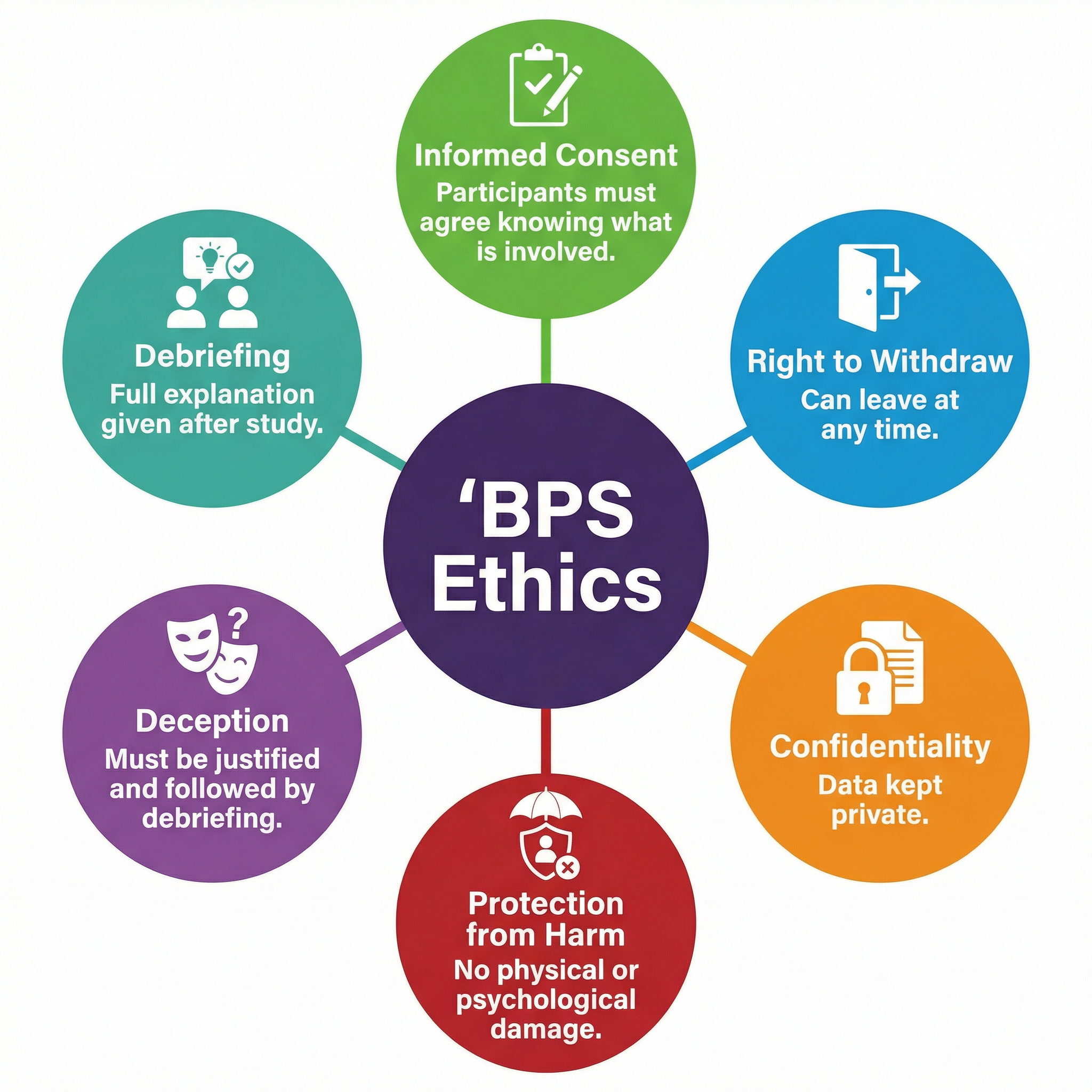
Adherence to BPS (British Psychological Society) guidelines is mandatory. You must know these by name and be able to apply them to scenarios.
- Informed Consent: Participants must be told the true aims of the research and agree to take part.
- Right to Withdraw: Participants can leave the study at any time, and have their data removed.
- Confidentiality: Personal data must be kept private and anonymous.
- Protection from Harm: Participants should not face any more physical or psychological risk than they would in daily life.
- Deception: Misleading participants must be strongly justified and must be followed by a full debrief.
- Debriefing: After the study, participants are told the true aims and offered support if needed.